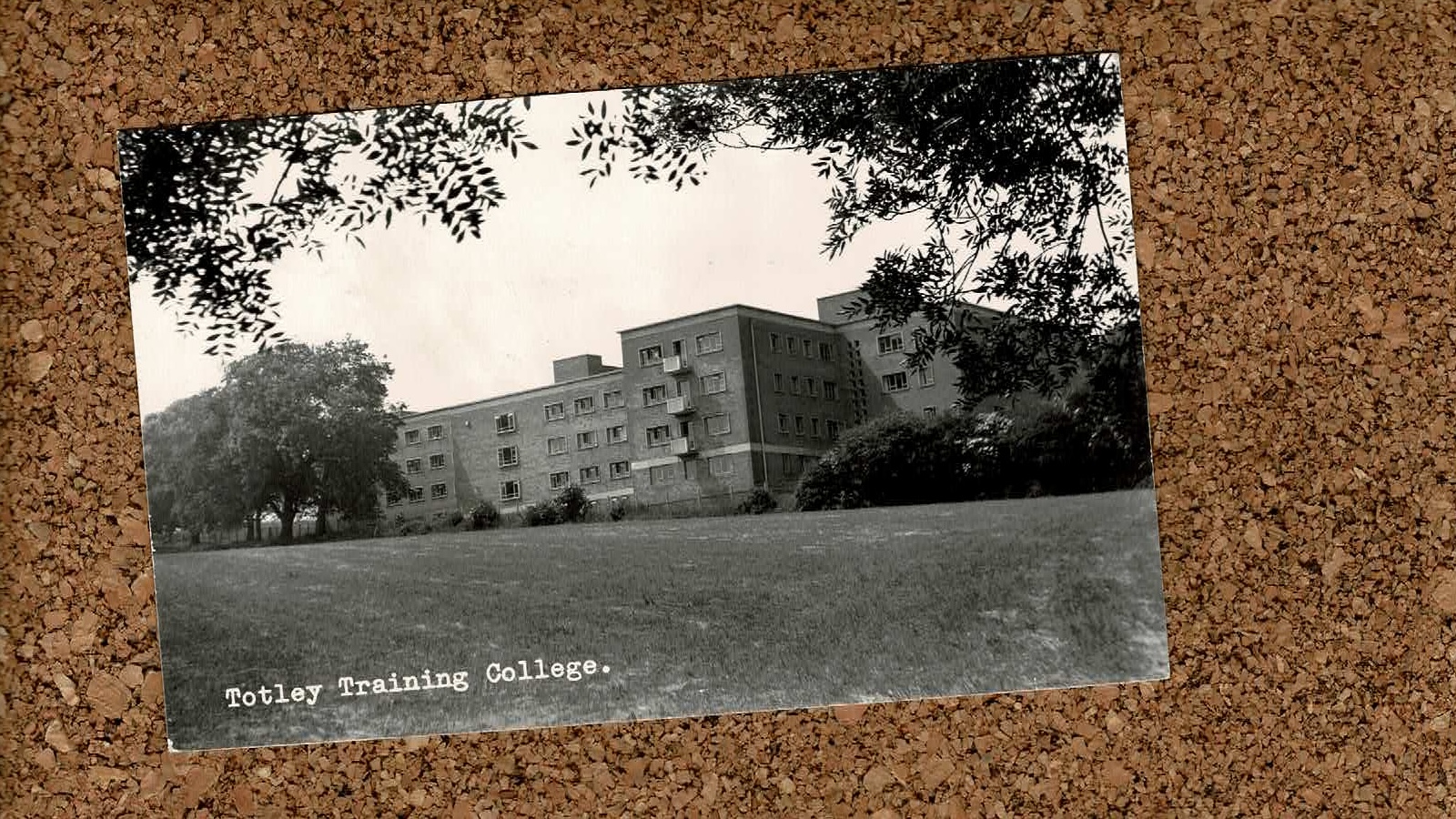


Back in 1943 the UK government knew that more school teachers would be needed. The school leaving age was to be raised: this and other planned changes meant that 70,000 extra teachers would be needed over the coming years. The teacher training colleges then in place trained 7,000 a year, so there was a problem.
The solution? Emergency Training Colleges. A compressed curriculum was piloted at Goldsmiths College, and in five years about 50 such colleges produced about 35,000 teachers. But it was a short-term scheme, and many of the colleges were wound up after 1950 or 1951.
Nevertheless, there continued to be a need to grow base capacity to train teachers. The emergency colleges had dealt with the immediate shortfall, but with more children attending schools every year, there was still work to be done. Some of the emergency colleges became regular training colleges, and some local authorities established new colleges of their own. And this is where Totley Hall enters the stage.
Not shown on the card is Totley Hall, built in 1623 and in 1949 passed to Sheffield Council. This was to be the heart of a new training college – the Totley Hall Training College of Housecraft. Its mission: training domestic science teachers.
There’s a wonderful account of the college’s foundation and development, written by Anna Baldry, who was one of the first lecturers at the college. It’s well worth a read. Highlights include her nerves at interview; problems with electricity blackouts; HMI inspections; the admission of men; its opening by Violet Attlee; and some lovely photographs.
More prosaically, the college had by 1963 become the plain Totley Hall Training College, focusing on training primary teachers. In 1967 men were admitted; in 1969 the best students could continue to study for a fourth year to gain a Bachelor of Education (BEd) degree from the University of Sheffield, rather than the Certificate in Education. And in 1972 – there being simultaneous vacancies in the principalships – Totley Hall Training College and the nearby Thornbridge Hall Training College were merged, to form the Totley/Thornbridge College of Education.
In 1976 the College became part of Sheffield Polytechnic, which was renamed Sheffield City Polytechnic – and this in turn became Sheffield Hallam University in 1992, and I’ve written about it here.
Here’s a jigsaw of the card.
The card was posted, but I can’t read the postmark, so don’t know when. The 3p stamp shows it was after decimalisation. If it was in 1971 or 1972 it was sent first class; if it was 1973 it was sent second class. Those are the only options for that stamp.
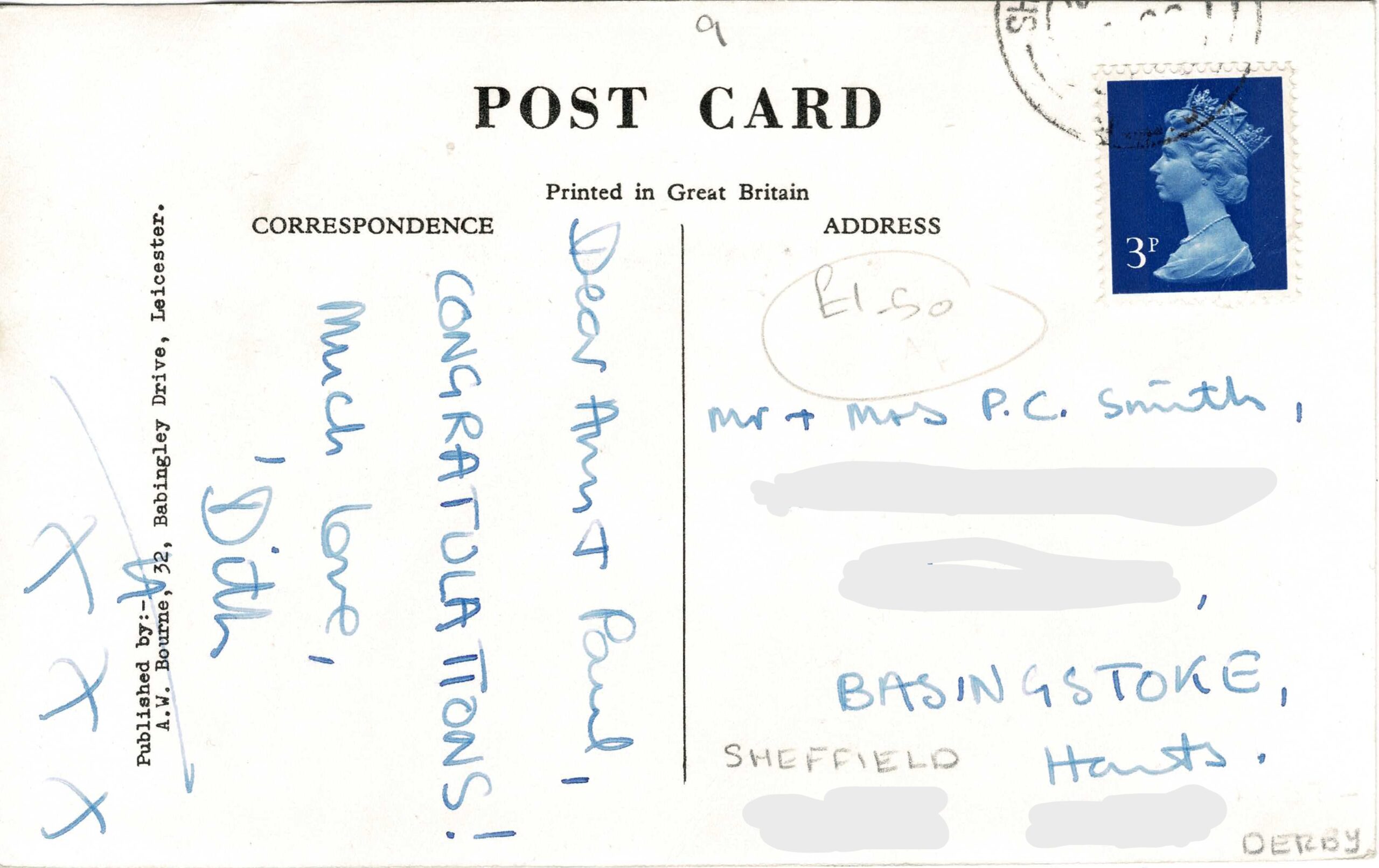
An engagement? A wedding? A pools win? A baby? What do we think?



During my first year at Sheffield Hallam University I had an examination at Totley… it was quite the journey from Collegiate Crescent campus by car or bus – good times though!
I first discovered that there had been a teacher training college at totley hall when doing research for my PhD – there is an excellent study of grammar schooling and comprehensivisation in Sheffield from the 1970s written by a student there (Ball, F. (1971). The Development of the Grammar Schools in Sheffield, Sheffield: Totley Hall College of Education Special Studies in Education.). It was wisely placed in the local records section of the library where I hope it still remains.
What fascinated me about the college when I looked it up was that it was part of a wider pattern of aristocratic mansions requisitioned during WWII used for educational and other public purposes afterwards. Thornbridge Hall, mentioned above, remained owned by Sheffield City Council and used for outdoor pursuits for school students till it was sadly sold off during austerity (and bought up by Emma Harrison of A4E infamy…)
During Covid I thought how a radical (or not even radical left – simply Keynesian) government might have done the same with vacant shop space. After all, the Labour 1945 government aside, these were not radical governments, simply governments that thought planned economies and education systems made sense.
To me it is a reminder of the capacity of for public services to be constructed in spaces that were once the preserve of the wealthy – that should give us all reason for hope. If it was done once, it can be done again.