Higher education postcard: Queen Margaret University
This week’s card from Hugh Jones’ postbag cooks up a treat!
Comment|
Hugh Jones is a freelance HE consultant. You’ll find a daily #HigherEducationPostcard if you follow him on Bluesky
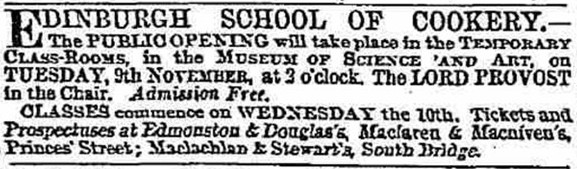
The Scotsman of 27 October 1875 proudly announced the event: the opening of the Edinburgh School of Cookery.
This had been gathering momentum since April of that year, when the provost of Edinburgh chaired a meeting to garner support, and an organising committee was formed.
Naturally, this being Victorian Britain, a sequence of grand men took their places in the various committees and groups. But the energy behind the initiative came from two women, Christian Guthrie Wright and Louisa Stevenson.
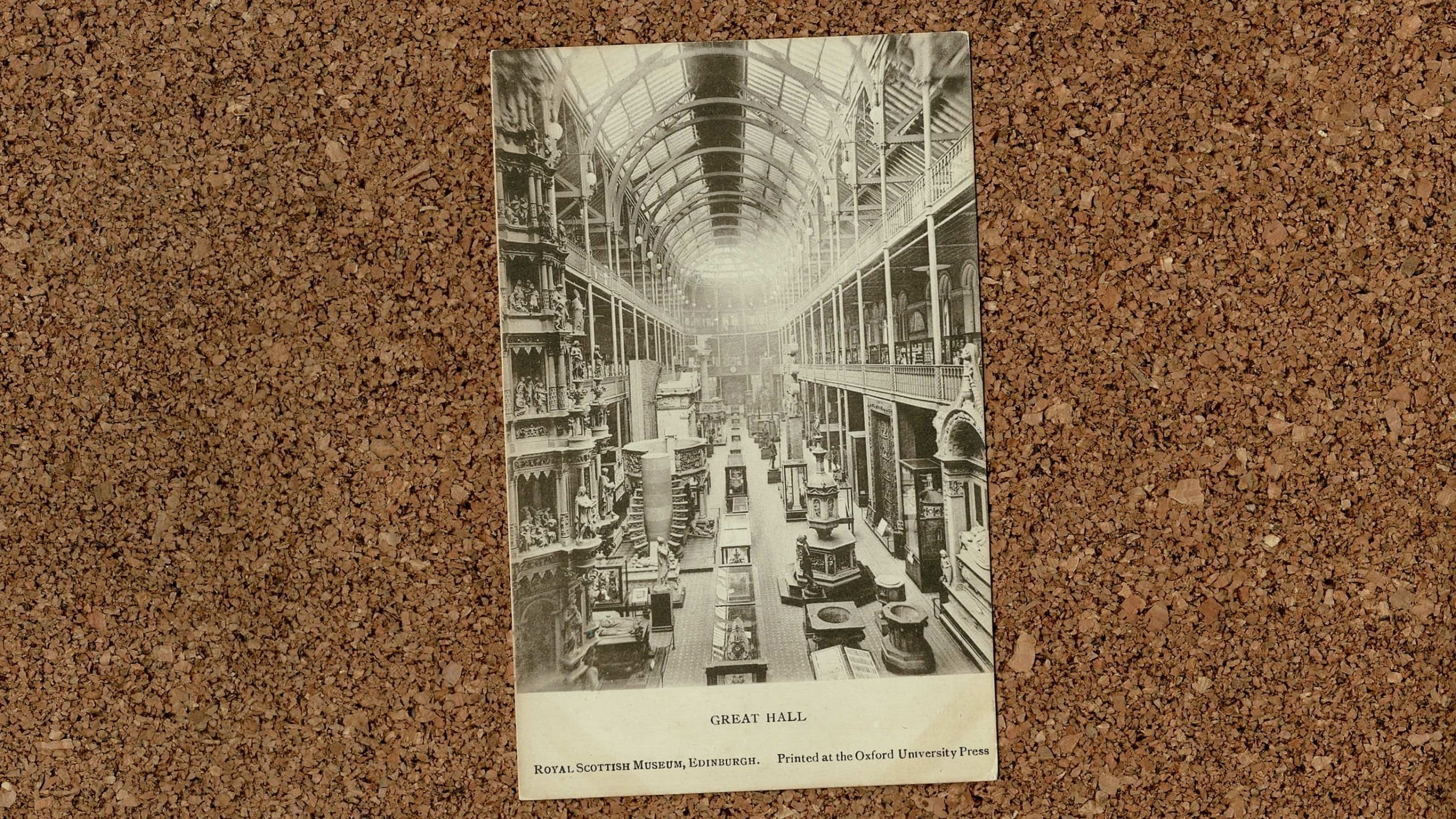
As per the advert, the first lectures took place in the Royal Scottish Museum. Which is why this postcard counts!
The lectures clearly met a demand. And we have some direct learner feedback, from the letters page of the Scotsman on 30 November and 2 December:
Sir, As The School of Cookery just established in Edinburgh professedly aims at the general good of the community, I feel sure the promoters will welcome any hint as to how its advantages may be more widely diffused. This could be done either by transferring the plain cookery lessons from the morning to the afternoon, or by arranging separate means of instruction to be had later in the day. Ladies, like myself, who have a house and family to attend to, find it extremely inconvenient – nay, almost impossible – to get out by ten or even eleven o’clock in the forenoon, they being until long after these hours entirely absorbed in domestic arrangements. Could not a class be formed to meet at two or half-past two, when one’s engagements are over? I am quite certain, from Inquiries made, that abundant support would be given by those who at present, like myself, are reluctantly obliged to forego the advantages so temptingly offered . —l am, &c. MATERFAMILIAS.
Lasswade, December 1, 1873. SIE, —Will you allow me to add another suggestion to that offered by “Materfamilias,” in the Scotsman of yesterday, as to the arrangements for the “plain cooking lessons.” I have no doubt many ladies who, like myself, live at a distance from town, and can only spare time to take an occasional lesson would find it a convenience to have the subjects of the lesson advertised the day previous, instead of as at present on the day it is to be given . Now that even very plain cooks demand wages which it is quite out of the question for people of moderate income to give, there is no doubt that the Edinburgh School of Cookery will be a great boon to many wives and others. —I am, &c. MATERFAMILIAS No. 2.
Two solid lessons there: take account of the other commitments in students’ lives, and be clear in advance about the curriculum.
And the nascent school seems to have listened: the cookery school became, at first, peripatetic, with demonstrations taking place the length and breadth of the country. This included the establishment of a base in Manchester, which eventually became part of Manchester Metropolitan University.
By 1877 the school had moved out of the museum into a place of its own, on Shandwick Place, Edinburgh, which is just at the bottom of Princes Street. It stayed there until 1891 when it moved a few doors away to Atholl Crescent.
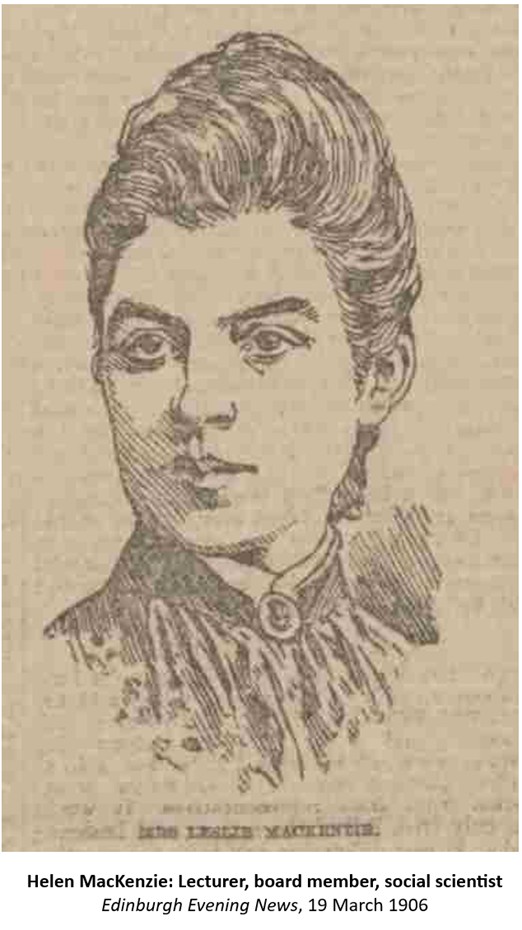
Public health was becoming a growing concern in the UK at this time. Two leading lights in identifying issues in Edinburgh were the power couple Leslie MacKenzie, medical inspector at the Scottish Office, and Helen MacKenzie, who lectured at the school and would later serve on its board. The MacKenzies conducted research into poverty in Edinburgh, demonstrating that children from poorer parts of Edinburgh were smaller, lighter and more diseased than children from more affluent areas. They testified on this to the 1904 Inter-departmental Committee on Physical Deterioration, which had been established as a response to the deficiencies of the British forces in the South African War 1899–1902. Amongst the recommendations of the committee was that cookery should be taught to children at schools. And so the Edinburgh School of Cookery gained a role in training teachers.
In 1909 it became government funded – what was known in Scotland as a Central Institution – and was called Edinburgh School of Domestic Science. Its focus was teacher training.
A highlight of the college’s time at Atholl Street (there’s another move or two still to come!) came in 1944. The London Daily News of 19 October reported that
Twenty-one girl cooks from the Edinburgh College of Domestic Science have arrived in London to cook for men employed in bomb damage repairs. They volunteered for the work and after three weeks will be replaced by other girls from the college.
It seems that poor conditions in the hotel at which the builders were staying meant that they did not stay for long; the arrival of the final year students from the college, and the transformation of the hotel, turned the situation around.
Post-war the college developed into a broader range of subjects. In 1961 a site for a new campus was acquired in Clermiston in the west of Edinburgh, which would give room for growth and new subjects. The college moved there in 1970.
It was now a college of higher education offering a range of subjects, and so a new name was needed. Saint Margaret, queen of Scotland 1070–93, and a great-great-great-great-great-granddaughter of Alfred the Great, was renowned for her piety and was canonized in 1250. Known sometime as the “Pearl of Scotland”, her qualities were thought to exemplify the values of the college, and so Queen Margaret College was chosen as a name.
In the 1970s mergers were in fashion, as government sought to bring together small colleges within local authority control. And so the college incorporated lots of other provision:
- The Edinburgh College of Speech and Drama
- The City of Edinburgh Health Visitor Certificate Course
- The Edinburgh School of Speech Therapy
- The Royal Infirmary of Edinburgh School of Physiotherapy
- The Occupational Therapy Training Centre, Astley Ainslie Hospital.
This continued in the 1980s and 1990s:
- The Edinburgh Foot Clinic and School of Chiropody
- The Edinburgh School of Radiography
- The School of Art Therapy at Edinburgh University Settlement.
By 1993 the campus was again running out of space, and a second campus was opened at the former Duke Academy in Leith. During this time the college again continued to develop, with taught degree awarding powers in 1992, research degree awarding powers in 1998, and in 1999 permission to be called Queen Margaret University College.
And in 2007 the college became Queen Margaret University, with yet another move: this time to an entirely new campus in Musselburgh. Alumni include singer Susan Boyle and Blue Peter presenter Matt Baker.
The university’s website has a good history, with some cracking photographs from the college’s archives, and has been very useful to me in compiling this account.
Here’s a jigsaw of the postcard, which I hope you enjoy. It’s a bit trickier than some of the others I’ve shared – sorry!