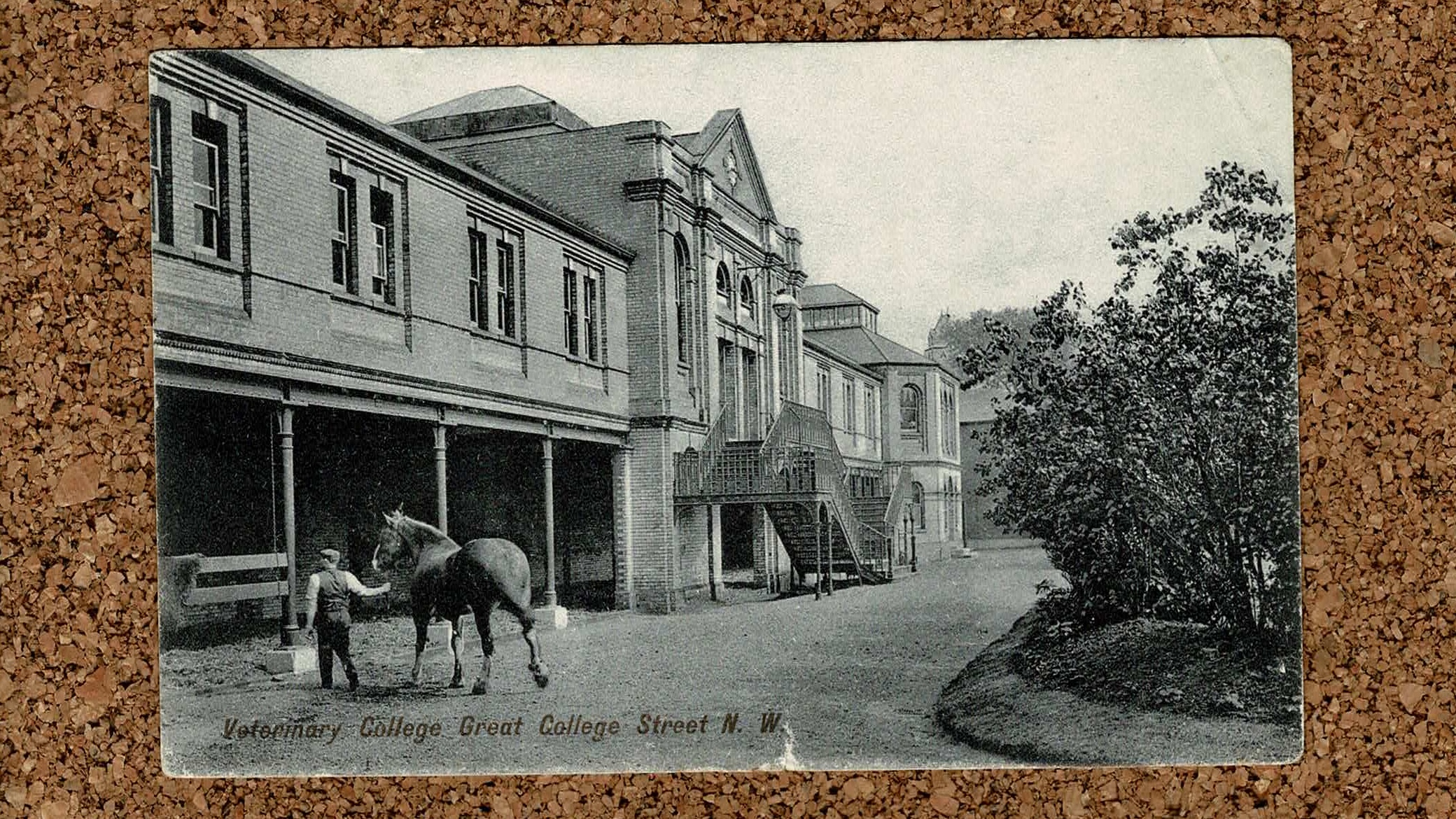


Greetings from rural Camden! Yes, that’s right – back in 1791 Camden was rural – and it was here that a group founded Britain’s first veterinary school.
We have to start with Charles Vial de St Bel, French veterinary surgeon. He had trained as a vet in France and did well, eventually being appointed by the King as an assistant professor at the Royal Veterinary College in Paris. In 1788 he visited England, married, and published proposals for establishing a veterinary school. This came to nothing, but after the revolution in 1789 he once more came to England.
He was asked to conduct an autopsy on the racehorse Eclipse, which in 1769 and 1770 had swept all before it, and after retiring from racing had been hired out as a stud (incidentally, it seems that 95 per cent of modern racehorses are descended from Eclipse). He wrote a paper on Eclipse’s anatomy, and in 1790 the Odiham Agricultural Society, chaired by Granville Penn, took up the St Bel’s scheme for a veterinary school.
Granville Penn seems an interesting chap. He was the grandson of William Penn, the colonist who founded Pennsylvania in the US of A. And he was, by profession, a geologist, and in particular a scriptural geologist. Which, as I understand it , means a geologist who believed in the literal timeline of the Christian bible and sought to reconcile this with the evidence of rocks. (Think Bishop Ussher and his conclusion that the earth was created on 23 October 4004 BC and you’ll get the sort of thing that Granville Penn was about.)
The Reading Mercury of 6 June 1791 tells us that

Notices in the newspapers in October 1791 (the quote below is from the Kentish Gazette of 25 October) informed readers that
The object of this institution is to reform, and bring into a regular system, that important branch of Medicine which regards the treatment of diseases incident to Horses and other [sic] Cattle, hitherto neglected, and much abused in this country; for which purpose it is proposed to erect a building as a College in which Pupils may be admitted, and be instructed by a Professor of Veterinary Medicine in every branch of the science.
Fees were 20 guineas per year (a guinea is £1 and one shilling, so this means £21 per year) and the college was renting space in Camden on which to build a building. The committee was chaired by the Duke of Northumberland, and included the Earls of Grosvenor, Morton and Orford; Lord Rivers; Sir George Baker; Sir T C Bunbury; Sir William Fordyce; and John Hunter. I suspect that this might be John Hunter the famed surgeon, who at the time was Surgeon General.
The first students enrolled in 1792, and were taught by St Bel, who had been hired as the first professor. St Bel died the following year, having contracted glanders from a horse he was treating at the college.
At this point it is instructive to note comments by William Dick, the founder of the Dick Veterinary School, now part of the University of Edinburgh. Dick studied, briefly, at the veterinary college in London in 1817 or 1818:
Finding that it was possible to derive as much knowledge in Edinburgh as would lay the foundation for the successful working out of the scheme which I intently cherished in my mind, I considered it was not necessary to remain longer in the English metropolis. After three months’ study there, I had the confidence to apply for a diploma, the time of residence not being then defined, and I obtained it.
By 1826 the college was calling itself the Royal Veterinary College, due to the patronage of the King, George IV. This was strictly unofficial: it would not gain a charter until 1875. In the meantime, the veterinary profession was developing, with the Royal College of Veterinary Surgeons established in 1844, and an increase to two years of the time it took to study to become a vet.
Like medical education, veterinary education needed clinics to give students supervised experience. From the outset the Camden site acted as a hospital for sick horses; and in 1891 the Cheap Practice Clinic opened. A picture on the college’s website (scroll through to 1879) shows that this was catering to pets – dogs and cats – not horses. And by then, of course, Camden was thoroughly urban.
By the end of the nineteenth century, veterinary education took four years and required a written examination (introduced in 1892). Veterinary medicine was becoming more scientific, with an x-ray machine installed in 1895, and in 1901 the college’s principal, John McFadyean, argued strongly at the International Tuberculosis Congress that TB could be transmitted from other animals to humans.
After 1919 women could be admitted at students, and in 1922 Aleen Cust, noted Irish veterinarian, became the first woman to gain membership of the Royal College of Veterinary Surgeons. She took a revision course at the Royal Veterinary College as part of her preparations, but she had been in practice for many years beforehand.
In 1927 the college’s buildings (the ones you see on the postcard) were declared unsafe. A fundraising campaign was launched. And I can’t do better than quote this from the Burton Observer and Chronicle of 2 May 1935:
The largest padlock in the world, and two hand wrought keys, made by Mr F. Byrne, a Burton-on-Trent man, were presented to another Burton man, Sir Frederick Hobday, C.M.G, F.R.C.V.S., Principal and Dean of the Royal Veterinary College, N.W., at the annual dinner of the London and District Horse Shoeing and Shoe Making Championships at High Holborn.
The presentation was made by Mr A. Elstrap, president of the National Master Farriers Association, and it is to lock the world’s largest nose-bag, which is to travel all over the country, with the object of collecting 250,000,000 farthings to endow the Royal Veterinary College Hospital.
This novel scheme of collecting is supported by the Duke of Gloucester, president of the College, Sir Walter Gilbey whose ambition it is to make the hospital the “best-dressed” Institution of the kind in the world, and Sir John Moore, and both this and last year’s Lord Mayors of London.
Some forty veteran War horses and one dog have specially converted Army nose bags, in which they are collecting; and there is a book of the nose bag in which autographs include those of the Duke of Gloucester, the owners of the 24 war horses paraded at the International Horse Show last year, and many leading sportsmen.
There is a very human story attached to dog Toby which, with his inseparable stable companion, Bessie, a war horse, Is leading the dogs of the Empire in an appeal for 10,000,000 farthings. Toby was paraded at the Horse Show, led by a guardsman, because he could not bear to be separated from Bessie, and the horse would not parade without her canine comrade.
Sadly I have not been able to find a picture of either Toby or Bessie. Or indeed the giant nose-bag.
By 1935 the degree programme had extended to five years in length, and a new animal hospital – the Beaumont – had been opened in London. The new buildings for the college were opened in 1937.
In 1949 the college became a school of the University of London, and in 1959 a new campus in Hertfordshire – the Hawkshead campus – was opened by the Queen. The college has continued to develop, with more clinical and research facilities at Hawkshead, and a wider range of clinical and scientific programmes. In 1998 veterinary nursing began to be offered at degree level, in conjunction with Middlesex University. And in 2020 a range of veterinary science programmes was launched at Aberystwyth University, offered in conjunction with the Royal Veterinary College.
Here’s a jigsaw of the postcard. The card was posted on 2 November 1905, to a Miss Bull in Deddington, near Banbury: “Tell boy to meet me at same time tomorrow night 6.43”.