


One unarguable thing about the British Empire is that it was global: “a vast empire, on which the sun never sets,” wrote George Macartney, colonial administrator and diplomat, in 1773. And being a vast empire on which the sun never set, it required a lot of ships to sail between parts of the empire – for trade and warfare and conquest – and ipso facto a lot of sailors for those self-same ships.
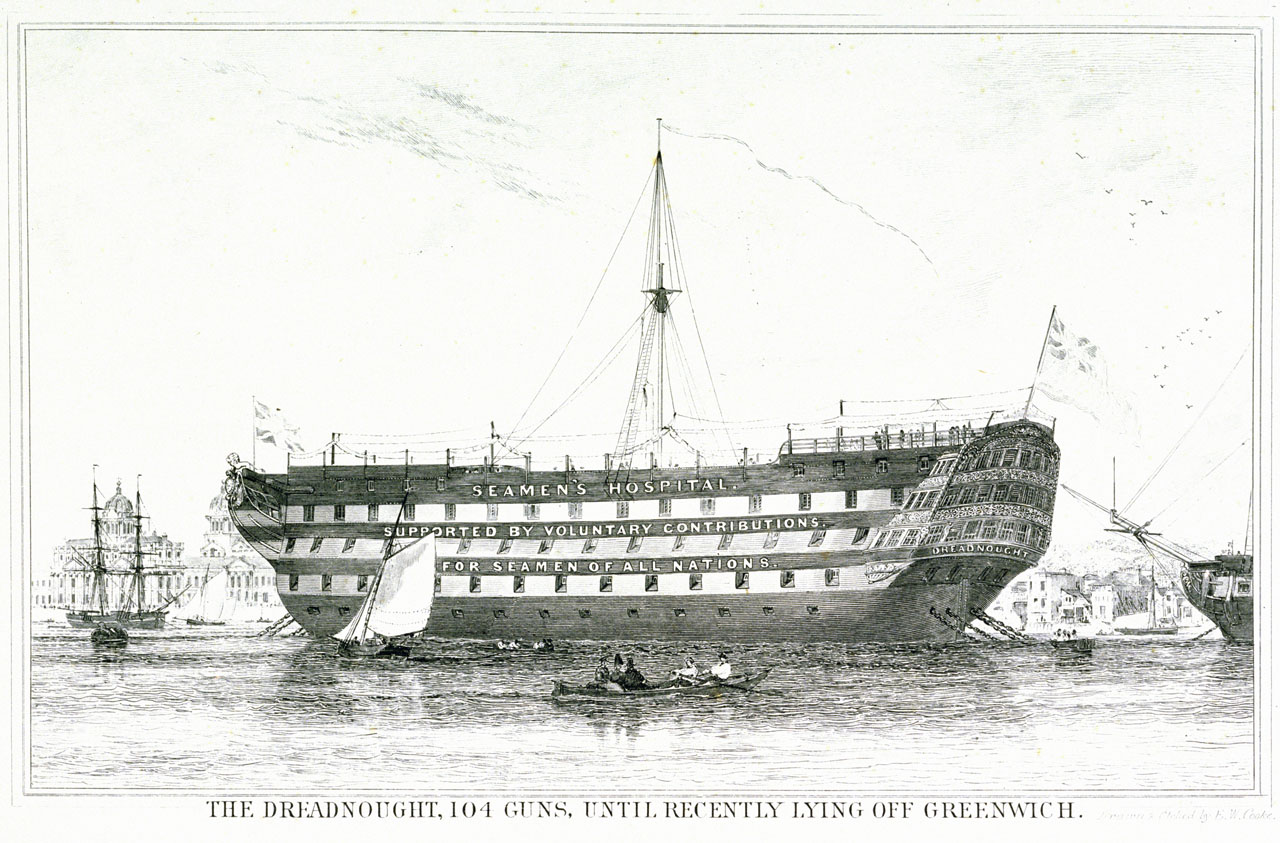
And what do you get when you have a lot of sailors sailing all around the world and then returning to Britain? Disease, that’s what. And in 1821 the Seamen’s Hospital Society (now known as the Seafarers Hospital Society) was established, to provide healthcare for seafarers (it wasn’t just disease: after the end of the Napoleonic Wars an awful lot of sailors were discharged from the Royal Navy, and many were unable to make a living). Initially, this was done via a ship on the Thames – here’s the Dreadnought, which fought at Trafalgar and was from 1831 to 1857 moored off Greenwich as a hospital ship.
All of this might seem a long way from a University of London college, but bear with me, I’ll show relevance.
In 1870 the society’s hospital provision moved ashore – initially to Greenwich Naval Hospital, and later to the Albert Dock, where in 1890 an extension to the Greenwich hospital was opened.
By the late nineteenth century another issue was pressing: the high mortality rate amongst colonial administrators being sent from Britain to the colonies, and dying from disease. So in 1899 at the Albert Dock hospital, the London School of Tropical Medicine opened its doors. The school had been supported by various individuals, and by foreign and colonial governments, but a key driver was the British Colonial Office, and in particular Joseph Chamberlain, colonial secretary. (This is the Joseph, incidentally, after whom the clock tower at the University of Birmingham is named Old Joe.) Students were already medically qualified, or in their final year of medical school.
The school was clearly successful, and by 1918 it was clear that – after the war – there would be a need to expand. And so the search for a more central location began. Eventually the school moved to Endsleigh Gardens, with an official opening by the Duke of York (the future King George VI) on 11 November 1920. The building continued to serve as a hospital for tropical diseases.
To understand something of the cultural environment in which the school was operating, we can look at the Pall Mall Gazette of Sunday 13 October. The following short article makes clear that empire, and race, were societal concerns which must in part have motivated state support for the school of hygiene. The saving grace is that the actions of the school show that its focus was all of humanity:
TROPICAL DISEASE. TASK FOR THE COLONIAL OFFICE The good work already done by the London School of Tropical Medicine, which has moved its headquarters this week from Poplar to Endsleigh-gardens, is but an earnest of what it may do in the future, and we hope that the Government —and all successive Governments —will spare no expense to make this branch of Imperial study independent of private beneficence. It is to the good, of course, that private persons and public corporations interested in the tropics should bring their gifts, for too much can never done towards making the jungle lands of the Empire safe for the white man. But this work is really an Imperial business, and should be made first charge upon the revenue of the Crown Colonies which will benefit from it. It is known now that nearly all the scourges which have made so much the earth a deathtrap for the white man are preventible. Discovery of the insect carriers most of these diseases has paved the way for a system of tropical hygiene, which, applied thoroughly, as it was by the American authorities in the zone of the Panama Canal, gives absolute protection to the European. As time goes on shall become more and more dependent upon the products of those regions, where growth is rapid and harvests do not fail; and it is the first duty of the Colonial Office to see that no means of hygiene are neglected.
(Please note that I do not include this to throw any shade on LSHTM. Higher education has, to my mind, a very positive aspect in relation to growing the capacity of the world, and being a force for good. But it is also, often, a creature of the state, and where the state does bad things, higher education institutions can often be found amongst the supporting cast. One of the challenges for universities is to do only the good. And to my mind LSHTM has done a pretty good job of that.)
Anyway, back to the story, and two critical events which impacted upon the school’s future. Firstly, and shortly after the school had moved to its new buildings, a committee was established by the Minister for Health to review post-graduate medical education in London. The committee – in a report known as the Athlone report, after the chair of the committee – recommended, amongst many other things, the creation of an institute of state medicine, bringing together all of the existing courses in public health.
Secondly, the Rockefeller foundation – already a collaborator with the school through previous work on hookworm – was looking to fund an institute to be a European counterpart to the Johns Hopkins School of Hygiene and Public Health, which its funding had helped to establish in 1916.
These two factors came together to turn the London School of Tropical Medicine into the London School of Hygiene and Tropical Medicine. The new school would be part of the University of London, and would have buildings on Keppel Street, paid for by the Rockefeller Foundation. A Royal Charter was granted in 1924. There’s a couple of interesting blogs about this on the LSHTM website, here and here.
Construction of the new buildings began in 1926, and they opened in 1929. You can see on the card that there are names carved in stone on the frieze of the building. These are the names of pioneers in tropical medicine and public health. Twenty-three names were included when the building was constructed; another three were added in 2019, making the balance of the sexes represented 23 men and three women. You can find out more about them all on the school’s website.
Also on the building’s façade, and not quite so visible on the card, are gilded bronze images showing various vectors for disease: mosquitos, flies, lice and rats can all be found there. Wikipedia has a fabulous composite image.
Of course, the most important thing about a university isn’t its buildings, it’s the people in them and what they do. LSHTM has gone on to be a major influence on global health. Its distance learning master degrees educate thousands of health professionals from across the world. And its researchers, often in collaboration with other universities, have been involved in many critical developments. For example, the world’s first textbook on epidemiology was written by Major Greenwood, professor at LSHTM. (Major was his forename, not a military rank. See also Major Major Major Major, in Heller’s Catch-22.)
Other significant research from LSHTM includes the statistics behind the randomised control trial (RCT), now the standard for clinical research; research which demonstrated the link between smoking and lung cancer; research which demonstrated the link between sedentary lifestyles and heart disease; research which demonstrated the link between asbestos and lung cancer; research which demonstrated the link between pollution and respiratory disease; the use of insecticide-treated bed nets to fight malaria; a statistical approach (the sisterhood method) for measuring maternal mortality, helping to ensure that maternal mortality was appropriately recognised in world health aims; and showing that MMR vaccination was not linked to autism. It’s an impressive list!
LSHTM has many notable alumni. There’s two I’d like to highlight from the Covid pandemic. Firstly, Tedros Adhanom Ghebreyesus, director of the World Health Organisation. And secondly, Chris Whitty, Chief Medical Officer for England and a familiar figure from the daily Downing Street briefings in 2020. (LSHTM also played a significant role in the epidemiological modelling of Covid and managing the response. The impact case study is worth reading).
Here’s a jigsaw of the postcard. It hasn’t been posted, but the temporary buildings to the right of the image suggests that it dates from between 1929, when the LSHTM building opened, and 1932, when construction started on Senate House.



Really interesting Hugh, thanks