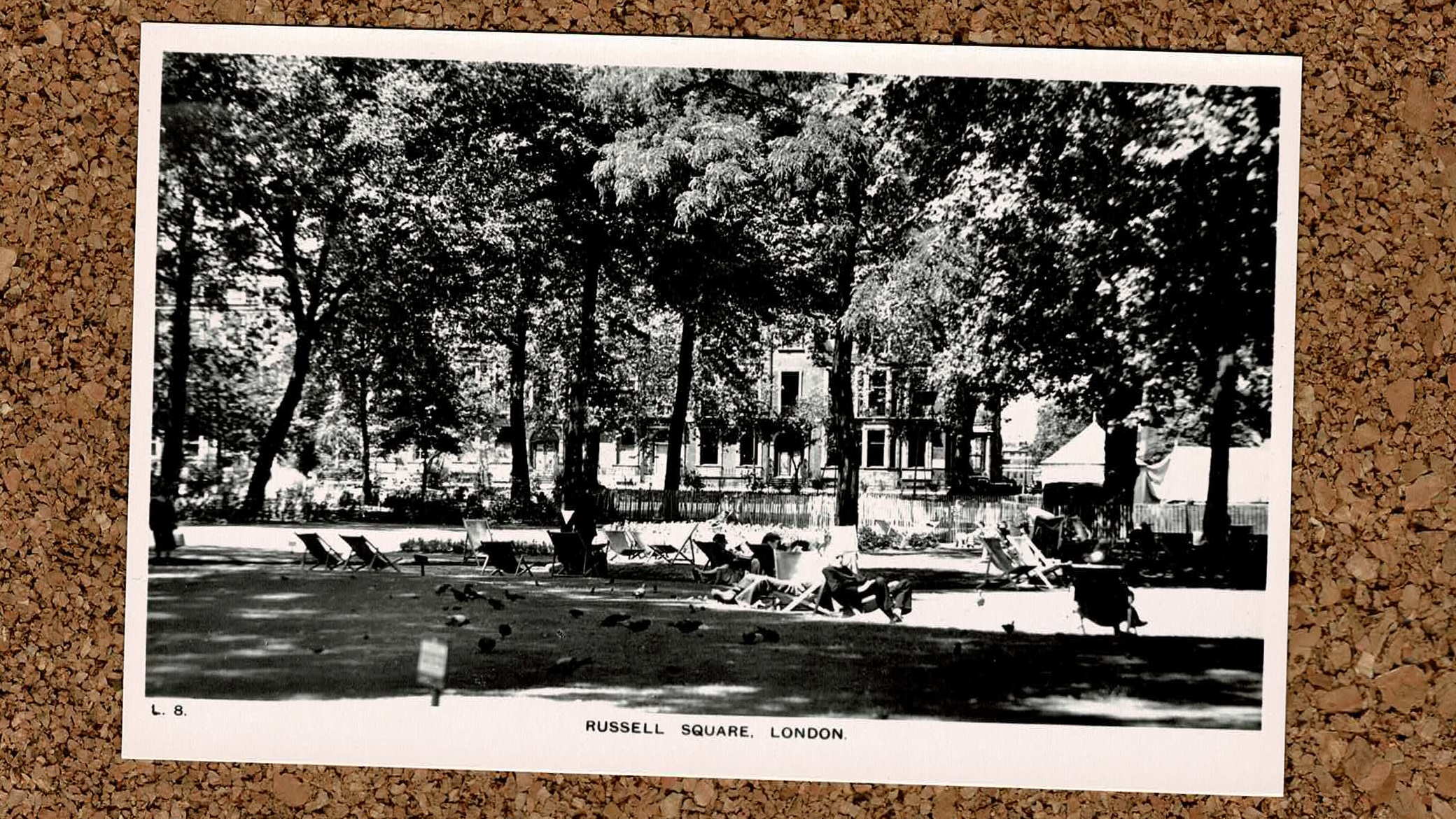


I know it looks like a postcard of Russell Square, but hiding behind the trees is a row of houses, and in two of those houses was, for a while, the School of Slavonic and East European Studies – also known as SSEES. Spoiler alert: it is now part of UCL, but for a long time it was an independent school of the University of London, just like UCL itself. But a lot smaller.
SSEES’s story begins in 1915. Rival European powers – Britain, France, Germany, Russia, Austria-Hungary and the Ottoman Empire – were at war. And the position of subject nations and people in Europe was in some quarters a cause célèbre (Conrad’s The Secret Agent will give you an insight into that world before 1914).
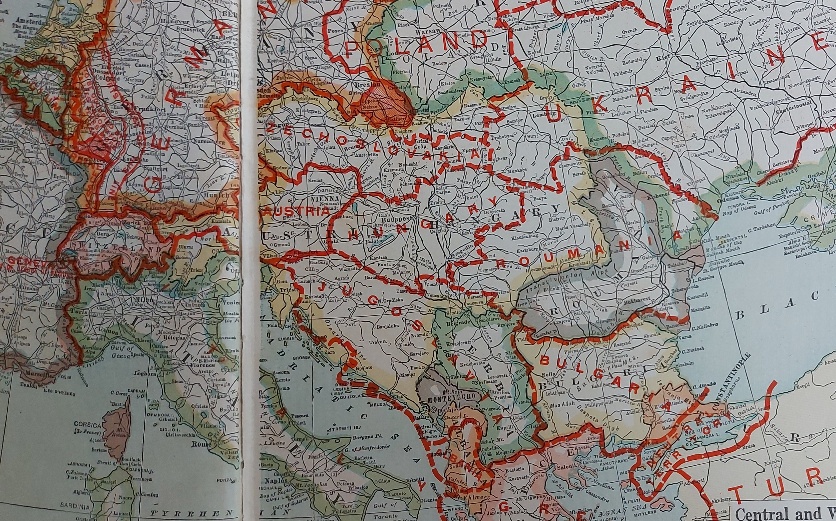
The plight of the so-called Slavic peoples of the Austro-Hungarian empire was a particular focus for some. Here’s a 1920 map, overprinted on pre-WW1 pages, which gives you a sense of what the Austro-Hungarian empire covered. Ignore the red over-printed lines, if you can, and look at the yellow-outlined land: Austria, Hungary, Czechoslovakia, part of Poland, part of Ukraine, part of Romania, Croatia, Slovenia, Bosnia-Herzegovina. This was where the Slavic peoples could be found.
Robert Seton-Watson was one such believer. A political activist and academic, you can read a fuller account of his life here. He was invited by the new principal of King’s College London to deliver a lecture on “The Spirit of Allied Nations”, and duly did so on 10 March 1915. (I haven’t read the lecture text but my guess is that it would have focused on the Serbian, Romanian and Greek struggles against Austria-Hungary and the Ottoman Empire.) Professor Burrows, the principal at King’s, was a classicist with a keen interest in the Balkans. When Seton-Watson wrote to him after the lecture suggesting that a Slavonic school be established, to teach the languages, history and culture of the Slavonic countries, Burrows was supportive.
The school became real later that year, with lecturers appointed and a small library beginning to be built up. There’s a micro-story of the involvement of emigres from the various Slavonic nations, which I won’t dwell on. Except to mention one important figure: Tomáš Masaryk, future Czechoslovak president. He was the first lecturer in the school, in Slavonic literature and history.
The nascent school’s activities grew through the war years, with more languages offered and the addition of Russian as a language to study. Bernard Pares was the first professor of Russian, and became director of the school.
Post-war, funding for the school became more constrained. It continued as a department of King’s College London, gaining funds from a variety of sources beyond the university. A special grant from the University Grants Committee (UGC) was given, with the injunction that the accounts of the school were to be kept separate to those of King’s College London. Some governments in the newly created Baltic states gave support, raising questions about their control over what was said. For example, the Greek government had since 1919 funded a chair in Modern Greek. In 1922 they objected to the views expressed by its holder, Arnold Toynbee… who in 1924 resigned the chair. You may draw your own lessons here. The parallels with today’s concerns about China’s influence over what universities do are clear.
An advisory board of the great and the good in foreign policy circles was established, chaired by Lord Treowen, and meeting just off Park Lane (how times have changed). The school was well established within Britain’s foreign policy elite.
(Lord Treowen, incidentally, had a son, Elidyr Herbert, who was killed as a captain in the Royal Gloucestershire Hussars in 1917. He is buried in the Gaza Military Cemetery, which, as the Commonwealth War Graves Commission notes, “has suffered extensive damage to headstones, memorials, boundary walls, staff facilities and storage areas. Memorials with reported damage are the 54th (East Anglian) Division Memorial, the Hindu Section, Indian UN Memorial, the Turkish section and the Muslim section.”)
Another challenge was accommodation. In 1924 the school had moved to rooms in Malet Street, rented from the Institute of Historical Research. The proposals to move the university itself to Bloomsbury, from its South Kensington offices, meant that the Mallet Street rooms were no longer tenable. A move back to the Strand was not welcome – Bloomsbury was nearer the core of university activity – and in 1929 the school moved to Torrington Place, to rooms rented by King’s from the University of London. This was a precursor to greater autonomy: in 1931 the school asked to be a separate institute within the University of London, and in 1932 this was agreed. The School of Slavonic and East European Studies was created.
During world war two the school suffered damage to (again temporary) accommodation, losing much of its library and records; but also gained many students for short courses in matters Russian, especially after 1941, when the Soviet Union joined the allied side. The government funded bursaries for students to study Slavic languages. Post-war interest continued, and the school continued to teach eastern European languages with the support of government, which recognised the need to be able to understand Eastern Europe better, particularly following the end of the war and the creation of the Iron Curtain.
The school’s fortunes initially waxed and then waned, as post-war focus on Eastern Europe turned to a managed approach dealing with the financial realities which faced Britain.
The school had space in Senate House, and also space in Russell Square, but it was never a large institution. And herein lay the challenge. When government was interested, and the global situation necessitated it, SSEES survived and, within its own terms, thrived. But when times were harder it was hard to keep going all of the different activities which a small institution necessitated, and a lot depended on a few people. In 1965 a UGC delegation heard the staff view that the biggest single factor holding back SSEES was the lack of a single building for all activities.
Nevertheless, the school steadily grew through the 1950s and the 1960s. In the late 60s there was money for academic posts which broadened understanding of other aspects (eg geography) of the Slavonic and eastern European countries. But there were also declining numbers of students: other universities had introduced Russian departments, and competition was strong. By 1969 another UGC visit found staff morale to be low, and in 1970 the University of London embarked on a review of SSEES. This recommended in 1971 that SSEES be incorporated into an existing, larger, school – King’s College for choice, but if not Queen Mary College or LSE. In 1972 working parties were set up to explore the practicalities of each option. King’s and LSE both pleaded lack of suitable accommodation, and these options were ruled out. But Queen Mary was keen, and in 1974 six specific working groups were established. But SSEES staff opposition must have been determined: by the summer the option was ruled out as unfeasible. Clearly SSEES’s willingness to be merged was seen then as a necessary part of the equation. And as a footnote, In 1975 the prospect of merger with King’s again reared its head, and was again ruled out.
With the advent of research assessment, SSEES did comparatively well, which stood it in good stead. A new director had been appointed and the school was beginning to modernise and learn lessons from other University of London schools about operational matters. The UGC had deemed SSEES to be one of the national centres for Russian, and staff from other universities joined the school. But finances were always tight, as the school’s clerk reported to the university in 1992:
It is vital that we continue to make strenuous efforts to generate additional income and also to keep expenditure very closely monitored. We live on a knife-edge financially, from year to year.
By the 1990s the University of London was changing its structure, and the larger colleges became directly funded by HEFCE. SSEES remained centrally managed, but in 1995 determined to seek college status in its own right. However, the 1996 RAE outcomes dealt a blow. SSEES scored 4s, but on a six point scale (1,2,3,4,5,5*) with selective research funding, the effect was financially calamitous. By 1998 it was clear that merger with another University of London college was the way forward.
Four colleges were interested: Goldsmiths’, King’s, Royal Holloway and UCL. And in December 1998 staff and students both voted in favour of UCL. The school merged with UCL on 1 August 1999, becoming a distinct unit within a larger organisation. It now has better accommodation, and teaching and research continue.
There are lessons here for the sector. When nationally important expertise is subject to market forces, it can be lost. And a regulator able to intervene, as the UGC did on several occasions, is a good thing for the country.
Here’s a jigsaw of the postcard. The card is unposted but, I guess, dates from the 1950s.
In writing this account I’ve drawn on I W Roberts’ History of the School of Slavonic and East European Studies, revised and extended by Roger Bartlett. You can read this via the UCL library, and it’s well worth it, not least for a sense of the significance, in a small institution, of individual characters and personalities.