Higher education postcard: the Radcliffe Camera
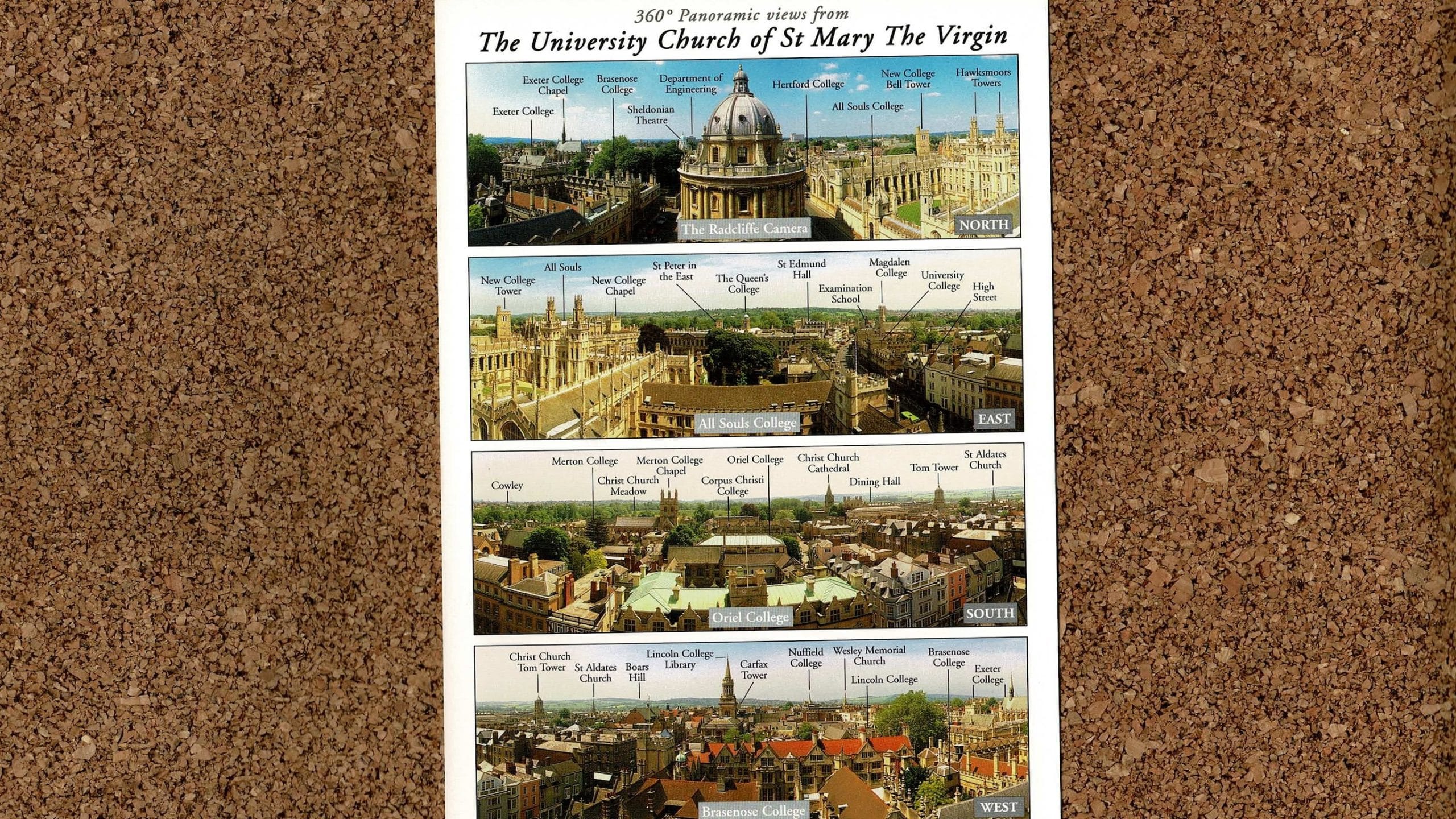
This week’s card from Hugh Jones’ postbag takes us to an Oxford fixture
Comment|
Hugh Jones is a freelance HE consultant. You’ll find a daily #HigherEducationPostcard if you follow him on Bluesky
Oxford and Cambridge both have iconic views. For Cambridge, it’s the view of King’s College Chapel from the backs; for Oxford choose from Magdalen Tower or the subject of today’s blog, the Radcliffe Camera.
You can’t miss it on the card above: it’s the one middle top, and you’ll have seen it in any number of TV shows and films set in Oxford.
So what and why is the Radcliffe Camera?
Let’s start with Radcliffe – it’s named for John Radcliffe, seventeenth century physician who studied at Oxford, built a successful medical career in London (physician to the royals!), served as a Member of Parliament and, dying childless, left large bequests to benefit Oxford and the university. As well as the camera, you’ll find his name on the Radcliffe Observatory, the John Radcliffe Hospital, the Radcliffe Science Library (which we’ll come back to) and, in the past, on the Radcliffe Lunatic Asylum (insert your own joke here about your Oxford college of choice).
Radcliffe died in 1714 and his will included £40,000 – payable in ten equal yearly instalments after the deaths of his two sisters, Hannah and Millicent – for buying land and building a library. It also included further sums in perpetuity to employ a librarian (£150 annually), buy books (£100 annually) and, 30 years after his death, to maintain the library building (£100 annually). In today’s money that’s £6.9 million for the library, £25,810 for the librarian (which is less than minimum wage for a 40 hour week) and £17,000 per year for books and maintenance. From which we learn (a) that his gift was generous and (b) that inflation has clearly impacted some things (building, wages) more than others.
It took a while to buy the land for the library – necessitating an Act of Parliament to enable the university and colleges to sell land to the library. The last of Radcliffe’s sisters (Millicent) died in 1736, meaning that construction of the library could go ahead. It did so in 1737, with the building designed and construction supervised by James Gibbs, who, incidentally, also designed the Senate House at the University of Cambridge. Gibbs was the only surviving architect of the seven who the trustees had initially considered, so must count as a lesson in the value of simply persevering.
Initially the library held a broad range of publications, but after 1811 focused on scientific works. The catalogue of the library was published in 1835. It seems that the original bequest continued to dictate the librarian’s salary. By 1835, for instance, its value had shrunk to two-thirds of the original, so it was a part-time occupation. A new librarian – Henry Wentworth Acland – in 1851 took stock of the situation, and recognised that the funds available were insufficient. Accordingly he promoted the idea that the library should transfer to the university.
This was agreed, and the transfer took place in 1861 (the final transfer of the freehold of the land took place in 1927 – things can move slowly in Oxford). The books were moved to what is now the Radcliffe Science Library, and the building became a reading room for the Bodleian. It also changed its name: no longer being a library, it was simply the Radcliffe Camera.
A note here about cameras. Camera in this case comes from the Latin for chamber, or room. Think about a camera obscura (a dark room with a pin-hole in the wall, through which a projection of the outside can be seen). Or a private hearing before a judge being referred to as in camera – in (private) chambers. So the Radcliffe Camera is simply chambers associated with Radcliffe. The use of camera to mean a device for taking pictures comes from the same root: the first cameras were a dark box containing a chemical plate and a pinhole opened to let light through.
The Radcliffe Camera is now the history faculty library, a part of the Bodleian Library.
Here’s a jigsaw of the postcard, and as a bonus here’s another which is of the Radcliffe Camera only.