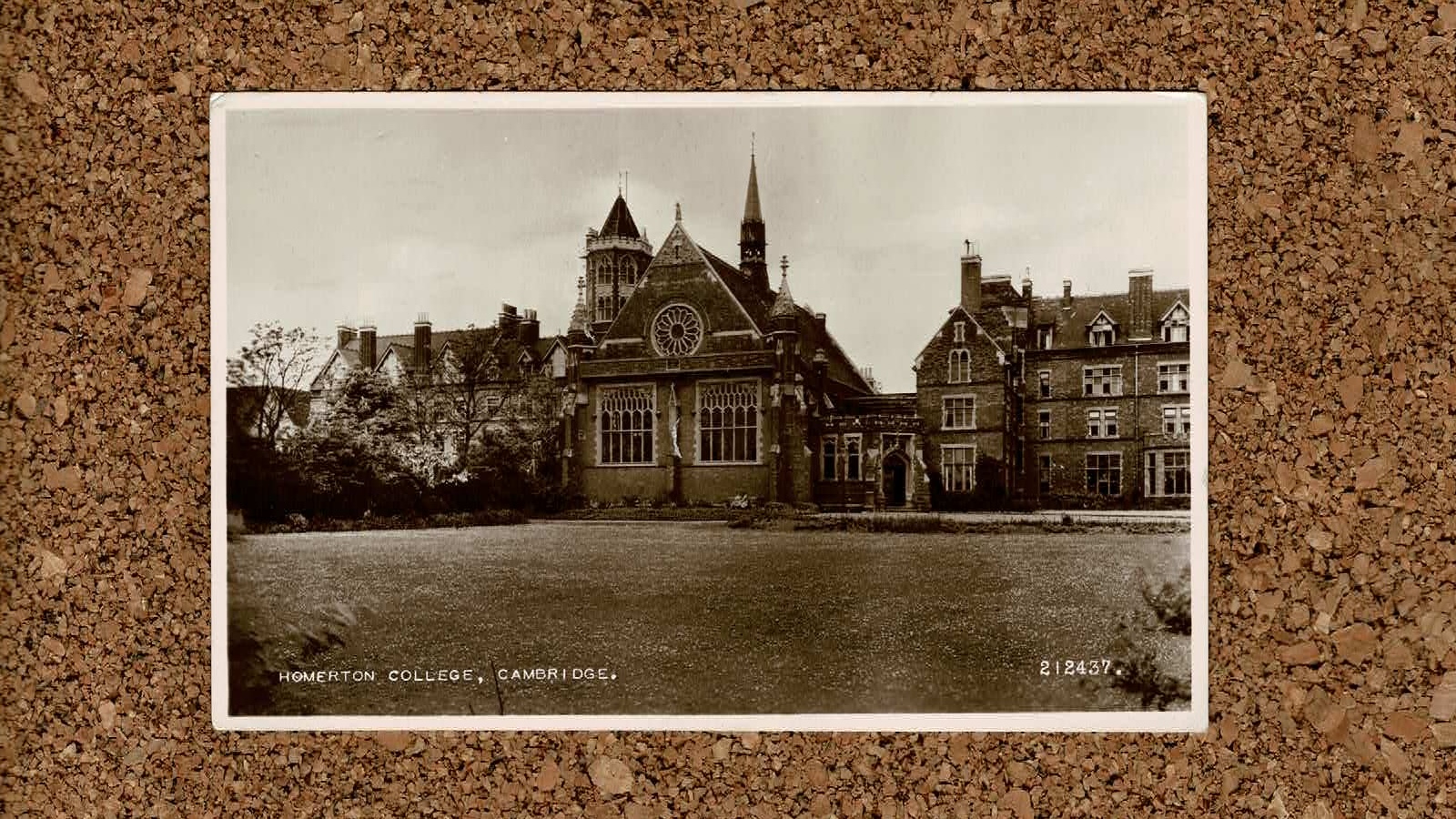


If you wanted to explore a Cambridge college you might find it odd to start in London, but that’s what we need to do for Homerton (and to be fair, the name is a bit of a clue).
In the late seventeenth to early eighteenth century (that’s the late 1600s to the early 1700s if, like me, you have to think carefully about this) religion was still a matter of state and politics in Great Britain. The civil wars and the restoration were still very much in living memory, and following the monarch’s religion was the done thing.
But not done by everyone. In 1730 a group of Calvinists established a society to support young men attending dissenting academies (that is, schools run by Protestant but not CofE sects). And by 1768 this had evolved into needing premises on Homerton High Street, in what became a college in its own right.
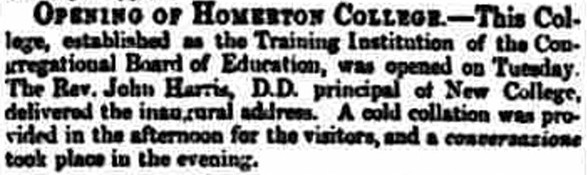
In 1850 the college underwent a change in focus. Its theological education was part of the amalgamation of nonconformist colleges which helped to create New College, London. This left Homerton College to focus on education, and specifically to training teachers. It was relaunched in 1852 as the Training Institution of the Congregational Board of Education, as this snippet from the Essex Herald of 27 April 1852 testifies. A cold collation and a conversazione must have added to the jollity.
From the outset the college was open both to men and women and, it seems, offered a longer period of training than other colleges.
At this point I need to introduce what is amongst the best facts about higher education institutions that I have so far encountered in 212 blogs for Wonkhe. And it is this:
In 1881, former students of the Homerton College who were members of Glyn Cricket Club founded a football section, to keep themselves entertained during the winter. This football section continued to grow and in 1888 changed its name to Orient FC. This became in 1890 Clapton Orient and then after the second world war, Leyton Orient. (Orient, by the way, was chosen because one of the players apparently worked for the Orient Steam Navigation Company, a precursor to P&O. It was both apt and added an air of mystery!) Here’s a fantastic run down on the Orient team that played in the first division in 1962–63.
Back to educational matters, and a quick trip up the A10 to Cambridge. In 1873 Cavendish College had been established in Cambridge. Like Selwyn College, it was a public hostel, not a full college of the university. Unlike Selwyn College, it did not prosper, and closed in 1892, but not before having had a set of buildings erected about a mile from the centre of Cambridge.
At a similar time, Homerton was becoming more industrial and less suited as a location for a training college. And so in 1894 the now empty Cavendish College buildings were purchased by the Congregational Board of Education, and the college moved to Cambridge. Some sources suggest this was in 1895, but there are reports of football matches in October 1894 involving Homerton College Cambridge, so we have a bit of uncertainty there.
Initially the college was called Cavendish (New Homerton) College, but this quickly reverted to simply Homerton College. E9 had become CB2. We also know that by this time the college no longer required students to subscribe to any denomination at all. Reporting on the annual meeting of the Congregational Board of Education, the Cambridge Independent Press of 9 March 1894 observed that:
Except for statistical information, no question, asked of any student as to what denomination of the Christian Church he or she may be connected with; nor any student is required to be communion a member of any church whatever. There some reason to believe that in some quarters undenominational means irreligious. This is by no means the case, and the Board feel that such a mistake can only arise from want of knowledge of the basis on which the work the Board rests. Though no dogmatic religious instruction is given as part of the curriculum, a religious tone prevails, and means are taken to ensure that all students can obtain such help in religious matters as their conscientious views require.
It seems that the college wanted a connection to the university, but that this was problematic. For example, one cross correspondent to the Cambridge Independent Press of 16 February 1894, on the question of whether Homerton might continue to house non-collegiate students, even though it was not part of the university, wrote that:
…If these students were entered the Non-Collegiate Board, all our University would know about would be that some official of the College (I use the word to avoid discourtesy, and not admitting it to be applicable) would be registered as the lodging-house keeper…
I haven’t been able to pin down the specifics, but reading between the lines it seems that – at least initially – Homerton didn’t have much formal connection to the university. Indeed, as our cross correspondent pointed out, the existence of the Ladies Training College – later Hughes Hall – meant that there was no need for Homerton too.
Homerton became single sex entry – women only, this time – from 1896. This may have been related to a desire to meet the university’s expectations, and may also have been market forces. (Compare with what is now the University of Chichester, which in an earlier guise closed as a training college for men in 1867 and re-opened as a training college for women in 1873.)
The college has a good page discussing its history. From this we learn that successive college principals – Mary Allan 1903–35, Alice Skillicorn 1935–60, Dame Beryl Paston-Brown 1961–71, and Alison Shrubsole, 1971–85 – worked hard to grow links with the university. This must have been a trying process. Eventually, in 1976, the college became an approved society of the university. This meant that Homerton’s students could study alongside the university’s other education students, and would gain a Cambridge degree. It also, at this point, became once more co-educational.
In 2001 the college was able to introduce a broader range of subjects, including admitting postgraduate research students. In 2010 it was given a royal charter and admitted as a full college of the University of Cambridge.
Homerton alumni include Emily Phipps and Dame Leah Manning.
Phipps was a Homerton graduate from its pre-Cambridge days, and was an ardent suffragist and trades unionist. She helped to found the National Union of Women Teachers, which grew out of the NUT Ladies’ Committee.
Manning was an educational reformer and political activist. She was Labour MP for Islington East in 1931 after a by-election, but did not support Ramsey MacDonald’s national government, and lost her seat at the general election later that year. Later that decade she disagreed with the policy of neutrality in the Spanish Civil War, and organised a relief ship to Bilbao to rescue almost 4,000 children stranded there in the nationalist siege of the city. A park and garden in that city is named after her. And in 1945 she returned to Parliament as the Labour MP for Epping.
Here’s a jigsaw of the postcard. It was sent on 15 October 1953 to Mr and Mrs Ashton in Birmingham:
Parcel received although falling to pieces – everything arrived though I think. Many thanks – especially for fudge. Must stop, will write later. Much love …
This sounds remarkably like a parcel sent from home, and I guess in that case the sender was a student at Homerton.
Finally, a note for those of you who have a go at the jigsaws I share. Did you know that you can change the number of pieces in the puzzle? If you click on the ‘play as’ button on the top right, you can change the number of pieces up or down, as you see fit. (This works on my Windows laptop and I think on iPads too. Hopefully it will work for you too!)










Thanx very much for this. Homerton is next to Cambridge’s Faculty of Education, so there is close interaction between the 2. In contrast, Oxford’s Department of Education doesn’t seem to have particularly close interactions with its neighbour Lady Margaret Hall nor its nearby colleges.
It’s a difference: Oxford didn’t incorporate a teacher training college in the phase of mergers. As a fully functioning teacher training college Homerton had a full range of facilities and space to accommodate the department.
It made sense after a merger to continue to use the teacher education buildings for that purpose. At Durham, Education used the teaching buildings of St Hild & St Bede after merger, with the residences becoming a college. Westminster didn’t become an Oxford college, but after merger Brookes concentrated its teacher training there (although it stopped teaching there last year).