The international student boom is over – and the bust is being delivered by stealth
With refusal rates spiking, withdrawals surging, and universities pre-emptively retreating from high-risk markets, Jim Dickinson finds an international contraction engineered through plumbing rather than policy
Comment|

Jim is an Associate Editor (SUs) at Wonkhe
Processing delays no one owns, withdrawals that don’t count as refusals, a compliance regime that makes universities execute their own retreat, and a squeeze on switching into skilled work.
A year ago, the immigration figures told a tidy boom-and-bust tale. International students had inflated net migration during the post-pandemic recovery, the dependant ban had taken the air out of the numbers, and the sector was being gently reminded that “they come for education, not immigration” had not aged well.
The data lagged, the levers had been pulled, and it was too early to say what staying-on would do to the headline.
New figures – ONS long-term migration to December 2025, the Home Office quarterly visa data to March 2026, and the Migrant journey: 2025 report – close the loop.
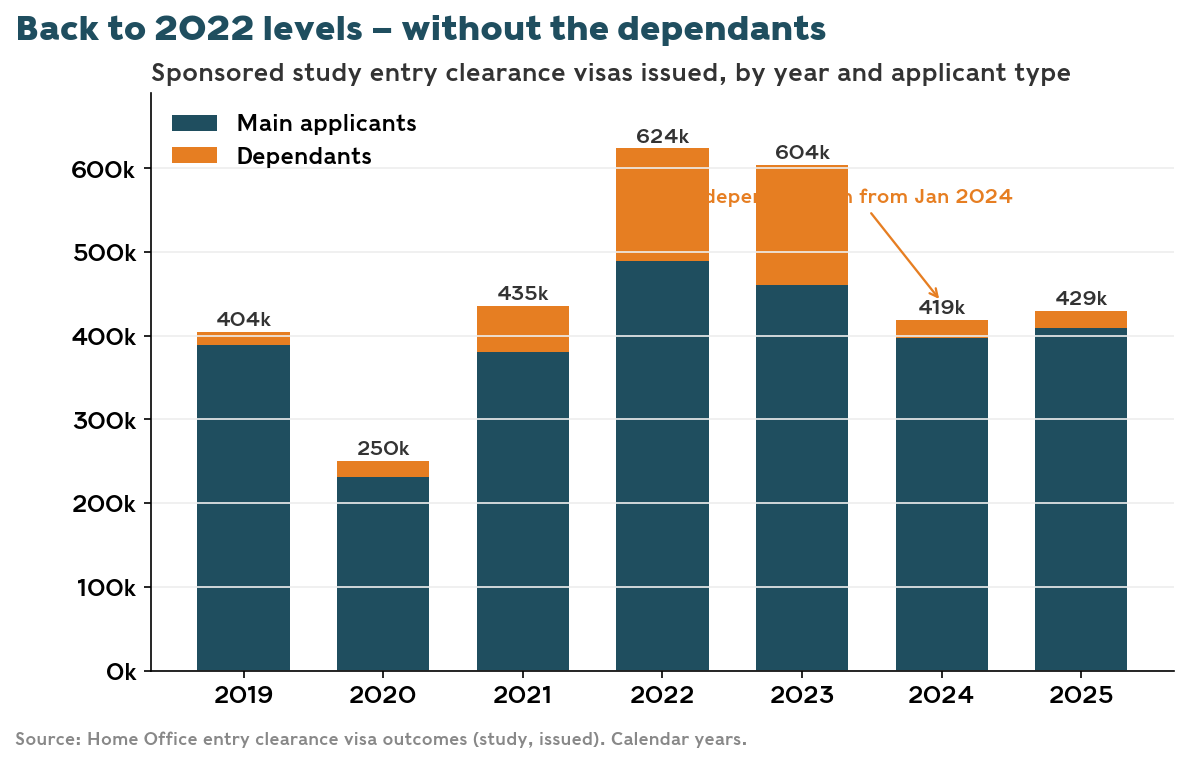
The boom is over – arrivals are back to roughly 2022 levels and net migration has halved. But the arresting thing about the bust is how little of it has been announced.
There is no headline ban to point at this time. Instead the contraction is being administered through the plumbing of the system – a delay here, a withdrawn application there, a compliance threshold that does the deciding, a salary floor that quietly closes a route.
Each lever is individually deniable. The aggregate is a bust delivered by stealth, with no single author and accountability that sits nowhere.
The boom is over
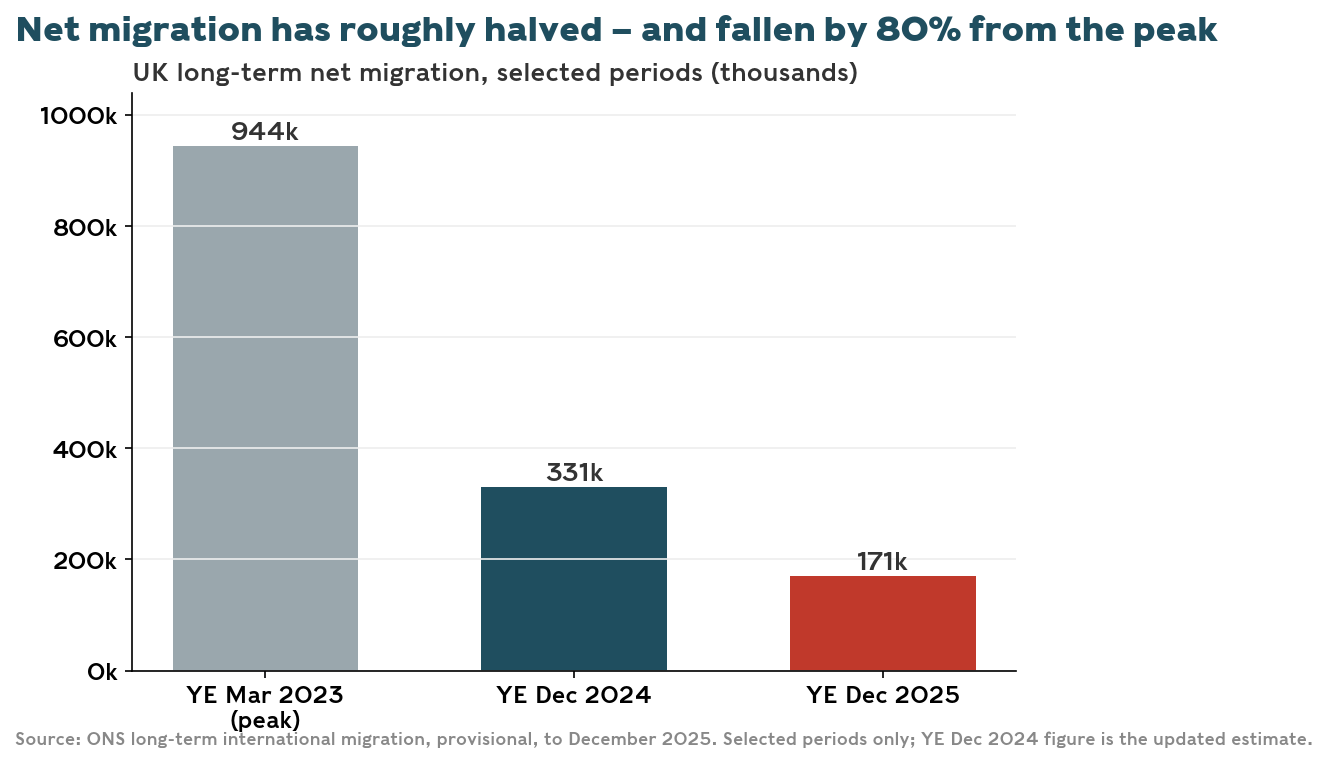
The Office for National Statistics (ONS) now estimates long-term net migration at 171,000 for the year ending December 2025 – down from an updated 331,000 a year earlier, and a long way below the 944,000 peak of March 2023.
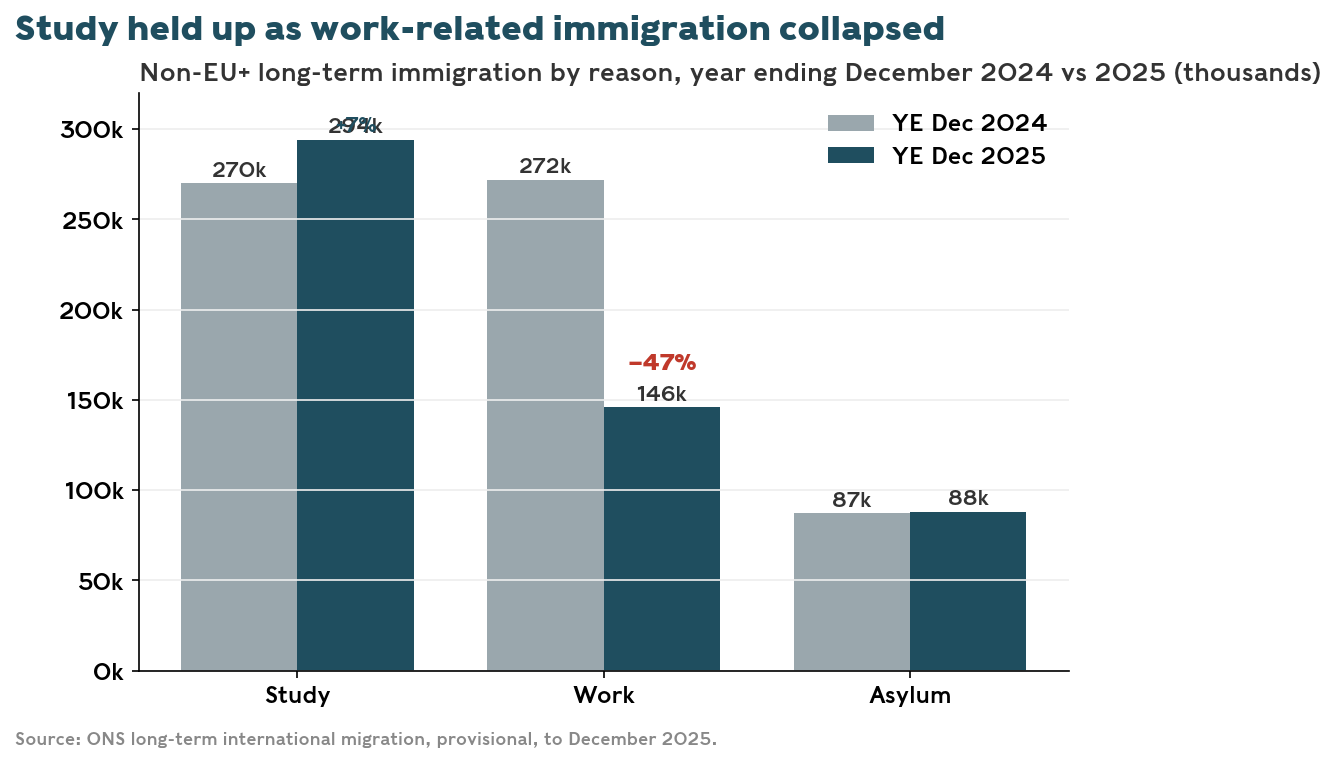
Home Secretary Shabana Mahmood called it a restoration of “order and control to our borders”. On the ONS telling, the engine of the fall was work, not study – non-EU+ work-related arrivals fell 47 per cent over the year, while emigration ticked down only slightly. Total immigration came in at 813,000, a 20 per cent drop.
Study, on the ONS annual measure, actually held up at the point of arrival. Study-related immigration of non-EU+ nationals was a provisional 294,000 – around 47 per cent of all non-EU+ arrivals, and up seven per cent on the previous year, albeit well below the 486,000 peak of September 2023. The dependant story does all the heavy lifting underneath – study main applicants (277,000) rose nine per cent, while their dependants (17,000) fell 17 per cent.
That “study held up” story sits awkwardly next to the Home Office’s own quarterly visa data, which show the front door closing fast. The two are not in tension – the ONS rise is the older annual flow to December 2025, while the visa data are the more recent leading edge.
And that leading edge is sharp. The first quarter of 2026 saw the fewest sponsored study visas issued for that quarter since 2020 – down roughly a third year on year, and about 60 per cent below the 2023 peak.
Over the 12 months to March, 409,954 study visas were granted, three per cent down on the previous year and 34 per cent below the year to March 2023. Master’s entry clearance visas fell 35 per cent in the quarter to around 21,700, the lowest in six years. Applications fell across all of the top ten source countries.
This is the same story as last year’s “back to 2022 levels” observation, only now firmly confirmed and without the dependants padding the totals. The levers have worked. The question is whether they have over-worked.
Why students became the lever
To understand why the squeeze is aimed where it is, we need to look at what’s changed in student behaviour. The old reassurance – that students come, study, and leave – has stopped being true for recent cohorts, and the data now show it pretty clearly.
Start with departures. Students who originally came on study visas are now the single largest group leaving the UK. In the year ending December 2025, an estimated 159,000 non-EU+ nationals who first arrived to study emigrated long-term – about 57 per cent of all non-EU+ emigration.
That continues a clear climb – 114,000 in the year to December 2023, 135,000 to December 2024, and now 159,000. ONS attributes it to the large post-pandemic cohorts completing their courses and departing, and links it explicitly to the intake surge of 2021 and 2022.
But the more important shift is among those who stay. The Home Office’s Migrant journey: 2025 report is where last year’s “they look more likely to stay” worry gets its hard evidence. Of 705,000 new journeys begun in 2025 – down 17 per cent – study routes accounted for 53 per cent. And retention has stepped up markedly.
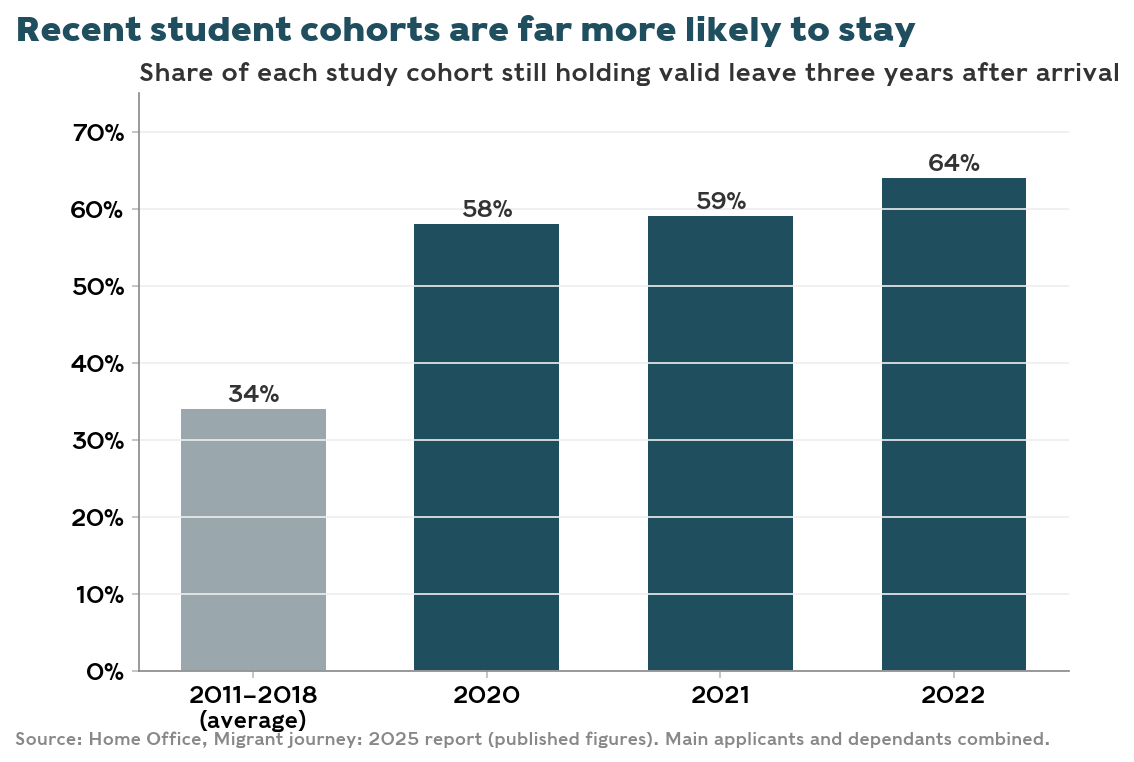
Among students arriving between 2011 and 2018, only about a third still held valid leave three years later – for the 2020 cohort that rose to 58 per cent, and for the 2022 cohort to 64 per cent.
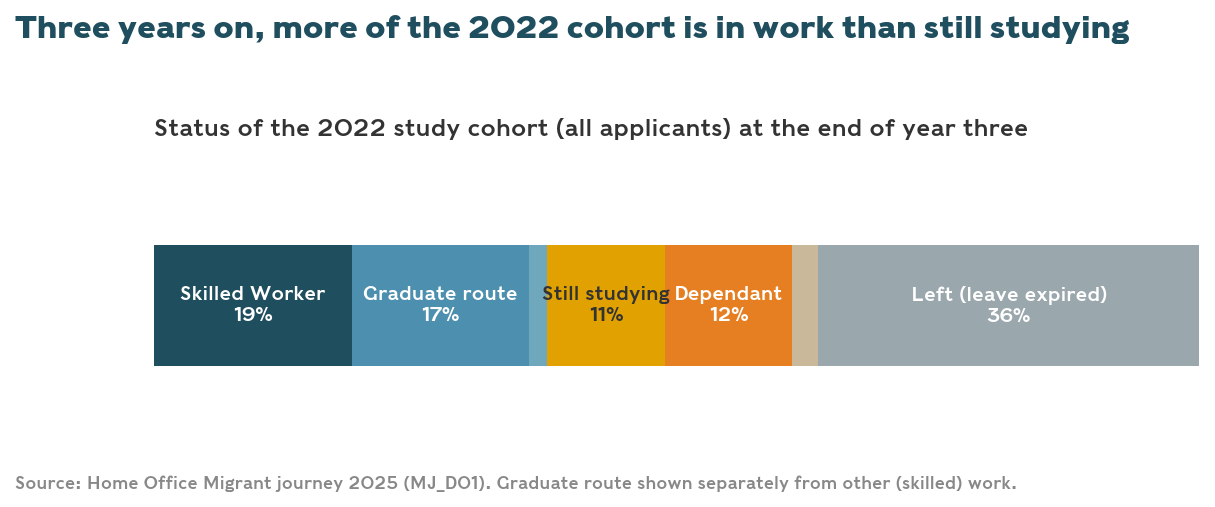
The reason is the switch into work. Of the 2022 study cohort, after three years 38 per cent were on a work route – 19 per cent on Skilled Worker and 17 per cent on the Graduate route – with just 11 per cent still studying. For the 2020 cohort, 26 per cent had moved onto work routes within five years, the majority on Skilled Worker, against just three to four per cent for cohorts arriving a decade earlier.
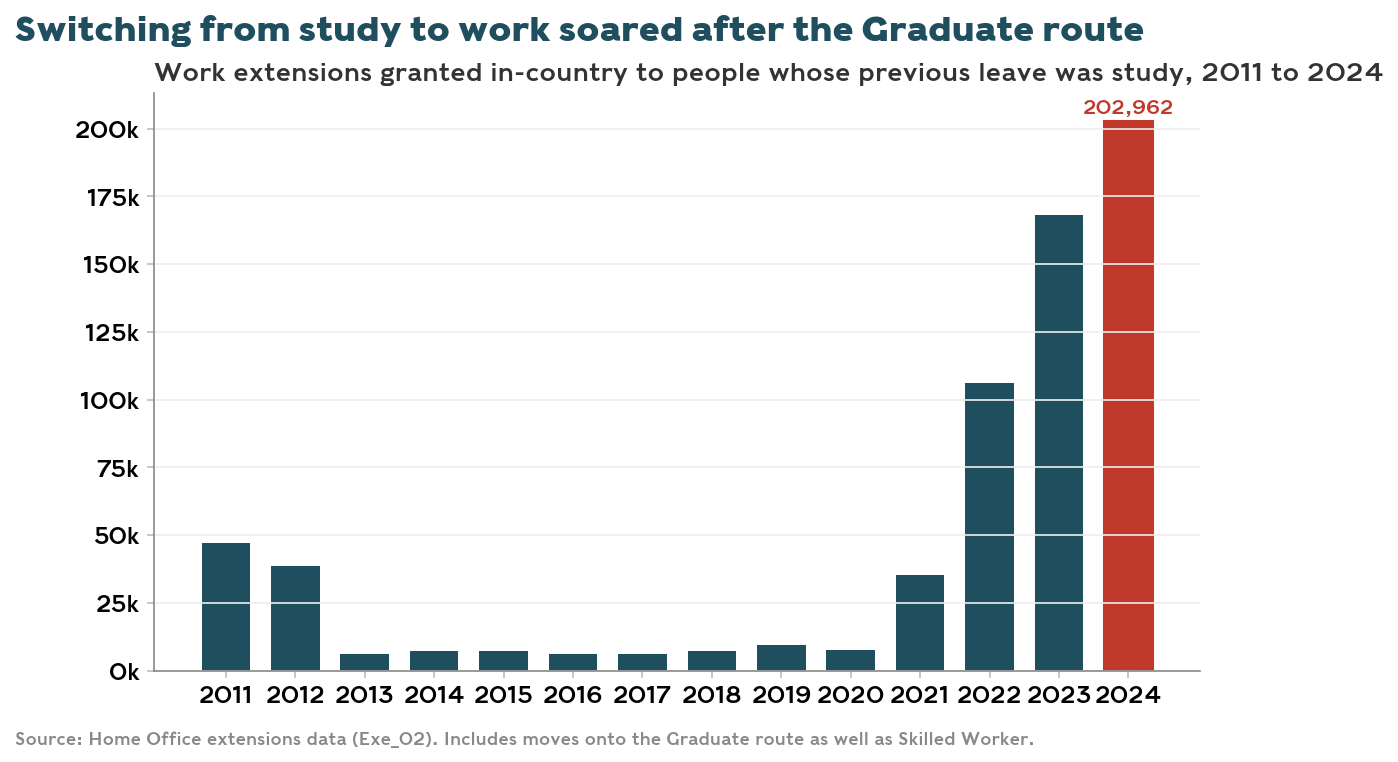
Students are also switching earlier – the share moving onto a work route within their very first year rose from around one per cent for 2012 to 2019 arrivals to 14 per cent for the 2023 cohort, before easing to 12 per cent for 2024. The in-country switching data tell the same story of scale – work extensions granted to people whose previous leave was study ran at around 6,000 a year in the late 2010s, then surged to a record 202,962 in 2024.
Composition matters. Chinese students, who tend not to stay, made up around 40 per cent of cohorts in the late 2010s but a falling share since – only 14 per cent of the 2020 Chinese cohort held valid leave after five years, against 58 per cent of Indian nationals.
And settlement remains a slow burn for students – study routes were just 11 per cent of 2025 settlement grants, and of those study-origin settlers, 52 per cent had switched to a work route before qualifying.
Study is, as ONS puts it, not a direct route to settlement – but it has increasingly become a route into work. That is the behaviour the policy programme has been built to interrupt.
A delay nobody owns
The first lever is the one no minister will ever claim.
From the start of the January 2026 intake, the Home Office acknowledged “unavoidable delays” to visa processing and invited institutions to extend their latest acceptance dates while it cleared a backlog stretching into February.
At some providers, reports suggested up to half of a winter cohort was still awaiting a decision despite a Confirmation of Acceptance for Studies (CAS) issued before Christmas – petitions described students stuck on “SLA not met” notifications weeks after submitting biometrics. The delays were reported to fall hardest on applicants from Pakistan, South Asia, and parts of Africa.
No one decided to cut the January intake – no rule change, no announcement, no number to hold anyone to. The intake shrank because decisions were not made in time – a form of bust-by-stealth, because operational drag leaves no fingerprints in any accountability framework.
Withdrawals that don’t count
The second lever is even stealthier, and it is where the delay turns into a number. Alongside refusals, the share of study applications that were withdrawn jumped to around 14 per cent in the first quarter of 2026 – against a normal range of well under four per cent, and as low as 0.3 per cent in some recent quarters. In raw terms, study withdrawals leapt from under 2,000 in the final quarter of 2025 to roughly 7,000 in the first quarter of 2026.
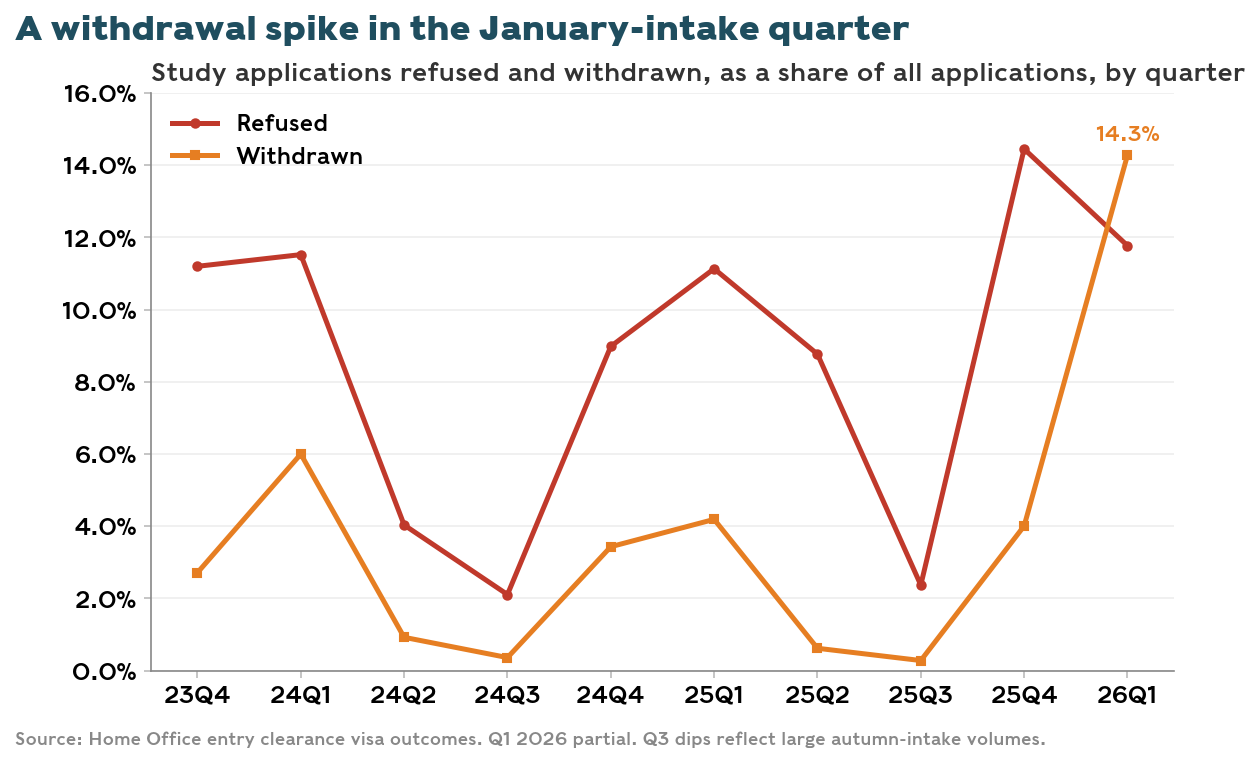
The fingerprint is unmistakable. The spike is concentrated almost entirely in the nationalities reported to have been worst hit by the processing delays. Pakistani withdrawals rose from a few hundred to nearly 3,000 in a single quarter – a withdrawn rate above 40 per cent – with Nigeria and Bangladesh also spiking sharply, while China actually fell and India’s withdrawn rate stayed around five per cent. Pakistan, Nigeria, and Bangladesh together account for the large majority of the quarter’s withdrawals.
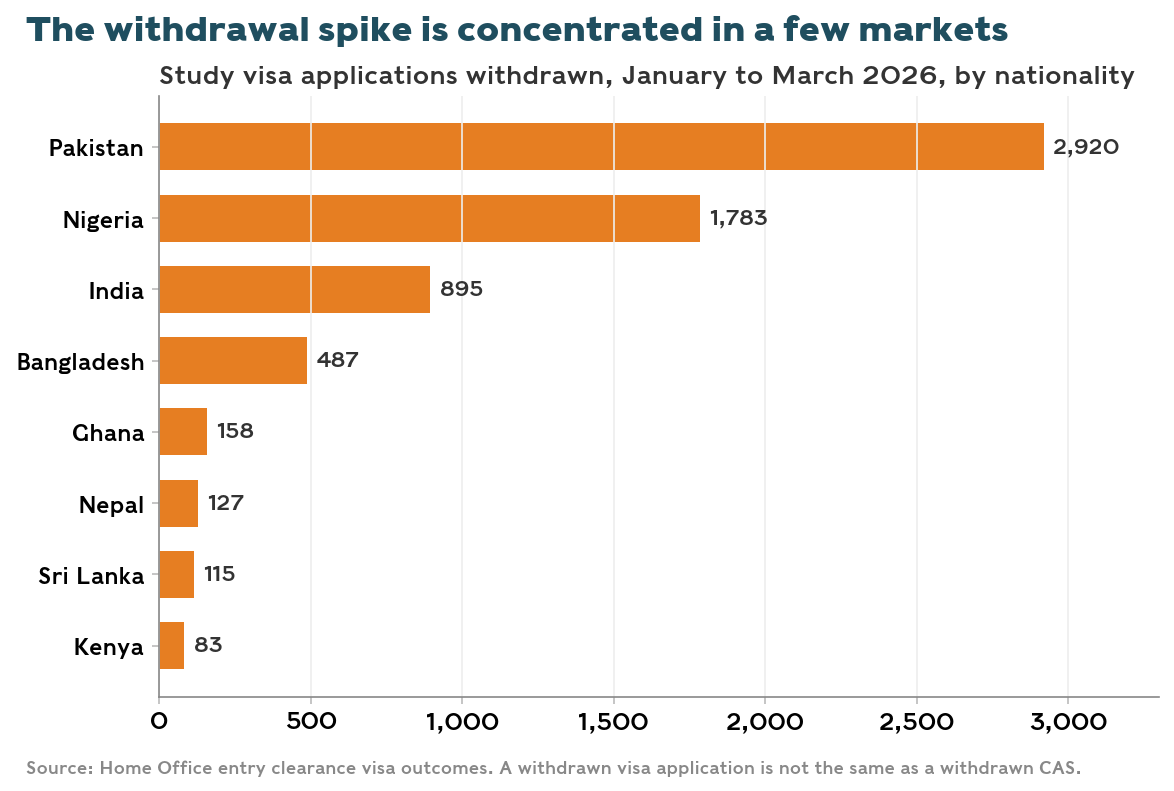
There is a bleak logic to it all. A withdrawn application doesn’t count as a refusal in the compliance metrics. So in a system that punishes refusals, the withdrawal route protects the institution’s number while the student absorbs the loss – the non-refundable flights, the priority fee that was never honoured, the place that evaporated. The delay creates the pressure – the withdrawal discharges it without leaving a mark on anyone’s record.
Universities do the cutting
The third lever is the one that turns a refusal rate into a recruitment decision – and it works by getting universities to do the cutting themselves. Refusals of study visas climbed to around 5,499 in the first quarter of 2026 – up 56 per cent year on year. Because applications fell at the same time, the refusal rate rose even faster – roughly 13 per cent of study applications were refused between January and March, double the proportion a year earlier and the highest level since 2015.
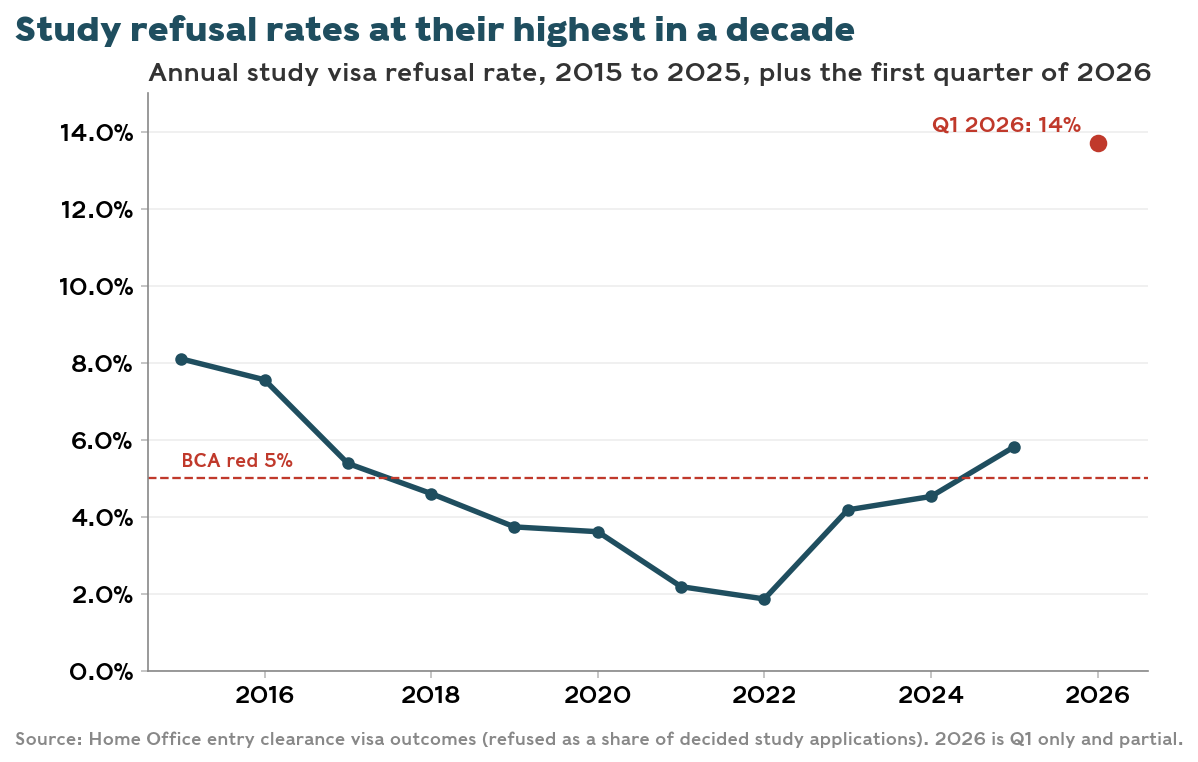
The underlying entry-clearance outcomes data show this building over several years. On a refused-as-a-share-of-decided basis, the study refusal rate drifted from about 4.2 per cent in 2023 to 4.5 per cent in 2024 and 5.8 per cent in 2025, before the Q1 2026 jump.
And the increase is anything but evenly spread. In the first quarter of 2026, Pakistan – the UK’s fourth-largest sender – saw upwards of 40 per cent of study applicants refused, against around six per cent a year earlier. Nigeria sat at roughly 21 per cent, with Bangladesh, Ghana, and Sri Lanka all above 20 per cent.
India recorded about 6.7 per cent – down on the previous quarter but more than double its Q1 2025 rate – while China stood out at 0.4 per cent.
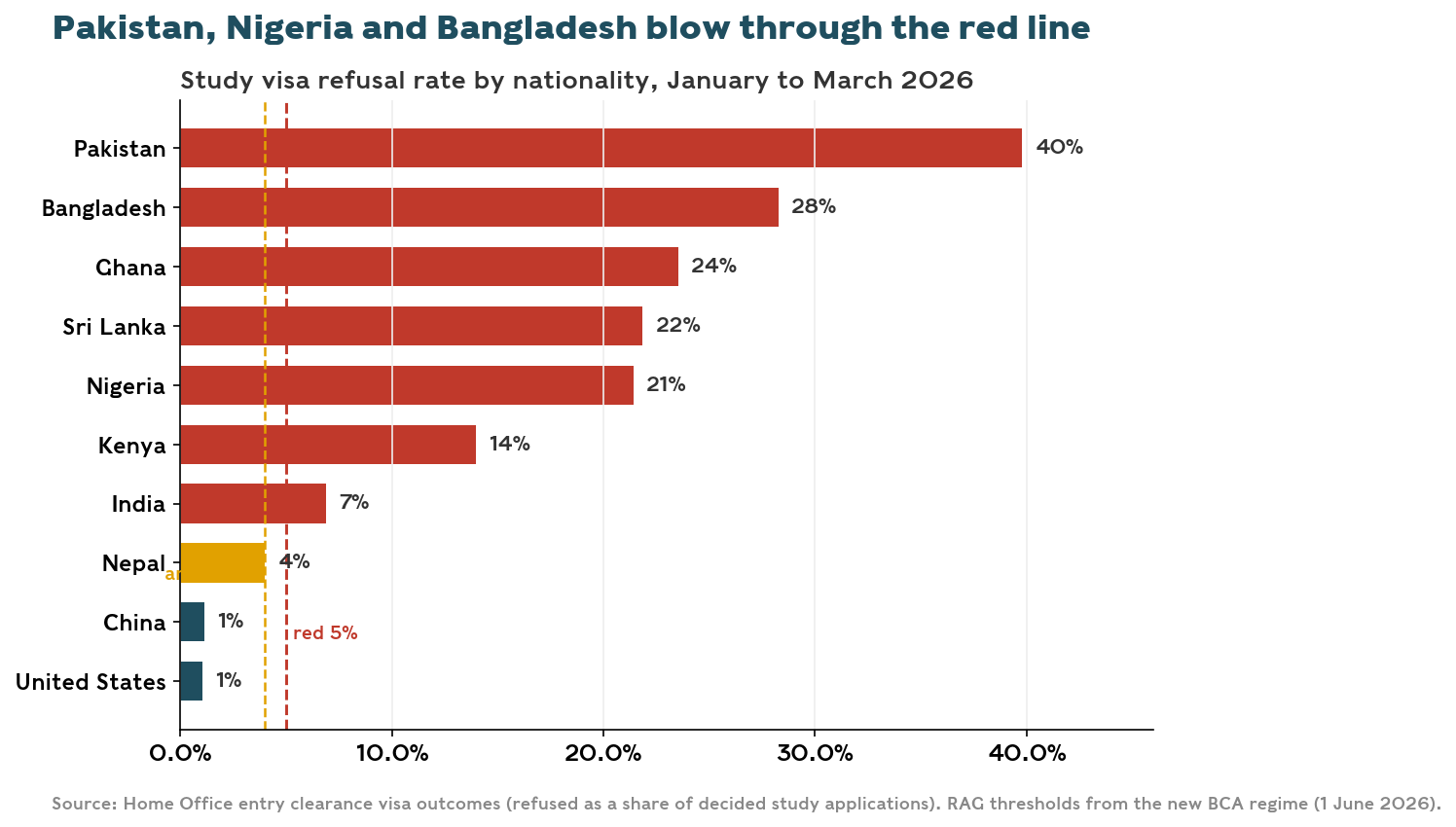
That last detail matters because of what arrives on 1 June 2026. The legacy Basic Compliance Assessment (BCA) is being replaced by a red-amber-green system in which a sponsor’s rating is set by its worst-performing metric. On refusals, green requires below four per cent, amber runs four per cent to just under five per cent, and red bites at five per cent or above – alongside a 95 per cent enrolment threshold and a course completion floor.
Of course, the BCA refusal rate is sponsor-specific – it is measured against an individual provider’s own CAS-linked applications, calculated the Home Office’s way, not against the national figures quoted above. The 13 per cent headline reported for the quarter and our own 5.8 per cent for 2025 also use different denominators – the former counts withdrawn and lapsed cases in the base, the latter is refusals as a share of decided applications. So the national and per-country rates here are best read as a guide to which markets carry compliance risk, not as a literal provider rating.
The point still holds, though – a national study refusal rate of 5.8 per cent in 2025, and per-market rates of 20 to 40 per cent in early 2026, mean any provider whose intake leans heavily on Pakistan, Nigeria, or Bangladesh is carrying a blended rate that could plausibly push it through the four per cent amber line, or the five per cent red one, on this metric alone, with the consequences that follow – a CAS allocation cut, loss of remote-delivery flexibility, a “final warning”.
This is the stealth in action. The Home Office does not have to say “stop recruiting from Pakistan”. It sets a threshold, and risk-averse institutions retreat from high-refusal markets pre-emptively to protect their rating, pausing recruitment, raising deposits, and bringing forward deadlines. The state designs the incentive, universities perform the cut, applicants in Lahore or Lagos never learn that a door closed, because formally it never did.
Choking the switch to work
The fourth lever is aimed at the behaviour described earlier – the switch from study into sponsored, skilled work – and again it is cumulative rather than announced.
From April 2024 the Skilled Worker salary floor jumped from £26,200 to £38,700, the care-worker route lost the right to bring dependants, and the salary-discount list was pared back.
From July 2025 the skill threshold returned to degree level (RQF 6), the salary floor rose again to £41,700, around 180 occupations were removed for new entrants, and the care route closed to overseas recruitment. The Graduate route is being cut from two years to 18 months for applications from January 2027. None of these individually is “the policy that ended student switching”. Together they are a programme designed to choke it.
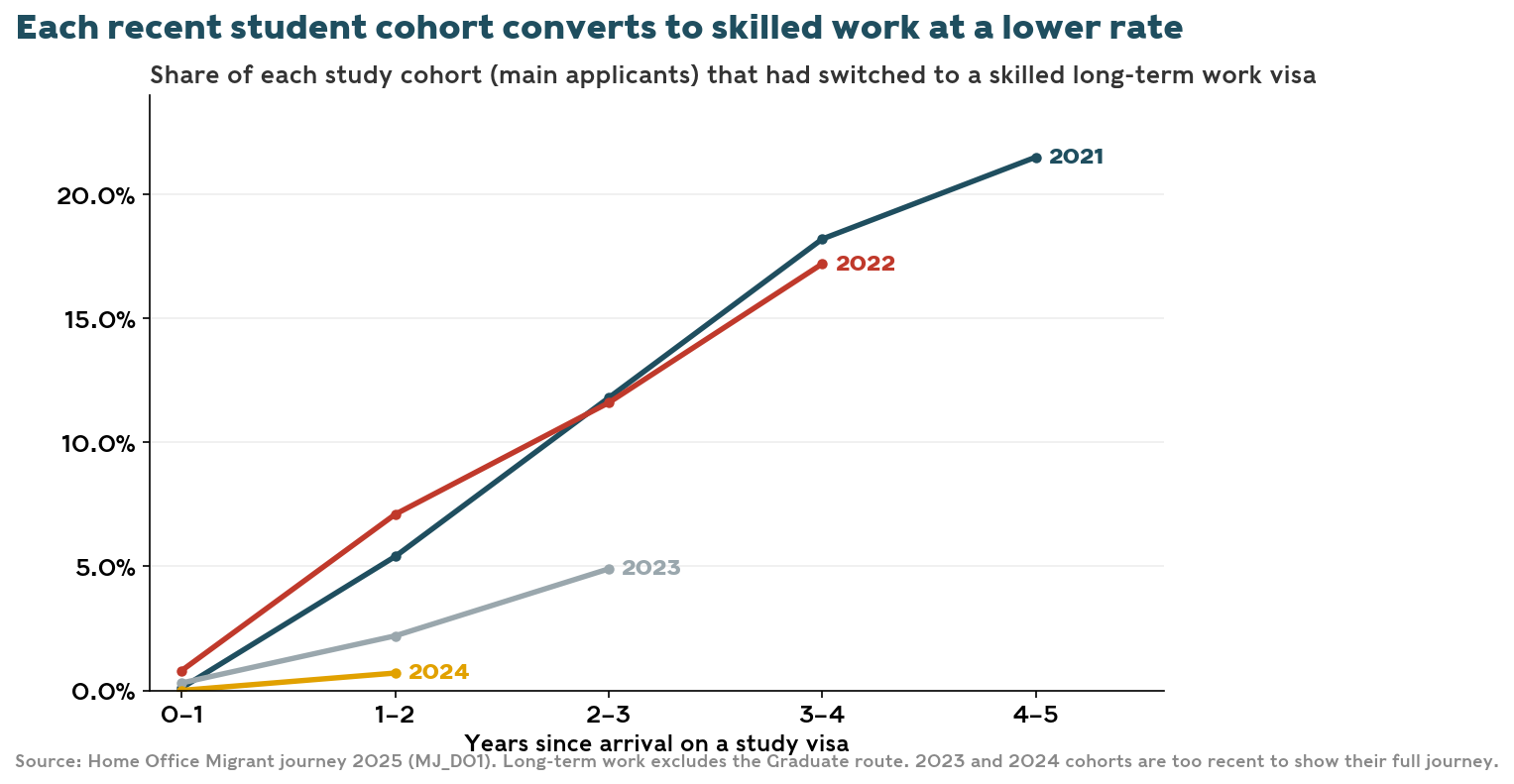
The Migrant Journey cohort data show conversion falling in that direction. Tracking each arrival year at the same point in its journey – the only fair comparison, since later cohorts have had less time – the share of student main applicants who had switched to a skilled long-term work visa, the Graduate route excluded, steps down with each recent cohort.
At one to two years in, the rate runs at around seven per cent for the 2022 cohort and five per cent for 2021, but falls to roughly two per cent for 2023 and under one per cent for 2024. At two to three years, 2021 and 2022 sit near 12 per cent while 2023 manages under five per cent. The 2023 cohort is converting at roughly a third of the earlier rate at the same stage.
Where this leaves the sector
Put the four mechanisms together and the shape of the bust is clear.
The arrival numbers have normalised, back roughly to 2022 and minus the dependants. The retention and switching data confirm that recent cohorts genuinely do stay and move into work far more than their predecessors, which is precisely why the levers were pulled.
And the contraction now underway is being delivered not through a single visible policy but through a delay nobody owns, withdrawals that never register as refusals, a compliance threshold that makes universities cut their own intake, and a salary-and-skills squeeze that quietly closes the route from study into skilled work.
The Home Office creates the delay, universities manage the compliance risk, and students bear the consequences. The boom was the sector’s own doing – it hit the international education strategy target years early, leaning on the post-study offer. The bust is being done to it stealthily, and the cleverness of the design is that no one has to fess up that it’s even happening.
Related articles

Student transition into university shouldn’t be a handover
Katharina De Vita | Comment | 13/10/26

Creating a space and a voice for widening participation professional practice
Tara Webster-Deakin | Comment | 13/10/26

During times of transformation emerging leaders need to be inside the leadership tent
Alistair Jarvis | Comment | 12/10/26