Beyond survival – five capabilities for higher education system leadership
Extraordinary times demand extraordinary leadership. Mohammad Ali, Millan Alvarez-Miranda Navarro and Ian Plover set out their framework
Comment|

Mohammad Ali is pro vice chancellor and dean in the Faculty of Business and Law at Anglia Ruskin University
Millan Alvarez-Miranda Navarro is Managing Partner at MAM Strategy and Leadership and Program Lead Coach at IMD Business School
Ian Plover is a leadership coach at Plover Consulting Limited and was previously deputy vice chancellor at Bucks New University
UK universities have entered a period of unprecedented volatility, and some may argue that they are moving towards a breaking point. Financial fragility is becoming the norm and is no longer restricted to a handful of institutions. Deficits are widespread, reserves are thinning, and the room for manoeuvre is shrinking.
The pressures facing the sector are structural. Fee caps, inflation, pension liabilities, volatile international markets, rising student expectations, digital disruption and the unfortunate political scepticism have permanently altered the operating model of universities. The old assumptions no longer hold. The long squeeze created by fee caps and inflation is now widely recognised in official and independent analysis, such as this House of Commons Library briefing on HE finances and funding in England.
The good news is that most universities don’t have a strategy problem. There is no shortage of ambition, talent or ideas. Here’s the uncomfortable truth: in this new world order, university leadership will struggle to build the institutional muscles required to deliver these repeatedly – at pace, through resistance, and without burning out staff or breaking trust.
Evolution of leadership towards systems thinking
A significant part of the solution is a fundamental redesign of how leadership is understood and enacted. Universities need leadership that can operate as a system – adaptive, distributed and capable of navigating complexity rather than simply managing it. This reframing shifts the central question from “Who is the leader?” to “What leadership capabilities are required for UK universities to remain legitimate, resilient and effective?”
Crucially, these capabilities must function as a system, not a checklist. Universities routinely over-invest in visible activities such as strategy development, new programme launches or digital transformation while under-investing in the conditions that allow change to stick: trust, governance, adoption, and cultural alignment. A systems view exposes these imbalances before they become failures.
This transition aligns with the MIT Leadership model, which emphasises that effective leadership is distributed and organisational rather than concentrated in a few individuals.
The MIT 4-CAP+ framework (Sensemaking, Relating, Visioning, Inventing, and Building Credibility) provides the foundational logic for this systemic approach.
In the UK university context, this systematic approach translates into five capabilities that leaders must be able to deliver consistently. It is important to treat them as a system, not a menu. These are not optional competencies – they are the institutional survival kit.
1. The commercial–academic hybrid
If your plan is “recruit more international students” or “increase research income,” you don’t have a plan; you have a gamble. Income and margins are not the same, and the sector’s overreliance on a narrow set of revenue streams has now become a structural vulnerability.
The commercial–academic hybrid capability is about converting academic strengths into sustainable, mission-aligned income with clear routes to market and full transparency in institutional financial models. This capability demands leaders who can operate confidently at the intersection of pedagogy, market demand and financial discipline without reducing education to a commodity or compromising academic integrity.
This capability also requires genuine entrepreneurial thinking, historically unfamiliar to much of the sector. Leaders must diversify portfolios across international partnerships, commercial research, professional education, apprenticeships, micro‑credentials, modular provision and employer co-design. They must also understand the financial sustainability of different delivery models, including online and hybrid formats, and be prepared to close or redesign programmes that no longer serve students or the institution.
This is where data-driven decision making at speed becomes essential. Without real‑time visibility into recruitment pipelines, programme-level margins and research performance, leaders are flying blind. The commercial–academic hybrid is impossible without the institutional data maturity to support it.
Tell-tale sign you don’t have it: You cannot clearly explain which programmes subsidise which – or how long that cross-subsidy remains viable.
2. The government and industry collaborator
Another sacred cow must also be toppled: the era of the ivory tower university. We need to transform into vibrant and dynamic regional nerve centres. Institutions still acting as if their primary focus is inward-looking academic excellence are misunderstanding the current moment.
Universities must now function as dynamic regional nerve centres, deeply embedded in their civic, economic and industrial ecosystems. The government and industry collaborator builds durable, reciprocal relationships where industry shapes curricula and co‑designs skills pathways; government sees delivery against policy priorities; the university becomes an anchor institution for place‑based growth.
Beyond individual partnerships, this capability requires system stewardship. Inter‑university alliances – whether around shared provision, digital services, research infrastructure or workforce development — will be essential for sector‑wide resilience. The era of universities acting solely in institutional self‑interest is over.
This is also where political and stakeholder navigation becomes a core leadership capability. Universities have become political pawns in part because they have been too passive in explaining their value. Public legitimacy can no longer be assumed; it must be continuously earned through transparency, responsiveness and demonstrable contribution to national and regional priorities.
At the same time, leaders must understand the digital transformation reshaping industry and government. Partnerships increasingly depend on the university’s ability to deliver flexible, technology‑enabled provision, share data responsibly, and collaborate on innovation at pace. Leaders who cannot speak the language of digital change – or who underestimate the cultural transformation required – will struggle to build the partnerships the future demands.
Tell-tale sign you don’t have it: You lack a single “front door” for employers and government, and partners are bounced around internal silos.
3. The purpose-led governance strategist
Governance must stop being either theatre (endless papers) or brake (no decisions). As scrutiny intensifies, governance has become one of the most critical – and consistently weakest – elements of university leadership.
The purpose-led governance strategist aligns mission, strategy and risk appetite into a coherent system of oversight that sharpens decisions rather than diluting them. This capability requires leaders to treat governance not just as a bureaucratic requirement, but as a strategic enabler – a mechanism that accelerates clarity, accountability and action.
The Office for Students is explicit about the risk landscape: real-terms erosion of UK undergraduate income, inflationary pressure on operating and capital costs, and over-reliance on international fees. These are not background conditions; they are governance realities.
Purpose-led governance translates mission into accountable outcomes through evidence-based oversight, transparent reporting and disciplined action closure. It integrates assurance across performance, risk, compliance, data quality and audit, allowing boards and executives to focus on what truly matters rather than drowning in noise.
Emerging risks – from financial fragility and reputational exposure to AI governance and cyber security – cannot be treated as technical side issues. They are leadership challenges. Institutions that fail to develop this capability will find themselves paralysed precisely when decisive action is most needed.
This is where data maturity and cultural leadership become inseparable from governance. Without real‑time insight and organisational trust, governance becomes guesswork.
Tell-tale sign you don’t have it: The board receives lots of information, but few decisions actually stick.
4. The digital and physical infrastructure architect
Too many universities “buy” transformation. They procure systems and then hope adoption happens by osmosis. It won’t. Universities have invested heavily in digital platforms and estates, yet too many see limited return because leadership attention stops at procurement.
This digital and physical infrastructure architect capability is adoption-first: digital and estates designed around pedagogy, research and student outcomes, delivered by cross-functional teams. The leadership focus must shift from buying technology to changing practice. That means prioritising training, cultural change, workflow redesign and benefits realisation rather than symbolic implementation.
AI illustrates the challenge starkly. Its potential will only be realised where institutions invest equally in AI literacy, governance and cultural readiness. The same applies to estates: fit-for-purpose spaces must be actively translated into new ways of learning, working and collaborating. Buildings do not transform pedagogy; people do.
Cross-functional delivery models – bringing together academics, professional services, IT, estates and students – are essential. Without them, digital and physical transformation becomes fragmented, slow and misaligned with academic needs. This capability also intersects directly with workforce transformation. New delivery models require new skills, new roles and new expectations. Leaders must be able to retrain staff, redesign processes and support teams through the discomfort of change.
Tell-tale sign you don’t have it: You measure project delivery (on time/on budget) but not changed practice (usage, capability, outcomes).
5. The values-led transformational leader
This is not “soft”; it is the operating system. Trust determines whether strategies are believed, whether governance is respected, whether partnerships deepen, and whether staff will carry change. It functions both as an input to, and an outcome of, effective leadership.
The values-led transformational leader puts credibility at the centre of leadership, doing what they say they will do, distributing leadership and ensuring visible alignment between values, decisions, resources and behaviours, especially under stress. This capability is critical in the current environment of high sensitivity and volatility, where the “myth of the omniscient leader” must be replaced by distributed leadership models that empower teams and build institutional resilience.
This capability is about lived alignment between purpose, decisions, resources and behaviours, experienced consistently by staff, students, governors and partners. It creates environments characterised by clarity, psychological safety and accountability, rather than fear, fatigue and cynicism. Leadership narrative becomes a strategic asset. Credibility is built not through slogans but through consistency between what institutions say and what they do, particularly under pressure.
This is also where cultural leadership becomes the hardest capability of all. Universities with centuries‑old traditions, decentralised faculties and consensus‑driven governance structures were not designed for rapid change. Leaders must be able to build trust, align incentives, and sustain momentum in the face of resistance.
Tell-tale sign you don’t have it: Staff either don’t know the values, or they may hear the values but experience contradictions.
Leadership as a system, not a list
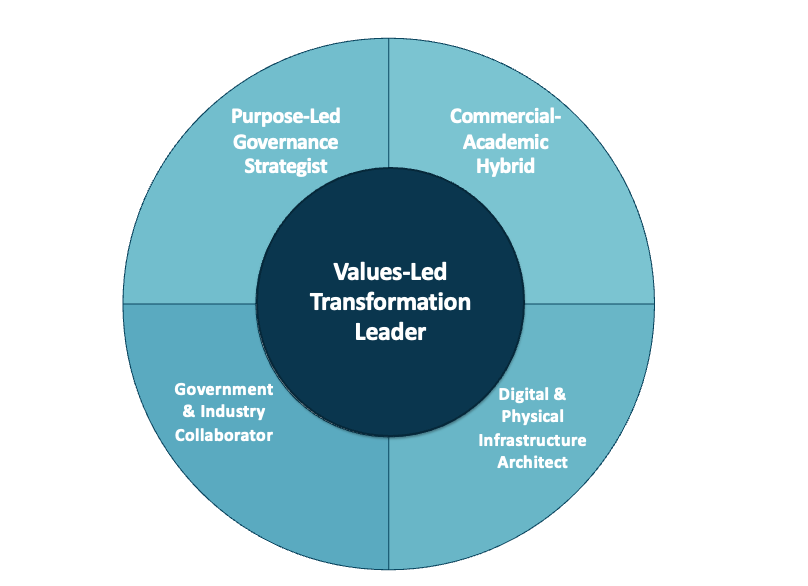
These five capabilities are interdependent. Strength in one cannot compensate for weakness in another. Over-investment in strategy, digital transformation or commercial growth will fail without corresponding strength in governance, trust and adoption.
A systems view of leadership shifts the focus from executing isolated initiatives to designing the conditions that allow change to take hold. It enables leaders to diagnose imbalance, anticipate failure points and address root causes rather than symptoms.
Strategies don’t fail on PowerPoint, they fail in the gaps between these capabilities:
- Commercial moves without values destroy legitimacy
- Partnerships without governance create unmanaged risk
- Digital investment without adoption wastes capital
- Governance without credibility produces compliance, not commitment
The next step is for leaders and governing bodies to assess their own institutional strengths and gaps with honesty, to prioritise capability-building with the same seriousness as strategy development, and to invest in the cultural conditions that will allow change to take root. If universities can do this, they will not only weather the present turbulence but also emerge with a leadership system fit for the decade ahead.
By way of a diagnostic test, senior leaders and governing bodies should ask themselves:
- Can we clearly explain how our academic strengths translate into sustainable income?
- Do government and industry experience us as a coherent partner or a fragmented organisation?
- Does our governance accelerate or slow down strategic action?
- Are our digital and estates investments genuinely adopted or merely implemented?
- Do staff and students trust our leadership enough to follow it through disruption?
If the answer to any of these is unclear, the issue is not effort; it is capability.
Universities do not lack talent, ambition, ideas or commitment. What they lack is a leadership system capable of converting purpose into sustained performance in a hostile environment.
By fostering these five capabilities – the commercial-academic hybrid, the government and industry collaborator, the purpose‑led governance strategist, the digital and physical infrastructure architect, and the values‑led transformational leader – university leaders can navigate the current crisis, restore the sector’s credibility, and reassert its vital role as an engine of national renewal.
Ultimately this framework is offered not as a critique of current leadership, but as a constructive pathway for renewal. The sector has the talent, the purpose and the collective will to adapt. What is needed now is a shared commitment to building these capabilities deliberately and systemically.
Related articles

Boards can’t predict the future, but they can make sure their institution is ready for it
Debbie McVitty | Comment | 19/10/26

What counts as a graduate outcome when the labour market is changing?
Angel Tan | Comment | 16/10/26

Widening participation isn’t finished while background still predicts destination
Hannah Rolley | Comment | 16/10/26