China is reinventing itself as a study destination, and the UK must take note
The old international recruitment paradigm thought about China in terms of how many students it would send abroad. Leina Shi explains its increasing focus on attracting international talent – and why the UK needs to pay attention
Analysis|
Leina Shi is Director of Education for the British Council in China
The past couple of months have been busy for all of those working on UK higher education engagement in China. But they have also brought an unusual degree of clarity.
A cluster of official data releases, sector events and conversations all seem to point in the same direction. The familiar story of China as one of the world’s largest exporters of students still matters, of course – yet it is no longer the whole story. What is becoming harder to ignore is China’s growing confidence in the other direction: as a country that wants not only to send talent out, but also to attract it in.
That shift matters because it changes the frame. For years, most international discussion treated China primarily as a source market. Universities in the UK, the US, Australia and elsewhere asked broadly the same question: how do we recruit more Chinese students? That question remains important, but it is no longer sufficient. China is now better understood as several things at once: a major sending country, an increasingly purposeful study destination, a research partner, a soft-power actor, and in some areas a growing competitor for global academic attention.
The Ministry of Education of China’s data release on 11 April sharpened that point. It was the first official publication since 2020 of China’s outbound study numbers, showing that 570,600 Chinese students went abroad in 2025, whilst 535,600 returned from overseas study. That is still a very large outward flow by any standard. But it is also materially below the 2019 peak of just over 700,000. The simplest reading, then, is not “recovery” in the old sense. It is a market that has resumed movement, but on different terms.
China’s outbound study market expanded rapidly from 2008 to 2019, then reset sharply during the pandemic period. The recovery since then has been real, but incomplete. This chart makes the longer arc visible, showing outbound study numbers by year, in tens of thousands:
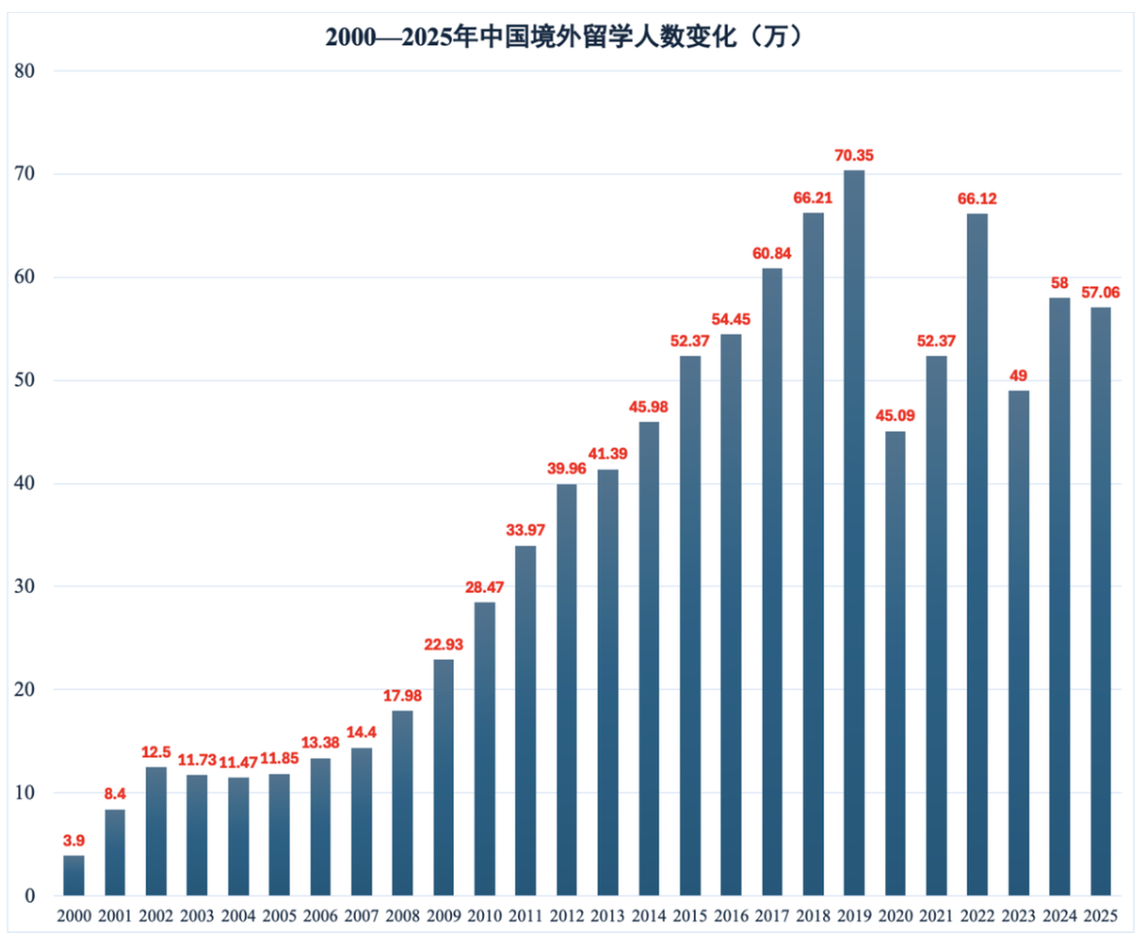
China’s outbound market did not vanish after Covid, nor has it returned to the assumptions that shaped much of the past decade. Demand has become more selective, more segmented and more contested. Students and parents are asking harder questions about value, employability, safety, policy stability, and return on investment. That feels less like a temporary pause than a structural adjustment. The market is still vast, but it is no longer one that any destination can take for granted.
That mood was reflected clearly at the QS China Summit in Shenzhen in April. What struck me there was not only the familiar emphasis on reputation and rankings, but the way those themes were connected to a much broader agenda. The 2026 summit theme – “Connected Cities, Collaborative Campuses” – brought together discussions of skills, employability, institutional performance, quality, research, technology and the future of student mobility in and out of China. Internationalisation was not being treated as a side project. It was being treated as part of how universities build position, influence and long-term competitiveness.
One of the most revealing visuals at the summit was a slide on future source-country trends for students coming to China:
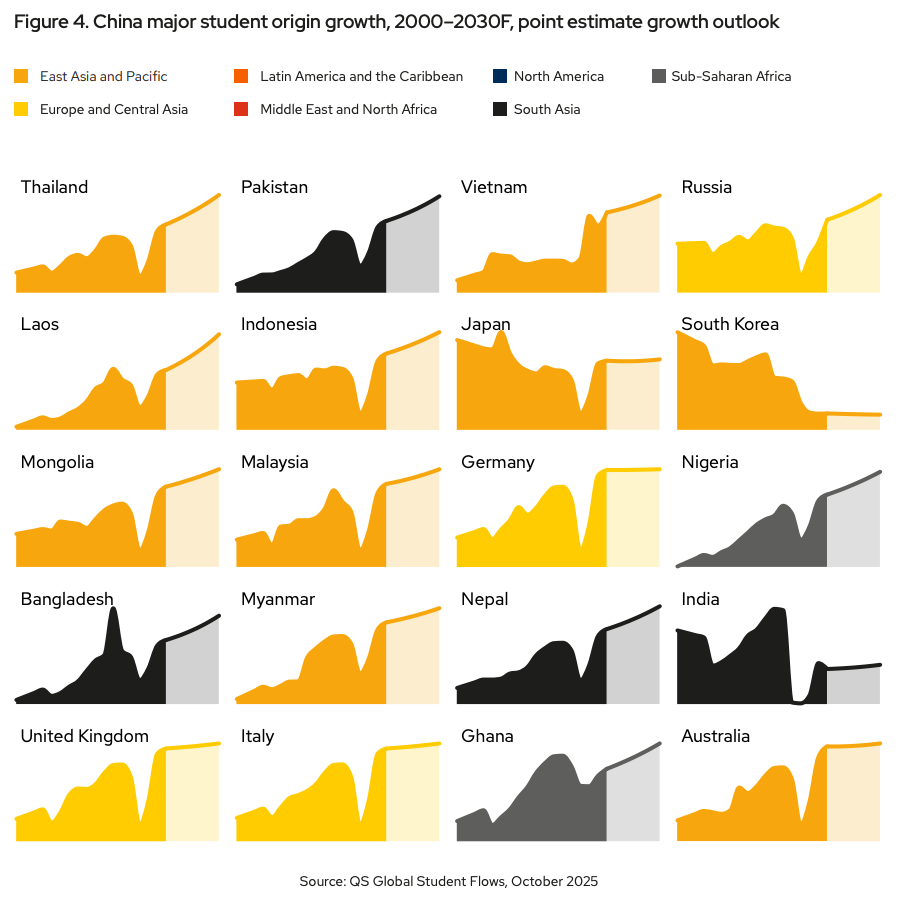
What stood out in that graphic was where the momentum appears to be coming from. The strongest projected growth was not from the traditional Western markets that have long dominated global mobility narratives. It pointed instead toward East, South and Southeast Asia, with additional growth from parts of Africa and the wider Global South. That matters because it suggests China’s inbound internationalisation may not simply mirror the Anglo-American model. It may be built first through regional connectivity, neighbouring systems and wider South-to-South linkages. In other words, China’s rise as a study destination may follow its own geography and logic.
A similar message came through in Beijing at the China Study Abroad Forum, organised by the Chinese Service Centre for Scholarly Exchange (CSCSE), a public organisation under China’s Ministry of Education that supports international education services and exchange. Its programme included a themed session titled “Study in China, Connect the World,” which in itself said a great deal about the direction of travel. This was not simply a conference about managing outbound demand. It was also a statement about China’s desire to strengthen its attractiveness as a destination.
The numbers released around the forum reinforced that message. China reported around 380,000 international students from 191 countries and regions in the 2024–25 academic year. Of those, around 205,000 were degree seeking; postgraduates accounted for about 35 per cent of the degree cohort, engineering was the largest field at 27.8 per cent, and the regional mix was led by Asia at 61.1 per cent, followed by Africa at 16.2 per cent, Europe at 15.6 per cent, and the Americas and Oceania combined at 7.1 per cent. This does not look like a purely volume-driven recovery story. It looks more like an inbound strategy tied to talent, research capability, industry alignment and international positioning.
From technology powerhouse to study destination
Seen in that wider context, the movement from technology powerhouse to study destination does not feel cosmetic. It is part of a broader national trajectory. Over the past a few decades, China’s global weight has often been explained through manufacturing scale, infrastructure, research intensity and technological advance. Higher education now sits more visibly within that same story. A country that wants to compete for talent, extend influence and strengthen its innovation ecosystem does not rely on industrial capability alone. It also builds universities, reputations, academic networks and student pathways that draw people in.
For the UK, this has several implications. The first is that China remains immensely important, but the basis of engagement is changing. The UK continues to hold strong advantages in academic quality, institutional diversity and global reputation. Those strengths still matter. Yet the old assumption of automatic growth is weaker than before. Home Office data show that Chinese nationals were granted 89,019 sponsored study visas in the year ending December 2025, accounting for 22 per cent of all such visas – but this was 15 per cent lower than the previous year. China remains a top-tier market for the UK, but it is a more competitive and more demanding one than it was even a few years ago.
The second implication is that headline totals alone do not tell us enough. In a recent HESA based breakdown shared with me, the most interesting shift was not simply overall volume, but composition: the China cohort in the UK appears to be changing by gender, level and subject in ways that deserve closer attention.
For example, while overall China‑domiciled enrolments in the UK are only modestly below pre‑Covid levels, the cohort is becoming less female‑dominated due to a sustained decline in female participation, particularly at undergraduate and taught postgraduate level. This shift appears broad‑based across subjects and likely reflects a combination of heightened risk and safety perceptions, changing cost-benefit evaluations, and a longer‑term rebalancing of destination preferences following the post‑Covid shift away from the US, which has historically attracted a more male‑skewed share of Chinese outbound students.
This all suggests a market whose internal shape is moving, not just its size. The more useful questions now are about which students are still choosing the UK, for what kinds of programmes, and under what perceptions of value, risk and future opportunity. That is a very different strategic conversation from the older, simpler understanding of “Chinese student demand.”
There is also a point here about outward mobility from the UK side. If China is becoming more significant as a place to study, research and collaborate, then building UK students’ knowledge of China becomes more, not less, important. This is not only about recruitment. It is about literacy, familiarity and long-term capability.
A shift in significance
What I have taken from the past few weeks is not a sense that China is retreating from international education. Quite the opposite. The stronger impression is of a country entering a new phase: still a major sender of students, but more intentional about attracting them too; still deeply connected to global academic exchange, but more interested in shaping the terms of that exchange.
For the UK, that means China can no longer be read simply as a recruitment pipeline. It is, at the same time, a partner, a destination, a competitor, and a test of whether we are reading the next chapter of international higher education with enough nuance.
For a long time, the outside world looked at China and saw outbound demand in education. China now seems to be looking at itself rather differently: as a place that can host talent, build reputation, deepen academic influence and connect higher education more directly to national ambition. That is a significant shift. The task for the UK is not merely to note, but to respond at pace with realism, reciprocity and a better understanding of what the relationship now requires.
Related articles

Whose universities are they anyway?
Jim Dickinson | Analysis | 4/09/26
We say we value diverse research, but can we assess it?
Ola Thomson | Analysis | 27/08/26

Accommodation matters, for foundation year students too
Wendy Ashall | Analysis | 26/08/26

Going deeper: Student loans, public expenditure and the devolution funding gap
Jim Dickinson | Analysis | 25/08/26