The origins of the May Day festival stretch far back into time.
Although it has Roman (Floralia) and Celtic (Beltane) origins, according to the National Trust its popularity in the UK started more recently (the NT use the useful word medieval, which might mean anything from 400CE to 1500 CE; I’m guessing it’s the 1300s). By the Victoria era, it was very popular, with May Queens, maypole dancing, and other festivities. And as this blog will be published on May Day, let’s look at how this went down in one teacher training college.
And so we’re off to South West London, and Whitelands College, which is now part of the University of Roehampton. I’ll do a proper post one day on Roehampton and its constituent colleges; but for context Whitelands was founded in 1841 as a training college for women teachers, by the National Society. (You’ll recall, perhaps, that we came across this society when looking at Marjon. My guess is that Whitelands was the counterpart for women of St Mark’s College, a training college for men founded by the National Society also in 1841.)
Anyway, all that is for another time. For now, it suffices to know that in the late 1870s the principal of Whitelands was Reverend John Pincher Faunthorpe, who was a friend of John Ruskin, noted Victorian polymath. Faunthorpe supported Ruskin’s work (for example, proofreading his books), and in 1881 Ruskin inaugurated an annual May Day ceremony at the College.
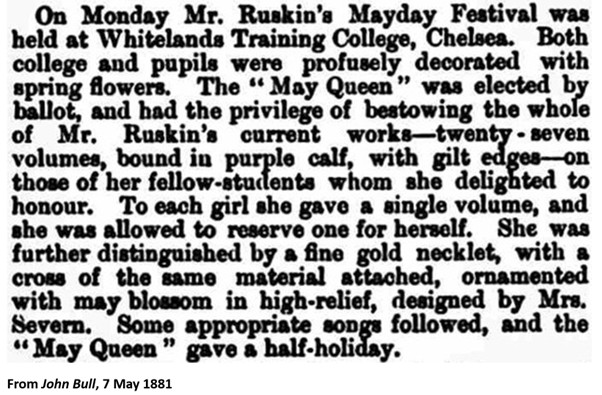
This brief story from John Bull sets the scene:
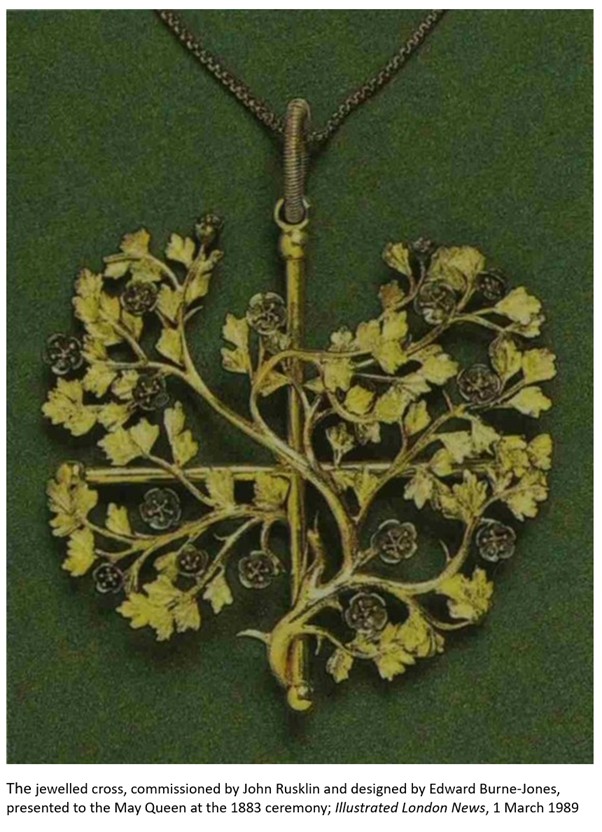
From the Illustrated London News we also have this picture of the rather splendid gold cross given to the 1893 May Queen:
The ceremony, and the idea of it, clearly had caught the Victorian imagination. Here’s a piece from The Sketch on 7 May 1893, describing that year’s festivities:
MR. RUSKIN’S CELEBRATION OF MAY DAY. For several years– twelve, we fancy– Mr. Ruskin has generously repeated his gift to Whitelands College on May Day, and this year’s festival was celebrated with all the brightness imaginable. Early in the morning the students assembled in their dim yet luminous chapel dedicated to St. Ursula, where a brief musical service and a special prayer on behalf of the master is offered up, after which a procession of the students all in cream-white dresses, with large sleeves tied in with ribbons of either pale orange or heliotrope, and sashes of the same colour was led by the queen of last year, who, attended by her maids and in her royal robe of white and green, and wearing the royal gold cross, went slowly round the grounds, making a very charming picture. Eventually, all assembled in an upper hail, daintily decorated with festoons of ivy, with chains of cowslip-blossoms and other wild flowers. Her Majesty was pleased to abdicate the throne, and taking instead of an apple-blossom crown one of forget-me-nots, the silent request, so gracefully accomplished, was answered affectionately by all her late subjects. While the new queen is being elected there is much going on to entertain and interest all. Songs are sung, recitations given, a stately minuet is danced about the May-pole, and a May-pole dance, with all its variations, is performed. Then there is the Principal’s address to listen to, which was both brilliant and animated, as usual. But soon the elected queen is ready, and her maidens having been chosen, a procession is formed anew. Before her are carried white wands tied with flowers, behind her, on a cushion, the floral cross of gold, and then follow maidens carrying a set of Mr. Ruskin’ s works bound in his own Oxford binding of blue calf. On entering the hall once more all do homage to the Queen of May, a second May-pole dance is gone through, and her Majesty presents Mr. Ruskin’s books to some forty of her young subjects.
The ceremony continues today, although updates to reflect changing entry profiles (it is now the May Monarch, as there have been kings as well as queens) and changing expectations from students. Here’s a piece from the Roehampton website giving a little bit more about May Day at Whitelands. Here’s another piece telling us about the early May Queens. And here’s a rather fabulous page with images of some of the May Queens’ (and Kings’) costumes over the years.
As always, I’ve made a jigsaw of the postcard to distract you. The card was sent on 3 June or July 1904, to Miss Blanchard in Lancaster.
Lohengrin – in the original German just now. Imagine me ‘the nonmusical’ listen to a German opera of which I did not even know the plot. It was very painful
The front has written on it a good motto: “Never express a wish for a thing – always get it before another gets the chance.”