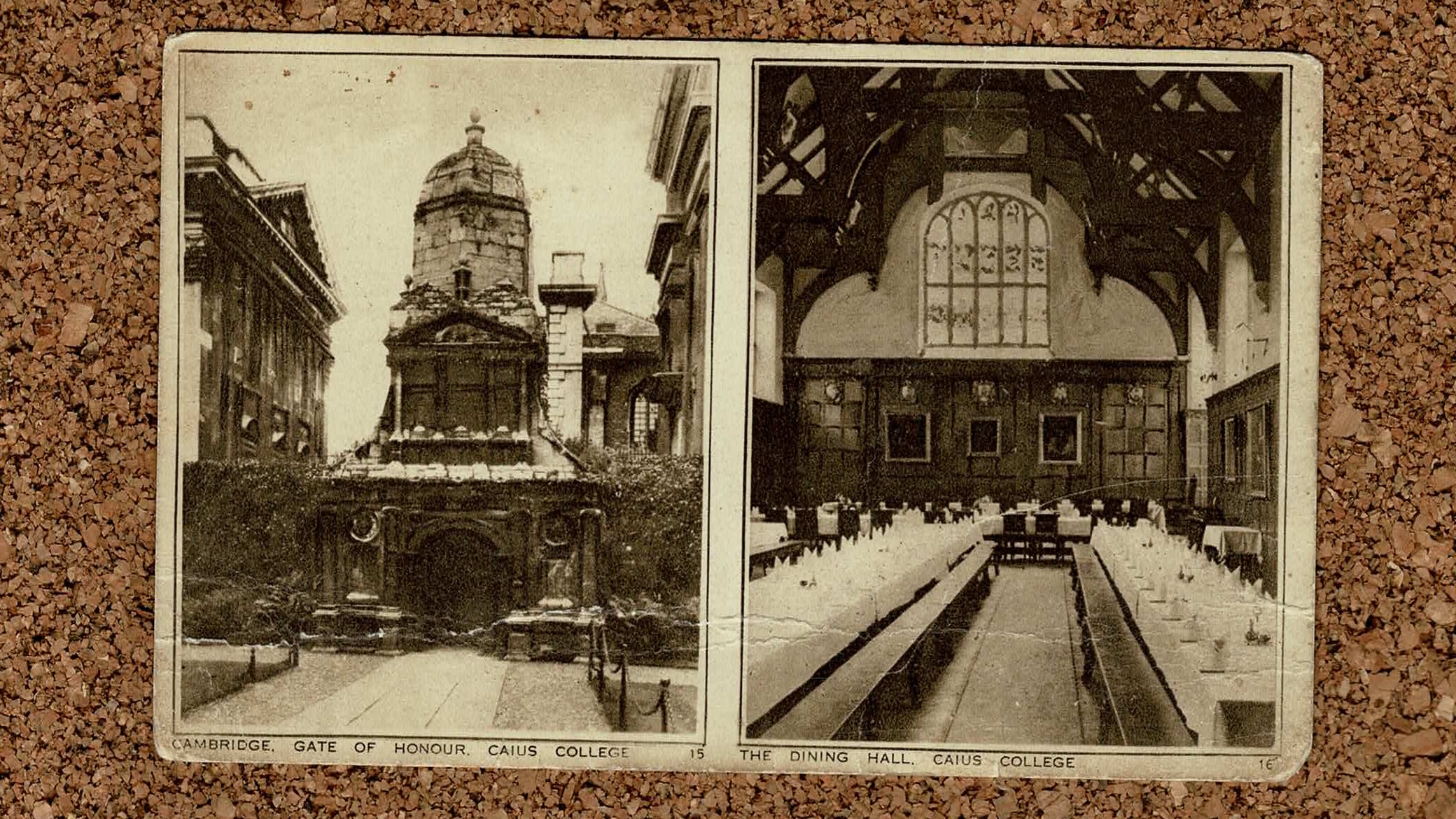


OK, so we’re in Cambridge today, and let’s get one thing clear right from the start. “Caius” is pronounced “keys”. So there’s no need to feel embarrassed if you didn’t know how to say it, because you do now.
And secondly, Caius is only part of its name: it is properly (like when it’s being told off by its mum) Gonville and Caius College.
Now we’ve got those things out of the way, let’s begin. And we begin in the 1300s, with Edmund Gonville. He was a priest, serving as rector in three different parishes in East Anglia (Thelnetham, Rushford and Terrington St Clement, successively, if you want to know). This – and maybe acting as a landlord’s agent – put him in a position to lend money to the king, Edward III. And in return he was appointed a king’s clerk, which in modern money might be something like a secretary of state. But this was in the 1300s when things were very different.
(Incidentally, one of the great things about writing these short articles is that I learn a lot about medieval times. I’m indebted to The History of Gonville & Caius College, Cambridge, written by the late Professor Christopher Brooke. The book enlightened me on a lot of detail about Gonville and Caius College. And it has also helped me understand that, in the fourteenth century, a college sat on a continuum with abbeys, monasteries, chapter houses, chantries and the like, all providing some mix of civil and religious services, and sometimes a bit of education too. You can download an e-book of Professor Brooke’s work here.)
Anyway, back to our main topic. In 1348 Gonville petitioned the king to let him establish a college at Cambridge, and so Gonville Hall was born, supporting twenty scholars. Gonville himself died fairly soon afterwards in 1351, when the college was only partially established, but the work was continued by William Bateman, Bishop of Norwich. Bateman was the executor of Gonville’s will and also, himself, the founder of Trinity Hall. There was some swapping of property with Corpus Christi College and finally Gonville Hall was established with statutes. It was funded, in part, by the tithes of three parishes in the diocese of Norwich, and its graduates were broadly to serve that diocese.
Fast forward a couple of hundred years, and Gonville Hall was not doing well. Whilst it was founded for 20 scholars, the tithes actually paid only for 5 or 6 only, leaving a shortfall. (This may have some current resonance.) And then, enter stage left, John Kays. Kays was an alumnus of Gonville Hall, and after his time there studied medicine at Padua, where he graduated. This was his making: he became a celebrated doctor, writing a very influential treatise on the sweating sickness (which we now know as influenza) and becoming physician to King Edward VI, Queen Mary, and Queen Elizabeth I. He was also president of the Royal College of Physicians.
In 1557 he made substantial gifts to Gonville Hall – estates from which an income could be derived, and cash gifts to build – and gained a Royal Charter, re-founding it as Gonville and Caius College. Caius was the latinized version of his surname, which was the fashion at the time.
(Let’s add here another aside. Contemporaneous with John Caius, but not related to him, was another Caius – Thomas Caius, Registrar of the University of Oxford from 1535 to 1552, and Master of University College Oxford from 1561 to 1572. The Oxford Caius published a book – An Assertion of the Antiquity of Oxford University – which repeated the claim that King Alfred had founded University College Oxford. This was prompted by a visit by Queen Elizabeth I to the University of Cambridge, where she was treated to speeches about that university’s antiquity. And is in 1568 John Caius – the Cambridge one – wrote a rebuttal, On the Antiquity of the University of Cambridge, in which he argued that the University of Cambridge had been founded in 375 BC. A sixteenth century rap battle, and equally full of hot air.)
Caius was also master of the college from 1559 to 1573. He continued to give considerable sums to the college, and also oversaw the introduction of new statues, which included duties to pray; a duty of celibacy on the fellows, and a provision on admission which would not meet today’s expectations: no-one shall be elected master, fellow or scholar who “is deformed, dumb, blind, lame, maimed, mutilated, a Welshman, or suffering from any grave or contagious illness, or an invalid, that is sick in a serious measure”. You will be relieved to hear that this provision no longer holds.
We should also remember that the transition from Queen Mary to Queen Elizabeth was not without religious bloodshed and strife. In 1570 Caius was suspected of harbouring Catholic sympathies, which were very suspect under the newly excommunicated Queen Elizabeth. In December of that year the vice chancellor of the university raided Caius’s quarters, removed suspect items (which had been itemised by disgruntled fellows) and burned them.
There is a lot more college history to cover, but I’m not going to do so here. I recommend Christopher Brooke’s work, which I linked to above. For now, lets jump ahead to today. The college now has one of Cambridge’s largest undergraduate populations, with almost 600 students. It is associated with many notable names, including fifteen Nobel laureates and, perhaps even more impressively, William Harvey, discoverer of the circulation of blood in the human body.
Here’s a free online jigsaw of the postcard. The card hasn’t been posted but I would guess that it dates from the 1910s–1920s.






Unlike my former employer (Cardiff University) Caius (my old college) has remained true to the spirit of academic endeavour and the pursuit of excellence. It remains a community of scholars, scientists and students dedicated to the discernment of truth from falsehood, a truth that is to be pursued with moral vigour and intellectual seriousness. In recent years it has re- affirmed its commitment to academic freedom (especially notable in the writings of the late David Abulafia).
Cardiff University by contrast has comprehensively betrayed the academic principles of its founder, Viriamu Jones. Its leaders are in the process of eviscerating the humanities. It has replaced the spirit of academic endeavour and academic freedom with a bureaucratic culture of pharisaic philistinism and sanctimonious spite.