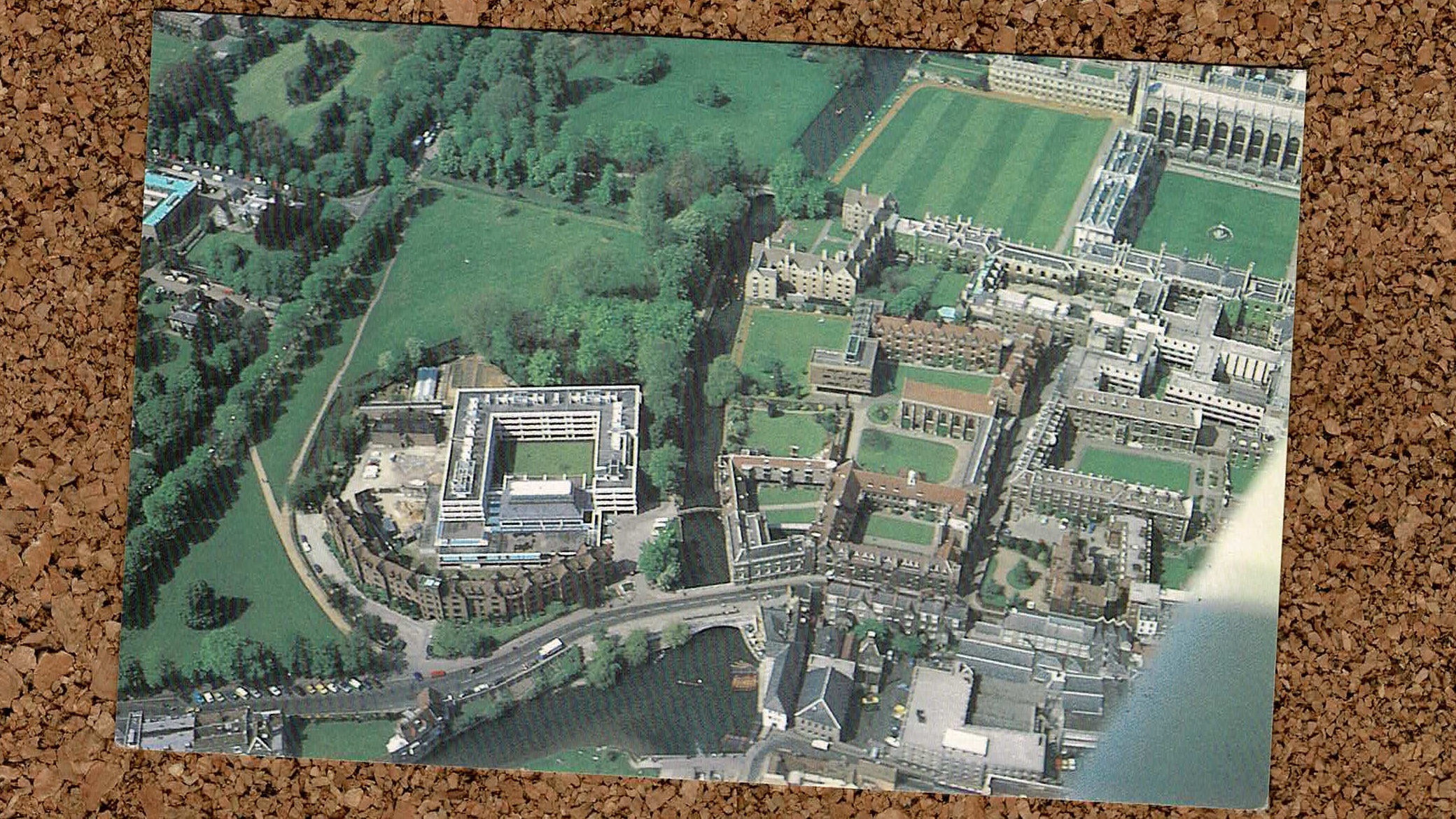


Greetings from Cambridge!
One of the delights of telling the stories of our universities is that I get to learn a lot of incidental history on the way. And when the postcard is of an Oxbridge college, that history often means going back a long way. And so it is with Queens’ College Cambridge, which is shown in today’s postcard.
The history in this case is the shenanigans relating to the late fifteenth century and the Wars of the Roses. A man called Andrew Dokett, about whom little is reliably known, was vicar of St Botolph’s in Cambridge and owned a hostel – St Bernard’s Hostel – providing accommodation for university students. He wanted to upgrade the hostel to become a college and in 1446 gained a charter from the King, Henry VI, for the foundation of St Bernard’s College. (In this case the college was named for Bernard of Clairvaux, bigwig in the Cistercian order of monks. And not, disappointingly, for the dog breed, which is named for a different Bernard.)
A year later – 1447 – St Bernard’s College acquired a better plot of land (on which the current college stands) and gained a second charter from the King. And then in 1448 – yes, the very next year – a queen gets involved. In this case, Margaret of Anjou, who was married to Henry VI.
The thing to bear in mind is that this would not have been a calm and settled state. Henry and Margaret were both young and inexperienced; there were undoubtedly powerful nobles who were seeking to better their fortunes. And in this context founding a college would help with a broader question of legitimacy. And, handily, St Bernard’s College was still quite new, so once more had to surrender its charter so that a new one could be awarded. This time the college was re-founded as The Queen’s College of St Margaret and St Bernard. The King provided some funds and work on building a college could begin. (Dokett, by the way, was not thrown out: he was and remained the first president of the renamed college.)
And then there was regime change, with a bit of civil war thrown in. In 1461 Henry VI (Lancaster) was deposed, Edward IV (York) became king. In 1464 he married Elizabeth Woodville; Elizabeth was crowned queen in 1465. And also in 1465 Edward issued a license to the college enabling it to own limited assets. In the deed executing this license he described the college as existing “by the patronage of Elizabeth, Queen of England, our beloved consort.”
And that made two queens Margaret and Elizabeth. The Queen’s College now became the Queens’ College.
Many colleges would have called it a day at that point, but not this one. So let’s fast forward just a teensy bit, to 1483. Edward IV, having been unkinged briefly in 1470 and then re-kinged after the battles of Barnet and Tewkesbury in 1471, had died. After his death, his marriage to Elizabeth had been declared bigamous, meaning that their children were ineligible to succeed to the throne. (These children, Edward and Richard, were sent to the Tower of London and never seen again.)
Instead the crown passed to Richard III, who was married to Anne Neville. And in 1484 he issued a similar license at that issued by Edward IV in the name of Elizabeth, but this time increasing the amount of assets the college could own. And again the deed granting this license was described as being “out of special consideration for Anne, Queen of England, our beloved consort” and to a college “which exists by the foundation and patronage of our aforesaid consort.”
(The college, by the way, has a very thorough account of its history, from which I have drawn much of the above. You can see it here, and I recommend that you read it, but only when you have time. It is detailed.)
Anyway, this makes three queens. You’d think that perhaps a double apostrophe might be needed for such royalty, but as we’re not greengrocers here we won’t go down that route. Instead we will again defer to the investigation by the College of its apostrophisation. Its full and Sunday best name is: The Queen’s College of St Margaret and St Bernard, commonly called Queens’ College, in the University of Cambridge.
(The other infamous apostrophe in higher education belongs to the institution which now styles itself as Goldsmiths, University of London. Its proper and Sunday-best name is Goldsmiths’ College, the apostrophe indicating that it is the college of the Goldsmiths, being The Goldsmiths’ Company of the City of London. And I have written about it for Wonkhe previously.)
Anyway, back to Queens’ College. Notable events included the college sending its silver to King Charles I during the 1642-1651 civil war, an act which resulted in the college president and fellows being thrown out of office, until 1660 and the restoration of the monarchy, when they were readmitted.
There’s some pretty famous names associated with the College. Erasmus studied there; St John Fisher was president. Tin Tut, who negotiated independence from the British empire for Myanmar (then known as Burma), was a student. We also have Richard Dearlove, chief of MI6, and Stephen Lander, Director General of MI5.
Also at the College is the famous Mathematical Bridge. Which I will leave for another day, as it is a popular Cambridge sight and I have several postcards which show it.
Here’s a jigsaw of the postcard. This was sent to “David,” c/o an infant school in Luton. It may be related to this world record attempt described in the LA Times. I have a few postcards sent to “David” so if anyone can shed better light on this I would be very grateful!