Higher education postcard: Marjon
This week’s card from Hugh Jones’ postbag takes us to Plymouth, via Chelsea, Battersea and a hovercraft
Comment|
Hugh Jones is a freelance HE consultant. You’ll find a daily #HigherEducationPostcard if you follow him on Bluesky
The Victorians were many things, some bad, some better. And amongst the better was their zeal for reforming education. Today we’re going to look at two strands of this, and the institution that resulted.
But we need to start with another aspect of nineteenth-century British society – religious sectarianism. We’ve seen elsewhere about how this drove higher education – for example, in the rival establishments of UCL and KCL, and in the establishment of Keble College, Oxford. It was also present in school education with two rival organisations: the National Society for Promoting the Education of the Poor in the Principles of the Established Church in England and Wales, founded in 1811, and the British and Foreign School Society for the Education of the Labouring and Manufacturing Classes of Society of Every Religious Persuasion founded in 1814. (And can we just for a moment reflect on the absolute magnificence of the sorts of names given to organisations in the nineteenth century.)
Both the National Society and the British and Foreign Schools Society, as they became known, promoted models of education and, in due course, teacher training. We’ll come back to this later on; first we need to look at another name.
Marjon is – you perhaps won’t be surprised to learn – not the formal name of the institution in question. If you look at the OfS register you’ll find the University of St Mark & St John, and this is the clue. It arose from two separate colleges, St Mark’s College in Chelsea and St John’s College in Battersea. And Marjon came from an amalgamation of the saints’ names. But more of this later!
(Also note that it isn’t mah-jong, either the traditional rummy-type game or the tile-matching game which is popular online. I do rather hope that there is a Marjon mah-jong club. If there isn’t, perhaps this post can inspire its establishment?)
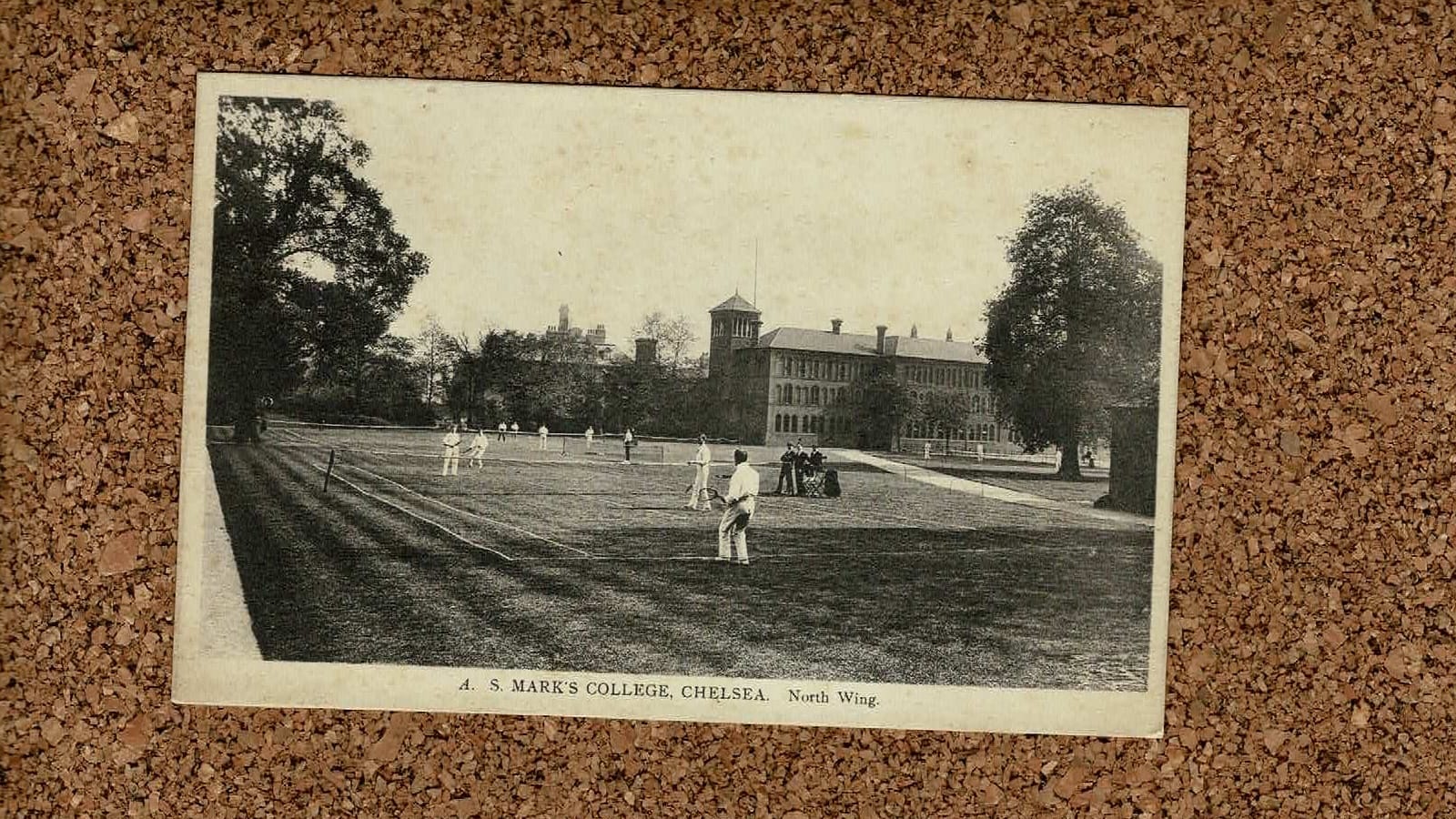
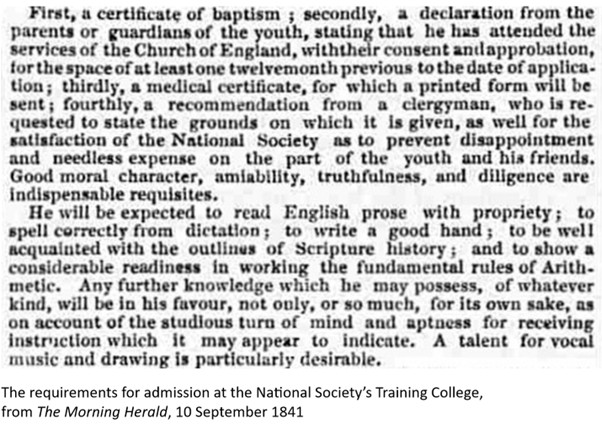
1841 the National Society opened its doors in Chelsea to a new training college for young men. By 1843 this had become known as St Mark’s College. The admission requirements – as can be seen from this notice in 1841, before the first students were admitted – were godliness, health, character, reading, writing and arithmetic. Bonus marks for singing and drawing.
The principal of the college was the wonderfully-named Derwent Coleridge, Anglican minister, scholar, educationalist and, incidentally, son of the poet Samuel Taylor Coleridge. (My guess is that the name Derwent came from Coleridge’s friendship with William Wordsworth, and, no doubt, time spent in the Lake District together.) The site on which the college was built is just south of Chelsea’s football ground, and looks like it is very posh flats now. Part of the surrounding greenery is called Derwent Square, remembering its past use.
Meanwhile, south of the river, another teacher training college was being set up in Battersea. This was the brainchild of Sir James Kay-Shuttleworth. Kay-Shuttleworth was a doctor and a social reformer, and can reasonably be considered a foundational figure in English education. He was the first secretary of the government committee which funded public education, and in this role established Her Majesty’s Inspectorate, the forerunner of today’s Ofsted.
(Fun fact: he was born James Kay; his hyphenated surname came when he married Janet Shuttleworth and they both adopted the surname Kay-Shuttleworth.)
In 1840, alongside his friend Edward Carleton Tufnell, Kay-Shuttleworth founded the Normal School, Battersea. (We’ve come across Normal Colleges before, in the case of Normal College, Bangor.) This was a radical move. It was the first teacher training college in England, and its methods were subject to much derision. See, for example, this from the West Kent Guardian of 18 September 1841:
Speaking, last week, of the great Workhouse experiment which Doctor Kay is carrying on in the schools of Greenwich Hospital, it was collaterally observed that “the Doctor has an amateur training school for masters at Battersea, where they are alternately engaged in digging at the roots of numbers and the roots of potatoes.”
This, we find, has been received by many persons as a mere joke but we assure our readers there is no joke in the matter; as we shall presently show, by reference to the Doctor’s own printed statements, and to the pernicious mode of management he is introducing into the Greenwich Schools.
His plan of action with the teachers who have the misfortune to be under his control, is based upon a principle, picked up in some corner of Germany, that as humility should be one of the primary virtues with instructors of youth, there can be no better mode of exhibiting it than in combining with the duties of their office the most menial employments, and the most familiar and unrestricted intercourse with their pupils.
By the latter mode of procedure, according to the Doctor’s theory, the school becomes a family, and the teacher a supplementary parent; and by the former, the pupils are prepared to bear, with greater fortitude, any low condition of life in which they may hereafter be placed, by their recollection of the humility and cheerfulness with which the supernumerary father, provided for them by Doctor Kay, submitted to the most degrading offices.
This principle, in education, appears to be just about as wise as if the Doctor were to recommend the entire body of the profession of which he was formerly so distinguished member, to get one of their legs cut off, order to convince those of their patients who may have occasion to submit to amputation, that the loss of a limb is a mere trifle.
Contextually, we need to remember that this is Victorian culture wars stuff: a Whig government had just been replaced by a Tory government; there were real political battles about the amount of change which was needed in the country. Education which empowered the children of the working classes and which demonstrated a different way to conceive of authority was right on the dividing line between the two ways of looking at the world.
By 1842 the school was being known as an Industrial Training School. At first it was jointly funded by Kay-Shuttleworth and Tufnell, but it seems that a government grant of £1,000 was also provided by 1843. That year also saw the school transfer to the National Society. By 1850 it was known as St John’s College, Battersea: my guess is that this renaming took place soon after the National Society took responsibility, but I can’t substantiate this.
In 1923 the two colleges merged to form the College of St Mark and St John; it seems that the colleges moved to Chelsea (where new buildings were erected by 1927) and had a new principal. (There’s perhaps a lesson here for the current situation: does a merged university benefit from a new leader without ties to either of the existing institutions?)
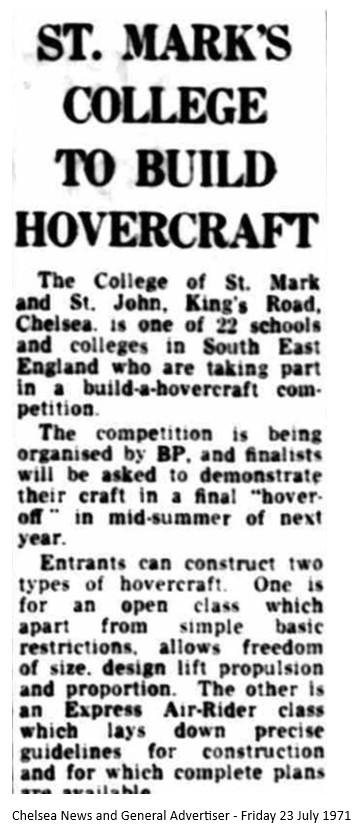
Life at the college continued for the next fifty years, with the usual sports teams, dances and, it seem, participation in a build-a-hovercraft competition. Sadly I have not been able to find out who won.
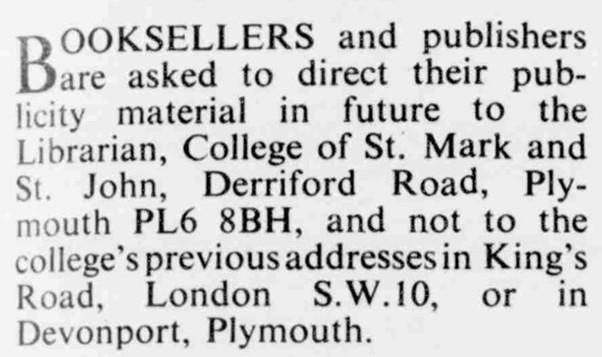
In 1971 the Greater London Council compulsorily purchased the college’s grounds, for building the planned inner ring road for London. The current West Cross route, an elevated road from the Westway to Holland Park, was to have carried on to Battersea, and the college stood in the way. (As a footnote, the planned road was never built.) A move was necessary, and Plymouth was the destination. The Bookseller of September 15 1973 carried the following notice. What human drama must have been hidden behind such a workaday announcement!
The college moved to a new campus on the outskirts of Plymouth. Over the years it has expanded its provision, and now offers a wide range of subjects. In 1991 – in anticipation of the closure of the Council for National Academic Awards, the former degree awarding body for polytechnics and colleges – the college became affiliated to the University of Exeter. In 2007 it became a university college and in 2013 became the University of St Mark and St John, also known as Plymouth Marjon University.
Alumni include Bob Brunning, bassist for Fleetwood Mac; Olympian rower Helen Glover; coach and commentator Ron Pickering; and Joy Carroll Wallis, inspiration for the Vicar of Dibley.
Here’s a jigsaw of the card. The card itself hasn’t been posted, but I guess dates from the first decade of the last century.
Comments · 1
New comments will come back with sign-in later this year.
gil fewings · 9 Mar 2026
This is really great – thank you for featuring us! You should really come and see the rest of our postcard collection – the ones with the messages home are a fascinating insight into the student experience first-hand. As for the pieces of the story you couldn’t verify – maybe our archive collections can help fill in the blanks?
Related articles

Boards can’t predict the future, but they can make sure their institution is ready for it
Debbie McVitty | Comment | 19/10/26

What counts as a graduate outcome when the labour market is changing?
Angel Tan | Comment | 16/10/26

Widening participation isn’t finished while background still predicts destination
Hannah Rolley | Comment | 16/10/26

Higher education postcard: The Warburg Institute
Hugh Jones | Comment | 16/10/26

If not university then what?
David Kernohan | Comment | 15/10/26

John Healey’s drive for a resilient economy could further squeeze universities
James Coe | Comment | 15/10/26