Students who lead and serve other students have better outcomes
We used to think that students spending time taking part in extracurricular activities were not spending enough time studying. Mike Kerrigan and Laura Guiver have contrary evidence
This article is more than 4 years old
Analysis|

Laura Guiver
Laura Guiver is Monitoring and Evaluation Data Assistant at Nottingham Trent University
Previously we looked at whether there was a link between student participation in sport and their academic success, finding that participants in sport at our university had, on average, better student outcomes in comparison to the wider student population.
We also know from research the importance that extracurricular activities within universities and SUs have when it comes to students’ wellbeing and course and career confidence.
So is there also a link between SU extracurricular activities and student success, similar to what we saw amongst sports participants? We carried out some analysis to find out.
Extracurricular activities at NTU
There are three overarching types of extracurricular activities students can be a part of at Nottingham Trent Students’ Union. These are:
- Academic reps – Students who collect feedback from other students and speak on their behalf to improve the university academic experience
- Society members – Students who are members of one or more of the many societies run through NTSU (here they are split into 5 sub-categories: academic & vocational; common interest; cultural faith, media creative and political campaigns).
- Society committee members (elected student leaders of societies)
First, we looked at the (Uk domiciled) students who get involved in SU extracurricular activities and there were some interesting findings as shown in the graph below.
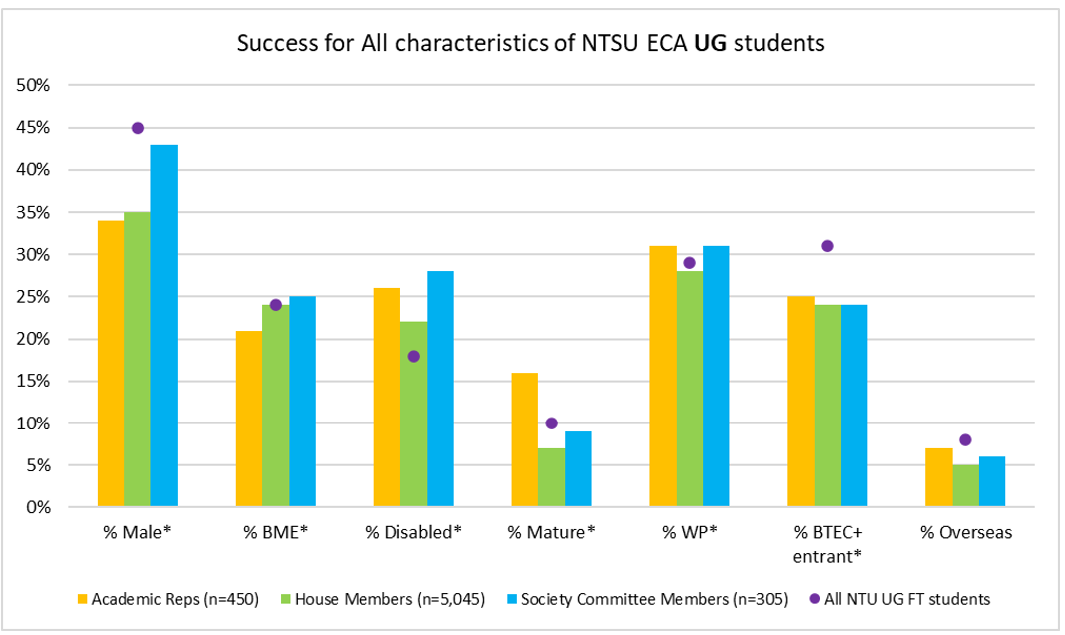
Disabled students were over-represented within extracurricular activities compared to the underlying student population. This is an encouraging finding considering previous analysis has found that 78 per cent of disabled students involved in extracurricular activities are more confident about completing their degree, compared to 66 per cent not involved.
Conversely, students who completed either a BTEC or a mixture of A-levels and BTEC (BTEC+ entrants) prior to starting university were considerably under-represented compared to the NTU population.Research has found that students who study BTECs prior to starting university are less likely to complete their undergraduate degree programme compared to those students who study other qualifications and are also less likely to achieve Firsts and 2:1s.
Furthermore, it’s been found that students not involved in extracurricular activities are twice as likely to not feel confident about their degree. Therefore, more work should be done to encourage such student groups underrepresented in extracurricular activities to take part.
Success of NTSU extracurricular activity students
From our analysis we found that all three extracurricular activity types had, on average, more students receiving grade based assessment (GBA) scores equivalent to a 2:1 or First (across all year groups), compared to the average for all NTU students.
Academic reps had the highest GBA scores, with 77% receiving the equivalent of a 2:1 or First, followed by society committee members with 64%. Society members had higher grade based assessment scores at 58% compared to the NTU average of 56% but they were significantly lower than the other two.
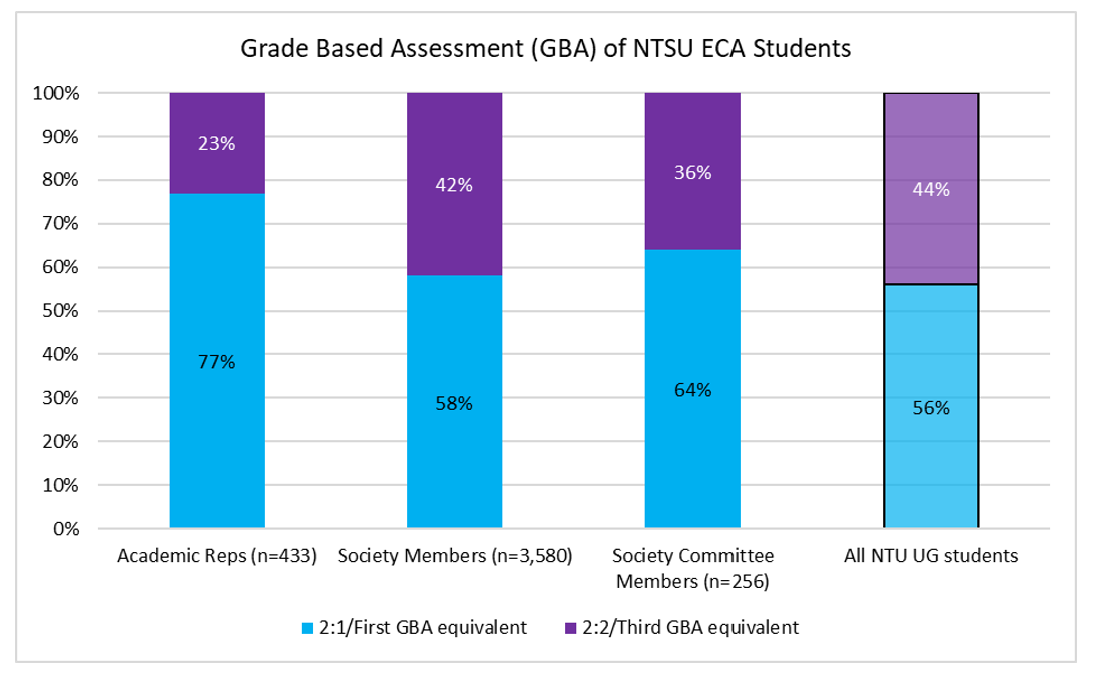
These findings were confirmed by statistical testing when controlling for a range of demographic and academic factors. This means that the enhanced grade based assessment scores of participants of NTSUs extracurricular activities, could not be explained by participants’ pre-entry qualifications, subject areas, or demographic characteristics.
What’s going on?
So why is it that students who take part in SU-led extracurricular activities are more likely to achieve higher grades compared to the wider NTU population? Well, we don’t know for sure based on the evidence at our disposal, but previous literature can help to give us some ideas.
Students who are academic reps have nominated themselves to help improve the academic university experience. It could be argued that these students are already passionate about their degree and doing well and therefore probably work very hard already.
Analysis done at Nottingham Trent University found that students with high levels of engagement according to our learning analytics platform have a higher chance of achieving a better degree outcome than those with lower engagement scores. So there could be some selection bias at play here.
However, the society committee members are the elected leaders of societies and additional research has found that being in a leadership position can improve academic performance in both the short and long term.
Furthermore, our statistical evidence demonstrated that the considerably larger group of society members performed better in their assessments than the underlying student population, thus refuting the (outdated) zero-sum framework, which suggests students spend too much time taking part in extracurricular activities and are therefore not spending enough time studying.
Whilst this may be true for a few students, our work would suggest that student engagement with extracurricular pursuits has clear benefits. Ours is one of many studies that have been conducted looking at extracurricular activity at student outcomes and the consistent finding is that taking part has a positive impact on academic performance.
As always, correlation does not mean causation and, in the absence of a causal research methodology (a “Type 3” standard of evidence according to the OfS framework) we cannot say for certain that participation in SU driven extra-curricular pursuits directly caused the improved student outcomes.
However, our evidence supports the view that extracurricular activities should be considered a crucial part of the university experience - and work should be done to ensure all student groups are given equal opportunity to take part.
Related articles

Whose universities are they anyway?
Jim Dickinson | Analysis | 4/09/26
We say we value diverse research, but can we assess it?
Ola Thomson | Analysis | 27/08/26

Accommodation matters, for foundation year students too
Wendy Ashall | Analysis | 26/08/26

Going deeper: Student loans, public expenditure and the devolution funding gap
Jim Dickinson | Analysis | 25/08/26