The case against the student campaign to boycott the NSS
Boycotting the NSS will not stop the TEF, but it might make it worse and give failing departments a place to hide, argues Andrew McRae.
This article is more than 9 years old
Comment|
Andrew McRae is Dean of Postgraduate Research at the University of Exeter and was formerly Head of the English Department.
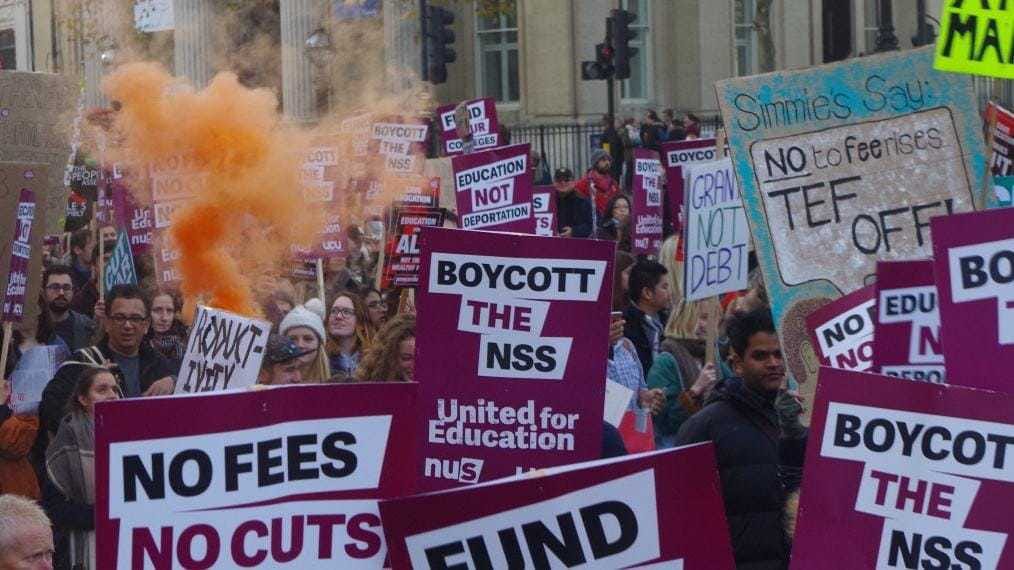
The National Union of Students call for a boycott of the 2017 National Student Survey is finding support on many campuses across the UK. The argument goes that once the NSS is used as a metric to inform the Teaching Excellence Framework (TEF) – as is now happening – it becomes implicated in the commercialisation of education. Hence by boycotting the NSS, students might undermine the TEF and derail the connected fee rises.
As a long-time lover of the NSS, I share the frustration that it should be monetised by TEF in such a crass manner. Yet the boycott is based on wonky (not Wonkhe!) logic, and will only hurt those that NUS represents. Students, please, don’t boycott the NSS.
When ‘fee rises’ aren’t fee rises
TEF, according to NUS, is a vehicle designed to increase fees. But really it’s the opposite: TEF is designed to suppress fees. Inflation means that the £9000 that a student was paying four years ago is not the same as £9000 today. Hence the government’s decision in 2010 that £9000 was a fair price for 2012 entrants leads logically – or should have done – to a principle of rises in line with inflation. Did anyone seriously believe that £9000 would remain the maximum price indefinitely?
The only reason we are where we are, in fact, is that the government in 2010 neglected to future-proof the system. That was stupid, but it was also politics. Today’s political fix is not a rise, nor indeed is it a commitment to maintaining funding levels in real terms. In fact, because only some institutions will be allowed to increase their fees in line with inflation, it’s a commitment to reducing net funding for universities. Going forward, those that receive ‘silver’ or ‘bronze’ ratings in the TEF will experience real-terms cuts since their students will pay less, in real terms, than those of previous years. Students and staff alike really should be angry about this assault on universities’ financial health.
Some people will argue that £9000 was not a fair price in the first place. Others see the TEF as a kind of stalking-horse, that will open the door to more fundamental deregulation of fees. Yes, very many of us regret the state’s withdrawal of public funds for higher education. But the fact remains that, given where we are and the system in which we’re working, what look like fee rises are really nothing of the sort.
Students can’t break the TEF; they can only make it worse
I don’t much like the TEF. I think it’s unnecessary because standards are already high, because it’s an instance of government fussing about stuff it doesn’t much understand, and because the infantile ‘gold’, ‘silver’ and ‘bronze’ tags will make us all look ridiculous. I also rather suspect it might collapse, or at least metamorphose into something quite different, under the weight of its contradictions.
But a boycott of the NSS will only make the TEF worse. Participation rates may drop in response to the NUS campaign, but not enough to trouble anyone at a senior level. TEF Chair Chris Husbands has already signalled the direction of travel by stating that panels will “not be overweighting the NSS”. Just about all the TEF data is already wobbly one way or another; this is a low-expectation environment. The data will also be less valuable, because some of the most politically engaged students will withhold their opinions. But probably the only people who will notice the difference will be those of us at department level who really, deeply care about the NSS because we profoundly value our students’ opinions. A boycott will hurt us, but the TEF will roll on regardless.
What’s so smart about saying nothing?
Plenty of people have argued that the TEF is not really assessing teaching quality at all. That’s fair enough at a theoretical level, and we can all see that satisfaction and graduate outcomes are not precise measures of teaching quality. But it’s nonetheless ridiculous to argue – as does NUS – that the NSS does not “have anything to do with teaching quality”.
In actual fact the NSS is a pretty good proxy for measuring quality. Moreover it has been the greatest agent of educational reform that I have known. Poor NSS results can be a catalyst for major reforms within academic departments, and even within those department getting quite good results, the NSS helps academics to rethink aspects of how we work.
I could give countless examples, but here are a few. The NSS has put contact hours firmly on the agenda across the sector. Ditto schedules for the return of feedback on assignments, and equally the form and quality of feedback. Now, thanks to the new questions on student engagement, we’re all thinking about the culture and communities within which our students are learning.
Of course universities use good NSS results for promotional purposes. But why does this become, for NUS, such a terrible thing? Good NSS results are the result of hard, successful work. There are still departments out there getting crap results, and boycotting the NSS will only give them an excuse to hide for another year.
So please, please let’s not boycott the NSS. There’s plenty to be angry about TEF, but I can’t believe we’ve reached a point at which saying nothing makes political sense. In fact this campaign feels to me like an insult to students who have waited for three years to have their say. I think those students are smarter than NUS’s campaign.
This article is republished from Andrew McRae’s Head of Department blog.
Related articles

Inside the overnight row over EU fees
Jim Dickinson | Comment | 22/11/26

The Milburn review’s proposals on apprenticeships miss the bigger economic picture
Mandy Crawford-Lee | Comment | 22/11/26
Franchised HE is getting bigger, owners are getting richer, and more students are dropping out
Jim Dickinson | Comment | 20/11/26

In the final REF guidance, the devil is not in the detail
Karen Stroobants | Comment | 20/11/26

As TNE grows, the UK needs a broader definition of international education
Francesca Woodward | Comment | 20/11/26

Higher education postcard: The Shakespeare Institute
Hugh Jones | Comment | 20/11/26