


As my colleague David Kernohan notes elsewhere on the site, the five universities that took the government to court over the weekend delivery issue have lost – comprehensively.
The judgment fills in a back story that has so far only been guessed at. But on its own, it also leaves other mysteries – who these students were, at which lead and delivery partners – that we’ve now been able to resolve this week via the magic of FOI.
Meanwhile, you may have seen that on Friday 7th August, The Times splashed with “Fraud alert over loans to foreign students.”

The story was a summary of some FOI work from shadow policy minister Neil O’Brien, who’s found out that in the past year “foreign” students – mainly those from the EU with settled status – received about £4 billion in tuition fees and maintenance loans, with one in 20 of all first-time student loans going to Romanians alone.
You’ll be familiar with the slipstream. The FT reports that the Global Banking School is now the UK’s “biggest university”. The Times reports that 60 per cent of students on franchised courses “lack qualifications”. Rupert Lowe put down a written question on the nationality of student loan recipients in March, and the Telegraph ran “Romanians claim record student loans in widespread fraud”.
Each of those stories has bits of something real, but they’re rarely joined up with any of the others. Which is where the weekend cohort turns out to be useful. Because those students had been flagged inside the Student Loans Company’s (SLC) systems for a change of circumstance and blocked-payment exercise, they exist as a countable population rather than an estimate.
A note on what follows – nothing in the data I’ve obtained establishes fraud, dishonesty or wrongdoing by any student, university, lead provider or delivery partner, and I’m not making allegations about any organisation named in this piece. What the data does is describe a population, and a set of commercial relationships, that in my view warrant public scrutiny.
So I asked SLC for the details of who the weekend delivery 22k were enrolled with, who they were studying with, and who they were. And after many months, we now have a response.
You’ll never guess
The SLC identifies 21,380 students in its response, and age band information was available for 21,375 of them – 385 students were under 21 and 1,620 were aged 21 to 24, while 3,410 were in their late twenties, 8,655 were in their thirties, 5,240 in their forties and 2,065 aged 50 or over. That means 19,370 students, or 90.6 per cent of those with a recorded age band, were 25 or above, and 15,960, or 74.7 per cent, were at least 30.
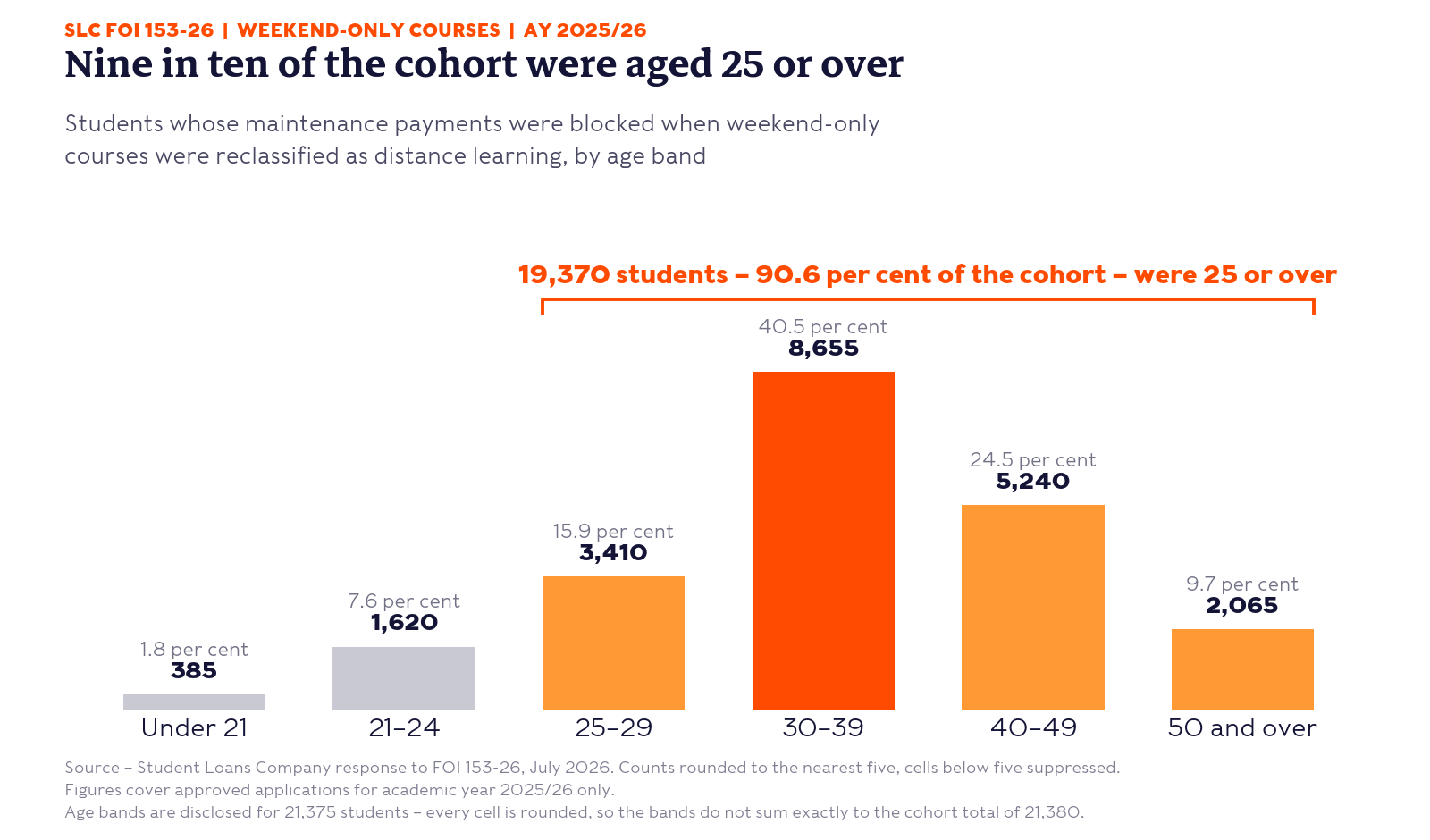
This was (and still is) a market in working adults with jobs, mortgages and children, which is the population that flexible provision is supposed to serve and the population with the most to lose when the funding stops mid-year.
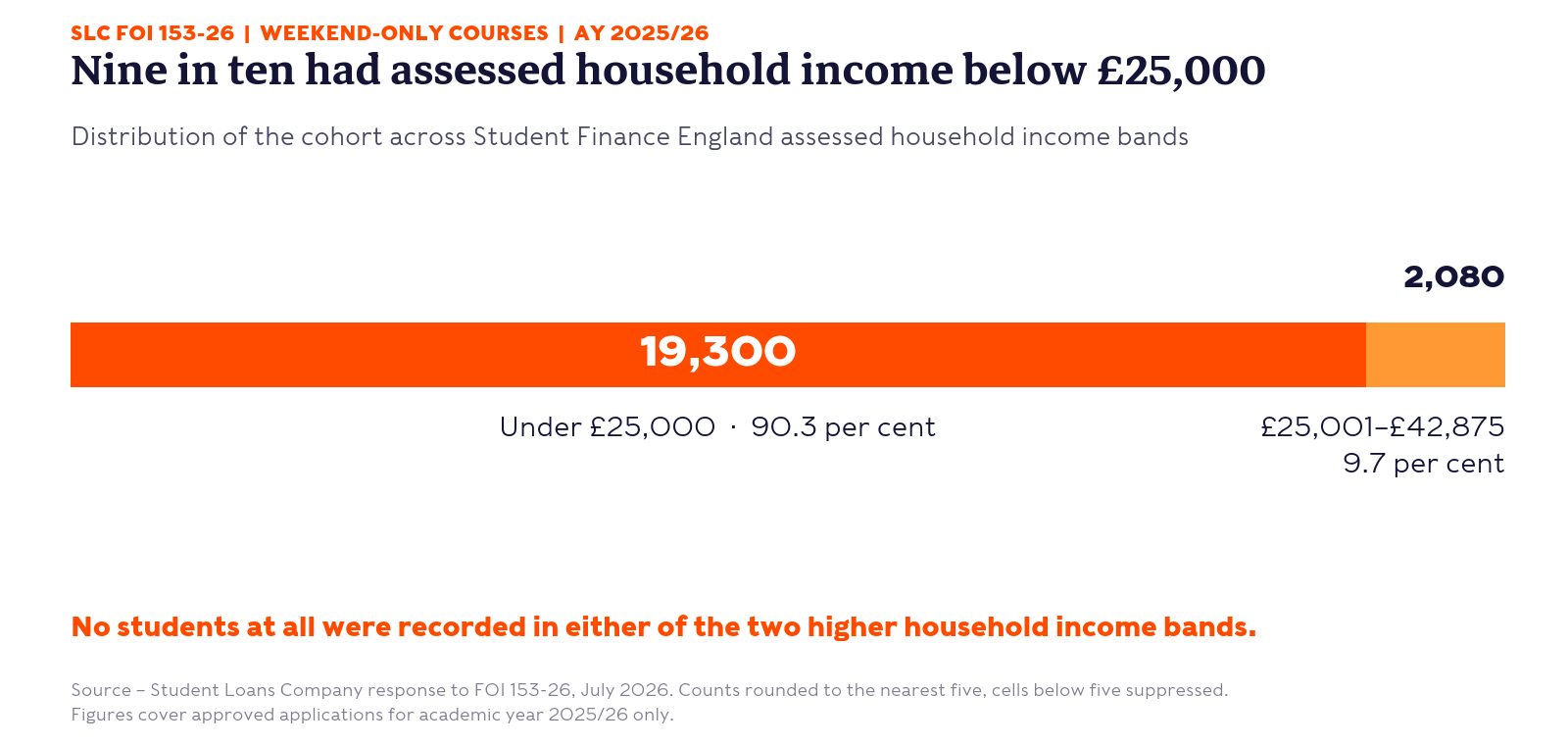
On money, 19,300 students – 90.3 per cent – had assessed household income below £25,000, with the remaining 2,080 in the £25,001 to £42,875 band and nobody at all recorded in either of the two higher bands I asked about.
Almost the entire cohort qualified for maximum or near-maximum means-tested support. 99.24 per cent had requested the maximum maintenance loan available for their domicile and living arrangements.
Some 12.7 per cent were awarded Childcare Grant, with a mean entitlement of £11,694.84, while 26.85 per cent were awarded Parents’ Learning Allowance, 5.65 per cent had an Adult Dependants’ Grant, and 22.45 per cent were recorded as care-experienced, estranged or in receipt of the Special Support element.
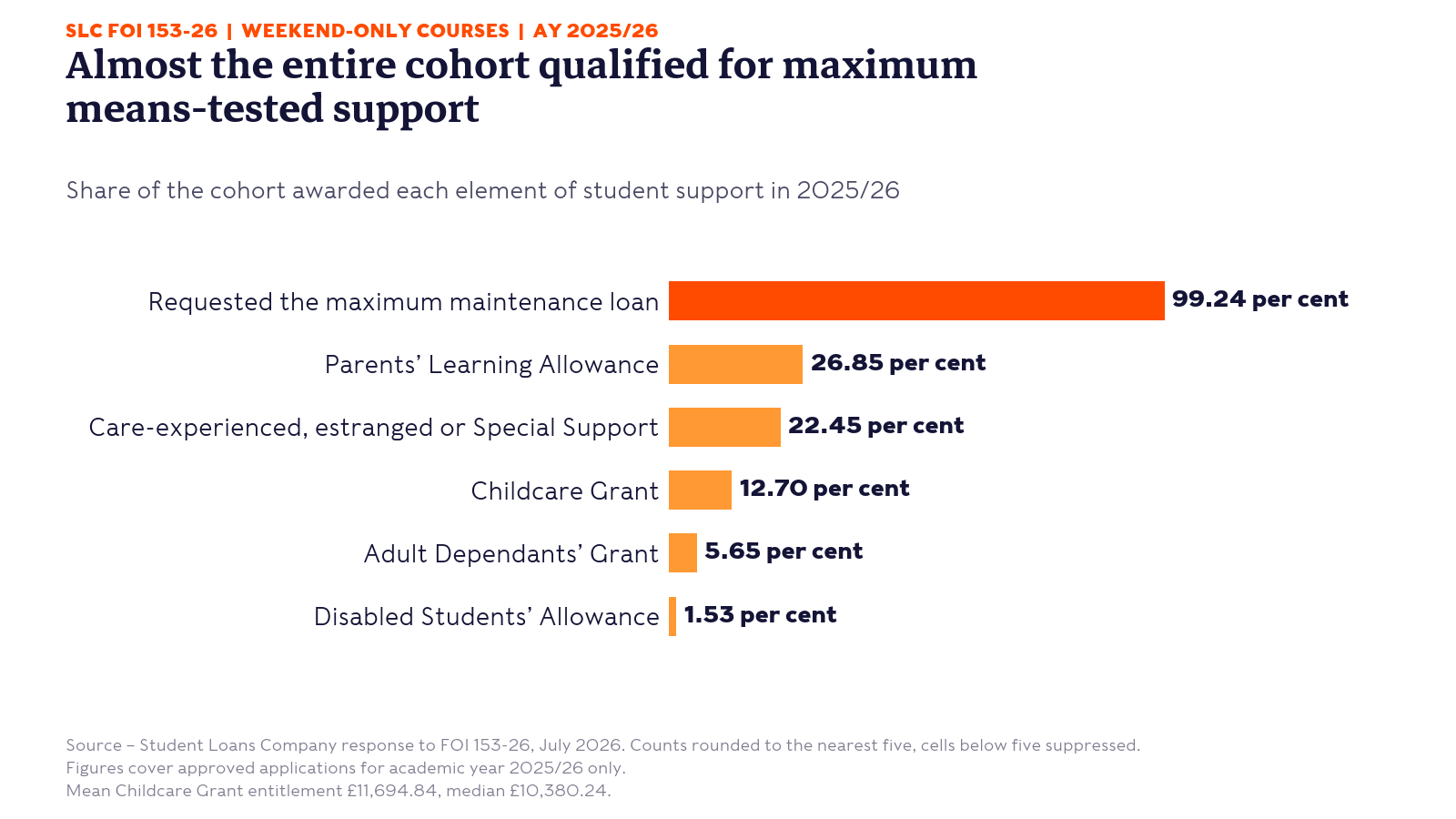
This was (and still is) a cohort of parents and people in precarious circumstances who had arranged childcare, shifts and household budgets around payments that SLC had assessed and approved, and who were then told the course had been the wrong sort of course all along.
We might ask ourselves what was motivating a Labour government to suspend such a large amount of student financial support for such a precarious cohort. There’s one other field in the data that may be relevant.
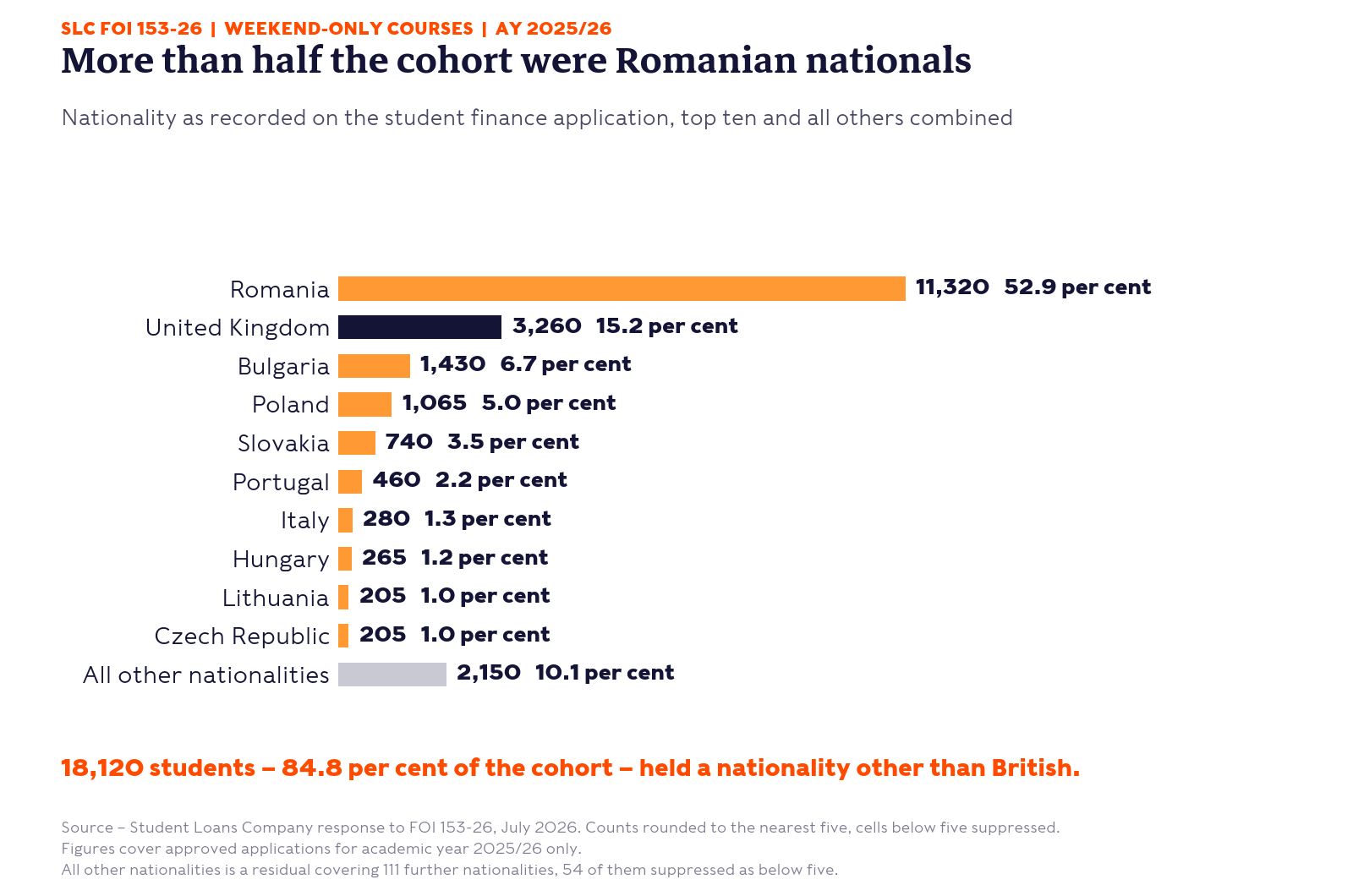
11,320 (52.9 per cent) were Romanian nationals and 3,260 (15.2 per cent) were UK nationals, with 1,430 Bulgarians, 1,065 Poles and 740 Slovakians behind them – some 84.8 per cent non-UK in total.
In her letter to the sector in June (which, amusingly, the OfS Board Papers page marks as “exempt from publication”), Jacqui Smith announced that DfE intends to consult in the autumn on a new minimum English language requirement for student finance, “to provide greater confidence that recipients are able to benefit from their course.” DfE frames that as being about educational benefit rather than nationality. It seems to me hard to read it as unconnected to the nationality profile of cohorts like this one.
Six universities and five companies
The SLC data does not, by itself, establish fraud by any student, lead provider or delivery partner, and I am not alleging that any named organisation committed fraud. What the data does show is a discernible pattern in how this provision was organised.
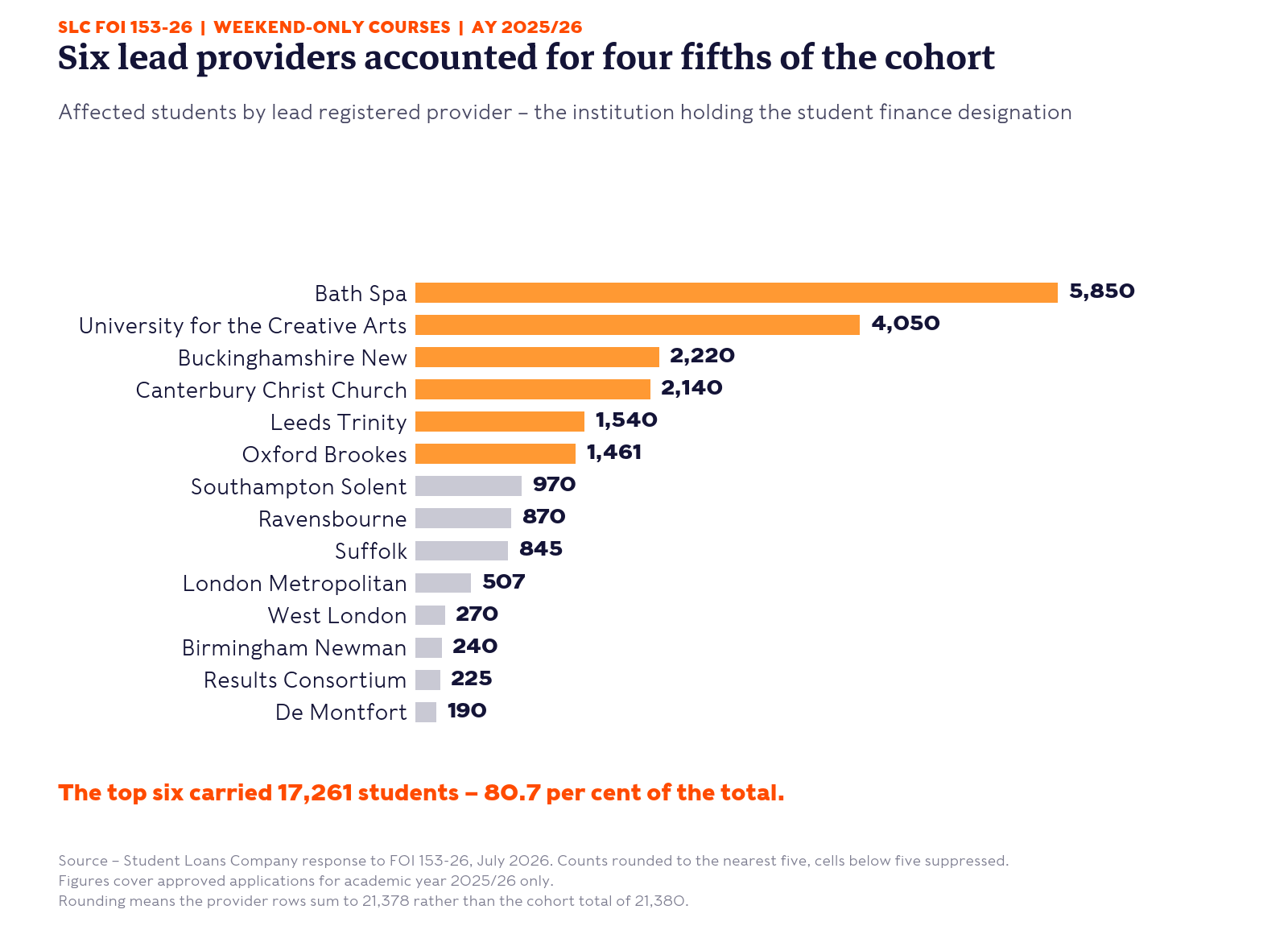
Bath Spa was the largest lead provider with 5,850 affected students, followed by University for the Creative Arts on 4,050, Buckinghamshire New on 2,220, Canterbury Christ Church on 2,140, Leeds Trinity on 1,540, and Oxford Brookes on 1,461 – making up 80.7 per cent of the total. Solent, Ravensbourne, Suffolk, London Metropolitan, West London, Birmingham Newman, Results Consortium and De Montfort form the long tail.
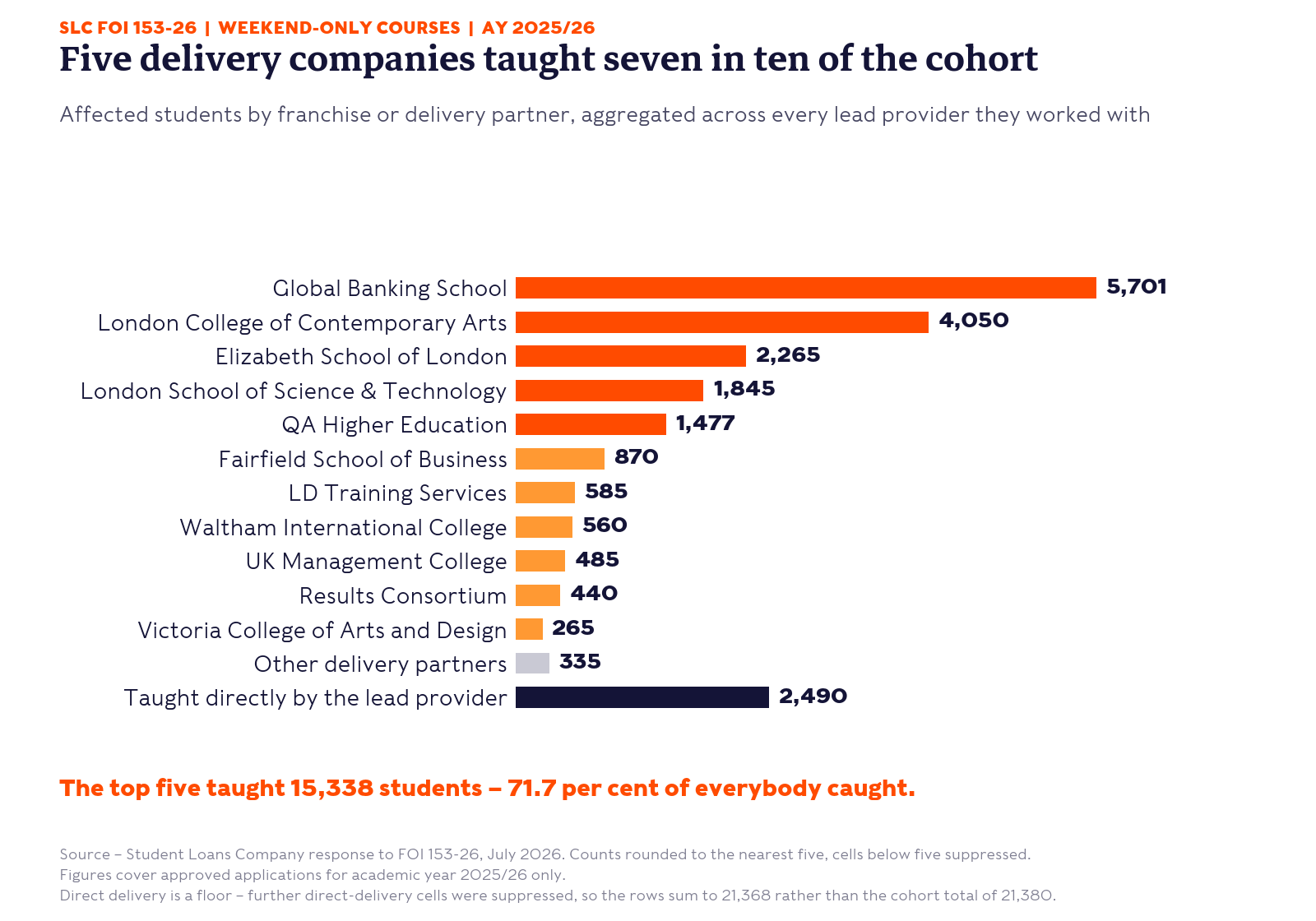
Aggregate the delivery-partner rows and the concentration gets tighter still – roughly 5,701 students at the Global Banking School (GBS), 4,050 at the London College of Contemporary Arts (LCCA), 2,265 at the Elizabeth School of London (ESL), 1,845 at the London School of Science and Technology (LSST) and 1,477 at QA Higher Education.
Fairfield School of Business, LD Training Services, Waltham International College and UK Management College make up most of the rest, and Results Consortium appears both as lead and franchisee, with 225 students as a lead provider teaching directly and 440 as Leeds Trinity’s delivery partner. The first five account for about 15,338 students, or 71.7 per cent of everybody caught.
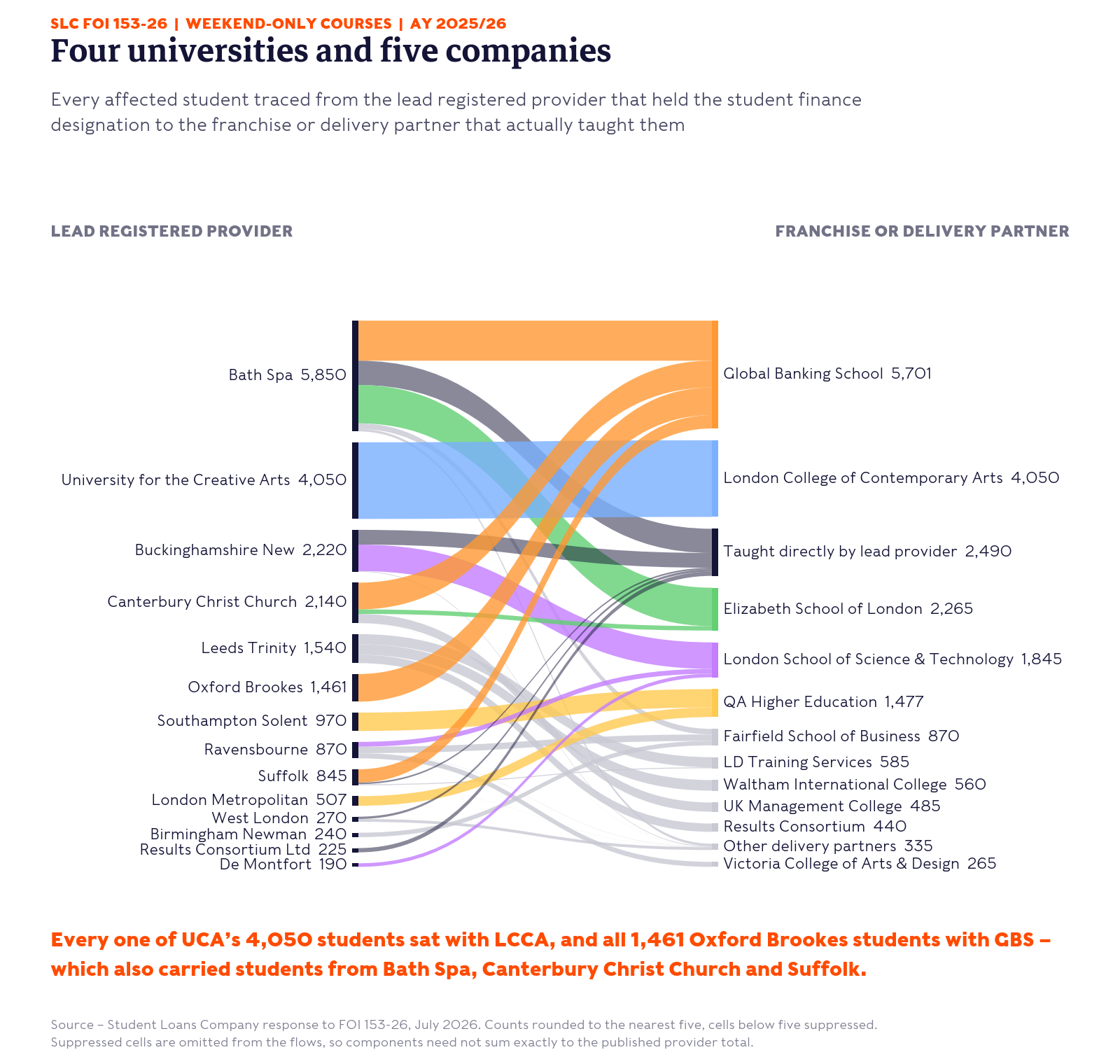
If anything, the pairings matter more than the totals. Every one of UCA’s 4,050 cases sits with LCCA. All 1,461 Oxford Brookes cases sit with GBS, which also carried 2,120 Bath Spa students, 1,415 Canterbury Christ Church students and 705 from Suffolk. De Montfort’s 190 went to LSST, and London Met’s 507 and Solent’s 970 both went to QA.
None of that is evidence of wrongdoing. Concentration of this kind is what you would expect from the economics of student recruitment at scale – a small number of operators with the sales infrastructure to fill weekend cohorts, and a larger number of universities willing to buy that capacity. What it establishes is that a handful of relationships accounted for most of the exposure, which is a reason to look closely at how those relationships are governed.
These are the sorts of partnerships that often show up in the B3 quality data, the huge growth in foundation years, and the significant profit figures.
To be fair, at least 2,490 weekend delivery students were marked “not applicable – lead provider”, meaning the provider taught them itself, and several further direct-delivery cells were suppressed for containing fewer than five people. This was concentrated in franchise networks – but it wasn’t confined to them.
Spend it, save it or take a holiday
As I’ve noted on Wonk Corner, immigration status creates a pool of people who might be eligible, but it doesn’t explain the demand – which appears to be being helped along considerably by domestic sales agents. But is any of it fraud?
After announcing investigations in March 2025 – for which government has published no outcome that I can find – and promising urgent action on domestic-agent abuse without subsequently publishing a ban, the grand plan to tackle all of this from DfE has been to make delivery providers teaching 300 or more franchised students register directly with OfS to keep access to student finance from 2028–29.
A large unregistered delivery provider can register and accept scrutiny, shrink or leave. But it can also restructure its relationships so that admissions and teaching sit inside a registered provider’s own corporate structure – though DfE guidance expressly recognises that subsidiary companies may themselves need to register. During 2025–26 the Newcastle College Group (NCG) restructured its relationship with ESL along those lines, leaving a detailed public paper trail.
In July 2025 NCG’s subcontracting plan anticipated 2,220 ESL students attracting £11.197m, of which up to £8.823m would pass to ESL while NCG retained £2.374m – about 21 per cent. The plan does not itemise what the retained sum funded.
By September the board had taken legal advice, and a company owned 100 per cent by NCG – with Planet Education Networks (PEN), ESL’s owner, holding no shares and supplying services by contract instead – had become the preferred option over an incorporated joint venture, subject to further review and final approval. Full ownership would give NCG control of admissions, and transferring teaching staff would give it control of the workforce and, through it, the teaching.
The papers say the other part out loud too. The minutes record that the model would “change the narrative from one of partnership and franchise”, and was expected to be viewed more favourably by DfE and OfS.
NCG’s minutes present the model as increasing its control over admissions, staff and teaching. That addresses some of the concerns policymakers have raised, but does not by itself determine whether the subsidiary is direct provision or remains within the registration policy. It looks to me like regulatory categorisation driving corporate form, and the minutes envisage other ESL campuses entering teach-out with selected sites converted to the new model later, so this was designed to be repeatable.
Ten days after that meeting, NCG Higher Education Centre Limited was incorporated. On 10 November it entered a business purchase agreement with Elizabeth School of London Limited, and 28 ESL employees transferred under TUPE. NCG’s accounts say that, because elements of the consideration were contingent, it could not reliably estimate the total consideration for the purchase. The company now runs a higher education centre at Harbour Exchange in Canary Wharf teaching business, computing and integrated health and social care.
Separately, the procurement records show a direct-award contract between NCG Higher Education Centre Limited and Planet Education Networks worth £2.781m including VAT. According to the procurement notice, the contract covered marketing and digital marketing, outreach, brand promotion, open-day coordination, advice and support for prospective applicants, and applicant administration, initially until 31 July 2026. The notice allowed an extension to 31 January 2027, although I have not established whether that option was exercised. It was awarded under the direct-award procedure.
NCG Higher Education Centre relied on the Procurement Act direct-award ground for extreme and unavoidable urgency. The notice records the justification as “urgency”, explaining that consultation on the future of franchised provision had prompted it to explore alternative delivery models, and that the marketing contract was needed so the new centre could deliver programmes previously delivered with other parties and grow the new business model. I’m making no allegation that the award was improper or that the urgency ground was wrongly relied on – that is a matter for the procurement regime rather than for me. I do think it is fascinating that a policy consultation was treated as the source of the urgency.
The published documents show formal control of admissions and teaching staff being brought within the NCG group structure, while marketing, outreach, applicant support and applicant administration were contracted to PEN. They do not establish that the arrangement was a sham or that it fell outside the franchise rules. They do show that the former partner’s owner retained a substantial commercial role.
The notice doesn’t disclose PEN’s pricing formula, and says that no key performance indicators were set because the contract came in under £5m. What it does establish is that a contract valued at £2.781m was awarded to the former partner’s owner for functions whose stated purpose included growing the business.
In a statement, NCG told me that it established the Higher Education Centre as part of its commitment to widening access to higher education, and that “it is direct provision, not franchised provision, and we have direct responsibility for the academic experience, quality of provision and support provided to students.” Any future plans for the centre, including additional campuses, would be “subject to scrutiny and consideration through NCG’s established governance processes, including Corporation Board oversight.”
NCG also confirmed that its franchise relationship with ESL is now in teach-out, with students completing their studies by October 2027, and said that “any fees retained by NCG reflect the cost of staffing, governance, and quality assurance and enhancement arrangements required to oversee partnership provision and maintain quality and standards throughout the ESL teach-out period.” Planet Education Networks was approached for comment but did not reply.
Bath Spa and Canterbury Christ Church
Meanwhile, Bath Spa and Canterbury Christ Church have both changed their relationships with Elizabeth School of London, although in different ways. Bath Spa ended or placed into teach-out its ESL relationship at Canary Wharf, took over the operation and transferred ESL staff under TUPE into its wholly owned subsidiary, Bath Spa U Ltd, which now employs staff delivering Bath Spa programmes directly at the site.
Canterbury Christ Church’s 2025 accounts said that the university had decided to terminate its partnership agreement with ESL and issued a termination letter on 16 October 2025. CCCU has since clarified to Wonkhe that the university and ESL have mutually agreed that no new students will be recruited through the partnership, while existing students will continue their studies with ESL under the existing arrangements. “Current students will continue their studies with Elizabeth School of London under the existing partnership arrangements and in line with our agreement. Our focus is on ensuring that students continue to be well supported and have a positive learning experience throughout their studies.” Separately, CCCU’s wholly owned subsidiary Medco (CCCU) Ltd now operates in first-degree higher education and trades as “CCCU London”, recruiting permanent academic staff for provision in Canary Wharf and Holborn.
What has not disappeared, however, is the relationship with ESL’s parent, Planet Education Networks. PEN’s website described Bath Spa as a “recruitment partner” and said that it has a “recruitment collaboration” with Canterbury Christ Church as at 14 August 2026. That suggests that winding down new recruitment through the ESL franchise does not necessarily amount to a clean break with the wider PEN group. The precise contractual, operational and financial arrangements behind the continuing relationships between PEN and the two universities are not publicly clear.
Commissioning by accident
All of which leads us eventually to the loan book, where it’s going to be invisible for years. Franchised provision grew 73 per cent in three years to around 160,000 full-time undergraduates, most of those students are either still studying or too recently past their repayment due date to reveal anything, and the weekend cohort had 2,775 students – 13 per cent of the total – recorded as both new and in a foundation year during 2025–26.
A mature student from a low-income household can be an excellent public investment, and nationality tells us nothing whatever about whether an individual will make good. But a loan book exposed to commission-driven recruitment, low or unclear academic entry barriers and courses of unproven labour-market value carries risks that show up late and all at once.
If graduates don’t get the earnings uplift the model assumes, repayments disappoint. If borrowers leave the country, collection gets harder. If students withdraw early, maintenance has already gone out before fee liability arrives. If classifications turn out to be wrong, government can briefly treat about £125m of support as overpayments before reversing course. And if a large share of fee income goes to corporate margin, agent commission and acquisition cost rather than teaching, we might wonder what (or who) the loans system is really for.
Those costs then wash through the whole system as HMT seeks to protect the value of the loan asset on the balance sheet. Thresholds freeze, repayment periods extend, interest terms shift, maintenance gets squeezed, and ministers explain to the general graduate population that the system has become “unsustainable” – which amounts to charging ordinary graduates for a failure to control what went into the loan book in the first place.
We’ve built a system where publicly backed finance is available on demand while private recruitment companies and financially stretched universities decide between them where volume expands, according to the economics of student acquisition rather than anything resembling national need. The state maintains that it doesn’t commission higher education. It commissions it through the loan book, without ever deciding what it wants to buy, where it wants it delivered, or what it expects in return.
There are plenty of fixes sitting on the shelf. Mark Leach’s proposals on The Post-18 Project would ban per-student commissions for domestic recruitment, publish agent relationships and payments, make governing bodies approve the educational rationale for every large partnership, monitor maintenance payments without matching fee payments in real time, require prior approval for geographically distant delivery, cap the share of a university’s students taught through franchises, publish delivery-partner outcomes and financial flows, and give regulators power to recover public money. Registering large delivery partners is welcome, but won’t on its own change a single incentive.
I’ve said this before, but it bears repeating. Every pound spent tightening up regulation – every framework, every insight brief, every boot on the ground, every minute spent in governing body meetings mitigating against the huge incentives for all the players, is time and money that could be better spent on the sector’s other range of problems. It seeks to solve a problem that we just don’t need – at least not at system level.
Reversing course will need careful handling to protect vulnerable students that have signed up in good faith, and will require some assistance for those universities that are now relying on the funding. But Lucy Powell should now do the only sensible thing, and both ban domestic agents, and move to shut down student loan book funding for non-specialist, for-profit provision. It still isn’t worth the risks.