A fresh cost of living crisis is coming for students. You’d never know
With OfS’s proposed fairness condition under consultation, Jim Dickinson audits what universities tell applicants about costs – and finds silence, archaeology or arithmetic that doesn’t add up
Comment|

Jim is an Associate Editor (SUs) at Wonkhe
Food prices in the UK have risen by around 39 per cent since January 2020.
Higher energy and agricultural commodity prices have combined with rising labour costs, new regulatory burdens, supply-chain disruption and the structure of the food market to increase costs throughout the system.
These pressures move gradually from farms and energy suppliers through manufacturers, distributors and retailers before appearing in the prices paid by consumers.
The Food and Drink Federation argues that the industry is now less able to absorb another major shock after five years of cost-cutting and attempts to extract efficiencies from supply chains and operations.
The war in Iran has therefore appeared at a point of reduced resilience, with disruption to Middle Eastern energy production and the effective closure of the Strait of Hormuz threatening another sharp rise in energy and transport costs.
As a result, the federation has substantially increased its forecast for UK food inflation. Having previously expected inflation of 3.2 per cent, it now predicts that annual food price inflation will reach between 9 and 10 per cent by December 2026.
On that basis, analysis from the Energy and Climate Intelligence Unit puts UK food prices on track to be 50 per cent higher by November 2026 than at the start of the cost of living crisis in mid-2021 – squeezing almost two decades’ worth of pre-crisis price growth into a little over five years, with staples like pasta, frozen vegetables, eggs and beef all up by more than half.
And the shock hasn’t fully arrived yet. Britain is heading for its worst cereal harvest since records began in 1984, drought and heat have pushed wholesale tomato prices up more than 60 per cent and potatoes more than 40 per cent just as the same weather hits the European suppliers we’d normally import from, and the FAO reckons commodity cost rises take three to six months to reach retail prices – landing them squarely in autumn and winter.
Food price inflation is always higher for those who mainly buy own brands or raw materials – a venn diagram that has students all over it. Meanwhile the latest energy price cap change, on 1 July 2026, was a 13 per cent increase – which we’d have to assume nobody has noticed given the heatwave.
For some years now landlords offering “all inclusive bills” have been advised to bury acceptable use caps into those contracts, in pounds and pence rather than unit costs, to protect against price shocks. Of the sort we’ll experience this winter.
A student’s basket of goods is more heavily dominated by food, and if they rent, energy costs. HM Treasury has gathered expert estimates for average family CPI of between 3.1 to 4.5 per cent this autumn, in a year when the Department for Education has “future proofed” maximum maintenance loans to go up by 2.7 per cent.
That’s the max of course – thanks to that frozen means testing threshold, the median maintenance loan for a full-time student is projected by DfE to go up by 1.2 per cent this September.
In the face of all of that, we might have expected the sector’s cost of living information for prospective students to have improved beyond the shower I’ve found in previous summers (2025, 2024, 2024b, 2023, 2022).
Sadly, if anything, it’s the worst I’ve seen.
The archaeology
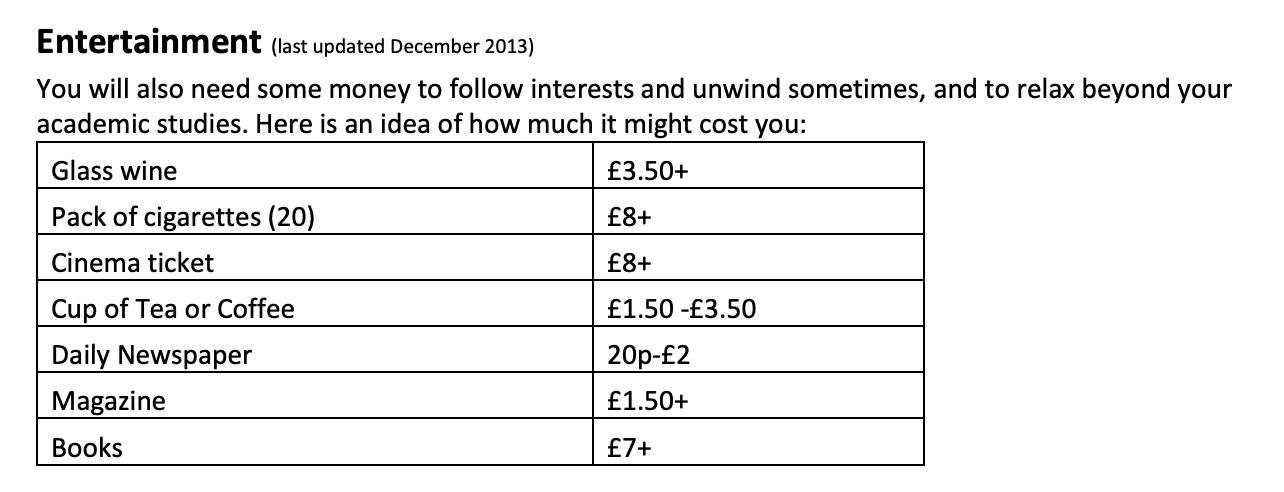
On the website of one institution in London, in a document explaining living costs to prospective US federal loan borrowers, accommodation was last revised in “Feb 2014”. Utilities, food and travel in “May 2013”. Entertainment in “December 2013”. Students weighing up a five-figure dollar loan in 2026 are told food costs £63 a week, on the authority of a spreadsheet that predates the 2015 general election.
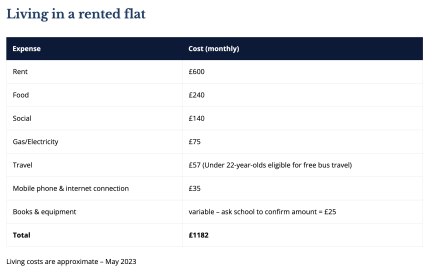
One Scottish university publishes a full itemised budget marked “Living costs are approximate – May 2023”, advising that a rented flat in its home city costs £600 a month. That city is Edinburgh, where UCAS/BlackBullion reckon the real range is £574 – £1,386 a month.
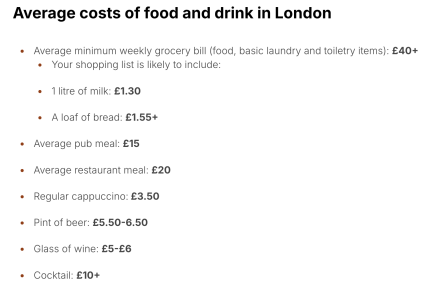
An institution in London tells applicants that living in the capital “is likely to cost £1,300 to £1,550 a month” – the exact figure it quoted in May 2022 – on a page where the tuition fees, helpfully, are bang up to date for 2026/27.

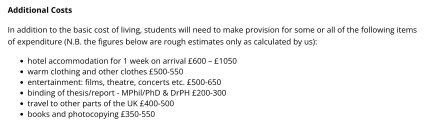
Another institution tells its overwhelmingly international postgraduate intake to budget for warm clothing at 2020 prices, travel at 2020 prices, and utilities on “2023 data” – the page hasn’t been touched since I flagged it two years ago.
And one London university has pioneered what we might call de-labelling. Last year its international costs page marked its monthly ranges “2023/24”; this year that page is gone – the URL now redirects to a rebuilt finance page serving the identical ranges and example prices with the year label removed. Its student travelcard rate is a fare revision behind too – the rebuilt page’s visa costs are current and correct, the rest not so much.
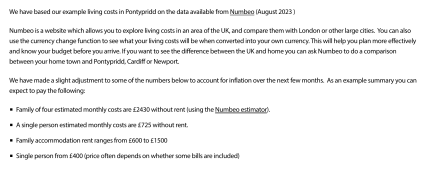
Special mention to one Welsh university, whose international costs page discloses “Page last updated 17.08.23” above figures built on crowd-sourced data from that same August, “with a slight adjustment… to account for inflation over the next few months”… of 2023. The page also warns, in the present tense, that costs are rising “at the moment”.
One North West institution’s entire cost hub brags it has the “lowest cost of living in the UK”, based on a 2023 newspaper ranking, Save the Student 2023, and a TV licence at £13.25 a month (the 2021–23 rate in monthly disguise).

One Scottish institution’s international costs table – framed for 2025/26, prices the TV licence at £13.25 a month, which is the £159 annual rate abolished in 2024, meaning the figure was already two years stale on the day the page was framed.

Another Scottish institution offers “£1,104 a month” on the authority of a 2024 survey, alongside utility ranges of “£0–200” – a span that includes both freezing to death and not having a boiler. It’s been bothered to update its own rent figures and TV license costs since last year, but none of the others.

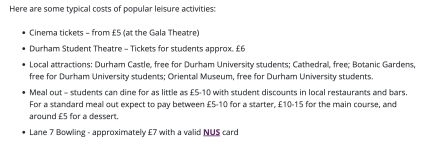
One northern university’s international page prices bowling “with NUS card” – a card retired in 2019 – on a page whose other figures are identical to those published in 2023. A note at the foot says the university “makes every effort to ensure that the information published on this page is accurate”, a note which appears to confuse the word “every” with “little”.
A fresh coat of paint
A page that says when it was last updated sounds like good practice, but in many cases the sector has responded by discovering that you can update the date without updating the page.
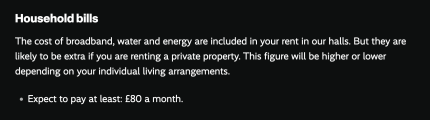
One university in the North West carries a May 2026 modification stamp in its page metadata. Every single “expect to pay at least” figure on it – shopping £170 a month, bills £80, going out £55, eating out £30, self-care £30, the lot – is identical to the August 2024 archive capture, down to a stray space in a typo (“Expect to pay at least : £33 a month”).
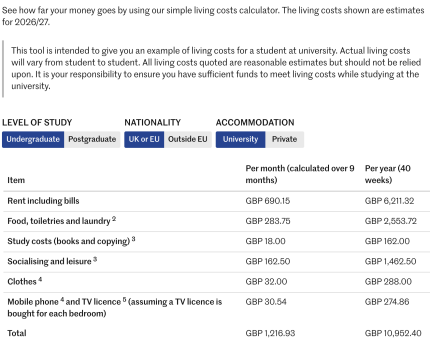
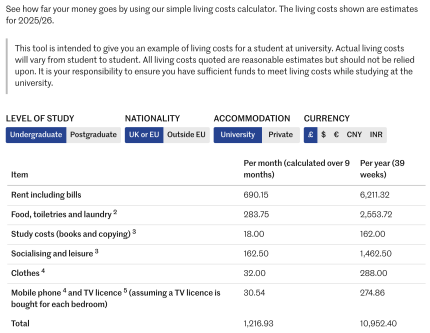
One institution’s living costs calculator presents “estimates for 2026/27” – and against the August 2025 capture, which presented “estimates for 2025/26”, every figure is identical to the penny – £1,216.93 a month, £10,952.40 a year. The same page quotes “the minimum cost of living as recommended by UKVI” at £1,023 a month – two upratings expired, and not a cost of living recommendation even when it was alive.
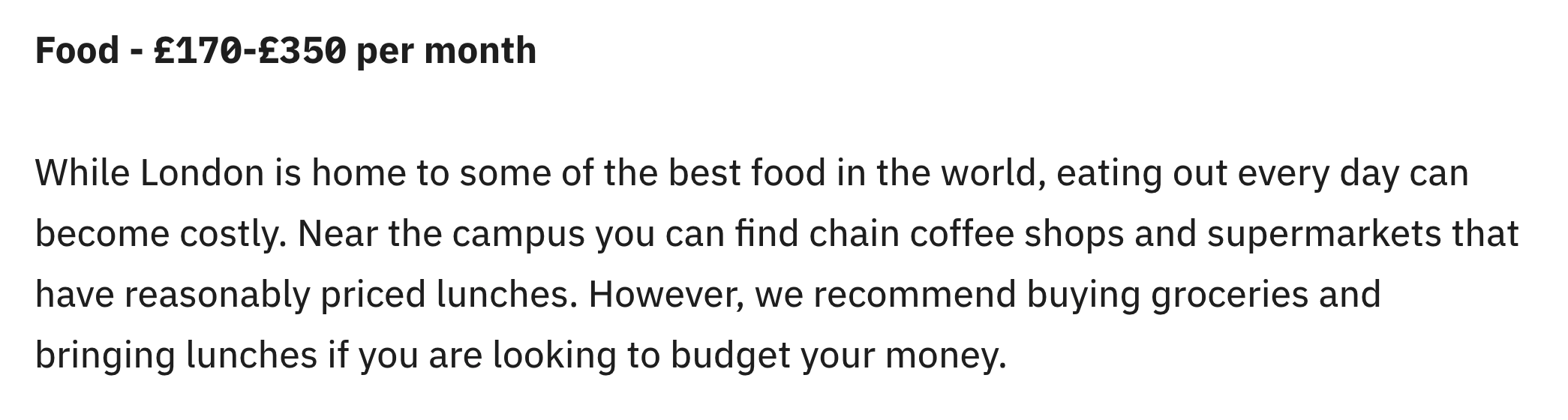
A Scottish university advised students that living in the city costs “£1,100 to £1,700 per month to live and study… published May 2024”. This year it estimates “£1,100 to £1,700 per month to live and study…based on a small sample survey of current students”. What are the chances!


A business school in the capital opts for consistency over relabelling – its Masters cost-of-living ranges for utilities, travel, food and entertainment are identical for the third consecutive year – 2024 capture, 2025 article, 2026 live – which for an institution that teaches forecasting is either negligence or a very strong view on inflation.
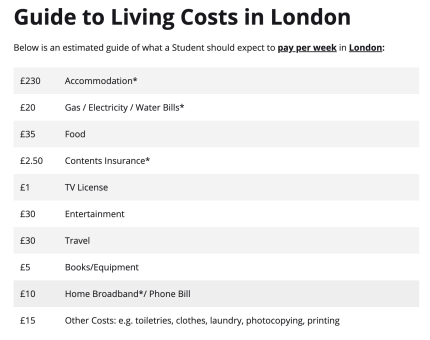
One provider’s weekly guide is stamped “estimated as of April 2025”. Against the March 2021 capture, exactly three of its ten lines have ever changed. Entertainment, travel, books, broadband, “other costs”, contents insurance and a TV licence priced at “£1” a week are all serving their sixth year. That £1, incidentally, is the abolished 2021–23 licence fee divided by three housemates and 52 weeks – a stale statutory rate laundered through a per-person share.
We’ve updated the prices. Ours.
The most reliable finding across 141 providers is that where a page has been partially updated, the parts that moved are the prices the university charges, and the parts that didn’t are the costs the student bears everywhere else.
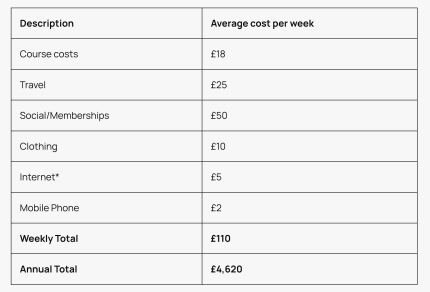
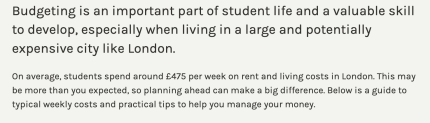
One university’s affordability page has opened with the same sentence since October 2022 – students “can spend around £475 per week on rent and living costs”. The component ranges under it have quietly crept up – rent £120–290 then, £180–300 now; food £30–40 then, £50–80 now – except contents insurance (£1.50–£2.50) and the clothing-and-going-out line (£40–130), unchanged to the penny across four years of inflation. Nothing on the page is sourced.
Another institution has repriced its accommodation repeatedly – £158–337 a week last year, £183–408.50 now – while its food estimate (£30 to £40 a week) and entertainment (£20 to £50) enter year six unchanged, with utility bills listed, in full, as “variable”.

Another university has advised £80 a month for utilities since 2018 – a figure that has survived the entire European energy crisis without flinching – on a page stamped “correct July 2025”; against the July 2024 capture, exactly two lines have moved – the visa figure and the campus nursery price. And its one-off-costs boilerplate (£1,000 laptop, £400–450 winter clothing, £500 for trips) is word-for-word identical to a Midlands university’s page. Even the errors are copy-pasted.
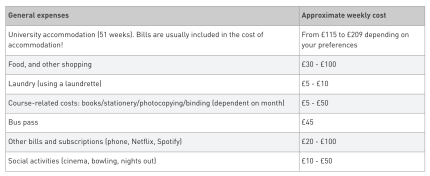
The long-service award goes to a post-92 first I first looked at in 2022, when nothing on its costs page had changed since 2015 except its own halls prices. The May 2024 capture against today’s page extends the streak – every row identical except accommodation. Its “£45 weekly” bus pass and “£20–£100 weekly” phone costs – figures that are self-evidently monthly-scale, sitting in a weekly column – have now survived a decade of “updates” unexamined.
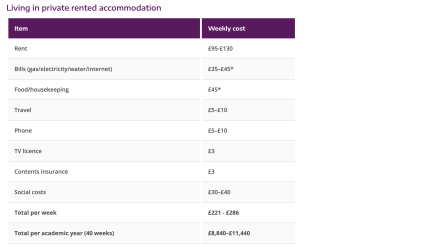
On the south coast, a university whose costs are “based on sector averages… monitored by our Student Money team” has nudged rent and food since the 2024 capture while travel, phone, social costs and a £3-a-week TV licence run unchanged since at least 2020 – and the caveat about “rapidly rising energy costs” that used to sit on the page has been quietly deleted. Bills have somehow got… cheaper!
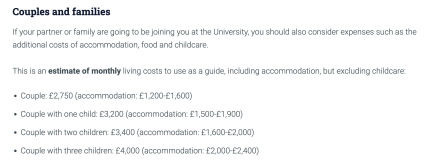
At one university, since its April 2024 capture, the single students’ lines have all been repriced, but the family totals – couple £2,750 a month, couple with one child £3,000 – are frozen even though the accommodation components inside them went up. The totals no longer sum. Someone updated the ingredients and declined to update the cake.
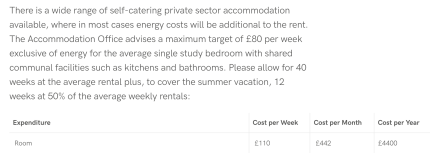
And back in Wales, an itemised page carries its own domestic contradiction – introductory text advising a “maximum target of £80 per week” for a private room, directly above a table pricing that room at £110.
The incredible shrinking food shop
As I note above, food inflation is forecast to hit nine to ten per cent by the end of this year, per the Food and Drink Federation. Four universities have responded by cutting their food estimates.
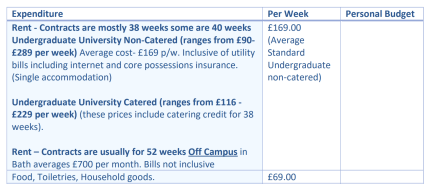
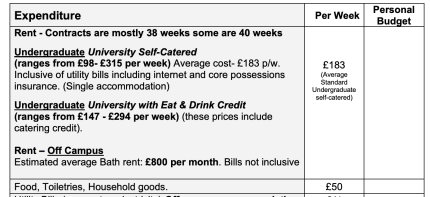
One in the South West publishes a properly dated, itemised sample budget as a PDF, filed under its corporate publications section where no applicant will ever trip over it. Set this year’s edition against its own still-live 2024–25 edition and the food line has gone from £69 a week to £50. Rent rose from £169 to £183 and utilities from £24 to £41, so the headline total moved just £11. The food line, it turns out, is a shock absorber – it exists to soak up the rises in the numbers the university controls so the total stays presentable.
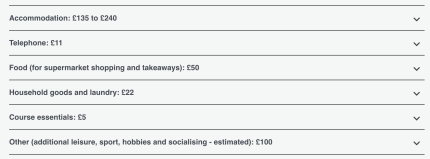
One university managed, in a May 2026 refresh, to cut food from £70 a week to £50 and course essentials from £20 to £5, while nudging “other – additional leisure, sport, hobbies and socialising” up from £80 to £100 and repricing its own accommodation upward. Students will eat less, buy no books, and have a lovely time.
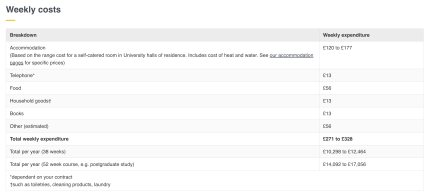
In the South West, one university’s example budget prices a TV licence at “£3.30 a month” – the abolished £159 annual fee split across a four-bed house, a fossil hidden inside a fraction – and its non-rent budget was cut by around a fifth between the March 2023 capture and today while the rent line rose by up to half.
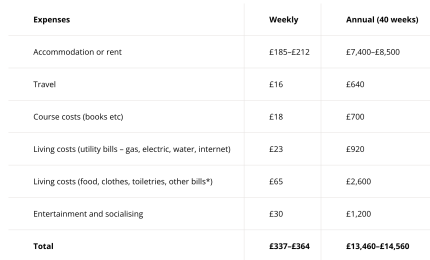
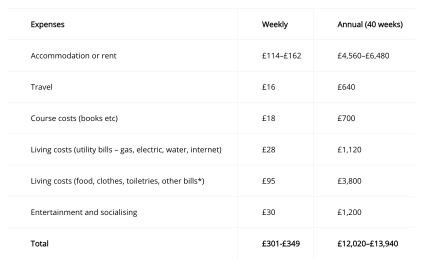
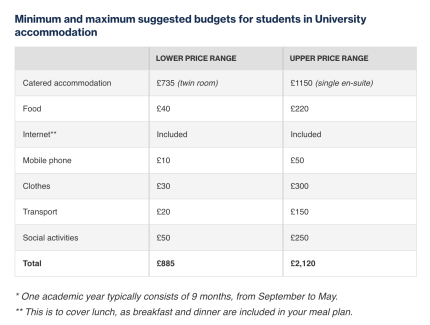
One London institution’s catered-accommodation budget for international students includes a food line of £40 – a month. Catering covers term-time weekday meals, but £1.30 a day for every other meal a human eats feels like a stretch in London.
Out of 141 providers, the number that tell prospective students that costs will rise materially during their course – with food inflation heading for double digits, hardly a niche prediction – is two. Both are ancient, both are rich.
One advises applicants to “allow for potential increases in living expenses of around 4% each year”, from figures built on a joint survey with its own students’ union blended with the government’s income and expenditure research, the other adjusts its published figures using the Bank of England’s inflation forecast. The universities with the least worried applicants provide the most honest forecasts. Everyone else presents this year’s prices (or 2021’s) as though the future has been cancelled.
Out of date, out of pocket
If there is one number a university has no excuse for getting wrong, it is the Home Office maintenance requirement – a figure with a statutory value, a publication date and a gov.uk page. Here is how that’s going.
Several providers still quote £9,207 – the requirement that expired in 2021. One prints its provenance with archaeological care – “from December 1st 2020 the minimum requirement for your living costs is £9,207”, on a US federal aid page that also quotes an NHS surcharge of £470 (the rate that ended in October 2020; it is now £776) and a visa fee of £350 (now £524). Every regulated number on the page predates the end of the pandemic.
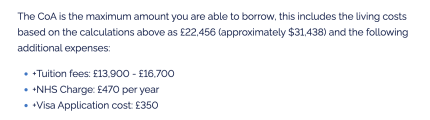
Another publishes the £9,207 in English and in Welsh, on a postgraduate FAQ last touched in September 2023 – a bilingual commitment to misinformation. An applicant who takes that page at its word will evidence £1,332 less than the real requirement, and their visa will be refused.
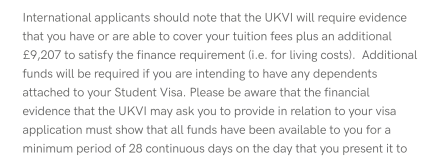
One Midlands university quotes the requirement as “£1,203 per month”. No such rate has ever existed – the sequence runs £1,015, £1,023, £1,136, £1,171. It appears to be a typo of £1,023 that nobody has noticed since the page was “Last updated: 16/08/2024”, a stamp it has worn through a September 2025 archive capture and into the present day.
A Yorkshire institution describes £1,023 a month as what “UK Visas and Immigration consider… a reasonable budget for an international student in Britain” – present tense, eighteen months after the rate expired, and even when it was current it was a visa threshold, not a budget. Its April 2025 capture shows the same sentence, so it spent that spring calling an expired rate “reasonable” too.

One Welsh institution has a page for international students titled “Estimated Costs of Living” – and the only estimate on it is the visa proof-of-funds figure, presented as what students should “budget to have”. Its recommended external tool for working out living costs (“student calculator”) links to a payday loans operator. The only cost of attendance document a US borrower can find on the site is a PDF from May 2020, quoting visa costs at less than half current rates.

In London, one university quotes £1,483 – one uprating behind – while a midlands institution quotes the current rate and then advises Master’s students to plan “£13,632 for a full year” – which is twelve times the expired £1,136; the right instinct, wearing last year’s arithmetic.
And a London provider has the current £1,529, which it presents as the amount students need “to meet basic living expenses” – an evidential threshold repackaged as a lifestyle guide, on a page where the food, campus meal and heating figures date from 2021.

Ask twice, get three answers
A special category for universities disagreeing with themselves in public.
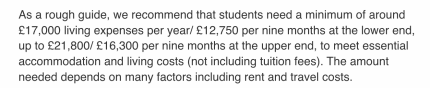
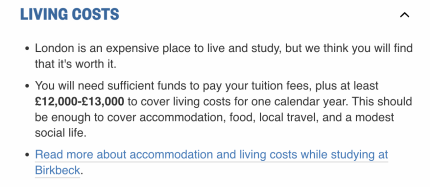
One London institution currently offers three simultaneous answers to “how much will I need?”. Its domestic pages say £17,000 to £21,800 a year. Its international fees page says £12,000 to £13,000 will “cover living costs for one calendar year”. Its US cost of attendance filing says £25,486 for 42 weeks, or £31,554 for 52. The cheapest answer is shown to international applicants; the most expensive to the US Department of Education, which has audit powers.

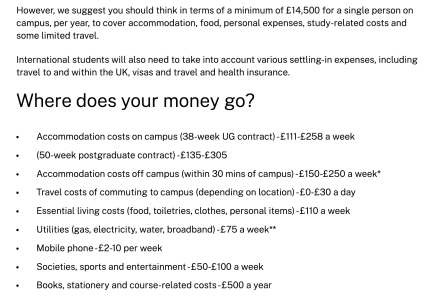
Another London university, stung by last year’s observation that its stated £12,500 postgraduate “minimum” was less than the sum of its own itemised breakdown, has raised the minimum to £14,500. Its own breakdown now sums to roughly £15,450 at the cheapest end. The correction preserved the contradiction and moved it £2,000 up the page – and added an unexplained “£75 a week” utilities line for good measure.
Sources: trust us
Where do the numbers come from? Mostly, nowhere. The modal sourcing across 141 providers is silence – figures presented as facts of nature. Where a method is described, it is often a job title – one Yorkshire university’s minimum costs have been “estimated by our support teams” since at least 2021, which makes those teams either clairvoyant or asleep – another’s “sector averages… monitored by our Student Money team” has been monitoring the same £3 TV licence for six years.
Where an external source is named, the news does not improve. The NatWest Student Living Index is enjoying a revival: one university crowns itself “the UK’s most affordable student city” on the strength of the 2025 edition; another lists the Index among the sources for its actual budget figures; a third builds its entire monthly breakdown on the August 2024 edition, citing a discredited survey a year late. It’s all twaddle – see here, here, here and here.
The withdrawn Which? student budget calculator – deleted years ago – is still recommended by name on several live pages, including a parents’ guide, presumably on the basis that parents enjoy heritage brands.

The compilation award goes to a blog post in north Wales, served under this year’s Clearing banner. Its sources: the NatWest Index (2021 edition), Save the Student (2022), and an accommodation platform (2023). Its content: private housing “can cost up to £266 per month” when “compared to that of £1300 in London – a 132% increase”, which is not what a rise from £266 to £1,300 is.

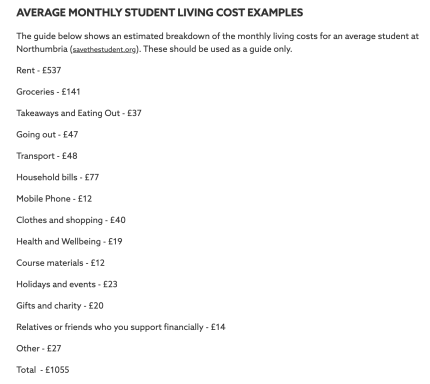
And the sector’s favourite source remains Save the Student’s annual money survey – a fine piece of work whose own headline findings are that students are skint, skip meals and use food banks. Universities strip those caveats and serve the spending averages as budget guidance – what hard-up students manage to spend, rebadged as what applicants should plan to spend.
One north-eastern institution simply relabelled the national survey table as its own students’ average monthly living costs and stamped it “08/07/24”, where it remains, two recruitment cycles later – the November 2025 capture is identical.
Cry regulation
Which brings us to the Office for Students’ proposed new condition C6 on treating students fairly – a consultation that closed last month, and to which the sector’s representative bodies have responded in a register I can only describe as wounded.
Universities UK supports fairness in principle but insists the OfS “should not seek to establish a higher regulatory standard than that required by existing consumer protection legislation”. University Alliance warns that the proposed condition “goes way beyond existing consumer protection law”, raises “serious questions about proportionality”, and might cause “increased risk aversion” – as though the sector’s current approach to cost information displayed a reckless excess of care.
And MillionPlus, while supporting transparency, cautions that the proposed publication requirements “will be a significant undertaking” and that information requirements “should remain focused on what students genuinely need”.
Well, what students need at the very least is an honest, dated, sourced estimate of what it will cost to live while they study, with a clear warning that past students often underspend, and inflation means those figures will rise during their course. Four in ten providers publish no estimate at all, while much of the rest publish archaeology.
Even better would be for the sector to get together and fund Loughborough University’s Centre for Research in Social Policy (CRSP) to update its Minimum Income Standard for students – which last year calculated that a student needs £61,000 for a minimum socially acceptable standard of living over the course of a three-year degree.
The sector says it can be trusted to treat students fairly without a new condition. Really? The universities that do this well prove it costs almost nothing. The rest have had four summers of being told, a consumer law framework the CMA refreshed in 2024, and the strongest possible incentive – their own recruitment – to get it right.
What they evidently need is a regulator prepared to read their websites the way an applicant does, and consequences when what’s written there isn’t true. If being required to publish an accurate number once a year is a “burden”, the word for what students have been carrying doesn’t appear in any consultation response.
Related articles

Careers support should help students decide, not just compete
Lorenzo Mugnai | Comment | 7/10/26

If we want social mobility, fund the universities that deliver it
Sharanya Sivarajah | Comment | 7/10/26

Unlocking the potential of working with charity and community groups
Fiona Walsh McDonnell | Comment | 6/10/26