


Ask people in and around higher education who owns “employability” and you’ll get a decade of debate – a toxic brand, an engagement problem, a function now central to institutional success.
Ask students whether their time at university is preparing them for a career, and you get something much simpler – just over a third can’t say that it is.
The question matters more now than it has for years. Graduate outcomes shape league tables, underpin regulatory judgement through condition B3, and increasingly carry the sector’s case for public and political confidence – all at a moment when the graduate premium is shrinking and the post-16 white paper frames higher education’s contribution almost entirely in the language of skills.
Earlier this year the Office for Students published research on “preparation for the transition out of higher education” – retrospective polling of 1,671 recent graduates in which half felt prepared for life after graduation and a third did not.
The graduates in its focus groups were precise about what had gone wrong. Nobody had told them where their degree leads, the support that existed was generic and invisible, and the gap between expectation and reality arrived as a shock nobody had prepared them for.
The regulator’s prescription was that institutions should make their careers services more visible – and as we argued at the time, that mistakes a student experience design problem for a communications one.
Elsewhere, the emerging sector consensus is that the answer lies in “embedding” employability into the curriculum and helping students articulate skills they don’t realise they have.
We wanted to test all of that against what students themselves say – at scale, while they’re still studying, and in their own words. Our new mini report, Where does this degree take me?, does exactly that. And the answers suggest the sector keeps reaching for the wrong levers.
Click here to view and download the full report
About the data
The report draws on 18,590 responses to Wonkhe/GTI polling across nine waves between February 2023 and March 2026, covering 178 UK providers.
In every wave, students were asked how far they agree that “my current activities at university are preparing me for my future career” on a 0–10 scale – around 14,000 gave a score – with an open-text follow-up that generated a little over 8,000 substantive responses.
Thousands more free-text comments on teaching, assessment, community, voice and support are drawn on throughout. As ever, the sample is broadly diverse but not perfectly representative, and we have weighted for gender and qualification level.
The report sets out the coding and classification decisions in full – including how we’ve separated vocational and professional courses from academic and generalist ones.
Four groups, two worlds
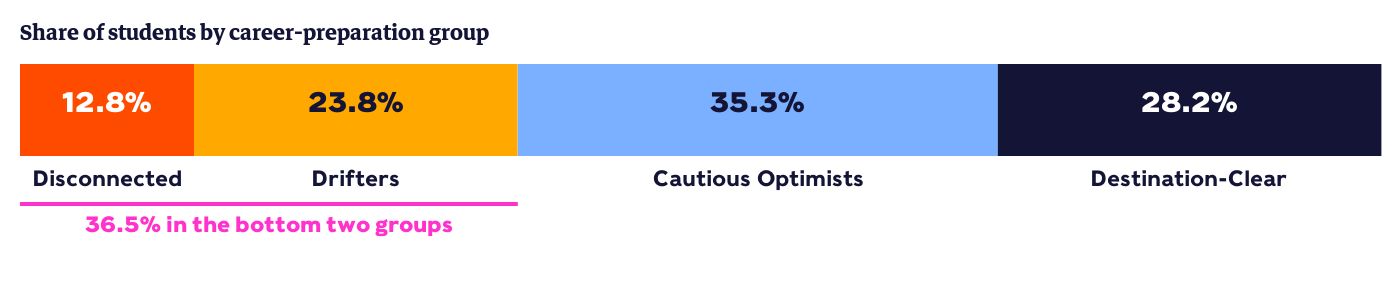
Scores on the career preparation question split the student body into four groups.
At the top sit the Destination-Clear (28.2 per cent), who describe a direct line from what they’re doing now to where they’re going. Beneath them the Cautious Optimists (35.3 per cent) can name what’s working – usually a placement or a professional module – but give the course itself only partial credit.
And then there’s the bottom third. The Drifters (23.8 per cent) describe an experience that is adequate but aimless, hedged with self-blame – “I haven’t taken as many opportunities as I perhaps should.” The Disconnected (12.8 per cent) describe something bleaker – not a weak careers service but a total absence of career-related communication:
I have not been asked or approached about what I want to do after university. No one has mentioned placements. No one has told me whether it will be effective. No one has helped building a CV or a portfolio for myself after achieving my degree.”
The lazy explanation is subject mix – some degrees are just less vocational. Subject does matter, and vocational students are markedly less likely to be Disconnected. But the spread between providers teaching the same subjects is as wide as the spread between subjects, and each accounts for under four per cent of the variation between individual students.
Two students on the same kind of course at different institutions differ, on average, by more than a point purely because of where they study. “Some subjects just aren’t vocational” turns out to be an inadequate explanation – and provider, unlike subject, is something an institution can act on.
The engine is relational
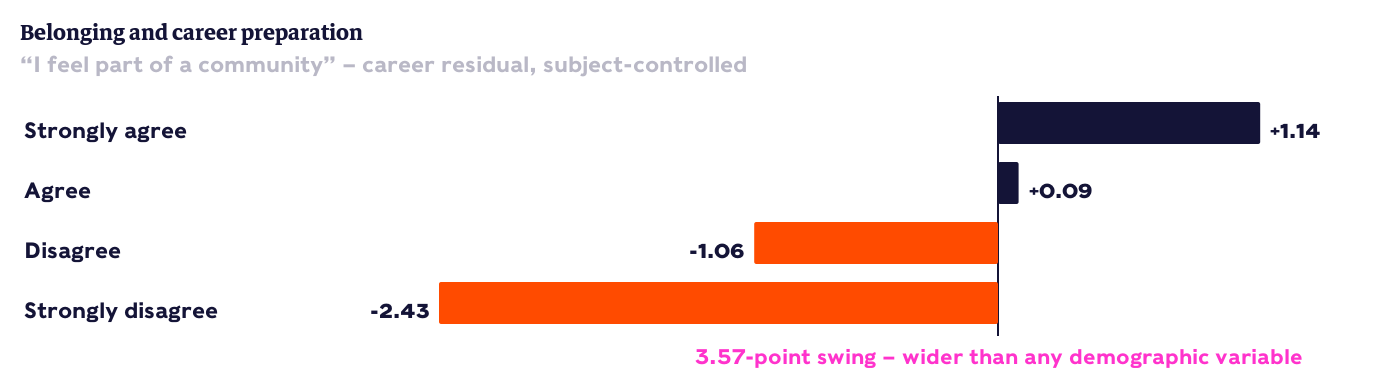
So what does explain the gap? Not the things the sector usually reaches for. Put the main experience measures into one model and the strongest predictors of career confidence are whether a student feels part of a community and whether their course stretches them intellectually – a relational cluster that accounts for around 28 per cent of the variation, roughly seven times what subject or provider explain.
Holding subject constant, the gap between students who strongly agree and strongly disagree that they belong is 3.57 points – wider than any demographic difference in the dataset.
Career orientation, in other words, is not primarily an information problem solved by a leaflet. It develops inside a community – peers comparing notes on placements, staff mentioning where the subject leads, subject associations staging events, a cohort that makes the future feel plannable.
On this evidence, belonging isn’t running parallel to employability. It may be the mechanism that produces it. Three further pressures show up alongside it – courses that fall short of what students were led to expect, visible cuts to provision leaking into student confidence, and students too depleted by heavy paid work to do the things that build career capital.
That last one connects directly to our previous polling on students at work – students doing a moderate 11–20 hours of paid work a week are the most career-confident, while those working 21-plus hours fall below even those doing none.
Just as telling is what doesn’t drive the gap. Central careers provision barely appears in students’ own accounts – references to “my course” and “my lecturers” vastly outnumber references to the careers service, for both credit and blame.
And AI, despite the sector’s preoccupation, is all but absent from how students narrate career anxiety.
A warning dressed as good news
One finding cuts the other way. International postgraduate taught students – the cohort that drove five years of recruitment growth, and the one whose graduate outcomes are worst and deteriorating fastest – are among the most career-confident students in the survey, with the confidence concentrated precisely in the nationalities and business school programmes where the expansion happened, and where the financial stakes are highest.
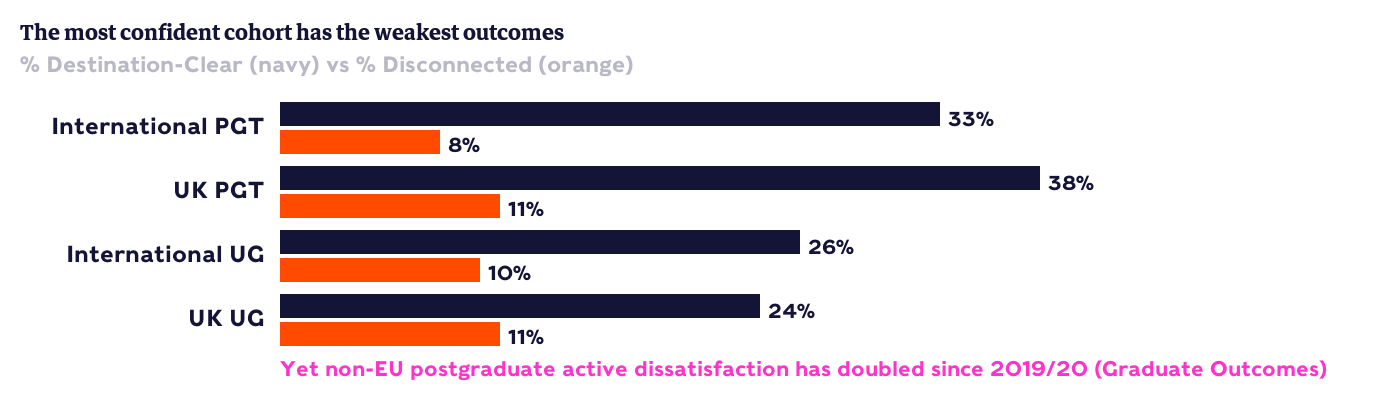
The survey catches the promise at its peak. Graduate Outcomes catches it after collision with an unfamiliar labour market, employers who barely know the visa routes exist, and a compressed one-year model with almost no room for the placements and networking that produce good outcomes.
A university looking at high international PGT satisfaction might conclude that this part of its provision is working. The report argues the opposite – in this cohort, high confidence is a reason to look harder, not to relax.
The degree, not the module
The report closes with recommendations that follow the structure of the problem rather than the org chart. Students in the bottom groups aren’t asking for their discipline teaching to be retrofitted with employability content – they’re asking for placements, guidance on where the degree leads, and practical experience.
That points to moving career preparation from optional central provision into the credited degree, locating ownership with course teams, and – drawing on what we’ve seen across Europe on our study tours – resourcing disciplinary student associations, which connect belonging to career confidence more directly than anything a central service can run.
There’s plenty more in the full report – the year-of-study question, the disability gap that survives every control, what the same activities look like from opposite ends of the confidence spectrum, and a three-tier framework for auditing where career preparation actually sits in a degree.
Click here to view and download the full report
Click here to view and download the deck of findings
We’ll be discussing the findings and their implications at the SU Membership Services Conference – and if your SU would like to get involved in future waves of our polling, drop us a line.