If the graduate premium is falling, supply-side tinkering won’t bring it back
Jim Dickinson assembles cross-national evidence showing Britain’s shrinking graduate premium is a demand-side problem – and that closing courses won’t fix it
Comment|

Jim is an Associate Editor (SUs) at Wonkhe
It’s not hard to find arguments that suggest that the UK has too many graduates.
And underneath articles of that ilk, we’re usually treated to laments about the decline of polytechnics, the idea that students should learn a trade, and (at best) the lack of investment in skills.
The Sunday Times spent the weekend declaring the graduate salary premium “a myth.” The Conservatives responded with a plan to cut 100,000 university places.
Conservative leader Kemi Badenoch says that New Labour’s 50 per cent target for school leavers was achieved by “creating loads of useless courses”, and shadow education secretary Laura Trott refuses “to keep funding degree courses which are not delivering for young people.”
Badenoch blames Britain’s “low-growth” economy on “the Blairite settlement” while proposing to fix it entirely by tinkering with the supply of graduates.
She treats the student loans crisis as a supply-side problem. Too many graduates, too many courses, not enough quality control. The prescription is familiar – restrict entry, close programmes, steer people elsewhere.
But cross-national evidence tells a very different story. The decline of the UK graduate premium isn’t an inevitable consequence of mass higher education. It’s a peculiarly British problem – and it’s rooted in what happens after graduation, not before it.
Occasionally, pieces like this from the FT’s John Burn-Murdoch offer up a counterpoint.
Just us, then
In 1999, the average UK graduate salary was 80 per cent more than their non-graduate counterparts. In the latest data that’s down to 45 per cent – and that’s before factoring in student loans. The obvious response is to blame oversupply – expand participation, dilute the pool, and watch the premium fall.
Even the Sunday Times’ more conservative measure – a premium of 30 per cent in 2007, down to 22 per cent by 2024, shrinking to 16 per cent after tax and loan repayments – points in the same direction.
But the problem with that argument is it hasn’t happened elsewhere. In the US, the graduate premium has risen from 80 per cent to 92 per cent even as degree-holding has climbed from 27 to 40 per cent. Premiums have held up or increased in Canada, France, Spain and the Netherlands too.
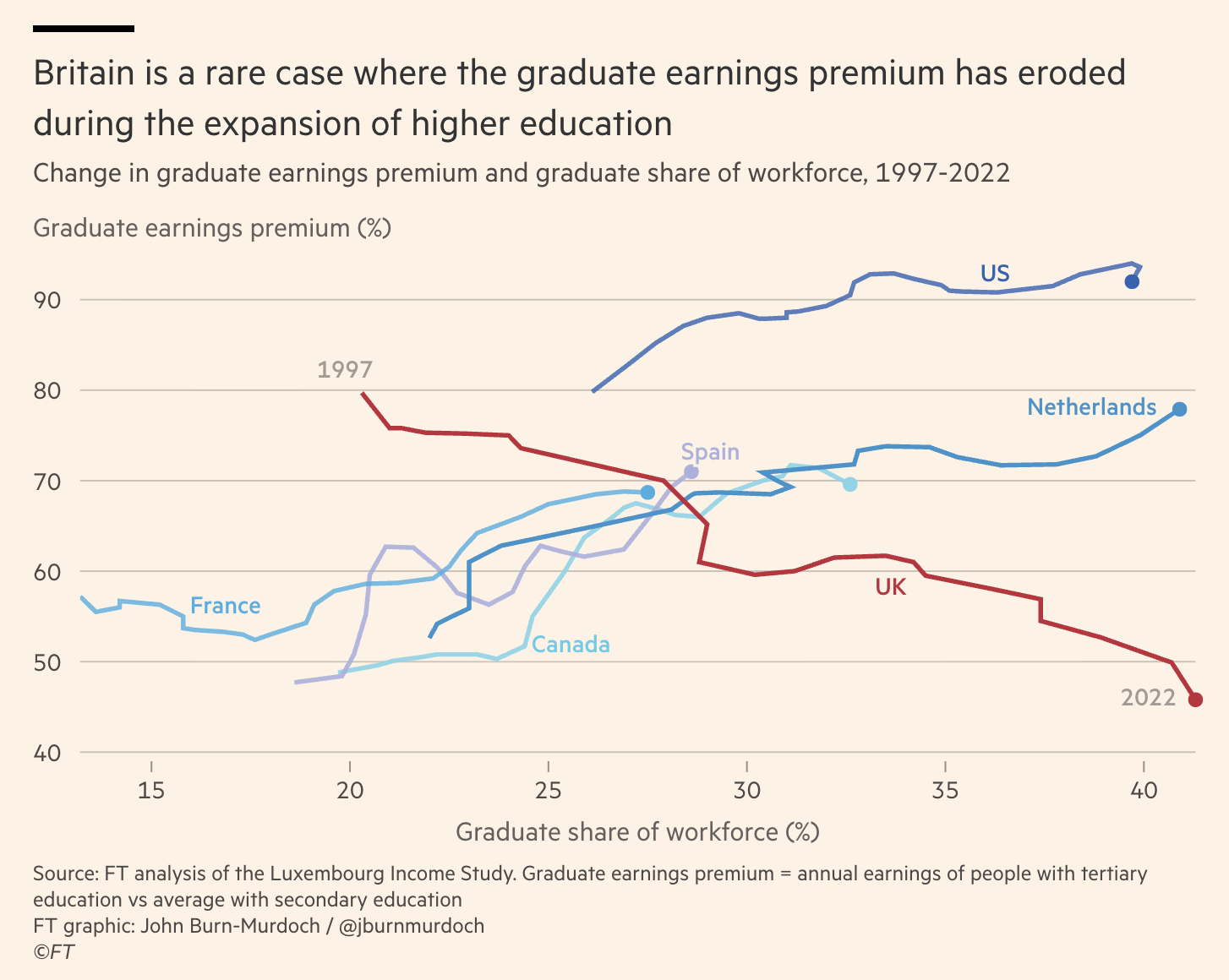
And in the US, a performing arts graduate earns around a third more than their British counterpart after adjusting for purchasing power – rising to 60 per cent more across all subjects.
The travails of Italy’s graduates in the 1990s and 2000s were more a comment on the country’s stagnant economy than its higher education system – the same is true of the UK today.
So the decline in the UK graduate premium isn’t an inevitable consequence of mass higher education – it’s a peculiarly British problem. The question is whether the answer lies in a weak labour market, weak graduates and courses (and their location), or something else entirely.
Use it or lose it
Much of the literature frames the UK issue not as “too many graduates” but as weak skills utilisation – the economy doesn’t generate enough roles, workplaces and progression structures that actually deploy higher-level skills.
A decent chunk of cross-national comparative work comes from Francis Green and Golo Henseke at UCL’s Institute of Education. Their 2016 study in the Oxford Review of Economic Policy used a validated index of graduate jobs across 21 OECD countries and found that graduate underemployment correlates with the aggregate supply-demand imbalance – but not with indicators of labour market flexibility.
You can’t deregulate your way out of this. You need to actually create the jobs.
Their cross-national OECD working paper found that in most countries between 70 and 80 per cent of graduates worked in graduate jobs – but the UK sat at the bottom of the table alongside Japan and Spain, with among the highest proportion of graduates outside graduate-level roles.
Their most recent task-based analysis in Oxford Economic Papers (2024/25) found that the growth of graduate skills requirements in the British workforce slowed markedly after 2006 – the demand side stalling while supply kept expanding. And they make the crucial point that for higher education to deliver “value for money”, employers need to demand distinctly graduate skills. For graduate skills to be rewarded, jobs need to make productive use of them.
There’s the “low-skills equilibrium” tradition, developed through Ewart Keep’s work at SKOPE in Oxford and going back to the Snower/Wilson analysis. That treats weak skills demand as self-reinforcing – large segments of the UK economy compete on cost and standardisation, leading to limited training, limited job redesign, limited internal progression, and a tendency to use credentials for screening rather than redesigning roles to exploit skills.
It produces a stable but low-productivity equilibrium that sticks around even when the education system expands.
The OECD’s own recent work on adult skills reinforces that. Its 2026 report on how workers use (or don’t use) their skills in the workplace separates skills proficiency from skills use at work – and explicitly highlights that high proficiency doesn’t automatically translate into high workplace use. The UK pattern is one where people have the skills but jobs don’t let them use them.
Geography doesn’t help. IFS research found that employment in high-paying occupations grew by 240 per cent in Inner London since 1993 but just 41 per cent in Cheshire. The new high-skilled jobs in IT, business and finance clustered overwhelmingly in London while low-paid service work grew everywhere else.
And the CIPD’s comparative work found that the UK has 58.8 per cent of graduates in non-graduate jobs – exceeded only by Greece and Estonia – while countries like Germany, the Netherlands and Slovenia with strong vocational training traditions have 10 per cent or less.
The usual suspects
None of this means we should ignore what universities do. But the evidence suggests the supply-side story is weaker than the policy debate assumes.
This “wage premium puzzle” paper for the IFS asked how the UK maintained a large education wage premium despite massive graduate expansion – and found that for a long time, endogenous organisational change (firms restructuring because graduates were available) kept pace with supply. The premium held up.
It’s only more recently, as the post-crisis productivity stagnation has bitten and the minimum wage has risen, that the squeeze has become visible.
The Productivity Institute’s work on graduate mismatch adds another idea – it’s not only the number of skilled jobs that matters but the sectoral composition of employment and the pathways into better matches. Graduates can be in the “wrong job” or the “wrong industry”, and the wage penalties for mismatch point to structural issues in how the UK allocates graduate labour, particularly after shocks.
This matters because much of the coverage frames the problem as one of institutional quality – Russell Group graduates earn well, post-92 graduates don’t. But the IFS data on geography tells a different story. If high-paying graduate jobs grew by 240 per cent in Inner London but just 41 per cent in Cheshire, the earnings gap between a London-based Russell Group graduate and a post-92 graduate in the Midlands is substantially a story about where the jobs are, not where the degree came from.
And management matters as well. Research on management practices shows that management capability varies hugely across UK firms and sectors, and that it directly affects task allocation, training, autonomy and whether skilled workers are set up to use their skills. The UK has a particularly long tail of poorly managed firms compared with the US and Germany.
Free riders
Hat tip to the drum that Johnny Rich regularly beats here – employers are probably underinvesting. UK employer investment in training per employee has fallen by 36 per cent in real terms since 2005, according to the Learning and Work Institute – a decline that has not been observed to the same extent in most other European countries.
The IFS confirmed in its 2023 study that participation in adult education and training has declined across every measure – the fraction of workers participating, the average number of hours, and the intensity of training.
If we compare that with Germany, companies invest around €18,000 per apprentice per year and the system generates a positive return on investment when longer-term benefits like lower recruitment costs and reduced turnover are factored in. The CIPD’s evidence to the Industrial Strategy Committee made the connection directly – a “significant part” of the UK’s low productivity compared with Germany can be attributed to poor workforce skills development, linked to business strategies that rely on cheap labour rather than investment.
So when the CIPD says that “the assumption that we will transition to a more productive, higher value, higher skilled economy just by increasing the conveyor belt of graduates is proven to be flawed”, it’s not making a case against higher education.
It’s making a case against the idea that supply alone creates demand. Simply increasing the qualification level of individuals going into a job does not typically result in the skill required to do the job being enhanced. That requires job redesign, management capability and employer investment. And the countries that maintain strong graduate premia during expansion are the ones that pair education growth with skilled job creation and occupational upgrading.
Johnny Rich’s long-held proposal for a graduate employer contribution gets the diagnosis right – the current system doesn’t incentivise the outcomes it needs, and employers are free-riding on public investment in human capital.
But his proposed solution – a 3 per cent levy on employers hiring graduates, paid back to universities – never seems right for the political moment, especially now.
After the employer NICs increase, the Employment Rights Bill costs and rising minimum wage obligations, another percentage-based charge on graduate employment would almost certainly reduce graduate hiring at the margin.
Worse, it gives employers a direct financial incentive to recruit non-graduates or international graduates to avoid the charge. The stronger version of the employer contribution argument would look more like the French model of a legal obligation to invest in workforce training – something that changes what employers do with their workforce rather than what universities charge them for producing it.
Not off the hook
So if the core problem is demand-side, there are limits to what universities can fix. If nothing else, tinkering with course closures based on earnings data that is really measuring the weakness of the economy rather than the quality of the course is addressing the wrong end of the problem entirely.
The Conservative proposal to cut 100,000 places and redirect savings into apprenticeships is exactly this error with a price tag attached – and as I’ve explored elsewhere, the maths doesn’t survive contact with reality either.
But that doesn’t mean universities have nothing to do. And it’s not OK to simply rely on “graduateness” or a resistance to instrumentalism in a mass system where the economy is on its knees. An accommodation is required – and it isn’t always “skills in the module.”
The comparative evidence on work experience is remarkable. Cross-national data from the REFLEX survey of European graduates found that British graduates gathered much less work experience during higher education than their counterparts in the Netherlands or Germany. Credit-bearing, structured work placements and co-op models – not just “employability modules” bolted onto existing courses – seem to matter for how quickly graduates transition into skilled work.
There’s a structural problem with how we do this in England. A sandwich year typically means an extra year of debt. At Manchester Met, the RISE programme enables students to “over-credit” their degrees with additional units based on engagement with employment-enhancing extra-curricular experience, building skills recognition on top of rather than instead of academic credit. It won a Guardian Award for course design and now involves over 3,000 students a year.
But even RISE sits on top of the degree rather than within it – which creates a question about whether “skills” in our system will always mean either extra time (and debt) or extra workload on top of what’s already a compressed experience.
It all connects directly to the evidence on student regret. The Bristol/HEPI/Advance HE “Benefits of Hindsight” research found that while only 2-3 per cent of respondents thought higher education was the wrong path altogether, 52 per cent of graduates said with hindsight they would have done things differently.
Among graduates who wanted to change, the most common reason was that different choices would have led to more career options. Four in ten expressed the need for different or better careers advice. For those employed in highly skilled occupations, satisfaction with their choices was markedly higher than for those in less skilled positions.
The regret isn’t about having gone to university. It’s about what happened – or didn’t happen – within the experience and afterwards. And that’s a gap universities can address, not by turning every course into vocational training, but by ensuring that structured engagement with skills and work is embedded in the credit system (not necessarily the curriculum) rather than offered as an expensive optional extra or a bolt-on employability week.
Credit where it’s due
One of the UK’s open secrets is that across our universities, there is an enormous volume of higher technical provision that the public and policymakers struggle to see. It’s there, but it’s invisible behind university branding and a policy debate that treats all degrees as if they’re the same thing.
On Kuenssberg, even Laura Trott had to concede that:
…universities are often involved in apprenticeships, which is something that we are going to expand quite dramatically for 18 to 21.
When we visited Técnico in Lisbon, taxi drivers knew exactly what the university’s faculty of engineering and technology does. In England, the equivalent provision is buried inside institutions whose names no longer signal what they offer.
But Europe has a complementary secret that is arguably more important. In systems across the continent, enthusiastic Bologna compliance and the credit structure itself does the work that UK degrees try to bolt on.
Technical students take humanities and social science credits. Purely academic students pick up formal credit for internships, work experience, volunteering and skills development. Students gain recognition for learning acquired through employment, service or positions of trust. And all of it sits within the standard 180 ECTS rather than on top of them – no extra year of fees, no optional bolt-on that time-poor students skip.
In other words, countries can maintain stronger graduate premia via systems where technical students do humanities, purely academic students pick up credit for skills and work experience, both have graduateness experiences we call “extra” curricular rewarded, and none of it requires an extra year of fees. A Chemistry student does less Chemistry – but they’re a more rounded graduate, and in a mass system, that trade-off looks increasingly sensible.
Some tell me that the UK’s compressed three-year, 360-credit model makes this harder but not impossible. But the real obstacle isn’t credit volume – it’s programme design philosophy. Our system tends to treat the subject as sacrosanct and everything else as an add-on, whereas the systems sustaining better graduate outcomes build breadth, skills and work into the core credit structure from the start.
Green and Henseke’s cross-national work suggests the mechanism matters. It’s not about ticking an “employability” box – it’s about work-based learning with clear outcomes and assessment that captures problem-solving and responsibility, making skills legible to employers and reducing the risk of graduates starting in low-skill trajectories from which they may never recover. Early mismatch can persist – which means what happens in the transition matters as much as what happens in the classroom.
And even when skills are developed – whether through the curriculum, work experience, or the kinds of extracurricular activity that European systems formally record on the Diploma Supplement – there remains a surfacing problem. As I’ve argued on the site elsewhere, students develop skills but struggle to name and evidence them, employers report attributes as missing that may actually be present but invisible, and the UK’s patchwork of documentation infrastructure fails to record what students have gained.
See also the desperate need for PSRBs to engage with all of this, and the policy disaster that is the Lifelong Learning Entitlement, which ought to make earning while learning a doddle, but in fact is almost as inflexible for full-time students on mixing and matching as the system it’s designed to replace.
Wrong end of the telescope
As well as all of that, across employers, government and universities, there is clearly a coordination failure. If employers don’t redesign work and invest in training, universities can’t “teach” their way out of underutilisation. If government focuses mainly on supply-side reforms, it can expand qualification rates while leaving the job structure unchanged.
And if universities treat skills as someone else’s problem – or as something that can only be addressed by bolting optional extras onto already overloaded students – then the accommodation the economy needs won’t happen either.
Right now, almost everything government is causing in HE policy and regulation – closing courses based on earnings data, restricting international recruitment, tightening loan terms – addresses the supply side of a demand-side problem. And now opposition parties are competing to do the same thing faster.
The countries that don’t have this problem are the ones that paired graduate expansion with skilled job creation, employer investment, and regional economic development.
The government’s own Skills and Productivity Board material is explicit that skills and productivity are connected but mediated by employer strategy, investment, management and local economic structure.
So place-based policy can’t just fund provision – it has to target adoption and diffusion of technology and management practices in lagging sectors and regions, use procurement and regulation to raise job quality in the large low-wage service markets where the state is a major purchaser, and align industrial strategy with occupational upgrading so that growth sectors translate into more skilled roles rather than just more headcount.
If Britain is “short of graduate jobs”, the policy lever isn’t restricting graduate supply. It’s increasing the number and quality of roles that genuinely require and reward higher skills, and accepting that skills do have a place in undergraduate credit.
Universities have a part to play – particularly in how they credit experiential learning, surface what students have gained, and in how they design degrees. Letting students design their own would be a great start.
But they also have a distinctive contribution to make on the demand side itself – surfacing and generating the policy research that government needs to understand why the UK is an outlier, what levers would shift employer behaviour, and what regional economic conditions would turn graduate capability into productive work.
Until that lands with ministers (or maybe, in the future, Mayors), the debate will remain stuck on supply-side tinkering while the real problem goes unaddressed – a surefire way to become the next Italy.
Comments · 10
New comments will come back with sign-in later this year.
Huw · 23 Feb 2026
An excellent analysis of the problem with supply side higher education approaches to economic development as it has played out in the UK over the last thirty years. The Treasury orthodoxy pursued by successive governments since the late 1990s has been informed by endogenous or “new growth” theory which argued that governments should invest in university based research and innovation as implied by Paul Romer and Robert Lucas. Allied to this was “human capital theory” and “skills biased technical change theory” as developed by Gary Becker, Laurence Katz and Kevin Murphy. The problem with these approaches is that they haven’t worked as expected in the UK context over recent years as Jeffrey Ding (2024) “Technology and the Rise of Great Powers” and Brown et al (2020) “The Death of Human Capital” make clear in their recent books. In short, it worked in theory but not as much in the UK in practice as had been hoped. Or as a former senior civil servant said to me recently about this question, “they (the Treasury) just don’t believe it like they used to”.
As Nikolai Chernyshevsky once said whatever the problem “What is to be done?” It seems to me that there are four problems upstream of the higher education and skills supply issue that need to be dealt with if graduate premia are to be improved and these changes are about the structure of industry and trade, not specifically about the offer from universities. Some things will have to give to make things right.
First, the UK has a lower rate of capital investment in companies and the public sector than most other G7 countries. This reduces productivity and as a consequence graduate premia.
Second, the UK is one of the most highly centralised economies in the UK with political, business and financial power concentrated in London and the South East.
Third, the UK economy is highly open to capital investment and movement with a high proportion of companies owned by overseas companies.
Fourth, the UK has progressively cut itself off from major international markets and has a less effective relationship with Europe, the USA and Commonwealth than it once had.
A more effective approach might therefore be 1) to invest inline with the Government’s Industrial strategy in what look like future industries. 2) Invest in transport infrastructure to connect the North, East and West more effectively with one another and with the South East. Relatedly to devolve decision making and finance powers over further and higher education to the regions of England. 3) To introduce greater controls on the takeover of companies and to develop more effective forms of employee involvement in corporate decision making. 4) Improve trading relationships with the UK’s major trading partners. 5) Encourage UK students to study overseas and graduates to get jobs in other countries. 6) These actions might require a reduction in the funding going to universities and improved targeting of this funding. All of the above have been done effectively in an English speaking nation a few miles to the West of Great Britain. And if you think this is bad have a look at the alternative economic plan that has been proposed for the UK.
Paul Vincent Smith · 24 Feb 2026
Good post, but I’d go further on point 2. Use the refurbishment of the Westminster Palace as an opportunity to move central government to Birmingham. Infrastructure would have to follow. It might even help improve outcomes on corruption indices.
Paul Wiltshire · 23 Feb 2026
How many times do I have to say ‘Correlation doesn’t prove Causation’?
“In 1999, the average UK graduate salary was 80 per cent more than their non-graduate counterparts.”
Yes – and also true was that in 1999 UK graduates had far higher prior academic attainment compared to non graduates than they do today.
It is innate academic ability that is the dominant causation factor of career pay
John Berkshire · 28 Feb 2026
Correlation doesn’t imply causation unless it’s one that you think supports your narrative.
https://www.theguardian.com/inequality/2017/jul/12/household-income-crucial-role-children-life-prospects-lse-report
Paul Goldberg · 23 Feb 2026
So if I’ve got right, the general conclusion is the following sentence towards the end:
“If Britain is “short of graduate jobs”, the policy lever isn’t restricting graduate supply. It’s increasing the number and quality of roles that genuinely require and reward higher skills, and accepting that skills do have a place in undergraduate credit.”
My objection is that “increasing the number and quality of roles that genuinely require and reward higher skills” is not a policy lever, rather it’s wishful thinking. Or, to the extent that the UK can pull levers that increase the number of skilled roles, that’s not going to happen quickly; it will take a decade or so. In the meantime, we should face up to fact that the UK is a lower-skill economy than the ones we like to compare ourselves with. And meanwhile, it’s a good thing to temporarily reduce the number of graduates that the UK produces, since it would mitigate the human cost of graduates emerging with massive debts and weak prospects of ever repaying them.
Bobby · 23 Feb 2026
“And all of it sits within the standard 180 ECTS rather than on top of them – no extra year of fees, no optional bolt-on that time-poor students skip.”
But those 180 ECTS credits take more than 3 years to complete. That for example a BSc Chemistry in Germany is completed in 3 years is fiction (and everyone in Germany knows that). So there in fact is an additional year (or two or three…).
Mark Gray · 23 Feb 2026
Very clear analysis, and I suspect very close to reality. The problem in the UK is that once we swallowed the kool-aid of degrees as a private positional good we took with it a chaser of strong belief that universities were the ones who had to create the market equilibrium. The fact is that the market for HE is in fact *two* unrelated markets – the market for places on courses (which is shaped by young people’s aspirations and hopes, which is absolutely right if they’re ultimately paying cost through loan repayment) and the market for graduates (which is shaped by errant government policy, slow adjustments in labour markets and weak signalling etc.) The argument that, in this bizarre situation it is the universities that deserve blame is plain daft. If, government, you tell universities to respond to the signals in the first market, you can’t blame them for effects in the second. If you tell universities – who across almost everything, except PGT international student provision, can’t generate a surplus – to respond to demand, they’re going to put on courses for which that demand exists.
Ruth Arnold · 23 Feb 2026
“If Britain is “short of graduate jobs”, the policy lever isn’t restricting graduate supply. It’s increasing the number and quality of roles that genuinely require and reward higher skills, and accepting that skills do have a place in undergraduate credit.”
Totally agree. Would be interested if Jim thinks there should be any change in the overall mix of subjects, and if so how that would happen.
Ewart Keep · 23 Feb 2026
This is a really useful article that should be compulsory reading for all in government involved in HE policy and the Industrial Strategy. The knowledge economy (KE) has been just about to arrive for the last 30 years.
The problem is that simple models of human capital theory and the KE are such a convenient fiction that policy makers cannot bear to discard them. Their great virtue is that they suggest that government just need to attend to skills supply and demand will take care of itself. The KE will just arrive propelled by the invisible hand of C21 capitalism and nearly everyone will end up as a knowledge worker. And if you do move beyond this model, then you are faced with really horrible (for English C21 policy makers) reality that you would need a proper industrial strategy (not the science strategy that we currently have cross-dressing as an industrial strategy) and policies that were willing to open up the black box of the workplace and productive processes and target competitive strategy upgrades, work organisation and job design, and workplace innovation and technology adoption.
As someone who has spent the last 30 years plus trying to speak this inconvenient truth to those in positions of power, I now despair of making any progress. Supply is relatively easy, and it now has a huge set of lobbying groups to push it forward. Both the demand side and skills utilisation are messy, and complex, and policies won’t yield swift results. Worst of all, no one owns the problem – DfE is a education/skills supply ministry, what happens afterwards is left to the market to determine.
Johnny Rich · 25 Feb 2026
Thanks for the hat tip, Jim, and for the insightful analysis.
I have to take issue – as you would expect – with the reservations about my proposed solution.
1. You’ve said it “never seems right for the political moment, especially now” because it’s “another percentage-based charge on graduate employment”. That’s not the case as it is not additional to current loans arrangements, but instead of them.
At the moment, employers and gradates collectively pay 9% over £25k for 40 years. In my graduate employer contributions (GECs) proposal, that reduces to 6%. 3% is paid by the graduate (in respect of any maintenance loans) and 3% is paid by the employer, directed back to the institution(s) where the graduate studied. The graduate’s 3% would be time-limited, but the employer”s would not. This aligns universities interests with employer’s long-term interests. It also creates a huge incentive for universities to do exactly the employability-building and skills signalling that you argue so eloquently is needed.
It would also affect the availability of courses, but it wouldn’t turn them into transactional conveyor belts of technical training, firstly, because that is only a short-term solution to employer needs. In the longer term, they want adaptable skills (in the broadest sense of the word). Secondly, universities would have to balance the two markets that Mark Gary has alluded to in his comment: the market to recruit students where courses are the ‘product’ unis offer, and the labour market where universities produce graduates for employers.
As I said, the 9% becomes 6%, so what happens to the other 3%? Graduate might keep it as high take-home pay, employers might keep it by reducing the gross pay for recruits, or – most likely – there would be a balance of the two over time according the shifting demand and supply of the labour market.
So this means that rather than a “charge” of graduate employment, it actually makes graduate employment potentially cheaper than it is at present. I would argue there’s never been a better “political moment” for exactly the reasons you outline.
2. You also claim it “would almost certainly reduce graduate hiring at the margin”. I partly disagree for the reasons above that it makes it potentially cheaper, but it is fair to say that, under my GEC scheme, employing a graduate would involve a 3% charge that an employer could avoid by employing a non-graduate.
How is that different from now? Even if we take the most meagre estimate of the graduate premium at 16%, that’s still more than 5 times the marginal extra cost of 3% that they would save in my model. The very fact that there is a graduate premium at all suggests that employers, for whatever reason – be it high skills, graduateness, signalling, ease of recruitment – value graduates more highly and are willing to pay more to employ them.
They could today decide not to recruit graduates and either accept a lower level of education (with all the reduced employability and productivity that that may entail) among their workforce, or they could choose to invest in their own training (which would be a good thing anyway). In either of these scenarios, they could save a lot of expense in their labour costs. But they don’t.
Nothing I’m proposing would change that for the worse. Indeed, I’d be making it marginally cheaper to employ graduates and giving universities an incentive to ensure their graduates are more demonstrably employable.
Who knows, though, maybe I’m wrong. Maybe the skills demand is so low and the downward slide is so gravitationally doomed, that switching to GECs would be the magic wand that clears the mist from the eyes of employers and makes them stop believing graduates do bring additional value. In that case we would find ourselves in a low skills economy. The plunging demand for graduates would mean we could no longer afford a mass HE market and universities would close. Generations of people who might have gone to university would lose that opportunity. It’s the heat-death of all that we hold dear.
But if that’s the labour market we’re headed for, that’s the outcome we’re going to get one way or another. Resisting it by overproducing unwanted under-utilised graduates on false promises will only speed up the process and mean the unpaid student debts are higher and even more depressing.
3. You’ve said my proposal would give “employers a direct financial incentive to recruit … international graduates to avoid the charge”. The GECs would be applied to international graduates too. They need work visas and if those visas require graduate-level skills, it is not a challenge to identify whether international employees are graduates, In that case the 3% employer contribution would not go directly to a specific institution, but could be used in one or more of several ways: increasing the national access fund that is integral to my proposal; plugging any funding gaps for strategically important subjects; supporting new institutions which don’t yet have a revenue stream from previous graduates’ earnings; just mopped up by the Exchequer to further reduce taxpayer support for the scheme (which, by the way, was estimated by London Economics to save £8Bn per cohort).
This would mean there’s no competitive advantage to employing international graduates.
4. You mention the French model of a legal obligation to invest in workforce training. On that, I agree, not as an alternative, but as an additional measure. I think the changes to the Apprenticeship Levy to become the Growth & Skills Levy are a move in the right direction in this regard, but there is still further that it could go and a broader levy alongside GECs would align education and training in the economy into a far better equilibrium for all.
Many apologies for the long comment and thanks to anyone who endured it to the end. Mention that you got this far when you next see me and I’ll buy you a drink.
Related articles

Understanding universities from the perspective of place
David Mba | Comment | 21/10/26

Universities should stop selling degrees and start building lifelong relationships
Dirk Schaefer | Comment | 20/10/26

Universities can’t leave LGBTQ+ researchers to manage the backlash alone
Rosie Nelson | Comment | 20/10/26

Boards can’t predict the future, but they can make sure their institution is ready for it
Debbie McVitty | Comment | 19/10/26

What counts as a graduate outcome when the labour market is changing?
Angel Tan | Comment | 16/10/26

Widening participation isn’t finished while background still predicts destination
Hannah Rolley | Comment | 16/10/26