Students are coping better because the system is demanding less
Signs of genuine recovery in student experience appear in this year’s Student Academic Experience Survey. Jim Dickinson argues the data tells a more constrained story – one where value, expectations and withdrawal form a single gradient, and money sits at its root
Comment|

Jim is an Associate Editor (SUs) at Wonkhe
Satisfaction’s up, mental health is improving, fewer students are thinking about dropping out, teaching and feedback feel better, students feel more like they belong, and more reckon their course is worth the money.
On first glance, the results of this year’s HEPI/Advance HE Student Academic Experience Survey really are a trebles-all-round moment for a sector that has felt pretty beleaguered over the past 12 months.
That there’s been a drop in independent study – 11.1 hours a week against 13.3 in 2024, a five-year low – is pretty much the only deterioration in what otherwise looks like a raft of improvements.
But there’s a problem.
The survey’s achieved sample has lurched – and this year, for the first time, the authors have applied age weighting in an attempt to correct it. That correction is welcome and overdue. It also feels insufficient, and in any event presents a problem for YOY comparisons.
In the raw sample, 27.5 per cent of respondents were over 25, against roughly 5 per cent in 2025 and around 20 per cent in the full-time undergraduate population. After weighting, the published figures rest on a sample that is 25.2 per cent over-25 – still five percentage points above the HESA population benchmark, and still representing a sample more than five times older than last year’s.
The survey now weights to ethnicity, domicile, school type, qualification type, discipline, and age. A much older sample continues to answer this year’s questions, and older students differ materially on work, wellbeing, value, residence, caring, commuting and how far through the course they are.
So a standard “what changed this year?” analysis would overstate some of the movement and understate the methodological problem. Better to ask what the survey is really telling us once we sort the genuine signal from the compositional noise.
Weighting game
Let’s start with comparisons that survive scrutiny. For reasons discussed above, the right anchor for year-on-year comparison is 2024 rather than 2025 – a year whose age profile is closer to 2026’s even after weighting, and one against which the official significance tests were not distorted by the 2025 sampling anomaly.
Value for money is genuinely up. The share rating their course good or very good value is 45 per cent – the strongest score in over a decade. But against the comparable 2024 sample (39 per cent) that’s a six-point gain, not the eight-point rebound the 2025 comparison (37 per cent) implies.
The same goes for expectations – the share saying the experience has been better than expected, at 28 per cent, clears the 2024 figure of 22 per cent, and the share saying worse (11 per cent) is below 2024’s 13 per cent too.
Thoughts of leaving are down, and that also looks real. The 22 per cent who have considered withdrawing is the lowest since the question began – but read against 2024’s 25 per cent rather than 2025’s 29 per cent, it’s a three-point fall, not seven. Still significant, still welcome, half the headline size.
Teaching, access to staff and feedback look genuinely improved. Every teaching behaviour measured rose significantly, and crucially the gains hold within the cleanest like-for-like cohorts – under-21s and UK-domiciled students – so this isn’t just an older, more contented sample flattering the numbers.
Wellbeing is where the rosy reading starts to wobble. Feeling that life is worthwhile and day-to-day happiness are better than 2024. Life satisfaction is up too, but only just clears the bar – and it’s the measure most flattered by an older sample, so treat its rise as thin. Belonging, at 66 per cent, is a genuine gain.
But anxiety’s apparent easing is not significant once you use the comparable year, and loneliness is actually slightly worse than 2024 – its year-on-year “improvement” is an artefact of comparing against an unusually young, lonely 2025 sample. This is no clean recovery story.
And paid work is no longer a simple “more and more students are working” story. The share in term-time work has fallen a little from 68 per cent to 65 per cent – the first reversal after years of sharp rises, and a real one, visible within every age cohort.
Those who do work are working slightly longer (12.5 hours a week, up from 11.8, on the survey’s outlier-trimmed measure), the two movements cancel out across the whole population, and the level remains historically high. The structural rise since 2022 is intact.
Hidden figures
It would be easy to file the composition shift under “methodology” and move on. But the older sample isn’t only a comparability problem. It’s also a population that student experience narratives routinely under-describe.
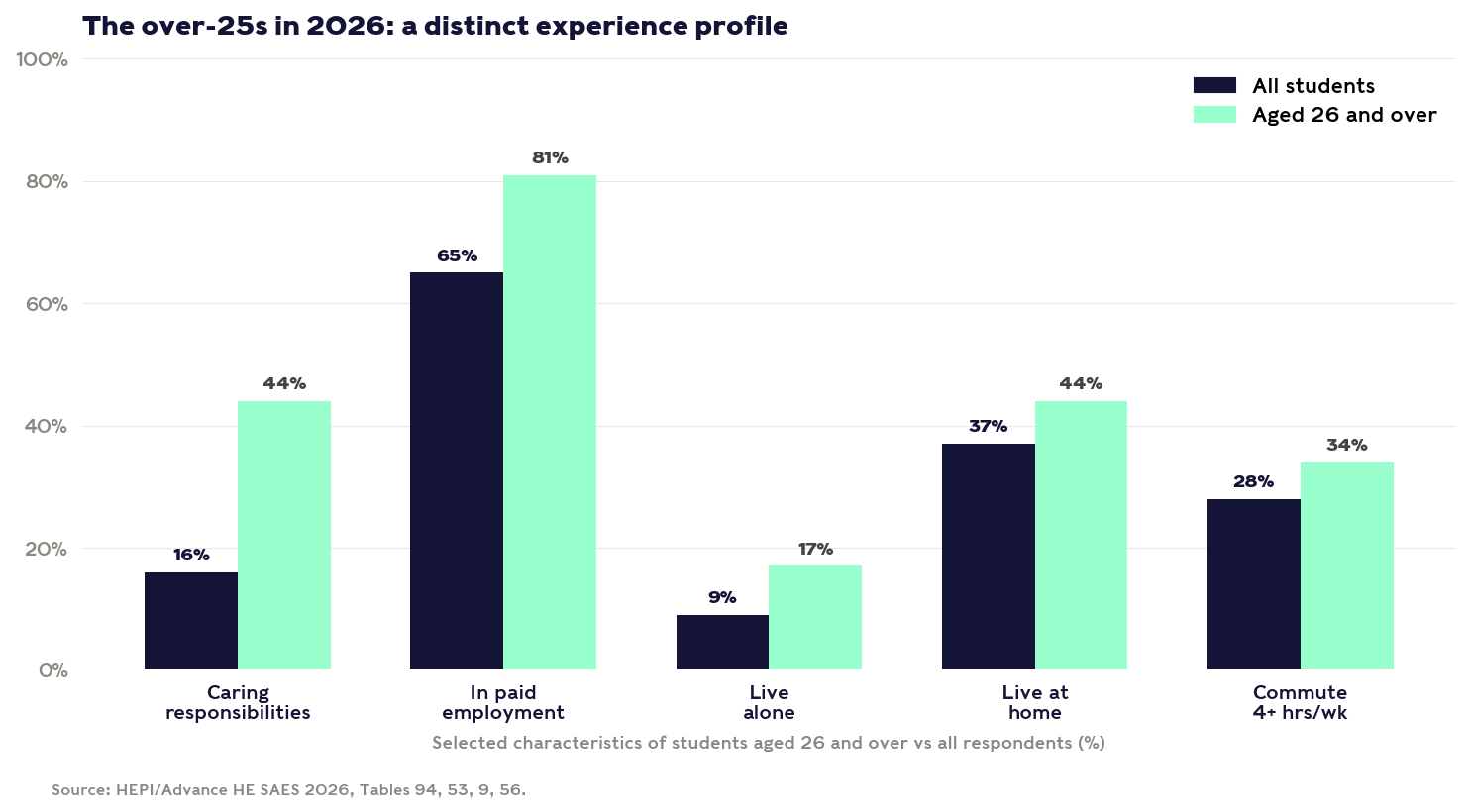
The over-25s who make up just over a quarter of this year’s weighted respondents are not a random scattering of mature students. They form a coherent cluster. Among them, 44 per cent have caring responsibilities, against 16 per cent overall. Eight in ten do paid work, against 65 per cent overall, most for ten or more hours a week. They are far more likely to live at home or alone, to commute, to have entered without A-levels, and to be further through their course.
That the published report applied age weighting for the first time this year is an implicit acknowledgement that the cluster matters. But once the working, caring, commuting cluster is this visible in the data, the implicit model behind much of the student experience debate – young, full-time, residential, campus-based, socially available, financially supported – starts to look like a description of the student the sector wishes it had, rather than the constrained students it increasingly teaches.
The price is wrong
The value for money improvement is real, then, and so is the easing of the expectations gap – on the cleaner 2024 comparison as well as the flattering 2025 one.
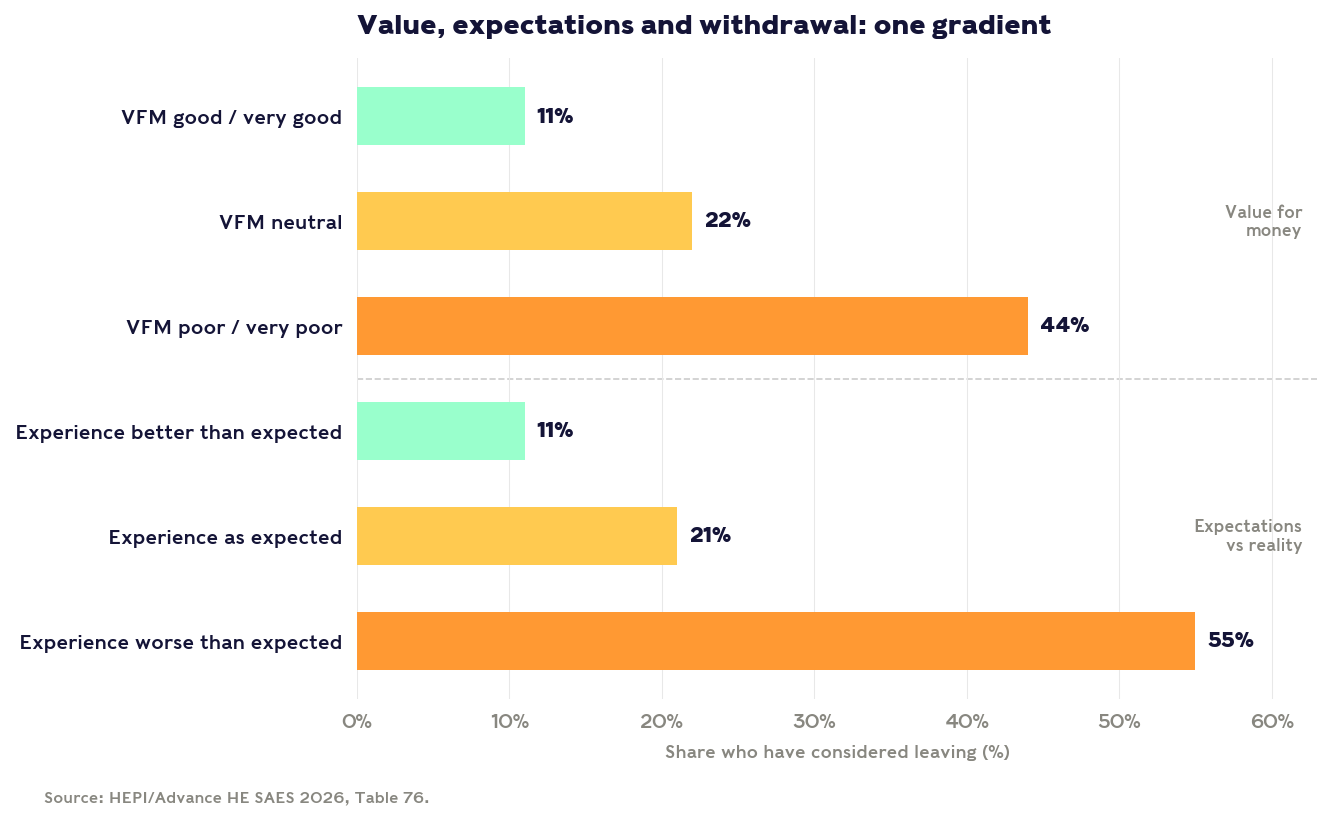
But the more useful finding is that value, expectations and thoughts of leaving aren’t three separate results. They behave as one gradient running from satisfaction to withdrawal.
Among students whose experience fell short of expectations, 56 per cent rate value poor and 55 per cent have considered leaving – the strongest associations anywhere in the tables. Among those rating value poor, 44 per cent have considered leaving. Among those rating it good, 11 per cent have.
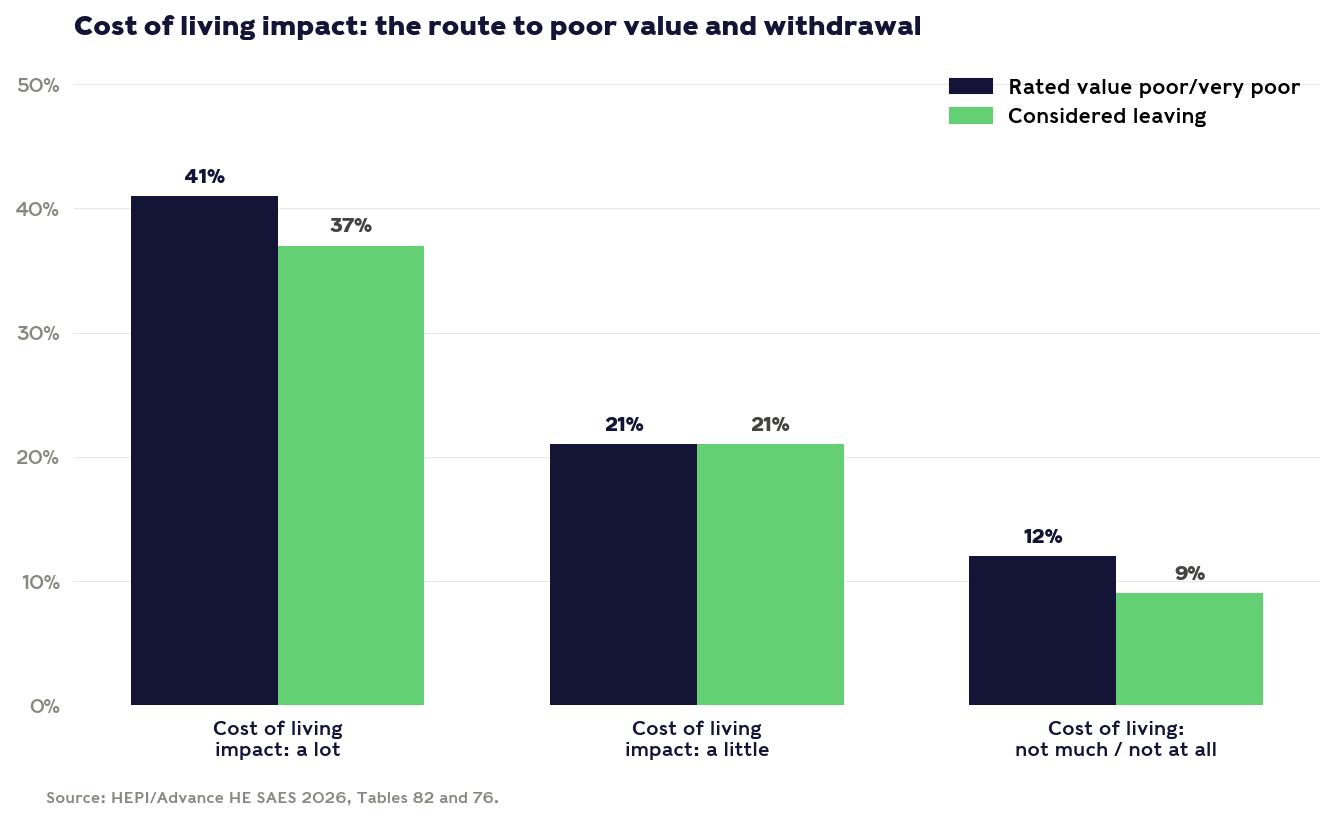
And what students are weighing when they reach those verdicts has diverged. Among those rating value good, the dominant frames are teaching quality (45 per cent) and course content – quality factors are cited by 88 per cent. Among those rating value poor, the frames are cost of living (44 per cent) and tuition fees (34 per cent), with teaching quality a distant 28 per cent. Satisfaction is taught – dissatisfaction is priced.
That doesn’t make teaching irrelevant – quite the opposite. It means students can recognise good provision and still judge the whole proposition poor value, because the financial and living conditions around it make participation feel impossible.
Over the longer run, teaching quality as a stated value consideration has fallen from 55 per cent in 2018 to 35 per cent now, while cost of living sits at its series peak. The terms of the value judgement have shifted from the lecture theatre to the bank balance.
The official report attributes part of the improvement to students being better prepared for the financial pressures of university life. The data suggest a different framing – cost of living is now cited as a value consideration by 35 per cent of all students, which is a series peak, joint highest in the survey’s history, and remains the primary frame for every student who rates value poorly.
What has shifted is not the pressure, but the proportion of students whose experience is good enough that other factors outweigh it.
Attendance noted
Credit where due – this is one of the more credible improvement stories in the 2026 data. All seven measured teaching behaviours improved significantly. Students report better access to staff outside timetabled sessions and more satisfaction with the timetable itself.
Four of five feedback measures rose significantly, and the share getting marked work back within a fortnight – around a third in 2022 – now stands at 60 per cent. The gains hold in the cleaner comparison cohorts, which makes them hard to dismiss as sample artefact.
But hold off on a “universities have fixed provision” conclusion. Total contact hours are flat against the comparable 2024 sample – the apparent fall is mostly the 2025 comparison talking. Independent study, though, is genuinely down, from 13.3 hours a week in 2024 to 11.1 now (all of these on the survey’s trimmed measures, which strip the zero and implausibly high responses that distort raw means), a significant decline and a sustained one – it was around 14.5 hours in 2022. The official report suggests AI tools may be partly responsible, by speeding up elements of independent study.
That explanation can’t be ruled out, but the multi-wave total hours data points to a simpler one – the combined work-and-study burden peaked in 2023–24 and has fallen as the share of students in paid work has edged down. Students are not studying less because AI has made study faster – they are studying less because other commitments have absorbed the hours, and the slight fall in the working rate has only partially restored them.
Put those two together and the question stops being about what universities provide and starts being about what students can use. Teaching is rated better at the same time as the hours students put into their own study keep shrinking – and the squeeze on those hours is coming from somewhere.
Paid work, caring, commuting and health do not appear in the timetable, but they are scheduled all the same. The survey increasingly measures the distance between provision and usable provision.
Notional value
The credit system, now hard wired into legislation via the LLE, sets an expectation – 120 credits a year, ten notional hours of learning per credit, 1,200 hours – roughly 40 hours a week across a 30-week year of contact, placement and independent study combined.
The survey has been measuring the components of that total since 2015. In 2026, the figure is 29.3 hours per week, 878 hours per year, or 73 per cent of notional. The shortfall is 322 hours – roughly the equivalent of eight additional full weeks of study that the credit framework assumes but the survey has never recorded.
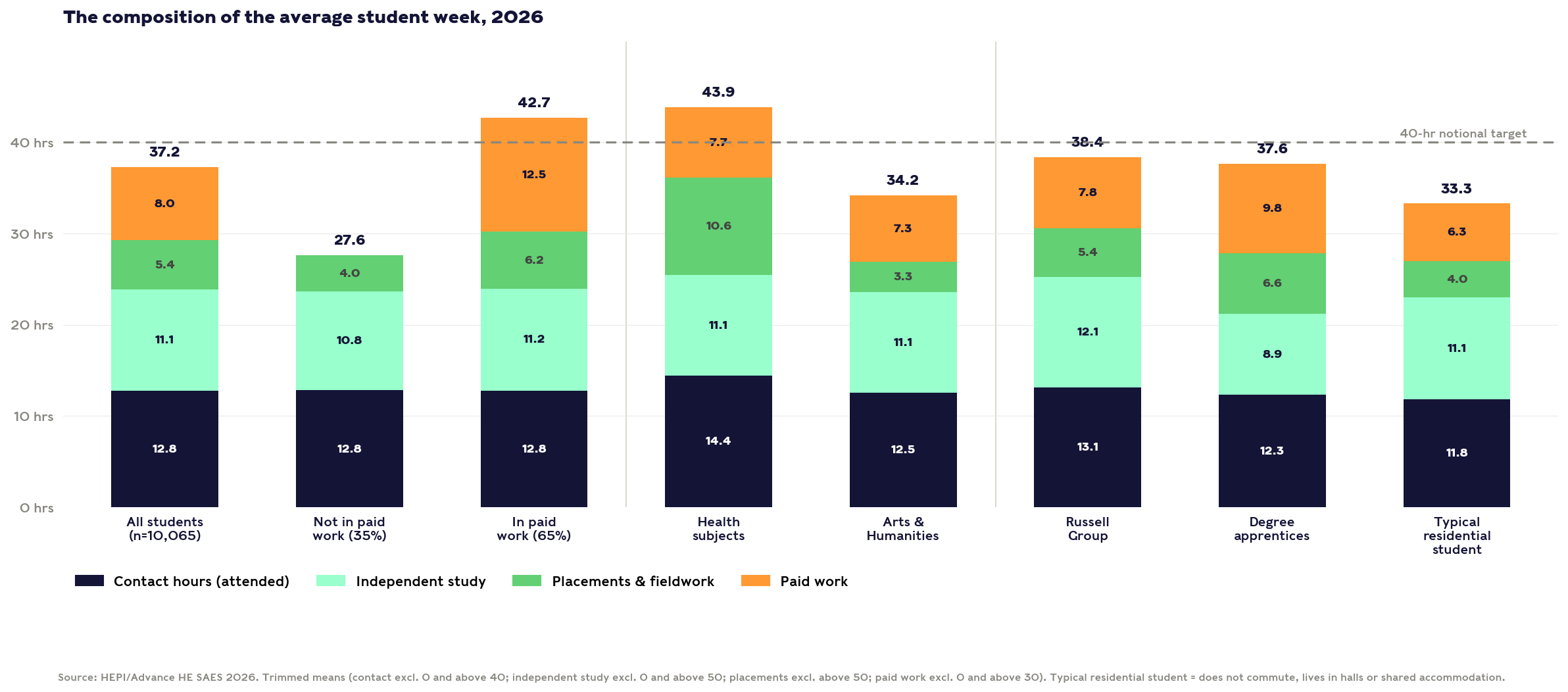
Contact hours and independent study combined stand at 23.9 hours a week in 2026. The deterioration over time is accounted for by independent study – 13.5 hours per week in 2023, 11.1 in 2026 – a fall of 2.5 hours, enough to knock 75 hours off the annual total. The assessment side points the same way – the number of coursework assignments students report is at a five-year low.
You can read that two ways, and the data contains both. Some of it is demand – fewer assignments set is a choice universities make. Some of it is supply – students rationing study hours around jobs, caring and commuting, because two-thirds of full-time undergraduates now also work.
Add the 12.5 hours of paid work the average working student does and their committed week is back above 36 hours – it’s not that students are doing less overall, it’s that less of what they do is study.
That reframes this year’s good news uncomfortably. Satisfaction is up, stress on the positive wellbeing measures is down, fewer students are contemplating the exit – at the same time as the academic demands placed on them, and the academic effort they can supply, are both falling.
A system can balance that way – ask less, and students cope better. The question nobody answers in a satisfaction survey is whether students who graduate having completed 73 per cent of the notional learning hours their qualification certifies will be glad of the trade in ten years’ time – or whether the sector is stealthily discounting the product rather than resourcing the user.
Not quite there
The positive wellbeing measures are modestly, genuinely better. Feeling that life is worthwhile is the strongest of the ONS measures at 6.88, happiness is up, belonging has risen to 66 per cent – all clearing the 2024 anchor with significance, which a pure composition effect would not. Life satisfaction trails the pack – up, but only marginally significant against 2024, and it’s the measure the older sample flatters most.
But one in eight students still reports low life satisfaction, nearly one in five low happiness, and the strain measures refuse to join the recovery. Anxiety is statistically unchanged on 2024. Loneliness is slightly worse. Selling 2026 as the year student mental health turned the corner would be writing a cheque the data can’t cash.
And the distribution matters more than the mean. Disabled students, students with mental health conditions, LGB+ students, women, estranged students, those hit hardest by cost of living and those who have considered leaving all remain clustered at the wrong end of the wellbeing measures – and these are not separate lists.
Of disabled students, 60 per cent report a mental health condition. LGB+ students are disproportionately disabled and disproportionately report mental health conditions. The same students keep appearing under different headings – disadvantage interlocks.
Working title
Last year’s standout stat was the leap in term-time working. This year the share has fallen back, from 68 per cent to 65 per cent – significantly, and within every cohort, so it isn’t a sample trick. That could be out of choice – it may well be a lack of jobs.
The students still working are working longer, and the population average is unmoved. Earning while learning has not retreated – it has normalised. Two-thirds of full-time undergraduates hold down a job, against barely a third a decade ago.
It is worth asking why. The standard explanations – students want work experience, career development, social engagement – are real for some students, although this year we don’t get data on that.
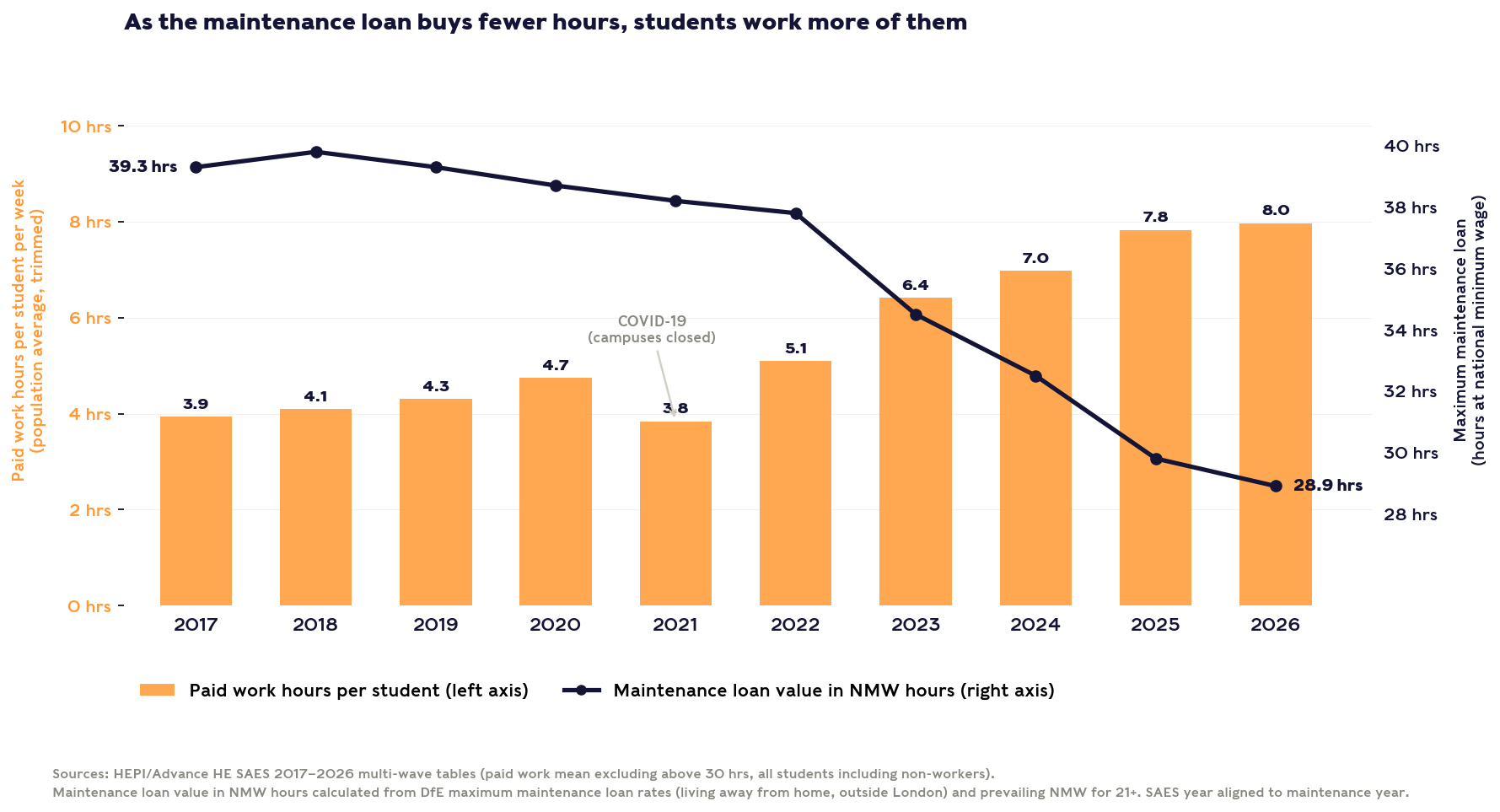
But ten years of SAES data, set alongside a simple calculation, points to a more structural driver. The maximum maintenance loan for a student living away from home outside London was worth roughly 39 hours at the national minimum wage in 2017. By 2025/26 it was worth 29 hours. That is a loss of ten hours of purchasing power in under a decade, concentrated almost entirely in the period since 2022 as inflation outpaced the uplifts.
The survey data moves in near-perfect mirror image: average paid work hours per student across the whole population – including those who do no paid work – rose from around four hours a week in 2017 to eight in 2026 on the survey’s trimmed measure, with the acceleration tracking the steepest years of the loan’s real-terms decline.
A maintenance system (that also sends signals to international students about how much to have in the bank) that once covered something close to a full study week now covers less than three-quarters of one, and students are doing the arithmetic that government has declined to do. The rise in term-time working is a funding gap expressed in hours.
New questions this year ask working students how their university supports them. Some 83 per cent identify at least one form of support – campus jobs (32 per cent), flexibility around deadlines (27 per cent), help recognising skills developed at work (26 per cent). But look at the 17 per cent who perceive no support at all – they skew towards women (20 per cent, against 12 per cent of men), first-in-family students (24 per cent), those rating value poorly and those hardest hit by cost of living. The students most in need of work-aware provision are the least likely to see any.
Commuting and residence run through all of this, but resist the lazy proxy. Commuters are not one population – the category blends relatively comfortable urban students living at home with more disadvantaged local students facing long journeys and few residential options. Living at home, living alone, commuting, working and caring overlap, but not always in the same direction. What they share is that each one converts time and money that the residential model assumes students have to spare.
Placing a problem
Geography sharpens it all. New analysis in the 2026 survey maps students by where they live during term – city, large town, small town or village – and the gradient is consistent across nearly every measure.
Students in small towns are less likely to say their experience has been better than expected (19 per cent, against 30 per cent of city students), less likely to feel they belong (59 per cent versus 68 per cent), and more likely to have considered leaving (26 per cent versus 22 per cent).
Wellbeing scores track the same direction – life satisfaction averages 6.40 among small-town students against 6.76 in cities, with similar gaps on happiness and worthwhile, and anxiety running in the other direction. Fourteen per cent of small-town students study entirely online and do not commute to campus at all, against 11 per cent of city students – a gradient consistent with poor transport provision pushing students towards remote study rather than pulling them towards it.
No protection
Meanwhile, a new harassment question should sit at the centre of the analysis. A fifth of students report experiencing harassment related to a protected characteristic. One baseline caution before anyone trends this next year – the figure is nudged upward by the older sample, since over-26s report harassment at 27 per cent against 19 per cent of under-21s – but the concentration, among minority groups who also sit below the headline on feeling able to speak, is unambiguous.
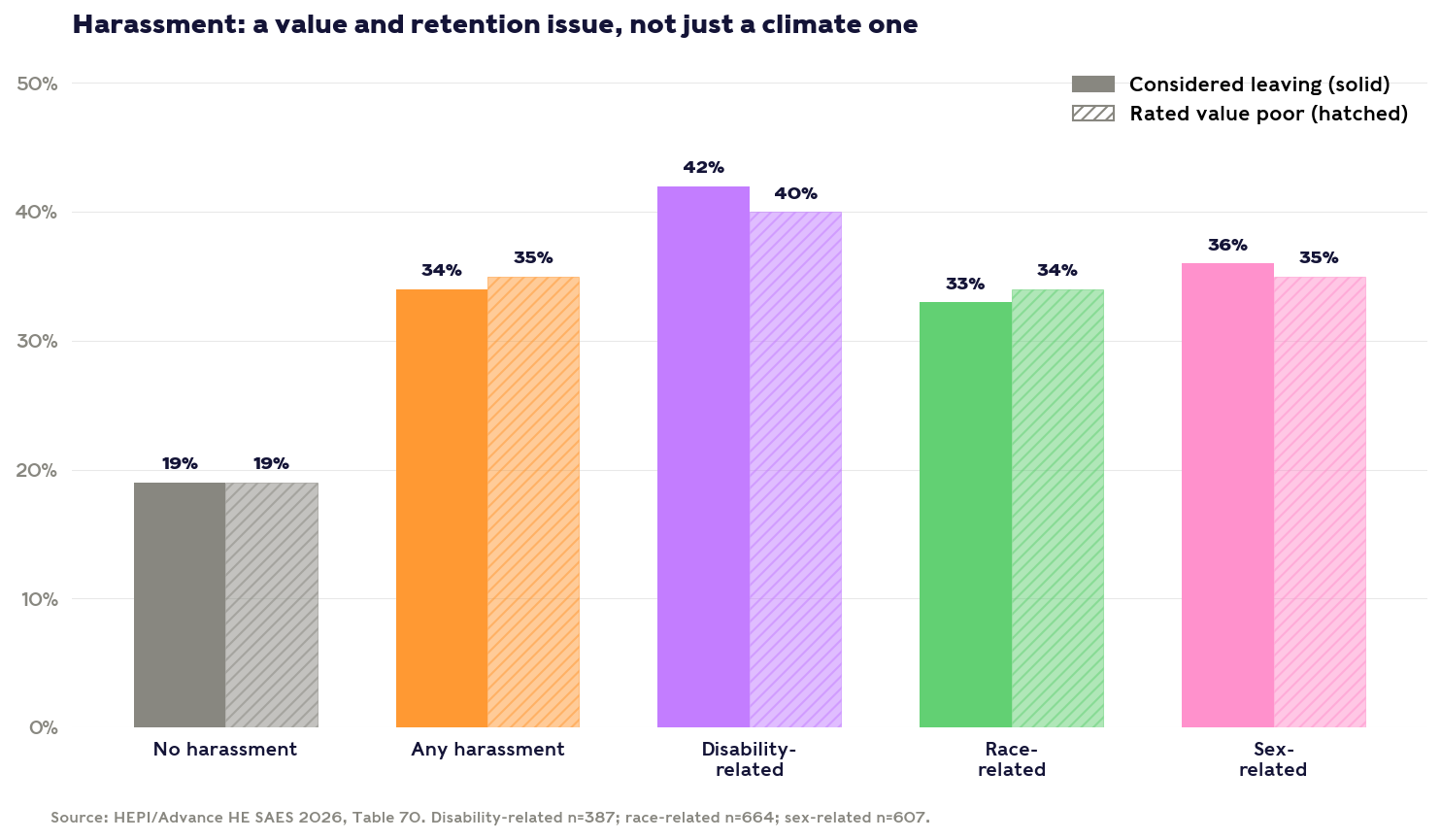
Students who have experienced any harassment are far more likely to have considered leaving (34 per cent, against 22 per cent) and to rate value for money poor (35 per cent, against 23 per cent). Every type tested – disability-related, sex-related, race-related – independently links to higher withdrawal thoughts and worse value, with disability-related harassment the most acute at 42 per cent considered leaving. Harassed students are also more likely to be in paid work.
Meanwhile the average climate measures have improved – 70 per cent now feel comfortable expressing their views, three-quarters say they hear a range of opinions in class, and a similar share say their institution promotes good relations – all genuinely up on 2024.
There is no contradiction. Average confidence in campus expression can rise at the same time as specific groups experience harms that push them towards the exit. The temptation will be to fold this question into the free speech culture war. The data says it belongs in the retention strategy and the value for money story instead – safety and dignity are conditions of the academic experience, not an adjunct to it.
Speak down
The 2026 survey also asked, for the first time, what lies behind discomfort in expressing views on campus – and the answer shifts the free speech debate onto different ground. Among the one in ten students who feel uncomfortable voicing their viewpoints, the single biggest stated reason is not institutional culture or peer hostility – it is not being confident at public speaking, cited by 52 per cent of the uncomfortable group.
That finding alone might be filed as a personal development matter rather than a structural one. But the school-type breakdown makes it structural. Among uncomfortable state school students, 55 per cent cite public speaking confidence as the barrier; among privately educated students in the same group, 36 per cent do – a 19-point gap, significant at 99 per cent.
State school students who feel comfortable, when asked why, are also more likely than privately educated students to credit their environment – their lecturers encouraging debate, their peers being open-minded. Private school students, by contrast, are more likely to credit their own skills and confidence.
The picture is not just one of state school disadvantage and private school ease, though. Privately educated students who feel uncomfortable are significantly more likely than their state school counterparts to say they are worried about being cancelled for their views – 38 per cent against 24 per cent, significant at 95 per cent. The anxieties are real on both sides – they just have different roots. The state school student’s barrier is a skills gap shaped by prior education. The private school student’s barrier is a social and reputational one. Neither is what the culture war commentary usually describes.
The official report’s recommendation – that institutions develop public speaking programmes, particularly for state school students – is a reasonable response to the skills finding as far as it goes. What it can’t reach is the prior educational inequality that produced the gap, or the reputational anxieties that hold back confident students.
The school-type gap shows up in the specific mechanism of discomfort, not in the headline rate: overall comfort with expressing views is only marginally higher among privately educated students than state school ones – 72 per cent against 69 per cent, not a significant difference. Fixing public speaking confidence would close part of the gap – it wouldn’t close the campus conditions that produce the rest of it.
Withdrawal symptoms
Thoughts of leaving are the behavioural readout of everything above – and at 22 per cent they are genuinely down, even if the real comparison says three points rather than seven.
Who is still considering it? The same groups as ever – students with mental health conditions (37 per cent), disabled students (34 per cent), LGB+ students (33 per cent), estranged students (37 per cent), women, carers, arts and humanities students, post-1992 students – and above all, those rating value for money poorly, at 44 per cent. None of this is news.
What should be news is how the reasons are shifting – mental and emotional health remains the single biggest driver at 30 per cent, but financial difficulty has more than tripled as the stated reason since 2021, from 4 per cent to 14 per cent – a series high, rising steadily even as the overall rate falls. Fewer students are thinking of leaving, but for those who are, money is an ever larger part of why.
The survey also asks for the first time about switching. Some 12 per cent of students have changed course or institution – a baseline, not a trend, so resist year-on-year claims next June. But the breaks are instructive – switchers sit at 37 per cent for considered leaving, 33 per cent for harassment, 33 per cent for poor value. Switching co-occurs with the whole dissatisfaction cluster.
It is less a story of healthy academic mobility than the behavioural footprint of a troubled experience – which is worth remembering as ministers talk up flexibility and the Lifelong Learning Entitlement as goods in themselves.
Conspicuous by absence
For universities, the diagnosis points away from “improve teaching” as a sufficient answer – teaching is improving, and the survey says so. The harder question is whether students can take up what’s provided.
That is a question about timetable design and compression, assessment load, placement expectations, commuter-aware and work-aware provision, employment rights information, harassment prevention that is treated as retention work, and decent routes for students who need to switch. It is provision design for the students institutions actually have.
The 40-hour question belongs on the same desk – if independent study keeps falling, institutions will need to decide whether to redesign courses around the hours students actually have, or fight to win those hours back – because drifting between the two is how qualifications get devalued by accident.
For government, the survey is a long, patient demonstration that maintenance, housing, transport, student employment and pace are the conditions under which academic quality becomes usable. A system can post improving teaching scores and still fail students if the financial and social conditions of study make participation brittle.
A maintenance package that pushes two-thirds of full-time students into jobs, then watches financial difficulty triple as a stated reason for considering leaving while study hours fall to 73 per cent of the certified load, has made itself a core determinant of academic standards – whatever departmental boundary it nominally sits behind.
One number from the official report’s own data deserves to sit alongside its recommendations. Financial difficulty as a stated reason for considering leaving has risen in every year since 2021 – from 4 per cent of those contemplating withdrawal then, to 6, 8, 11, 12, and now 14 per cent – a series high, and a 3.5-fold increase over five years. Mental and emotional health remains the single largest stated reason at 30 per cent.
To its credit, the report does follow this where it leads – it judges the Westminster government’s new subject-specific maintenance grants likely too small and too narrow to register, and calls for a more robust maintenance offer, alongside asks of the Northern Irish Executive and Scotland’s funding review. Wales, oddly, gets no ask at all.
The sharper silences are elsewhere. A new question finds a fifth of students have experienced harassment, the cross-breaks tie it directly to withdrawal risk, and the recommendations – landing in the first year of the OfS’s new harassment condition – say nothing about it. And where last year’s report carried a recommendation on student mental health support, this year’s, facing the same gaps in its own data, carries none. The report is at its bravest on money and its quietest on the harms its survey measures most precisely.
So the sector has earned the right to a cautious smile about teaching, feedback and value. But the more important 2026 finding is structural – student experience now behaves like a system of constraints. Value, expectations and withdrawal form one gradient – money, work, commuting, caring, health, safety and belonging determine where each student sits on it – and the system is currently balancing itself by asking less, not by resourcing more.
The question the sector should take from this survey is no longer whether different students have different experiences – we have known that for years. It is whether students have enough time, money, safety, health and belonging for higher education to be experienced as higher education at all – and what that might be doing to their long-term prospects.