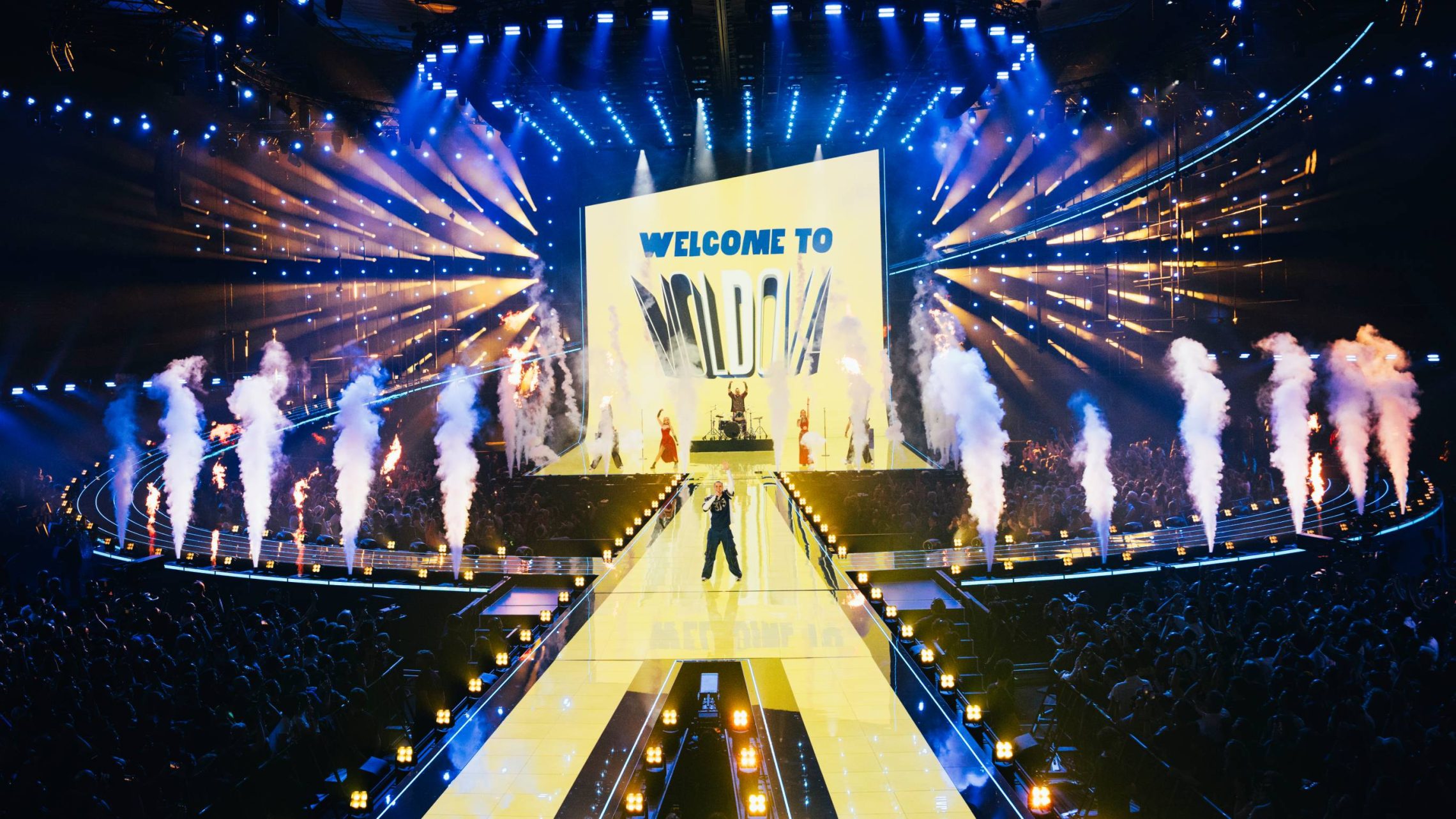


Easily my favourite entry in this year’s Eurovision, and the one that feels like it won Semi Final 1 based on the reaction in the Wiener Stadthalle, comes from Europe’s “least visited country” – Republica Moldova.
There was a lot to live up to. We’ve had Zdob și Zdub’s grandma drumming her way to sixth place on their debut in 2005, Nelly Ciobanu’s full village-wedding in 2009, and the emergence of Epic Sax Guy in 2010 with SunStroke Project’s “Run Away”. Moldova is a country that has managed to be both unmistakably itself and unmistakably Eurovision all on the slimmest of budgets.

It’s been banger after banger. SunStroke Project’s “Hey, Mamma!” in 2017 got them to third with groomsmen choreography and a sax hook, DoReDoS’s “My Lucky Day” in 2018 turned a bedroom-farce door-box into one of the most precisely staged three minutes in the contest’s history, and Natalia Gordienko’s “Sugar” in 2021 went full pink-candy camp with a gloriously elongated final note.
And then “Trenulețul” in 2022 – a song about that train journey loads of YouTubers have done from Chișinău to Bucharest via three glorious minutes of chaotic accordion folk-punk.

There might not be much money around, but the best thing about Moldova is that in the chaos there is craft. And Satoshi’s “Viva Moldova!” is a great example. It’s a maximalist folk-pop-rap song built from electronic beats, traditional Moldovan instrumentation, shouted hooks and a deliberately pan-European lyric, with cultural references in among the chaos to Moldovan food and authors.
It was all looking dicey – they withdrew from last year’s contest citing “economic, administrative and artistic challenges”. That all masked a more existential question – did the country still have the resources, and the cultural confidence, to send a credible package to Europe at all – especially when the public broadcaster TRM has a total annual budget of €10m?
Satoshi has an interesting backstory. Born in Cahul in southern Moldova near the Romanian border, he was a self-taught drummer from childhood who later studied at the Academy of Music, Theatre and Fine Arts (AMTAP) in Chișinău, Moldova’s national arts conservatoire.

For a specialist course like that, he had to leave his home town of Cahul in the South and head for capital Chișinău in a country that’s as concerned about the capital draining brains out of the rest of the country as it is the rest of Europe draining brains out of the country.
At least there’s a university in Cahul. For now.
My lucky day
One way to think about Moldova’s higher education reform agenda is as a straightforward aspect of EU-accession scramble. It’s actually a bit more than that, and one of its earliest architects is now the country’s president.
Maia Sandu’s first run at higher education reform began when she became minister of education in 2012. In a speech to the Universities Consortium around the time the new Education Code was being drafted, she set out an agenda for modernising the country with universities at its heart:
The production of knowledge and the training of highly qualified human resources, capable of ensuring the country’s economic and social progress, must take place in high-performing universities. This is the successful institutional model of the most advanced states in the world.
It involved a lot of work – moving doctoral programmes from the Academy of Sciences to universities, competitive project-based research funding scored against criteria including international collaboration capacity and willingness to invest own resources, a new National Agency for R&D, and EU integration as the anchor through Horizon 2020 association.

Corruption was (and still is) a big issue – it was Sandu who fought exam cheating in Moldovan schools and universities to the point where results actually declined (the only education minister ever to celebrate falling results) and it was Sandu who resigned from government when she discovered the rest of the ruling parties were involved in a banking-sector fraud worth 12 per cent of GDP.
A European-style university means, first of all, a democratic environment where everyone – both teaching staff and students – participates in decision-making, where the interests of the student as the beneficiary of educational services come first, and where academic performance is at the head of the table. In such an institution, it is much easier to increase the attractiveness of, and interest in, the study process.
Subsequent reforms have followed the same logic. 2022’s modernisation reform took Moldova’s higher education institutions from 29 to 16, merging universities with research institutes on grounds of demographics, duplication and weak institutional scale. A new funding methodology in 2023 brought performance-based elements, linking funding to equivalent student numbers and policy objectives.

The World Bank Higher Education Project has channelled around 280 million lei into universities over four years – the lion’s share of the roughly 350 million lei the system has received in this period – with more modernisation work running to 2029, covering quality assurance, the national qualifications framework, a Higher Education Management Information System, online admissions, dual education, and international student recruitment.
Together we can build an educated, free and prosperous society, with a sustainable economy.
Sugar
In December, education minister Dan Perciun convened a national conference on integrity and quality in higher education. Rectors, students, civil society and the EU’s High Adviser on education and research came to debate what diplomas issued in the Republic of Moldova mean in 2026.
His pitch was that the whole strategy of trying to keep Moldovan school leavers in Moldovan universities only works if the institutions deliver something worth staying for. The pitch put the responsibility on the system – convince young people that the home option is competitive education at European standards, or watch them leave.

A survey of more than 3,600 students and 400 staff across six major universities shows real progress – student satisfaction came in at 8.07 out of 10, and while students and staff agreed that harassment and bribery were serious, the ministry’s rapid response includes mandatory ethics modules, 3.3 million lei on video monitoring in exam halls across five universities, and a clear policy commitment to monitor and survey the system annually.
Funeriu’s framing in the context of AI was fascinating. Ethics, he argued, is a state of mind of the academic community, not a paragraph in a law. AI is a powerful tool, but without a clear purpose and an ethical compass it becomes a trap. Universitatea Tehnică a Moldovei (UTM) rector Viorel Bostan and Academy of Economic Studies of Moldova (ASEM) rector Alexandru Stratan agreed that assessment methods would have to change. I’ll send them a copy of Trained to Stop Learning.
The student experience is important when you’re trying to tempt people to stay. The Technical University of Moldova (UTM) runs a Students’ Fashion Day explicitly framed as a bridge between academia and the fashion industry, held in 2025 under the patronage of Moldova’s Ministry of Culture. It also stages a faculty comedy contest, TVC UTM – a survival of the old post-Soviet KVN-style competitive comedy tradition, reappearing as faculty rivalry and campus entertainment. And as you’d expect, every student association seems to have a Hora.
UTM’s “Mărțișor Meets Holi” event last March combined the UNESCO-recognised Moldovan-Romanian red-and-white spring charm tradition with Holi – colour, snacks, dancing, performances – which is a good shorthand for the country’s small but growing internationalisation agenda. The State University of Moldova has its folk song and dance ensemble Struguraș, recently congratulated by the rector after representing the university at the International Balkan Folk Festival in Turkey. And student housing is in the picture too – Moldova is renovating dormitories through the World Bank-backed Higher Education in Moldova project, with seven dormitories being fully renovated at an investment of €15 million.
Run away
The big test, though, of whether “modernisation” can maintain its integrity is happening 175 kilometres south of Chișinău, in the town Satoshi grew up in.
In December, the Ministry proposed to absorb the Bogdan Petriceicu Hasdeu University in Cahul into the Technical University of Moldova, creating a “university centre” branch in Cahul rather than a stand-alone institution. The ministerial case was familiar – 1,034 students of whom more than half were part-time, the regional recruitment pool is projected to fall 14 per cent by 2030 and 25 per cent by 2035, and it has staffing vulnerabilities including an aging academic workforce.

The case against was familiar too. A petition signed by local authorities, academics, civil society and business figures called for Cahul to remain an independent university with its own legal personality, arguing that a centre inside UTM could not compensate for the loss of its own budget, its own decision-making and its own identity.
Students intervened in January, objecting that the consultation period fell over the winter holidays, that the decision looked pre-determined, and that the recruitment-decline narrative didn’t match the facts on the ground – the institution had just exceeded 1,000 students for the first time in four years.

There’s a regional development strand too. Cahul is connected to the Port of Giurgiulești, customs, the police, local business and the cultural life of the south. Decisions made from Chișinău, opponents argued, risked deepening regional imbalance. The mayor reportedly offered up 1 million lei a year from the municipal budget for research and academic performance – minister Perciun’s counter was that integration into UTM would bring ten times that annually.
The government approved the reorganisation in February with a compromise package. The Hasdeu name stays. The Cahul site gets a separate budget line within UTM, a dedicated pro-rector role, at least ten seats in the UTM Senate, and a three-year moratorium on staff reductions caused by the reorganisation.
Hey, mamma!
It’s all tricky stuff for Sandu. Russia spent at least €300m trying to influence the Moldovan parliamentary election. The country’s whole GDP is around €20bn. How is it possible to stop that when people are spending 100 times more on it than you are?
The answer isn’t to outspend Russia – Moldova can’t. The answer is to build institutions that do the work Russia is trying to undo, and to build them well enough that the work holds. That means broadcasters that can identify disinformation, regulators that can enforce rules on illicit party financing, election authorities that can defend a vote count – and universities that reflect the values of the EU rather than those of Russia.
Public service broadcasters are having a rough decade. As for higher education, funding is tight everywhere, and where it isn’t tight, it’s politically contested.

The pedagogy graduates entering Moldovan schools currently qualify for a one-off allowance of 200,000 lei across their first five years in post – not because the labour market is short of bodies, but because the language and the curriculum and the relationship with the next generation are load-bearing parts of Moldovan independence.
The dual education arrangements rolling out from this academic year across third and fourth year programmes in marketing, logistics, pedagogy, engineering and IT aren’t really about employability metrics – they’re about whether Moldovan businesses have anyone to hire and Moldovan graduates have any reason to stay.
The 30-odd new bachelor’s specialisations opened in recent years – including AI, data science, animation, game design and multimedia – are about whether the country has the human capacity to do its own thinking.
Viva Moldova!
In a speech earlier this year at the State University of Comrat in Moldova’s Gagauz autonomous region, Sandu argued that universities are the places where dialogue, cooperation and trust are learned day by day. The Comrat context was specifically about a minority language and culture under pressure, and the role of a state university in keeping a small community’s intellectual life alive.
Every Moldovan university does that work for its own constituency. Whether the “university centre” inside UTM can do it as well is the question the absorption hasn’t yet answered.
A bit like our Eurovision entries, I’m struck with the idea that UK higher education often feels like it makes its case apologetically. It’s been a decade of trying to wriggle out of the culture wars by hiding values – institutional neutrality positions, careful statements, the promise that the education on offer isn’t ideological, just in case the government of the day takes against trigger warnings.
But the role of universities isn’t to teach democratic values like organic chemistry. It’s to be functioning examples of them – institutions where open enquiry, dissent within rules and the slow work of changing your mind in light of better arguments are how the place works.
For Sandu and Perciun, students who spend three years inside HE don’t graduate with the values transmitted into them. They graduate having lived inside a working example of what those values look like, and protect them everywhere they go.
Moldova is proud of that – and if we are too, we don’t half do a good job of hiding it.