


Following the Swiss and Austrian wins, in this year’s Eurovision France are attempting a popera hat-trick with Monroe’s “Regarde!”
Fourth in the odds behind Finland, Greece and Denmark, the seventeen-year-old is conservatoire-meets-Céline Dion – a “festival de vocalises”, staged in dramatic theatrical monochrome.
The Eurovision press office can never resist loading up the entries with values – it says here that “Regarde!” is about “love as a shared language across difference and struggle.”

That’s as maybe, but what I mainly think of when I hear it is my belly. That’s partly because when we visited an SU in January on our study tour we were treated to a sumptuous buffet of stuff that was cooked by students hanging out with local artisans. Now that’s what I call civic!
But it’s mainly because visitors aren’t the only people the French know how to feed.
Voilà qui je suis
As of 4th of May, every student in France can now eat lunch in a university restaurant for a euro.
It all began as a Covid emergency measure. The Centre national des œuvres universitaires et scolaires (Crous) – the public welfare body that runs French student housing, scholarships and catering – had long offered bursary-holders meals at €1, with everyone else paying €3.30 for a three-course lunch.
During the pandemic the €1 rate was extended to students who could demonstrate financial need. By 2024 the scheme covered around 667,000 students and served 46.7 million subsidised meals a year.
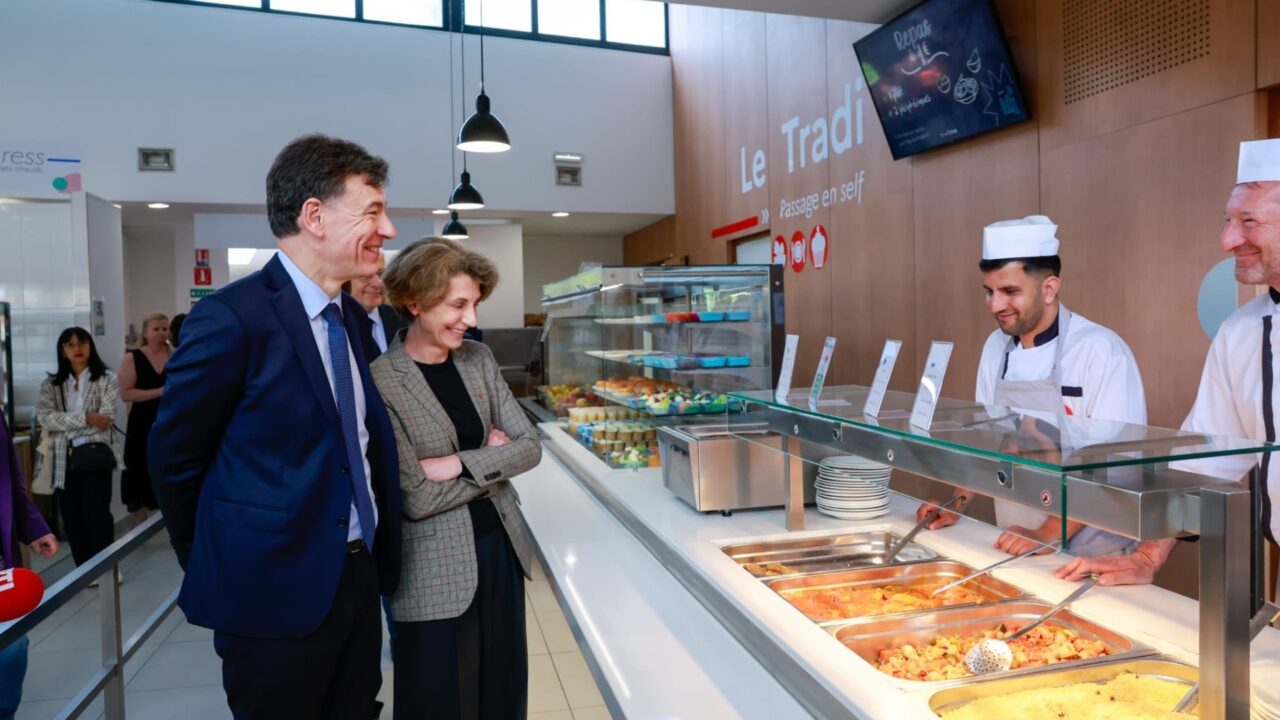
The big change is universality. Now any university student, vocational student, doctoral candidate or civic-service volunteer who walks into a Crous restaurant and shows their ID gets the €1 price.
The government has allocated €30 million for 2026 to compensate Crous for the lost revenue, plus a further €20 million for extra catering staff, with €120 million pencilled in for 2027.
The bill was passed after years of being blocked by the presidential majority – but the socialists made it their price for playing along with the coalition now needed to keep National Rally out of power.
S’il fallait le faire, j’arrêterais l’hiver
The minister now selling it spent years calling the idea indefensible. Philippe Baptiste – a former president of the French Space Agency who came to the higher education brief from the technocratic wing of the system in October 2025 – described universalisation during earlier votes as “socially unjust” and as “a system benefiting the most privileged”.
The Macronist position was that means-testing was the principled position – a system of equity and social justice that targeted those in need.
Now Baptiste describes it as “a small internal revolution” – the new line is that the income cut-off for bursary eligibility is too blunt an instrument, and that there are large numbers of students sitting just above the threshold whose financial situations are no different from those just below:
Income thresholds create arbitrary cliffs – the household a pound over the limit gets nothing, the household a pound below gets everything, and the household above is rarely as different from the one below as the eligibility code pretends.
With these sorts of things, take-up among those who qualify is always lower than eligibility figures suggest, because applying is itself a friction – the paperwork, the interview, the documented declaration of poverty. Means-testing carries administrative costs that eat into the subsidy delivered.
And the stigma of being visibly identified as the poor student in the queue is enough to push people away from food they’re entitled to.
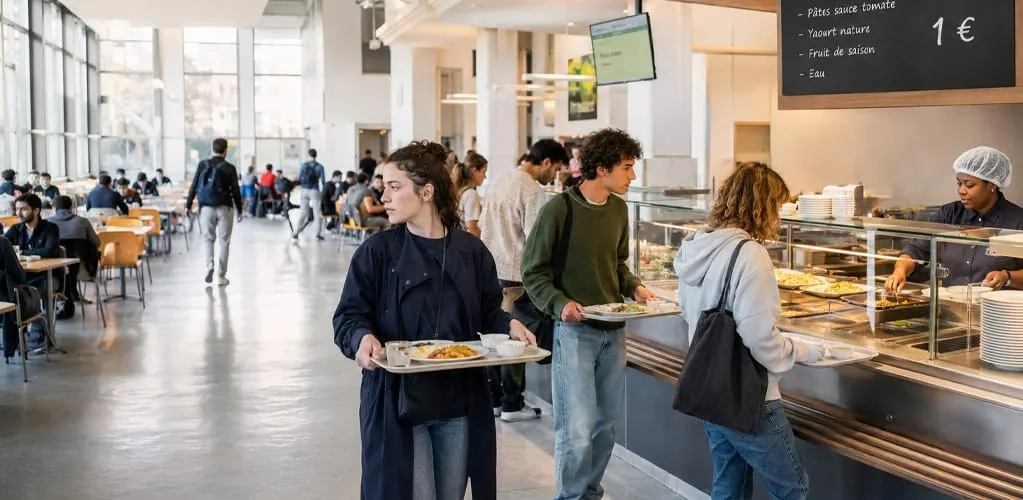
A January 2026 survey found that 48 per cent of French students had gone without food for financial reasons, with 23 per cent doing so several times a month. The COP1/IFOP barometer puts the share of students regularly skipping meals because of money at around 34 per cent – materially higher than the 29 per cent national average for the population as a whole.
A study at Sorbonne Paris Nord published in PLOS One last October found 11 per cent of students experiencing quantitative food insecurity and 35 per cent experiencing qualitative food insecurity, with a clear association between food insecurity and risk of academic dropout.
And in our own research with Cibyl, we found that students in major financial difficulties were significantly more likely to have struggled with concentration due to lack of food, to have skipped meals entirely, and to have had to ask family or friends for money to eat – with students entitled to means-tested bursaries twice as likely as their peers to have cut down on basic hygiene and health items.
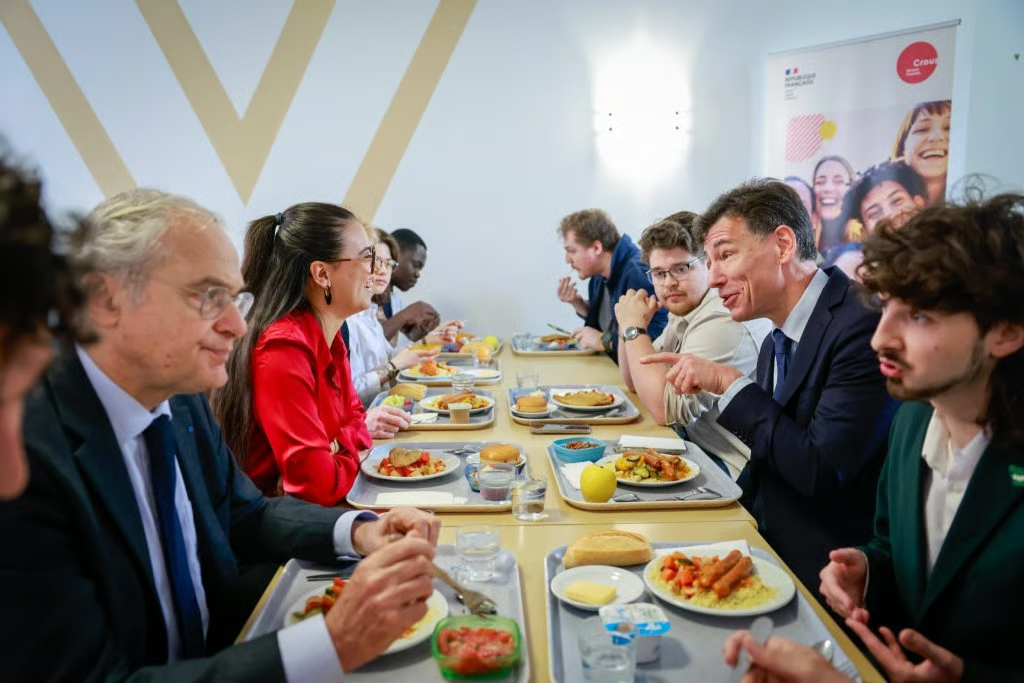
What’s different about France is that it has treated all of this as a thing that needs policy, rather than as a thing that needs charity.
It also demonstrates that when a country decides that food on campus is a welfare entitlement rather than a commercial transaction, it can find the money:
Regarding the €1 meal, you know that the 2026 budget is the result of a compromise, and if you followed the debates in the Assembly, you also know that I was initially opposed to this measure. That said, these 90 million euros are going to be given to students, who are not among the most affluent people in the population. So it is not money wasted, even if it will not be specifically directed at those who need it most.”
J’ai cherché un point de repère
In Finland, the Kela meal subsidy has been in operation since 1979. From 2026 the state pays €2.80 per meal across roughly 275 participating restaurants, bringing the student price to around €3.10. It’s universal, set in statute, and administered centrally.
Croatia subsidises 71.24 per cent of a menu meal via the iksica card. Italy treats canteen services as an essential level of provision under the diritto allo studio, the right to study, grounded in Articles 3 and 34 of the constitution itself. Bulgaria has a hard 50 per cent statutory subsidy under Article 31(3) of its Dormitory Ordinance.
Germany has no federal student meal law, but has a Studierendenwerk in every region which operates Mensen as part of a statutory welfare mandate alongside housing, health and grants. Austria runs canteens through a state-owned company and pairs catering with per-meal subsidies of around €0.80 to €2 for students on grants or with monthly food budgets below around €170 to €200.
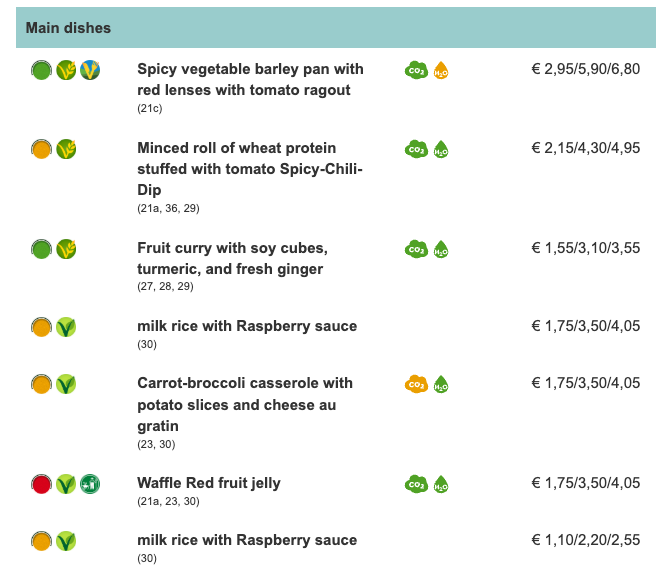
Norway tasks its studentsamskipnader with welfare provision including canteens via the 2007 Student Welfare Organisation Act. In Spain, each university runs its own bonos comedor – vouchers funded from the institution’s own budget. Portugal operates institutional welfare meals around €3.
But my favourite is Slovenia. The country never had the sort of large cafeteria infrastructure of others to deliver subsidies through, and so Zakon o subvencioniranju študentske prehrane gives every student with student status one subsidised meal per working day at any participating restaurant, anywhere in the country – around €5.19 per meal as of March 2026, indexed annually.
Each subsidised meal must by law be a three-course meal, with salad mandatory. The students’ union runs the tender competition. Both local businesses and multinational operators take part – which is why Slovenia is one of the only countries on earth where you get a bowl of soup in your Big Mac meal the state picks up most of the tab.
Je ferai tout ce que je peux
In late April, Brunel University London published a twenty-month British Academy-funded study of food poverty in English higher education. The headline finding was that 63 per cent of universities (or their SUs) now operate a food bank for students.
Of those universities that responded in detail to the Brunel team, some did it openly – free fruit, free breakfasts, occasional free hot meals at weekends, particularly around exam times. Others did it discreetly. Don’t want to send off the wrong vibes on the open day, eh?
But it’s all in retreat. Offers of free meals “for all” and localised schemes through specific departments are being scaled back as universities face their own financial strain. One of the academics working on the Brunel study:
There is a very real cost of providing free food at universities, with funding varying from one institution to another. Staff at the universities we spoke to pointed to the cost of running these schemes and how they are not viable in the longer term.”
One staff member told the researchers that food poverty is the biggest on-campus issue affecting student engagement and mental health. The researchers also found that students are often ashamed of accessing free food, and some were even concerned that doing so might be noted on their student record – which means whatever uptake figures we have are almost certainly an underestimate.
I note in passing that in the UK, CUBO’s Annual Benchmarking Survey 2026 makes no mention of food banks or free food. Year-on-year prices across food and drink items surveyed saw an 8 per cent increase in 2024/25, and the percentage of institutions offering a subsidised meal offer fell to 44 per cent in 2024/25, compared to 53 per cent and 66 per cent in the previous two surveys.
The Brunel team found that some international students expressed concern that they were taking support away from home students. Others felt that, given their higher fees and the absence of close familial support, they were in greater need of the provision.
They reported particular shock at UK food prices, with many ending up on cheaper processed food when the fresh fruit and vegetables they were used to at home turned out to be unaffordable here.
The same pattern shows up in continental research. A study of international students at the University of Debrecen in Hungary found 85 per cent of participants experienced limited access to nutritious and culturally appropriate foods, with 70 per cent reporting hunger due to financial constraints.

International students facing food insecurity described five psychosocial themes – stress and anxiety, sadness and depression, anger and frustration, guilt over financial burdens, and social isolation – and many continued to prioritise academic deadlines over eating, a coping strategy with predictable long-term implications.
Back home successive governments have spent years signalling that international students are at best a fiscal asset to be tolerated and at worst a migration number to be reduced. The food insecurity research suggests something deeply uncomfortable – that the cohort the sector now most heavily relies on to balance its books is the cohort most likely to be eating badly, hiding it, and developing mental health problems as a result.
Je n’ai que mon âme
The closure of the Strait of Hormuz will have real impacts. The Food and Drink Federation anticipates that food inflation will reach at least 9 per cent by the end of this year, citing the disruption to oil and gas facilities and its impact on energy-intensive food manufacturing.
The Energy and Climate Intelligence Unit reckons UK food prices are on track to be 50 per cent higher by November 2026 than at the start of the cost-of-living crisis in mid-2021, with pasta up 50 per cent, frozen vegetables up 55 per cent, eggs up 59 per cent and beef up 64 per cent over that period.
This winter is going to bite – and bite harder in the UK than across most of the rest of Europe. The danger is that the slice of the student body that has spent the last three years using campus food banks, free-fruit schemes and weekend community meals is likely to find – right at the point of greatest need – that universities can no longer afford to keep them running.
But why?
It’s partly that we never built the sort of independent student services infrastructure that many others did. University autonomy – that arrogant sense that most of the money spent on HE and students should be controlled by universities themselves because they know best – has seen canteens turn into posh cafes, and volume catering aimed at all every day turn into outlets that offer occasional treats to the few that can afford them.
It’s also allowed the state to abdicate on meeting students’ basic needs, as ministers flourish fantasies like “we’ve future proofed maintenance loans” while basing them on projections that obviously won’t hold.
It’s partly, as I’ve argued before here, that universities struggle with those levels of Maslow’s hierarchy that are underneath self-actualisation. A historic mixture of the student body being from relatively affluent backgrounds and an assumption that food, friendships and health are the state’s job has seen it neglected. It’s partly a profound lack of interest in the preconditions for learning – because entry tariffs and “aptitude” above the surface, and assumptions about social class, student struggle and preparedness below it have always allowed the sector to blame someone else when the student gets in but struggles to get on.
It’s also partly a result of universities’ lobbying being more focussed on their own budgets than their students’, partly about the shame of poverty being imported into the public positioning of universities’ brand positioning statements, partly a desire to know more about how a student might score on the NSS than how they might fund their next meal, partly that it’s so difficult to drop out in the UK that the lack of it hides real student struggle, and partly the army of jobsworths that seem to suggest a group of students cooking something for others on campus will result in widespread poisoning.
But a real crisis is coming, and that little pantry the SU is running almost certainly won’t cut it. As the French would say, “On n’apprend pas le ventre vide.”








Interesting how this is approached in other European countries. I feel that there is also a cultural element. It’s a generalisation, but UK culture is more individualistic and business / profit driven than other societies – the fundamental mindset seems to be that food is ‘your own problem’