
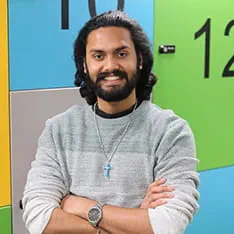


When we talk about democracy in SUs, we usually start with elections.
Votes are cast, results are announced, and legitimacy is assumed.
But after two years as an SU officer, one as president, and as an international officer, I’ve learned that elections don’t decide who is trusted.
They decide who holds the title. Trust is something else entirely, and trust is where power really sits.
I didn’t come to the UK to be a student officer. Like most international students, I came for my education, with a plan – or at least a sense – of what might come next.
Becoming an officer came later, and then I ran, and then I was elected.
That’s where something shifted. For many international officers, the moment you step into the role is also the moment you lose the safety net your course provided.
If you’re a final-year student, your friends graduate – they move into jobs, return home, or start very different lives, and familiarity disappears almost overnight.
You’re left in a new country, often without the peer networks that home students can fall back on, and your work becomes your primary community, your colleagues become your social circle, and your role becomes the thing you’re known for.
That’s not healthy, but it’s common – and it means international officers often begin the job already carrying a level of isolation and adjustment that home students simply don’t face, before trust is even questioned, before credibility is tested, before you even open your mouth in a meeting.
The usual accusation
On top of that starting disadvantage comes a familiar accusation – “you only talk to your own community,” “you’re only hearing from international students,” “you can’t speak for everyone.”
It’s usually framed as concern about representation, but it misunderstands how everyone operates.
No officer speaks to everyone, and no staff member does either. We all rely on networks, trusted conversations, and people we hear from repeatedly.
Home students do this too, but their networks are treated as neutral, invisible, and representative by default. International students’ networks are visible, and because they’re visible, they’re treated as suspect.
Just because someone is a home student doesn’t mean they’re speaking to all home students – they still return to the same people, the same groups, the same spaces. The difference is that no one names it.
When an international officer does the same thing, it’s described as bias.
This shows up most clearly in meetings. An officer says, “I’ve spoken to students about this,” and a staff member responds, “our data says something different.”
On its own, that’s a fair challenge – data matters. But add the follow-up – “have you talked to enough people?” or “are you sure this isn’t just your friends?” – and something changes.
The discussion stops being about the issue and becomes about the credibility of the officer raising it.
That burden isn’t applied evenly. International officers are asked to prove, again and again, that their insight is legitimate – that they’ve spoken widely enough, that their experience isn’t too narrow, that their mandate isn’t partial.
Scrutiny isn’t the problem. Asymmetry is.
Whose standards?
There’s an uncomfortable truth we rarely name in this sector – much of what we call professionalism is simply familiarity that’s been normalised.
Who sounds confident in meetings, who understands the unspoken rules, who knows when to push and when to soften and when to wait – when those cues line up with expectation, credibility is assumed, and when they don’t, credibility is tested.
International officers are more likely to misread those cues, not because they’re less capable, but because they’re operating across cultures, systems, and assumptions that were never designed with them at the centre.
So when we talk about “standards,” we should be honest about whose standards they are, and who learned them the hard way.
This isn’t just frustrating – it’s political. When trust is uneven, officers adapt. They over-prepare, soften their language, delay challenge, and choose safer framing, not because the argument is weak, but because the risk of being dismissed is real.
I’ve done this myself – not because I lacked conviction, but because conditional trust changes how you show up.
That should worry anyone responsible for governance. Systems that rely on informal trust don’t just marginalise certain voices – they reduce challenge, reward conformity, and quietly narrow the range of perspectives that shape decisions.
Not about bad people
It would be easy to frame this as staff versus officers, but that wouldn’t be fair. I’ve sat on both sides of the table, I’ve trusted some voices more instinctively than others,
I’ve leaned on data when it suited me, and I’ve benefited from being legible to the system. This isn’t about individual intent – it’s about inherited norms that feel neutral because they’ve never had to justify themselves. And neutrality, in this context, is the problem.
If organisations don’t design how trust is built and validated, they default to familiarity – and familiarity almost always favours the same people. Trust isn’t soft or accidental.
It’s produced by systems – how insight is gathered, how lived experience and data are weighed together, how challenge is received, and who gets the benefit of the doubt. If we care about democracy, those things can’t be left to instinct.
That means clear expectations for what counts as student insight, explicit ways of balancing lived experience and data, and processes that don’t require officers to perform credibility in real time. None of this removes scrutiny – it makes scrutiny fairer.
Over to the CEOs
This isn’t a message for officers – we don’t design the system. And it isn’t a criticism of individual staff, most of whom are working within structures they inherited. This is a question for CEOs, senior management teams, and trustees – if trust is the real election, who’s accountable for how it’s run?
Are you comfortable with legitimacy being quietly re-tested in meeting rooms after elections are over? And are you willing to accept that international officers are often where these cracks appear first – not because they’re weaker, but because the system was never built with them at the centre?
We celebrate democratic structures, but trust is where democracy is actually practised. Until we’re willing to examine how trust is granted, withheld, and defended, elections will continue to look fair while power quietly flows elsewhere.
A senior leader responds
Mike Hill is Director of Membership Services at ARU Students Union
As a senior manager, this piece lands uncomfortably – and it should.
What Rohan describes isn’t about individual behaviour or intent, but about systems that rely too heavily on instinct, familiarity, and inherited norms, and those systems sit squarely within the responsibility of senior leadership.
If trust is operating informally, unevenly, or conditionally, then it isn’t something officers can fix through better performance or clearer evidence – it’s something leaders must design for.
That means being explicit about what we value as legitimate student insight, how we balance lived experience and data, and how we ensure challenge is welcomed rather than quietly filtered.
It also means recognising that international officers, liberation officers, and those without long-standing institutional familiarity often experience these gaps first – not because they’re less capable, but because our systems weren’t built with them in mind.
If we’re serious about being student-led, elections can’t be the end of our democratic responsibility – they’re the starting point.
Our task as leaders isn’t to ration trust, but to build conditions where it’s applied fairly, consistently, and consciously, even when it challenges us. That’s work we need to own.


