The most universally despised creature in France
On Day 2 of the Wonkhe SUs Rhineland study tour, the tean discovers how French student leaders are translating hardship into political leverage. – one poster, grocery shelf, and housing hotline at a time
SU Blogs|
Jim Dickinson
Jim is an Associate Editor (SUs) at Wonkhe
One of the first things we do on these visits is look for posters.
They often tell you what an SU actually cares about, and what it thinks – not the mission statement on the website, but the thing a student leader thought was worth printing and sticking on a wall.
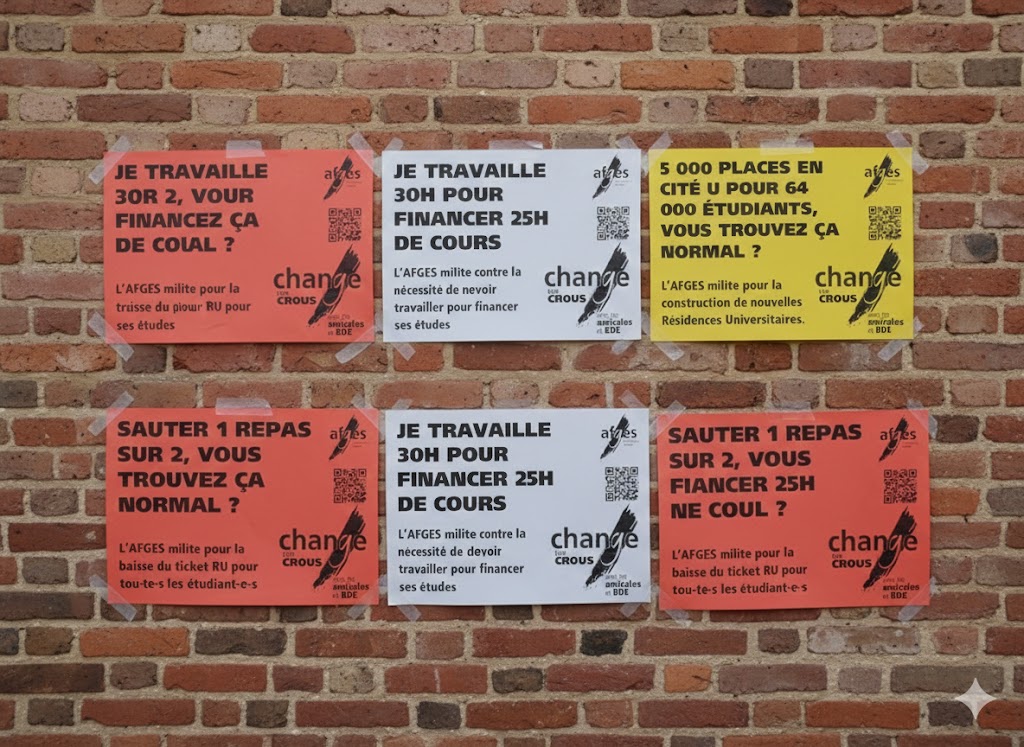
At AFGES in Strasbourg, the walls are covered in them. There’s bright blocks of colour, punchy slogans, QR codes, and a recurring question:
Vous trouvez ça normal?
One yellow poster asks:
5,000 places in student housing for 64,000 students – you think that's normal?
The maths is worth sitting with – one CROUS bed for every thirteen students. Twelve out of thirteen in the private market, competing for landlords' attention, hunting for guarantors, paying whatever the market demands. That's the baseline these students enrolled into. The poster asks – should it be?
One asks:
Skipping every other meal – you think that's normal?
Another asks:
My parents earned €20 more last year – that's €100 less per month for my grant.
France's means-tested grant system uses household income brackets. Cross a threshold by a few euros and your grant drops a tier – a tiny pay rise for your parents becomes a significant loss for you. The poster doesn't explain this – it just makes it visible. It makes you angry about something you'd otherwise accept as how things work.
That's the point. AFGES calls the campaign Change ton CROUS – Change your CROUS – and its genius is refusing to let students naturalise their own hardship. You adapted to the housing shortage, you got used to skipping meals, you normalised it. The poster says – don't.
The building that tried to destroy itself
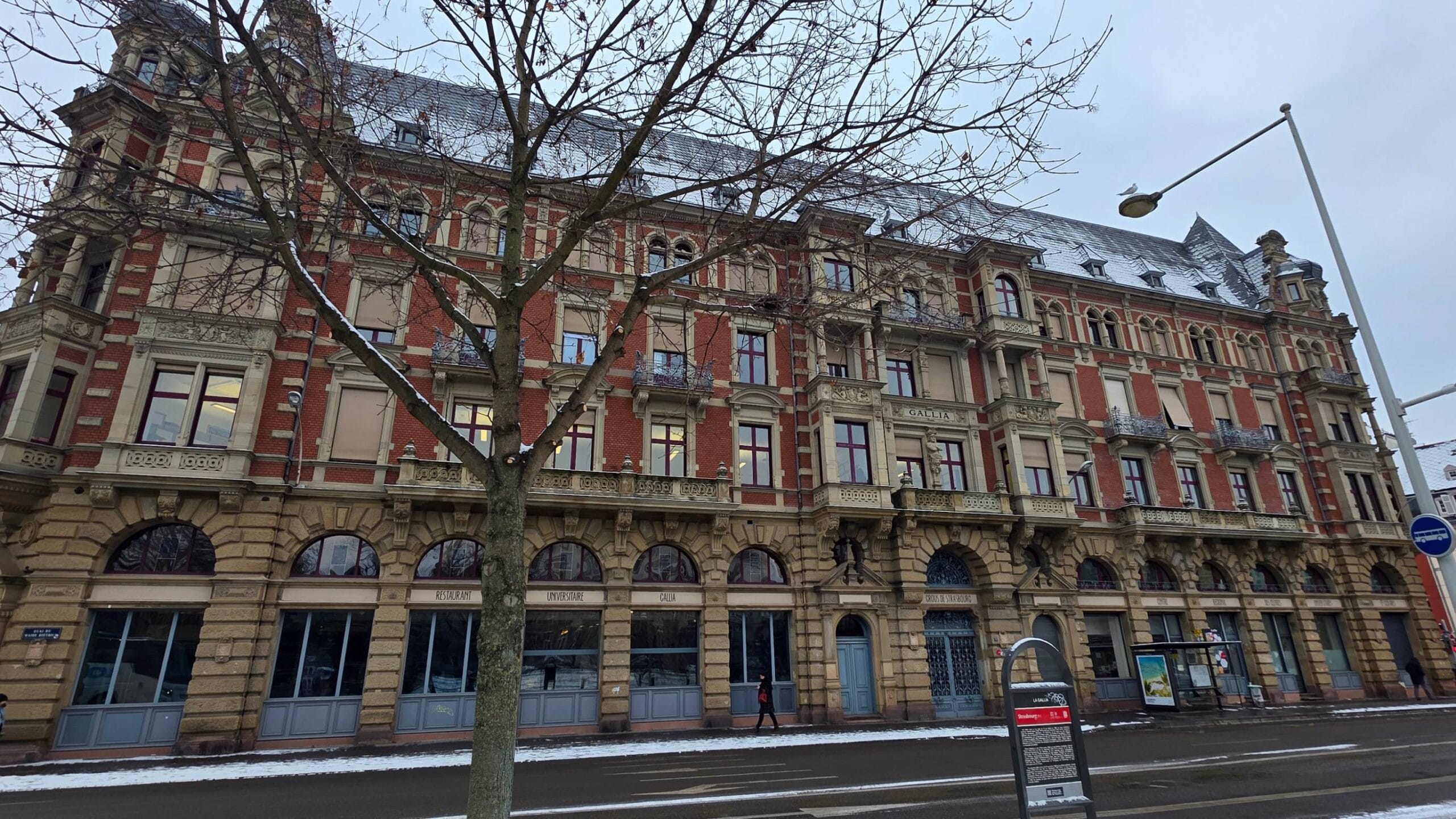
This morning we're at 1 Place de l'Université in Strasbourg on Day 2 of the Wonkhe SUs Rhineland study tour – thirty-five SU officers and staff spending a week in Germany, Switzerland, France, Luxembourg, Belgium and the Netherlands.
Each stop surfaces different parts of the student interest question. In Strasbourg, it's housing – and specifically, what happens when a student can't find a guarantor.
AFGES – formally "AFGES – Les étudiant-e-s d'Alsace" – was founded in 1923 as a federation of faculty "amicales", friendship associations, in a city that had been German since 1871 and became French again in 1918.

Students needed to organise, and they did – creating a federation that would outlast regime changes, world wars, and attempted revolutionary dissolution. The organisation still exists under Alsace-Moselle local law, the 1908 statute that governs associations in the territory, a legacy of that Franco-German history that gives it a slightly different legal character from standard French associations.
In 1927, AFGES opened La Gallia, a student restaurant it would run for nearly ninety years – students feeding students, at prices students could afford. During the Second World War, when the University of Strasbourg evacuated to Clermont-Ferrand to escape German occupation, AFGES went too.
It survived the war, re-established itself, and kept going. By the late 1980s it was involved in founding FAGE – the Fédération des Associations Générales Étudiantes – one of the national unions that now spans dozens of cities and gives local organisations like AFGES their lobbying infrastructure. Then there's 1966.
A group of Situationist radicals had taken over the AFGES leadership with the explicit intention of destroying it. They used the organisation's funds to publish De la misère en milieu étudiant – On the Poverty of Student Life – declaring that the student was:
…the most universally despised creature in France, apart from the policeman and the priest.
It called for universities to be abolished, and for “spectacular revolt” to replace the tedium of academic careerism.
The pamphlet became a founding document of May 1968. AFGES was placed under judicial administration. But the building survived its own attempted abolition – and students in it kept running student services through the wreckage.
The organisation that Situationists tried to abolish because student life was insufficiently revolutionary now runs food banks for students who can't afford to eat and housing casework for students who can't find guarantors. History has a sense of humour. The students queuing for groceries probably don't care much about the theory of the spectacle.
Someone to sign
Maxime Friess meets us in the AFGES office – Chargé de Mission Affaires Sociales, doctoral student in computer science, deputy elected member on both the Maths and Computer Science faculty council and the CROUS de Strasbourg board. We ask about housing. He pulls out his phone and starts showing us the AFGES casework system.
One of the problems is guarantors. If you're renting in the French private sector, landlords want someone to vouch for you – a parent, a relative, someone with income who'll cover the rent if you default. Same as the UK – if your family can't or won't sign, or you’tre international, you're stuck.
In the UK, guarantors often need to be UK-resident, creditworthy and be earning two or three times your annual rent. For a £600-per-month room, that's someone earning £15,000 to £22,000 who's willing to take on unlimited legal liability for your tenancy. If your parents are wealthy and British, it's paperwork. If they're low-income, overseas, estranged, or simply not in your life – if you're care experienced, a mature student, an international student, a refugee – you have a problem.
Commercial services exist. Housing Hand, UK Guarantor, RentGuarantor – they'll all act as guarantor for around £300 a year, which works fine if you can afford it. If you're already stretching to cover deposit, first month's rent, and agency fees, another £300 might be the thing that breaks the budget. Your other option used to be paying six to twelve months' rent upfront – but in England even that’s going thanks to the Renter’s Rights Act.
But France has found a solution.
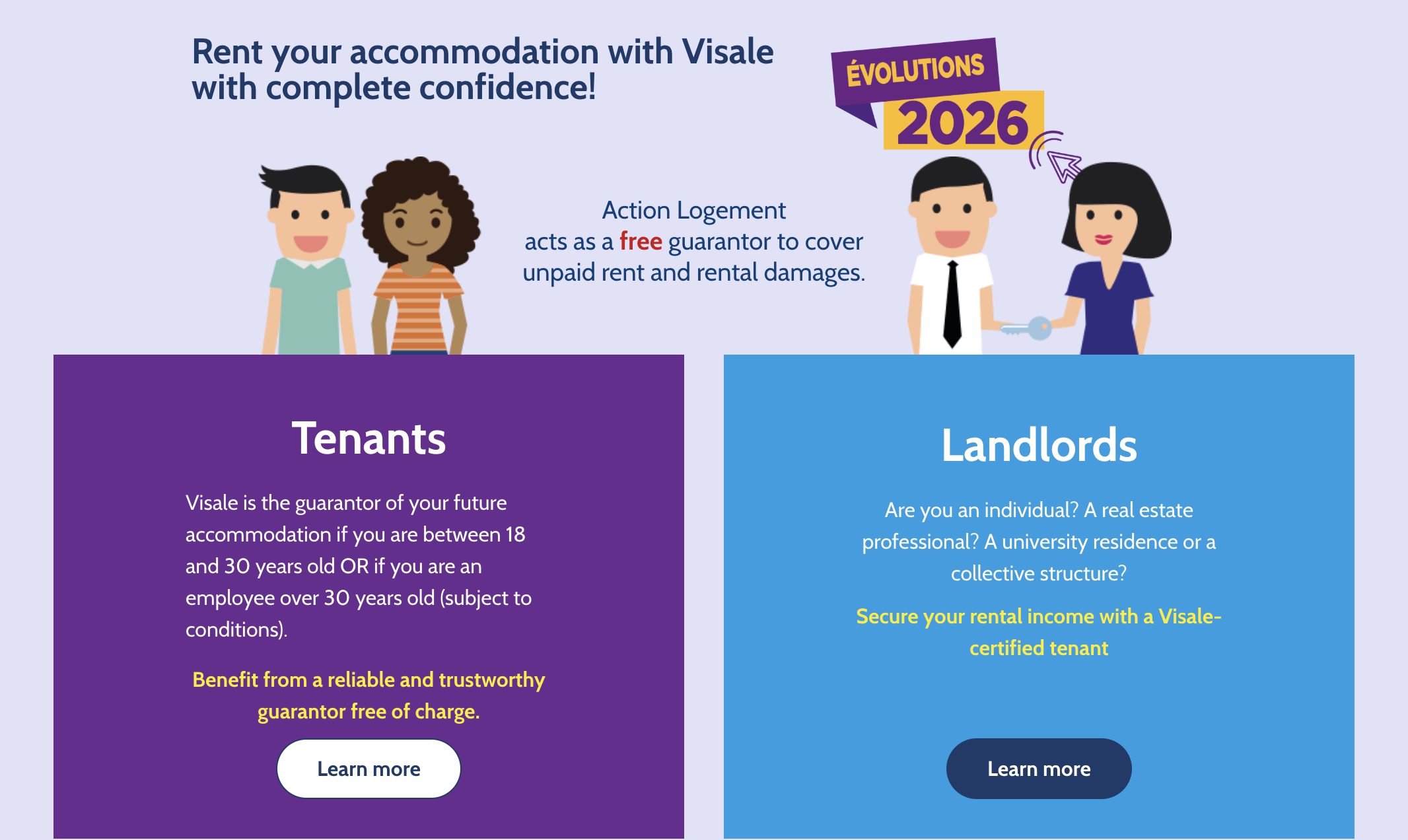
VISALE – Visa pour le Logement et l'Emploi – is a free state-backed guarantee run by Action Logement, a paritarian housing body funded through compulsory employer contributions. If you're under 30, you apply online before signing your lease. Action Logement issues a guarantee certificate and acts as your guarantor. If you default, they pay the landlord directly, then work out a repayment plan with you.
The eligibility is designed to catch the people the market misses. Under-30s can apply without income conditions – the whole point is that you might not be able to pay, and the system catches you anyway. There's a carve-out for students who are fiscally attached to their parents' tax return and aren't grant-holders – if you're still on your parents' taxes, presumably they can sign.
It's imperfect – you can be fiscally attached to parents who are overseas, low-income, or simply refuse. But for everyone else, the state vouches.
And if a landlord refuses VISALE, AFGES helps students to push back.
AFGES runs a dedicated casework hotline for housing problems. If an agency demands fees they shouldn't, AFGES explains your rights. If a landlord won't accept VISALE without good reason, AFGES helps you challenge it. If you're facing eviction, they connect you to CROUS social workers.
In September, AFGES even operates a "Dispositif de Logement Provisoire" – a temporary housing scheme that places students into partner hotel rooms for the first weeks of term while they sort permanent accommodation. It’s a sticking plaster, not a solution – but it's the kind of immediate-crisis response that requires institutional relationships built over years.
The casework model treats housing as a rights issue, not a consumer complaint – the framing matters.
Of course, there's still a supply issue - but thanks to FAGE lobbying, at least there's a plan. France has had sequential government-led student housing programmes with quantified production targets since 2017's "Plan 60,000 logements étudiants". The current iteration, AGiLE, was announced in September 2025 and aims to create 75,000 student housing units by 2030 through a mix of social, intermediate, and market-rent provision delivered by the state, the CROUS/CNOUS network, and social housing bodies.
Unlike the UK, where no minister has ever claimed student housing as their brief, France treats student accommodation as a cross-departmental policy priority with published targets and accountable delivery mechanisms.
The loop
FAGE's model is worth understanding because it's what makes local delivery connect to systemic change.
The federation combines service provision with political representation. Member organisations like AFGES run practical services – solidarity groceries, housing casework, academic advice. But they also hold seats on governing bodies, participate in national consultations, campaign for policy reform. The two functions reinforce each other – data from service delivery directly informs advocacy, and advocacy wins improve conditions for service delivery. It's a loop.
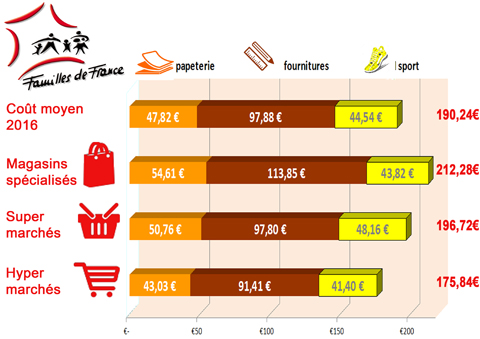
On VISALE specifically, FAGE claims significant credit. In its 2016 "coût de la rentrée" dossier – the annual back-to-university cost analysis French student organisations publish each September – FAGE stated it had won the extension of VISALE to all under-30s, including students.
There’s a track record on other issues. The abolition of the dedicated student social security regime – the RSSE – and its €217 annual contribution came through 2017-18 reforms; FAGE had campaigned for this. The 2023 expansion of grants on social criteria, with an additional €500 million announced for the rentrée, was framed by FAGE as a first-stage win – acknowledging that threshold effects remained, but claiming the budget increase as progress.
FAGE's current positions keep pushing. Housing benefit indexed to local rental markets – calculated on actual average rents for a 20-square-metre dwelling in each area, so students in Paris get support reflecting Paris prices. VISALE extended to cover all students without the fiscal-attachment exclusion. The parallel state-backed scheme, the Caution Locative Étudiante, merged with VISALE for simplicity. One comprehensive guarantee, harder for landlords to refuse.
What matters at AFGES level is that this creates a pathway from casework to change. Maxime sees the same housing problems coming through the hotline, month after month. He also sits on the CROUS board, where decisions about housing allocation actually get made.
When AFGES advocates for more CROUS places or different priority rules, it's not petitioning an external body – it's exercising governance power within the system.
And the posters on the wall aren't just consciousness-raising – they're connected to the committee papers upstairs.
Lieu de vie
Then there's AGORAé.
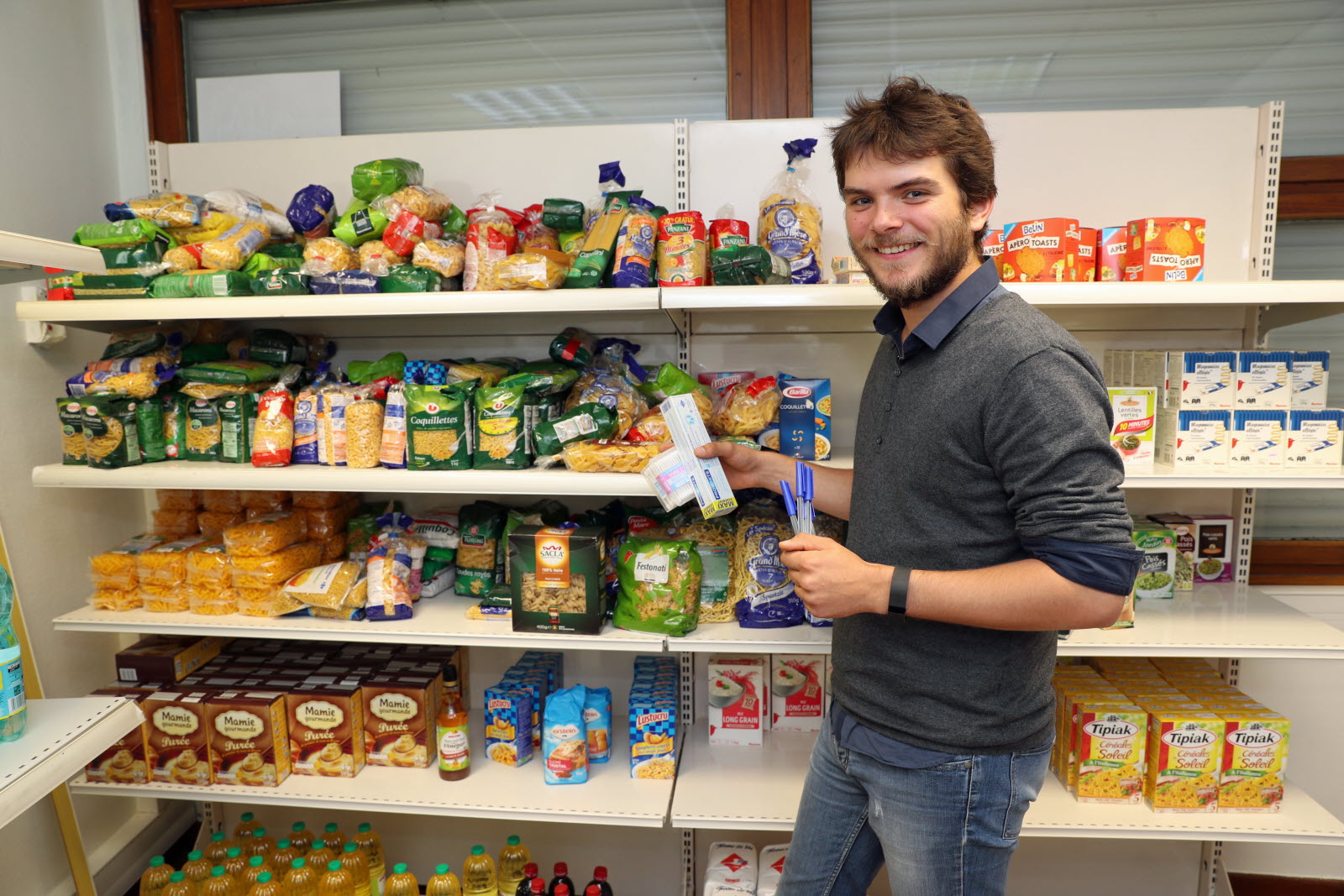
We saw AGORAé in Mulhouse yesterday, run by a different organisation. AGORAé Gallia in Strasbourg is AFGES's version – the same national model, local delivery. The name blends "agora" – the Greek public square where citizens gathered – with "é" for étudiant. It's a solidarity grocery – food and essentials at up to 90 per cent below market prices.
The space is cramped but carefully organised. Shelves of tins, dried goods, pasta, rice. A fridge with fresh vegetables – limited stock, first come first served. Hygiene products, cleaning supplies. A "friperie" section with second-hand clothes, where a winter coat costs a couple of euros.
When a student comes in, there’s no awkward means-testing conversation, and no proving her poverty at the door. She's already been assessed – you complete a "dossier d'accès" that calculates your "reste à vivre", literally "remainder to live on", the money left after rent and bills – and access is granted for a defined period. While that access lasts, you just shop.
The key is that eligibility isn't restricted to grant-holders. France's grant system misses people, just as the UK's maintenance loans do. Students working too many hours, students with income just above thresholds, international students ineligible for state support, students whose circumstances changed after assessment can apply to AGORAé. If your reste à vivre is low enough, you're in.
But the model is explicitly designed as a "lieu de vie" – a place of life – not just a distribution point. The distinction matters. A food bank is transactional – demonstrate need, receive food, leave. AGORAé is designed as somewhere you'd want to spend time even if you weren't buying groceries.
There’s tables where students can sit, information displays about housing and health services, and volunteers trained to signpost onwards. If someone mentions they're behind on rent while picking up pasta, they get connected to housing casework. The grocery is a gateway.
FAGE's national network now has 43 AGORAé sites. At AFGES, there's also an AGORA'Truck – a mobile unit visiting satellite campuses at Meinau, INSPE, Hôpital civil, and Illkirch. Nursing students doing clinical placements, trainee teachers with awkward schedules – the groceries come to them.
We've been writing at Wonkhe about "basic needs" work in UK SUs – Leeds's Essentials service, Staffordshire's survey finding nearly two-thirds of students going hungry at least once. The UK response is institutional – each SU lobbies to build its own operation, learns by trial and error, and depends on whatever funding can be found this year. There's no national network, no shared model, no common data collection. A student transferring from Manchester to Southampton has no idea if similar services exist at their new institution.
FAGE built the network a decade before most UK SUs had food pantries. There’s shared branding, common processes, and national data – the "baromètre de la précarité étudiante" that surveys AGORAé users annually and feeds evidence into lobbying. When FAGE argues for policy change, it has 43 sites' worth of data behind it. The UK has no FAGE – and the lack of collaboration shows.
Thirty hours
Another poster says "Je travaille 30h pour financer 25h de cours” – I work 30 hours to finance 25 hours of classes.
The maths is brutal – thirty hours of paid work to afford twenty-five hours of education – work takes more of your week than studying does. And the campaign demand – "l'AFGES milite contre la nécessité de devoir travailler pour financer ses études" – isn't modest. Not "fewer hours" or "better-paid work" but against the necessity of working to fund your studies at all.
One more – "La tomate dans mon plat a plus voyagé que moi” (The tomato on my plate has travelled more than I have). AFGES campaigns for local sourcing in CROUS restaurants. It's a food miles argument – but it's also about who benefits from catering contracts, whether students should care about supply chains, and whether the €3.30 meal includes costs that don't show on the price tag.
Bienvenue en France
One area where local delivery meets national controversy is international students.
"Bienvenue en France" – Welcome to France – is the branding for a 2018 policy package aimed at recruiting 500,000 international students to France by 2027. On paper, it bundles visa simplification, expanded English-taught provision, a Campus France quality label, and an international marketing push.
The label awards institutions one, two, or three stars based on their welcome arrangements – multilingual websites, pre-arrival documentation, welcome desks with access to prefecture and CROUS services, that sort of thing. The indicators are explicitly about service quality, not academic ranking.
The controversial part is what else the package included – sharply increased registration fees for non-EU students at public universities, bundled into a "welcome" strategy as if charging more were part of treating people better.
FAGE opposed the fee increase from the start, arguing it would price out students from lower-income countries while doing nothing for those from strong-currency backgrounds who could pay anyway. When the government shifted to making the fee increase optional for institutions, FAGE claimed the retreat as a win secured through mobilisation.

But the exemption-led design created its own problem – whether you pay the higher fee now depends on which institution you apply to, generating unevenness across the system. A student choosing between two universities might face radically different fee regimes for reasons unconnected to the programme itself.
The 2026 budget debate raised new alarms. FAGE's president Suzanne Nijdam publicly opposed proposals to remove housing benefit eligibility for non-EU, non-grant students. Her framing is stark – this would effectively push an entire generation of international students out of French higher education. If you can't get a guarantor without VISALE, can't afford rent without APL housing benefit, and aren't eligible for grants because you're not French – the combination becomes impossible.
Strasbourg is a border city with a genuinely international student population. The CROUS de Strasbourg explicitly states that international students access CROUS services "on the same basis as other students" for catering, student jobs, culture, campus life – with the caveat that accommodation and financial support are "subject to conditions". Those conditions increasingly mean that if you're international and not a grant-holder, your options narrow.
The AFGES website includes VISALE guidance in multiple languages, an English application form for AGORAé. The organisation clearly understands that a significant proportion of students needing help navigating French systems didn't grow up in France. But local service delivery can only do so much when national eligibility rules are tightening.
Vous trouvez ça normal?
The building at 1 Place de l'Université has been through revolutionary theory, judicial administration, decades of essential service delivery, and now runs a food bank and housing casework for students the system has failed. The Situationists wanted to abolish student identity as “false consciousness”. What actually happened is that student organisations built infrastructure to meet needs no one else would.
We're heading (for some of us, back) to Germany now – Karlsruhe this afternoon, Saarbrücken this evening. Vous trouvez ça normal?