

Another specialist provider collapses
Jim is an Associate Editor (SUs) at Wonkhe
Tags
A message on the front page of the college’s website announces the news:
After more than 70 years, we are sad to announce that the College of Osteopaths will cease trading. From Saturday 1st March 2026 current students will be continuing their studies via our collaborative partner, the University of Derby. We wish them every success as they continue their training.
An Office for Students (OfS) webpage confirms that because the awards are granted by the University of Derby, students can continue their studies there from 1 March. Students based in Stoke will move to Derby’s campus. For those based in Borehamwood, the university is still “working towards” continuing delivery at the campus in Hendon.
The college ran a single programme – a part-time, flexible Bachelor of Osteopathy (Hons) validated by the University of Derby, delivered across 18 teaching weekends a year.
The whole model was designed around adult learners changing career – lectures at weekends, clinic shifts on weekdays and Saturdays, staggered around work and family commitments. It charged £7,035 a year in tuition fees and explicitly encouraged applications from candidates “likely to be underrepresented in the osteopathic profession.”
Its website used to claim that its graduates account for nearly 10 per cent of qualified osteopaths in the UK – a remarkable claim for what was, by any measure, a tiny institution. Some of the students now affected will be three or four years into a vocational degree that they built their working lives around.
The most acute operational question is Hendon. The London cohort completed clinical hours through the College’s Borehamwood clinic. The September 2025 Student Protection Plan explicitly identified campus closure and service reduction as a high risk and acknowledged that clinical provision might need to shift between sites or into external practices if a campus or clinic closed. There’s no mention of that on the OfS page.
For those already enrolled that don’t want to transfer, the OfS webpage page mentions exit awards and credit transfer in a single sentence, with no information about what those awards would be worth or whether they’d have any standing with the General Osteopathic Council. Self-funded students wanting refunds are told that they:
..may experience delays to any refund you seek because an administrator would be appointed to consider all creditor’s claims.
“Delays” is doing a lot of heavy lifting – presumably they may well not get a penny. It also says:
If you used a credit card to pay for your fees you may be able to use Section 75 refunds in accordance with UK consumer protection law.
…which underlines how pathetic the actual OfS protection regime is.
The money
The Charity Commission record tells one part of the story. In its last reported year, ending August 2024, the college had total income of £842,185 – almost entirely from student fees – against total expenditure of £1,142,193. That’s a deficit of roughly £300,000 on an income base of less than a million pounds. That kind of gap between income and expenditure is not survivable for long.
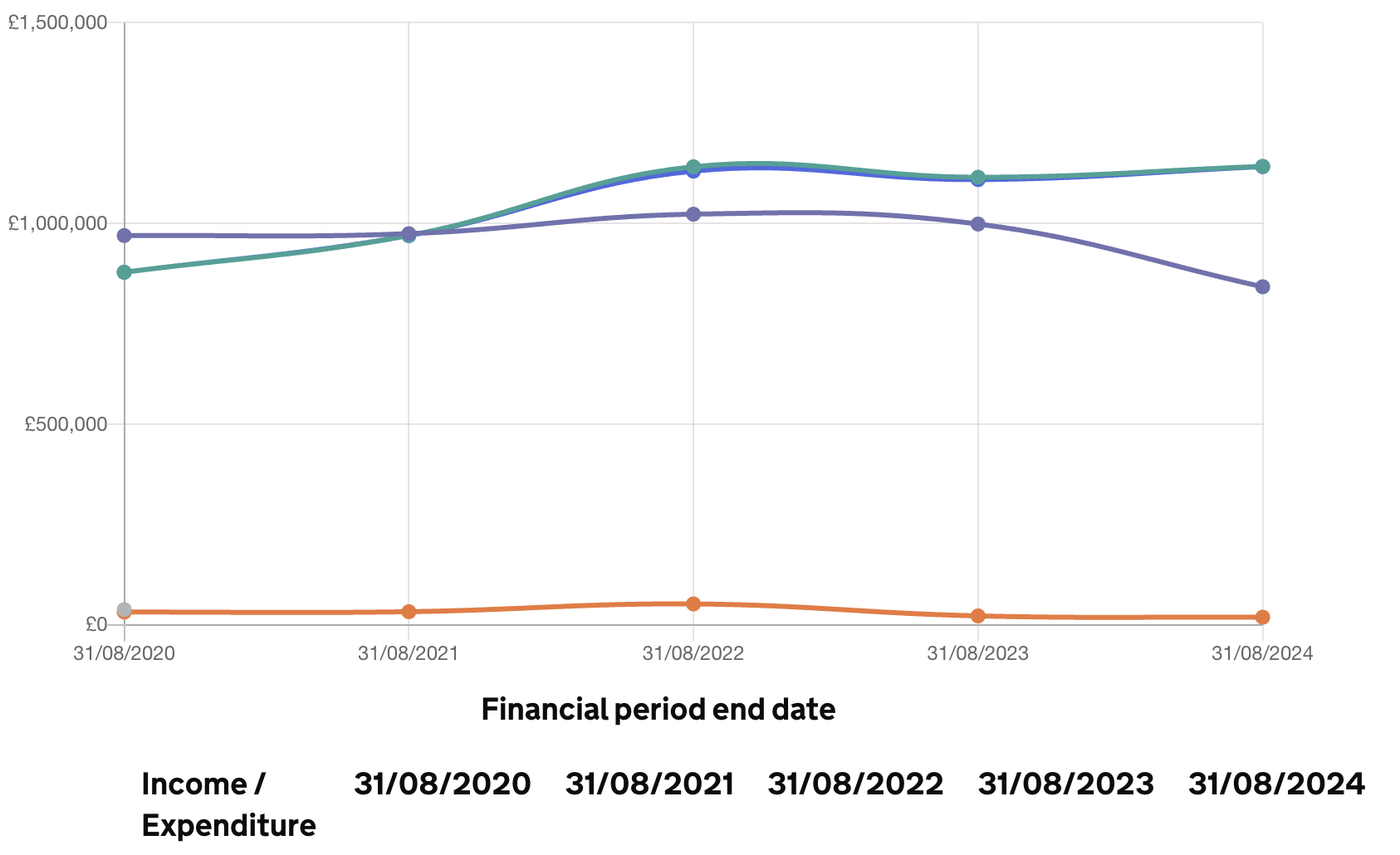
The college published successive Student Protection Plans. The 2019–20 version reads like the document of a confident small provider – the risk of it becoming unable to operate was assessed as low, backed by “very good and stable financial performance” and steadily increasing student numbers. Campus closure was also rated low. The overall framing was that significant disruption to students was not anticipated.
By last June the risk of the college becoming unable to operate had moved to medium – explicitly linked to falling higher education entrants and a decline in those opting to study osteopathy. Campus closure or service reduction moved to medium/high, and the risk of not proceeding with an intake at a particular site was also medium/high.
What we don’t know is whether students already enrolled – some of them three or four years into a vocational degree they had built their working lives around – were proactively told about the deterioration in the college’s position between the confident 2019–20 SPP and the increasingly bleak assessments that followed.
By September 2025, a new version of the SPP said the risk of the college becoming unable to operate was assessed as high. The explanation was blunt – the number of new students had fallen, and as a small specialist institution offering a single honours programme, the college was described as particularly vulnerable to sudden drops in application rates. Campus closure risk was also rated high. So was the risk of not proceeding with new intakes.
By this point, the college had already acted on at least one of those risks. The General Osteopathic Council’s Policy and Education Committee papers from October 2025 confirm that recruitment to the BOst had been suspended for 2025–26 and the college was entering a teach-out phase. The GOsC was planning a full Recognised Qualification review visit for the second half of 2026 to oversee that process.
Interestingly, the September 2025 SPP also introduced a specific mechanism called a Collaborative Closure Action Plan (CCAP) with the University of Derby that would outline how closure would be managed to secure continuation of study for all students, set out the possible consequences for students, be developed with essential student consultation and be made available to students within one month of a closure decision being made.
We don’t know when the closure decision was made, when or if the student consultation happened, and whether what’s been announced today is the upshot of that consultation.
An accompanying risk register from last October reinforces the picture. “Closure of institution” was rated high. “Failure to remain financially viable” was rated high. The college was under specific OfS monitoring because recruitment was falling and finances were under strain. Its collaborative agreement with Derby was due for renewal at the end of the academic year.
No new students enrolled in September 2025 – recruitment had already been suspended. OfS has confirmed that the college wrote to existing students before the autumn term to notify them of this decision. But knowing that recruitment has been suspended is not the same as knowing what it means.
By that point the college’s own risk register was rating closure and financial failure as high, and teach-out had begun. The collaborative agreement with Derby was due for renewal at the end of the year. It is not clear that students were told any of that – or that they were given the context to understand that “no new intake” was not a temporary pause but a signal that the institution was winding down.
This for me is where the regulatory architecture comes under pressure. OfS monitoring was flagged in the college’s risk register. The SPP had moved closure from low to high. The financial deficit was a matter of public record. The GOsC knew too – it had been told recruitment was suspended and teach-out had begun, and was planning a structured review to oversee the process.
It’s not immediately clear that continuing students were told clearly and directly what was happening. The decision to stop recruiting new students was itself a signal about the college’s viability. A student three years into a four-year degree, still paying fees and rearranging their life around weekend delivery, had a right to know that signal existed.
Put another way, once a provider’s own governance documents are formally rating “closure of institution” and “failure to remain financially viable” as high risk – and once recruitment has been suspended and teach-out has begun – that is not simply an internal management concern. Under the Digital Markets, Competition and Consumers Act 2024, the legal question becomes whether that level of risk is “material information” for the purposes of a transactional decision.
Under DMCC a practice is misleading if material information that the average consumer needs in order to make an informed decision is omitted, hidden or presented in an unclear or untimely way. Continuing to pay fees on a part-time vocational degree is a transactional decision. So is continuing to reorganise employment and childcare around weekend delivery at an institution that has stopped recruiting and entered teach-out.
At the point where the college, the OfS and the GOsC all knew the institution was winding down, every continuing student’s decision to stay, to keep paying, to keep turning up – was potentially made without full knowledge of the context.
On the one hand, this looks like a protection success story – a struggling provider where students will be able to complete their studies via some careful planning from all concerned.
“Protection” is almost always framed in “continuation of studies” terms. That makes sense. But if it’s the case those students who would now like refunds can’t get them – OfS’ webpage certainly suggests as such – there are real moral hazards with a regime that tends towards keeping provision running.
A previous version of this article did not make clear that recruitment was suspended for the 2025/26 academic year.
What strikes me is that the sums involved are so small and yet there is no talk of government support to see through the final cohorts. Operating expenses of slightly over £1M for 4 years is a drop in the ocean compared to other line items in the budget. In this case, the circumstances are very specific because it is a very unique offering, so transfer of the students would be exceptionally difficult. I can see a compelling case here.
There are compelling cases now on a regular basis sector-wide. What you’re seeing is the depth of government disinterest in this situation, as that lack of interest plays out with material consequences for learners and institutions.
In the event of insolvency the Ss joins the queue of unsecured creditors if they don’t want to carry on within a ‘teach-out’ plan and instead seek compensation for wasted fees when giving up on the course; or if they want compensation for extra travel & child-care costs if the teach-out is to be delivered in a more remote location.
Even if the failed HEP could afford to put money aside for funding such compensation, under insolvency law such cash can’t be ring-fenced for the benefit of the student class of creditors.
A specific insolvency regime is needed for HE as exists for FE – or the UK HE industry needs to come up with an ABTA-style bond mechanism as has the package tour industry.
Otherwise, we have yet another example of how Ss as consumers are let down by consumer protection law and by the regulators of HE delivery.