A right KEFuffle over knowledge exchange?
With REF and TEF already established what will the Knowledge Exchange Framework bring to the table? Tom Lyscom of the British Academy untangles what KEF might actually mean.
This article is more than 8 years old
Comment|

Tom Lyscom is a Senior Policy Adviser at The British Academy
The humanities and social sciences, and their graduates, are at the heart of the UK’s most productive sectors – including professional services and our flourishing creative industries. Improving knowledge exchange between these subjects and business, communities, government and the third sector is of national strategic importance to economic, societal and cultural growth.
But, following this week’s call for evidence, how can the Knowledge Exchange Framework (KEF) meet the challenge of measuring, incentivising and improving knowledge exchange?
A bit of background
Knowledge exchange is the transfer of ideas, research, expertise or skills between universities and business, communities, the third sector and government. Examples include February’s events on Social Impact Investment Markets at Edinburgh University, last week’s announcement that Teesside University is partnering with a regional media company to share content and skills and news from Imperial College that the NHS Safer Nursing Tool was made available to all healthcare organisations. We’re talking about a rich variety of virtuous information flows between university staff, employees in all industries, civil servants and members of the public. Clearly, knowledge exchange is an important thing.
And fellow wonks may have had knowledge exchange and the KEF on the mind this week with the deadline to respond to HEFCE’s call for evidence on KEF’s metrics. The KEF was first announced by then universities minister Jo Johnson at the HEFCE Conference October 2017. It aims to compare how effective universities are at business engagement and knowledge exchange.
What is the government’s vision for the KEF?
The government’s November 2017 Industrial Strategy cemented and expanded the idea saying the KEF will:
- benchmark how well universities foster knowledge sharing and research commercialisation
- capture the rich network of collaborations between universities and businesses
- sit alongside the REF and the TEF, providing a holistic view of how universities are delivering their threefold mission
But now that the KEF is taking shape, does it meet these ambitions?
So far HEFCE’s two KEF strands are much narrower. The first, the ‘KEF principles’, covers tech transfer only, and the second ‘KEF metrics’ strand, consulted on the use of elements of the Higher Education Business and Community Interaction survey which captures patents, collaborative or commissioned research income and total events attendance.
How can the KEF be broadened?
 Many knowledge exchange activities can’t easily be quantified, others are difficult to trace at all. But rather than give up, thinking about putting humanities and social sciences in the frame gets us closer to the ‘holistic view’ the government wants. Existing evidence and models for evaluating knowledge exchange are out there.
Quantitatively, HEFCE’s ‘Knowledge Exchange Performance Indicator’ tool draws upon the HE-BCI survey but adds HESA finance and staffing data. This data could be enhanced by including Table 5 of the BCI Survey on public events, and data on mature and part-time CPD education.
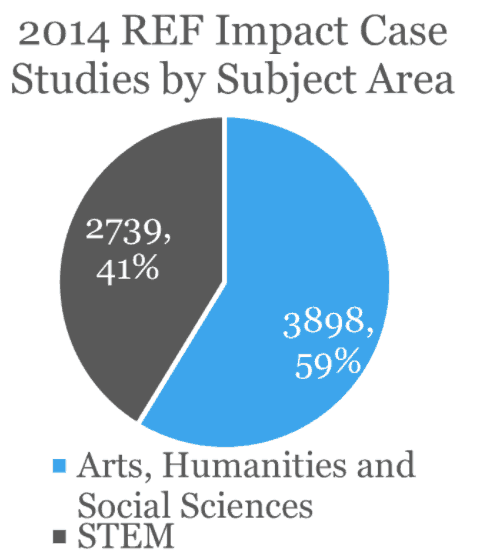
Qualitatively, the REF impact case studies contain great examples of knowledge exchange and could be a model to evaluate universities, including the humanities and social sciences which make up almost 60% of the submissions (right). A similar exercise or a refining of the Impact section of REF 2021 could provide evidence of knowledge exchange.
But this raises the questions of how the KEF will measure something distinctive from the not only REF but TEF as well, and whether a new framework is necessary.
Undeterred, let’s have a go.
Untangling the REF-TEF-KEFuffle

So at the moment, the direction of the KEF looks to be falling short of the government’s vision to capture the ‘third mission’ of universities, completing a ‘holistic view’, and it will miss many contributions universities make. This is especially true in the humanities and social sciences where information transfer ensures the UK addresses the significant challenges it faces, from driving growth and the future of work to ageing and integrating health and care.
Adding a third framework risks duplicating effort for institutions, and potentially double counting. Both the REF and TEF could overlap with a broad KEF, as illustrated left.
As I mentioned, the REF already captures lots of great examples of knowledge exchange in the impact section, and REF 2021 looks set to do the same.
The TEF also covers elements of knowledge exchange where it looks at knowledge diffusion, and skills and human capital development. Professionals and many employees are prepared through university education at all levels, and many keep updating their skills and knowledge through CPD.
It must be clarified how these frameworks will be distinct and work together.
The choices for HEFCE are:
- Let KEF catch what’s left after TEF and REF, but accept this will be a strange, distorted picture of knowledge exchange.
- Adopt a broader definition of knowledge exchange in KEF but then deal with the complex overlaps.
- Re-align, perhaps re-imagine, the 3 frameworks and avoid overlap, although this is starting to sound like an ‘Excellence Framework Excellence Framework’ – God help us!
Getting this right matters
Transferring ideas, research, expertise and skills between universities and business, communities, the third sector and government is clearly important. Having an incentive to improve how universities do this will help to drive economic, societal and cultural growth.
The question of funding remains unresolved. At the launch event, Jo Johnson hinted there could be a funding link to the KEF. And it’s not small fry either as the most likely candidate, the Higher Education Impact Fund, will reach £250 million per year by 2020-21. If the KEF is mainly based on measuring knowledge exchange income and expenditure, as the current direction seems, and then rewards this with additional funding, it will simply concentrate activity and funding within universities that are already successful. This overlooks so much good practice in knowledge exchange and misses the opportunity to incentivise and spread good practice across the UK.
The second funding issue is about this REF-TEF-KEFuffle. To be a valid funding mechanism, the KEF must use different evidence and a distinct set of indicators from other frameworks, otherwise, it just reproduces them.
Surely the last thing the government wants is for some parts of higher education to get paid twice for doing the same thing?
Related articles

Building a collective evidence base to tackle inequality in higher education
Omar Khan | Comment | 25/11/26

One in three Muslim students has faced Islamophobia at university
Rahma Hegy | Comment | 25/11/26

Universities are still making co-production harder than it needs to be
Siân Whyte | Comment | 24/11/26

The risks of letting AI mark assessments and give feedback
Richard Copeland | Comment | 24/11/26

When AI shows up in education it needs to be in service to human learning experiences
Debbie McVitty | Comment | 23/11/26

Learning is something to be savoured, not optimised
Sam Elkington | Comment | 23/11/26