How to shape digital culture in higher education
A network of educators met in March sought to think through making digital culture change happen. Here are the results.
This article is more than 5 years old
Comment|

Sarah Dyer is the director of the Exeter Education Incubator
Lisa Harris is director of digital learning at the University of Exeter Business School.
Whether or not universities can be successful in building enabling and productive digital cultures will be fundamental in determining the fate of higher education over the next decade.
When we discuss the need for “digital culture” in higher education, we’re not referring to shiny new toys, proctored exams or a life lived on Zoom. Instead, it’s about embedding a culture of collaboration, inclusivity, agility and openness both in and between our educational institutions so that innovation can flourish in all its forms.
To achieve this objective we need to tackle the pressing challenges of digital inequalities (access, literacies, skills) while resisting pressures from some for a return to “normal”, or to simply layer new technologies on top of existing outdated systems and processes.
A lot to do
While it is clear that significant progress in the uptake of digital tools has been achieved during these unprecedented times, there is still a long way to go. For some the increased use of digital technologies to support university education and research has been a silver lining of the last year, and they hope it has created a momentum that will continue to drive change.
However, institutions should be wary of assuming that behaviour in the last year will easily persist, never mind determine more far-reaching or substantial changes in culture. In times of crisis, the role institutional cultures and existing systems play as an enabler/barrier to change is greatly reduced. As a crisis subsides, those wanting to continue the momentum of crisis management find themselves having to contend with pre-existing cultures and systems. What’s more the shock and exhaustion from within the institution creates a pull back to familiar ways of doing things.
In contrast, the “post-digital” perspective on education emphasises a culture where multiple relationships can be developed between technology, pedagogy and the environment within which we all live, learn and work. This acknowledgement of the intrinsically networked nature of today’s world is a long way from the rigid distinctions made between “online” and “campus-based” education that we still see in standard discourse about the future of education.
This is often coupled with unhealthy comparisons of the activities of “traditional” competitors and a disregard for the potential of more agile market newcomers.
Bridging the gap
So the question is – what can we do to bridge this gap and develop a truly digital culture? As a first step, Jisc brought together a group of people (the authors of this blog). Our objective was to build a network of educators who sought to actually make culture change happen. The first outcome of our discussions was a webinar entitled “Shaping a digital culture in higher education”, which took place in March 2021.
The session brought together over 60 people from across the UK who were interested in exploring this issue. Some participants had roles which directly involved change management or leadership, but many more were people more generally interested in bringing about change because they saw it as necessary for their institutions to flourish in the digital economy. We have summarised the frank and wide ranging discussions below.
Firstly, attendees were asked to highlight what “digital culture” meant to them by entering key terms into a wordcloud:
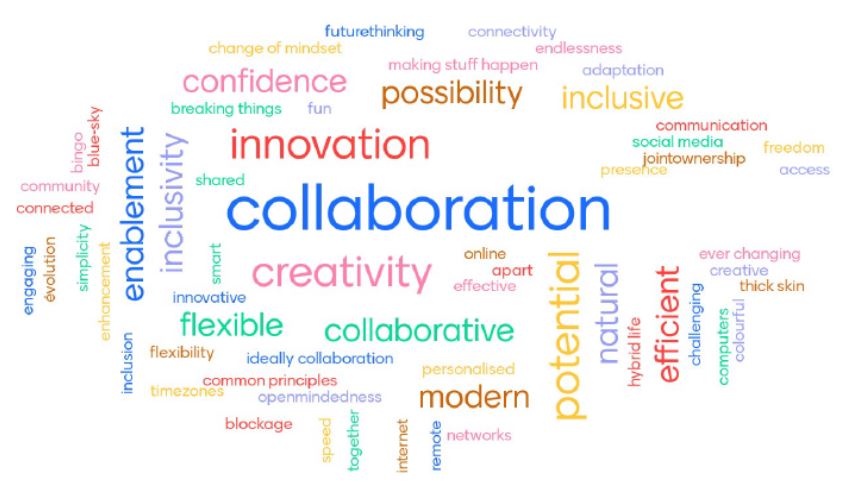
The workshop participants had many common concerns about the challenges of developing a digital culture:
- A need to make the most of change that has been enforced by the pandemic and not allow slippage back to “normal”.
- Universities can change quickly if they have to – but they still try to do this within existing culture, structures and processes (for example, do we really need a 3 term year that starts in September?)
- There is an outdated view of what constitutes competition within (and without) the sector.
- Examples were shared of institutions embarking on major digital transformations with very limited resources beyond the “technical fix”.
- The pandemic has highlighted and magnified existing issues (for example with regard to inclusion or teaching quality) rather than caused them in the first place (Henley report)
- Uncertainty in the employment market has led to a rise in applications to study which should not be interpreted as an endorsement of “business as usual”.
- The impossibility of pleasing everyone as both staff and students show very different attitudes towards “normal/new normal”.
- Some institutions that had embraced change had not necessarily supported it with the resource/training to make it sustainable.
- There were very few examples shared of collaborative, multi-disciplinary activities either within or between institutions.
There are some significant challenges raised in this brief summary. So what next?
Jisc has published a call to action which starts with the development of a community of practice. To address the challenges of change, we need to embody the culture we are working towards. This requires commitment from people with formal change roles, and also from those who quite simply have a passion to harness the impact of the past year into lasting cultural change across higher education and into wider society.
Additional contributors: Marieke Guy, Vicky Gosling, Christopher Bonfield, Russell Crawford, Deborah Sloan, Natasha Veenendaal and Allen Crawford-Thomas
Comments · 1
New comments will come back with sign-in later this year.
Doug Gowans · 4 Jun 2021
The move towards fewer digital platforms that we see in Universities is part of the foundation to establishing a digital culture. It means a common language and a means to innovate which supports that multi-disciplinary, collaboration which will be the source for change.
Related articles

Students just need to know where they stand on AI
Gracie Otley | Comment | 5/10/26

One year of leading UKRI
Ian Chapman | Comment | 3/10/26

Navigating the storms of student success
Kate Newby | Comment | 2/10/26

Higher education postcard: The Queen’s Tower, Imperial College
Hugh Jones | Comment | 2/10/26

A supplier shouldn’t be able to rewrite who owns students’ essays
Sam Dickinson | Comment | 2/10/26

Emeritus, honorary, and visiting professors are an untapped resource
Roger Watson | Comment | 1/10/26