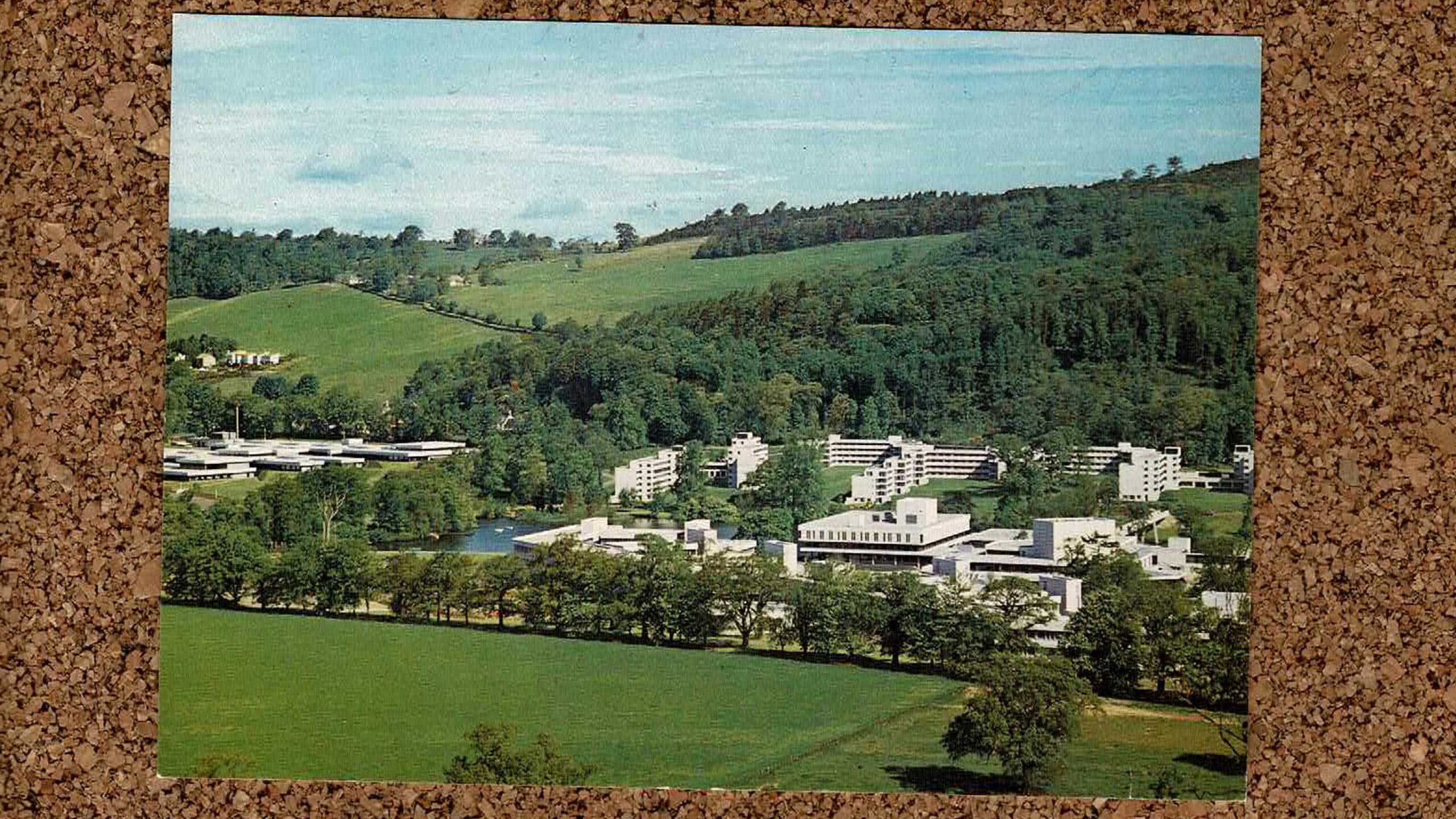
Higher Education Postcard: University of Stirling
This week’s card from Hugh Jones’ postbag shows a university which said “no” to death and glory
This article is more than 4 years old
Comment|
Hugh Jones
Hugh Jones is a freelance HE consultant. You’ll find a daily #HigherEducationPostcard if you follow him on Bluesky
To the north of the Forth you’ll find the University of Stirling, set in the grounds of the old Airthrey Estate.
The university was established in 1967. And Lord Robbins – Professor Lionel Robbins of LSE, chair of the committee formed to consider issues around the ongoing expansion of higher education – was the university’s first chancellor.
But Robbins did not decree a university out of thin air. Discussions about the creation of a fifth Scottish University (alongside Aberdeen, Edinburgh, Glasgow and St Andrews) had been held as early as 1947, although it was only in 1960 that matters became more serious, with five towns – Dumfries, Falkirk, Stirling, Inverness and Perth – formally requesting information from the University Grants Committee on how to submit a proposal for a new university.
In the end the competition was between Stirling and Ayr, Cumbernauld, Dumfries, Falkirk, Inverness, and Perth. Heffernan and Jöns argue that three factors swung in Stirling’s favour - the Robbins’ committee’s preference for universities to be near in or near large cities, an environment which might be like the ancient universities, and a very good lobbying campaign.
In any event, Stirling was the choice, and in September 1967 the first students enrolled – a mix of undergraduates and postgraduates, just less than 200 in number. The first of many - Stirling now has 17,000 students and over 90,000 alumni.
Stirling sought to innovate, as this cutting from the Aberdeen Press and Journal on Friday 21 October 1966 makes clear:
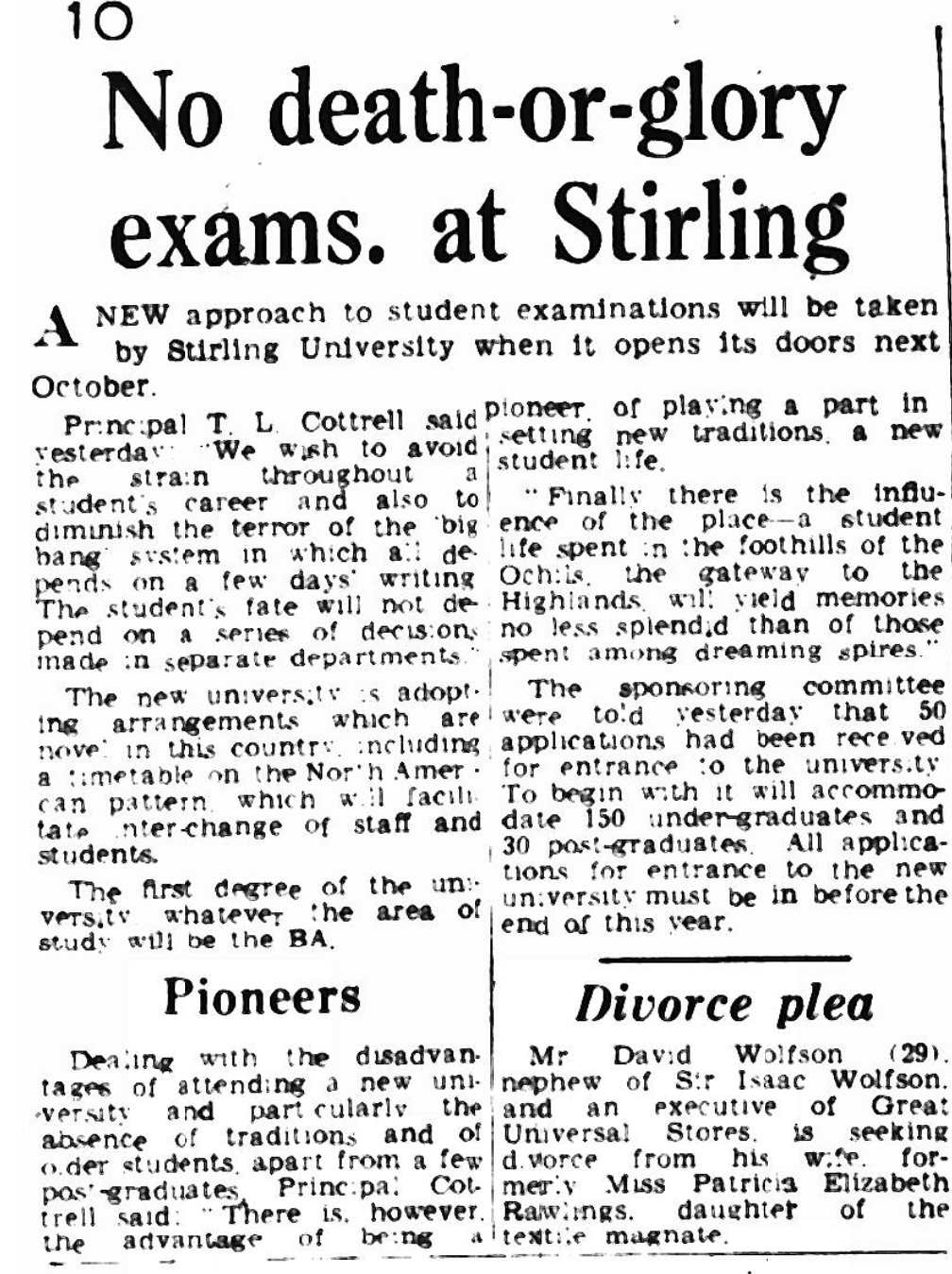
It is sometimes helpful to see cuttings like this, and see how far the sector has come, educationally, within the span of not too many decades.
Notwithstanding its modern creation, Stirling’s campus isn’t all concrete and glass. Airthrey Castle, dating from the 18th century, is home to the University’s INTO international student centre. Stirling also has more modern buildings – the National Swimming Academy, completed in 2001, has an Olympic Size (50m) swimming pool.
Its alumni include authors Iain Banks and Iain M Banks, Sir Alex Ferguson, and Jonathon Fletcher, who created JumpStation, the precursor to internet search engines such as Google, and, in 1993, the first of its kind.
Related articles

A field guide to mergers in higher education
Richard Mills | Comment | 24/09/26
If Scotland’s university funding problem is systemic, the response must be too
Vicki Stott | Comment | 24/09/26

There’s nine more pieces for the Quality Code
Nic Beech | Comment | 23/09/26