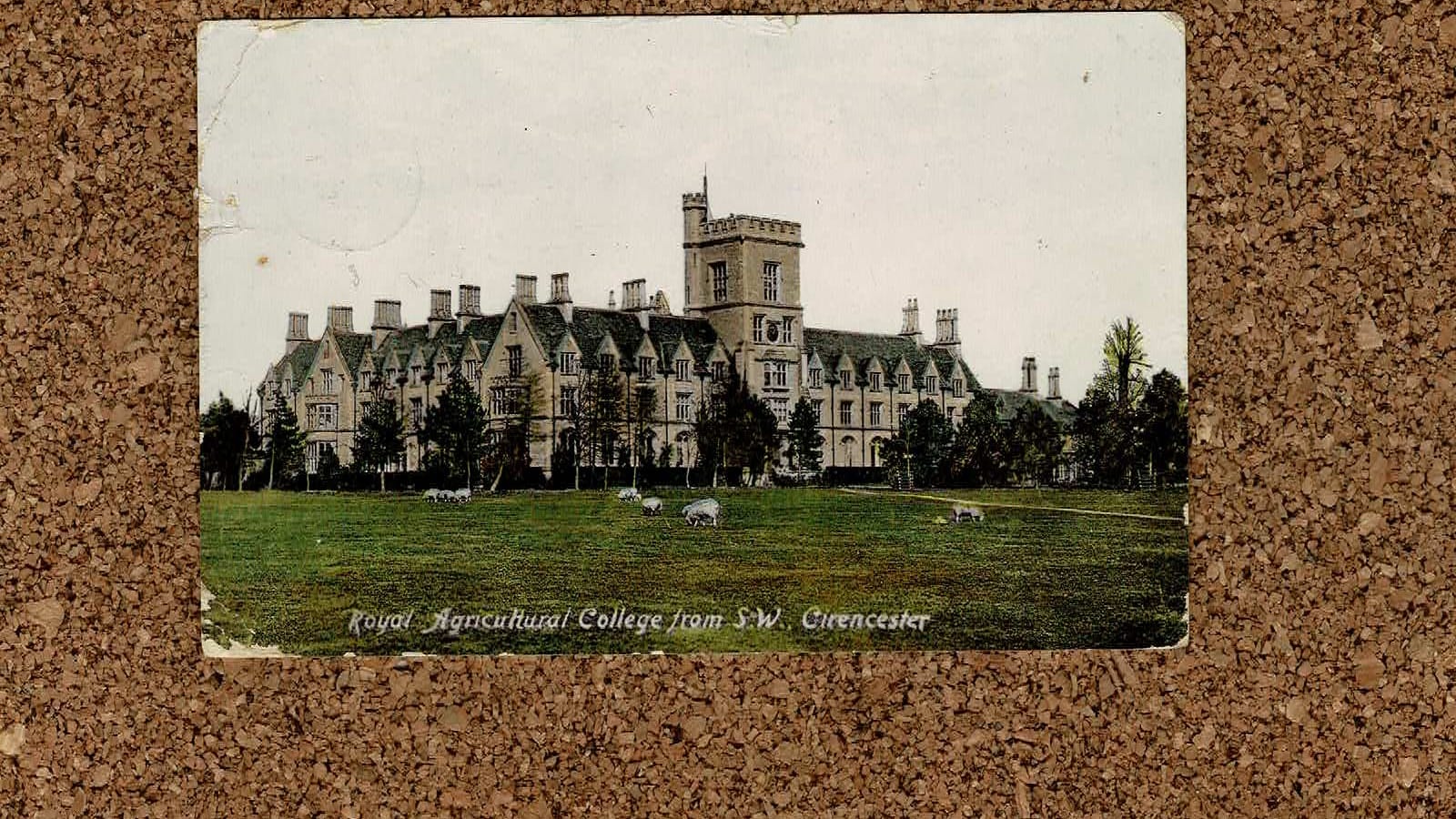
Higher education postcard: Royal Agricultural University
This week’s card from Hugh Jones’s postbag is broadcast at 7pm weeknights on BBC Radio 4
This article is more than 3 years old
Comment|
Hugh Jones is a freelance HE consultant. You’ll find a daily #HigherEducationPostcard if you follow him on Bluesky
Greetings from Cirencester!
You do know where Cirencester is, right? Midway between Gloucester and Swindon. There. Saved you a Google.
On 14 November 1842, Mr Robert Jeffreys-Brown addressed a meeting of the Fairford and Chichester Farmer’s Club, taking as his topic “On the advantages of a specific education for agricultural pursuits”. Here’s his start, as the Berkshire Chronicle of 21 January 1843 reported it:
I have undertaken to make a few remarks on the subject of education: a subject, the importance of which it is impossible to overrate, and for this reason —all other animals come into the world with faculties that expand with their growth to individual perfection. Man alone arrives, and continues (if left himself), a perfectly helpless and ignorant being. He could neither feed nor dress himself without the benefit of instruction and example; his mind would be a blank; and his voice would be inarticulate, indeed (if he survived) he would be very inferior to the lower animals…
Robert’s address struck a chord. There was a desire to promote agricultural education, and a committee, with Henry, Earl Bathurst as President, was elected. Funds were raised by public subscription, and in 1845 a site was leased for the construction of a building. That same year a charter was granted, and 25 students enrolled in September. The Royal Agricultural College was born.
You’ll see that this is a pattern repeated elsewhere in the history of British higher education: private means were used to establish a college to address a specific need, and it proceeded, sometimes with local authority support, sometimes industry support, and sometimes church support, until the state embraced them in one way or another. And then helped them thrive or close.
The College grew and developed over the years, and made a positive impact on both the practice and science of agriculture. It remained a private institution, outside of the state sector. Things began to change in the 1980s, where it partnered with the University of Reading to offer an honours degree in Rural Land Management.
In 2001 the College came within the ambit of HEFCE, accepting public funds, and expanding its provision. In 2013, with the change in criteria for university title, the college became the Royal Agricultural University. Not without some mild chuntering, though.
The University owns and operates two farms. And it still sits in farmland, just like on the card. Although I think those sheep have moved on now.
The card itself was posted on 19 August, 1912.
My dear Muriel, I am glad to hear you are enjoying yourself., While I am writing this postcard I am thinking about to-morrow. I was just getting ready to have a good scrub when mother said to me you had better write that p.c. to Muriel. I hope I shall enjoy myself tomorrow and I will not forget my little Muriel. Do forgive me for not writing before but I wanted to get you a nice post card from Cirencester. I must now close from poor old Siss.