


Now this sounds… familiar?
Demographic decline, falling or volatile domestic demand, and over-dependence on international recruitment – alongside uneven regional access, a concentration of provision in capital institutions, and thinning subject breadth outside the major centres – make for a recognisable picture.
Add a slow withdrawal from high-cost subjects, a mismatch between student demand and available provision, a gap between graduate supply and labour-market need, and weak alignment between higher education, further education, and skills planning.
Add insufficient differentiation between institutional missions, duplication in some fields alongside gaps in others, financial fragility, competition overriding collaboration, and limited system-level planning capacity – along with weak incentives to sustain strategically important provision, unclear mechanisms for mergers or consolidation, declining participation numbers, underdeveloped lifelong learning, and student accommodation and civic impact issues.
You might be forgiven for thinking that’s a shopping list of the wicked problems facing any of the UK’s higher education systems.
But in reality, we’re in surprise Eurovision 2026 winner Bulgaria. Which is great news – because it gives me an excuse to write about the various ways the Bulgarians have started to address them.
No one’s gonna sleep tonight
Dara – a Bulgarian pop artist and Voice Bulgaria mentor whom most bookmakers had dismissed as an outside bet – won the 70th Eurovision Song Contest in Vienna with a club-driven anthem called “Bangaranga.” She swept both the national juries and the public vote, beating Finland’s heavily fancied duo into sixth place.
The experts and the crowd agreed – and that, as we’ll come to see, wasn’t entirely unlike what Bulgaria has managed to pull off with its higher education ranking system.
Bulgaria is among the fastest-shrinking countries in Europe. Thirty-five years ago it had nearly nine million people – today it has around 6.5 million, and nothing in the birth-rate data suggests any reversal is coming.
The higher education system it inherited from the socialist period was built, in crude terms, for the larger population – and then expanded after 1989 through a combination of new private entrants and existing public universities piling into new subject areas to attract students.
The result is 51 accredited higher education institutions, of which 38 are public and 13 private, with total capacity for around 400,000 students. Active enrolments in 2024–25 stood at roughly 190,000.
The system isn’t monolithic. Alongside universities and specialised universities – technical, medical, agricultural, and including a police academy – there are specialised higher education schools offering a three-year professional bachelor degree directly linked to the labour market, sitting below the country’s standard four-year bachelor. Some differentiation, in other words, is already structurally baked in rather than being a product of recent reform.
That number – fewer than half the available places actually occupied – is the problem that drives everything else in Bulgarian higher education policy. It’s been inching upward (from 42.9 per cent in 2023 and 43.7 per cent in 2024) but the system is fighting a whole range of factors it can’t control.
There’s also a structural factor affecting Bulgaria’s international reputation and rankings. The Academy of Sciences isn’t a university – it’s a separate state institution, and the country’s dominant research hub, responsible for close to half of all research papers produced in Bulgaria.
That still generates research-informed teaching, albeit at arm’s length, but Bulgaria’s performance in research-heavy global rankings remains constrained by the reality of so much of the country’s research output sitting outside the sector those rankings measure.
Welcome to the riot
So what do you do? The answer, five years ago, was to make a map. A really wizzy map.
Bulgaria enacted a legal requirement in 2021 for something called the National Map of Higher Education. Adopted and updated annually by the Council of Ministers on a proposal from the minister responsible for education, its official purpose is to determine the “profile and territorial structure” of higher education by professional fields and regulated professions, in line with socio-economic development and labour-market needs.
The Map has two components. One asks whether the profile of education offered by institutions corresponds to demand from applicants – the student-choice side. The other asks whether the profile of graduates corresponds to employer demand, measured through indicators of graduate labour-market outcomes – the economy side. Both have to be satisfied before new provision is considered justified, and the two can – and often do – point in opposite directions, which means the Map has to balance both at once.
The 2025 edition lays it all out for policymakers to see – accredited capacity remains more than twice the number of active students. The overcapacity isn’t evenly distributed, and some of the most underfilled fields are also ones the state has identified as strategically important.
The policy challenge is therefore more demanding than simply closing what students don’t choose – it’s about understanding why provision the country says it needs is sitting empty, and doing something about it beyond cutting numbers.
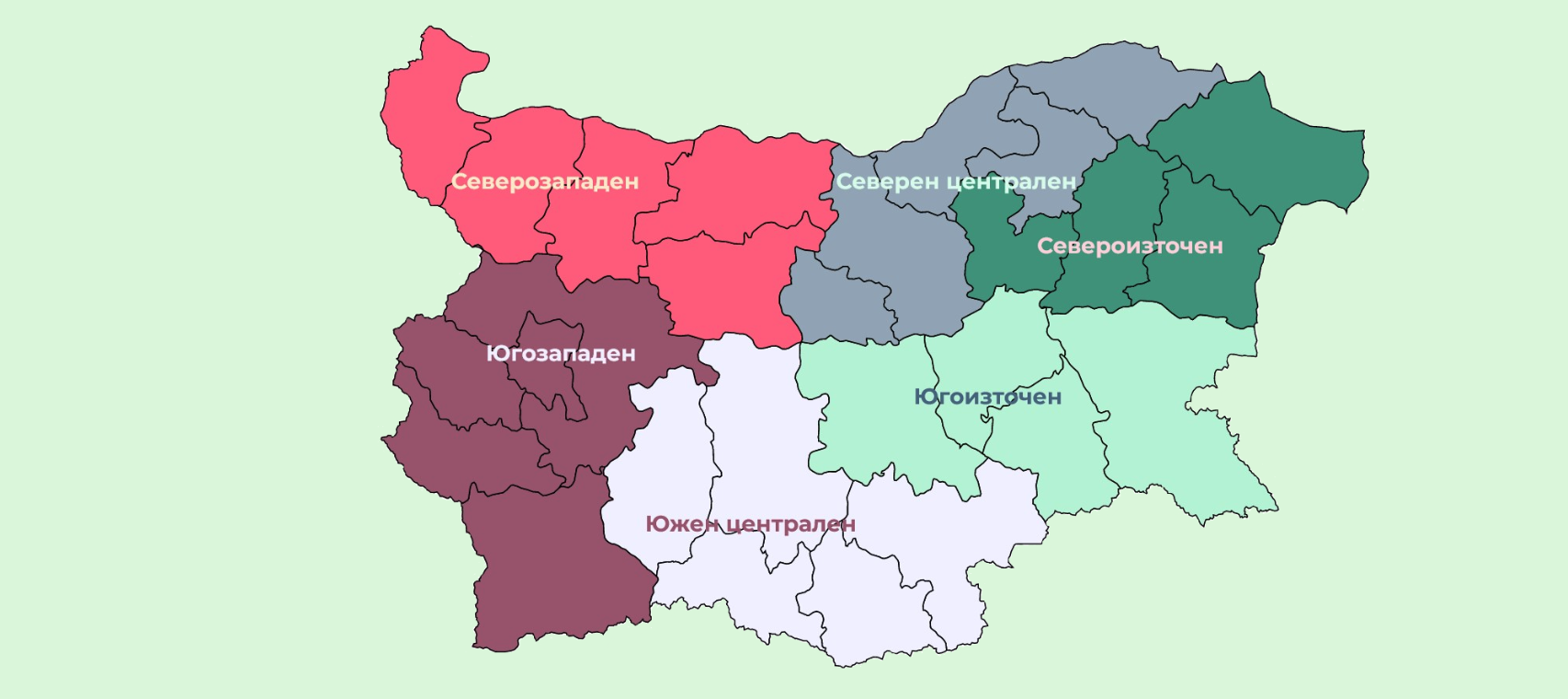
The Map also classifies Bulgaria’s planning regions according to their higher education development needs. The 2025 edition identifies the North-West and South-East as the regions most in need of better-aligned capacity – areas where, despite relatively high numbers of employed graduates in the local workforce, the ratio of students studying locally is low, meaning the region depends on importing educated labour it isn’t producing.
That’s a different kind of regional problem from the simple absence of universities, and it requires a different policy response.
The Map’s operational power is then a gate on institutional behaviour. If a Bulgarian university wants to open a new professional field – or expand into a new subject area, launch a new branch, or add to a regulated-profession programme – it has to demonstrate that the criteria for doing so are met.
For so-called Group 1 fields, provision can only be opened in certain region types if national enrolments in that field already exceed 80 per cent of accreditation-approved capacity – a threshold tightened in the 2025 edition from 70 per cent. For Group 2 fields, the bar rises to 85 per cent in the priority region categories, up from 80 per cent. In a system where the overall fill rate is under 50 per cent, these are prohibitive for most institutions in most fields most of the time.
The 2025 edition notes that the trend toward fragmentation has broken and that gradual consolidation is being observed – modest claims both, but real. The Map can prevent the system from getting worse in the ways it was getting worse before 2021, but it can’t quickly undo two decades of expansion logic.
The most obvious distinction is that in Bulgaria, institutional autonomy doesn’t extend to the decision about whether to launch new provision. That decision requires the Map’s criteria to be satisfied. Universities face no directive toward specific mergers or closures, yet they’re told, with legal force and sophistication, that they can’t keep growing their way into a shrinking market.
I’m a mover, For a freedom
The finances that surround the Map are worth noting separately. State budget funding for higher education is committed by law to a floor of not less than 0.9 per cent of gross domestic product (GDP). Academic staff in state higher education institutions are to receive an average gross salary of not less than 180 per cent of the national average gross salary for the preceding twelve months. Doctoral scholarships funded from the state budget are set at not less than 150 per cent of the minimum wage.
These are legally encoded floors, which means the system has some protection against the kind of real-terms erosion that has characterised UK higher education funding over the past 15 years.
There’s also a specific strand of strategic investment that shows how the Map connects to targeted industrial policy rather than just to generalised quality assurance. In November 2024, Bulgaria adopted a national programme to increase qualifications in nuclear technologies and nuclear engineering, running until 2029, involving a consortium of Technical University Sofia, Sofia University St Kliment Ohridski, and the Institute for Nuclear Research and Nuclear Energy at the Bulgarian Academy of Sciences.
Its stated objective is to reduce the risk of nuclear knowledge loss, maintain scientific capacity, and attract young professionals into a field where the demographic problem is particularly acute – the kind of thing a government can do when it has a planning instrument that tells it where the gaps are.
Anyone following the work of Medr – Wales’s tertiary education regulator – will find the diagnostic logic familiar. Medr has been mapping subject provision, demand, and distribution across Welsh higher education on the stated basis that, without a system-level view, institutions will keep making decisions in isolation that produce gaps, duplication, and withdrawal.
The diagnosis is much the same as Bulgaria’s. But Bulgaria has moved from diagnosis to constraint, and from constraint to targeted investment. Medr has the map. Bulgaria has the gate, the floor, and the programme.
Surrender to the blinding lights
The National Map sits alongside a national university ranking system that is both a consumer information tool and a direct input into the state funding formula and into the allocation of state-subsidised student places. Commissioned by the Ministry of Education around 15 years ago, it operates in two modes.
The predefined rankings – the ones that feed into policy – are built exclusively from administrative and third-party data, including data drawn directly from the national tax system to track graduate employment and earnings outcomes for up to seven years after graduation. There are no surveys in these rankings, no reputation scores, and no peer assessment.
Universities co-developed the methodology and continue to be consulted on its evolution, giving them a degree of ownership rather than mere subjection – and the result is that institutions most nominally exposed to the system’s judgements have become, over time, among its more vocal defenders.
The multidimensional tool aimed at prospective students is a “build your own ranking” interface that allows users to weight different criteria according to their own priorities, and which does include surveys of students, employers, and academic staff. This is where subjective and reputational data live, quarantined from the policy-relevant rankings.
The design choice is deliberate. It separates the consumer information function from the governance function, and avoids having institutional reputation – sticky, self-reinforcing, and often detached from actual quality – determine who gets more state money.
If your institution performs better in the predefined rankings, the state pays you more per student and your quota of subsidised places increases. Institutions have a material interest in taking it seriously, and prospective students have a reliable signal about quality backed by the same data the state uses to allocate money.
The system has been integrated into the funding formula long enough to generate its own political economy – universities know how they’re measured, know what improving performance requires, and know what the financial consequences of stagnation look like.
The perversity of the country’s 2024 tuition fee episode is notable. Around 10 per cent of Bulgarian students are enrolled outside the state-subsidised quota – the majority pay a nominal additional fee of a couple of hundred euros a year within it.
The fees for non-quota students are legally linked to the per-student rate the state pays for quota places, on the logic that universities shouldn’t cross-subsidise commercial income from state income. When the government increased the per-student state rate, the fees for those non-quota students shot up in direct proportion.
A tuition fee crisis caused by a funding increase. Parliament had to intervene to decouple the linkage. It may be the only time in the history of higher education policy that a sector has needed rescuing from the consequences of getting more money – and it illustrates both the tight integration of the policy architecture and what can go wrong when the connections between levers aren’t fully thought through in advance.
Come alive
None of this means Bulgaria has resolved its structural problem. Alongside the overcapacity issue, there’s a social equity gap. The Organisation for Economic Co-operation and Development (OECD) analysed the 2021–2030 higher education strategy and counted 160 implementation measures, finding that only one of them directly focused on disadvantaged learners.
A system this preoccupied with efficiency, differentiation, and labour-market alignment can lose sight of the question of who actually gets in.
And there’s the problem beneath all of it – the graduate economy. Sofia dominates provision, opportunity, and graduate retention. Smaller cities – Varna, Plovdiv, Blagoevgrad, Veliko Tarnovo – offer a cheaper and sometimes more cohesive student experience, but narrower routes into professional life.
Provision can be aligned with regional need as precisely as any Map allows, but if the economy in those regions doesn’t generate reasons for graduates to stay, the Map is moving chairs. This is the UK problem too – and neither country has solved it by redesigning the tertiary system alone, because it isn’t a tertiary system problem.
Let me light you, light you up
Dara is 27, from Varna, a city on the Black Sea coast. She attended the National School of Arts there, specialising in folklore singing – a training in traditional Bulgarian vocal technique that she describes as being in her DNA, shaping how she hears music even when she’s making something that sounds nothing like folklore.
She finished third on X Factor Bulgaria at sixteen, built a catalogue of number-one singles, mentored artists on The Voice of Bulgaria, and last year released an album called ADHDARA, named after an adult ADHD diagnosis she has spoken about publicly as a reckoning with her own contradictions.
In an interview before the final, she said that If she managed to perform worthily “then we all, Bulgaria, will shine on the map”. She described what “Bangaranga” actually is at its deepest level – an invocation of the kukeri, the ancient Bulgarian ritual in which men dress in costumes of bells and fur and animal masks and move through villages at the start of the year making ferocious noise. The purpose is to drive out bad spirits. The energy, she said, is overwhelming, almost frightening – and yet also joyful, communal, and alive. Noise and fire and rhythm, deployed as a force for good, to shake the room back to life.
It’s a reasonable description of what good public policy is supposed to do. Ferocious rather than gentle, something that disturbs the settled arrangements, confronts institutions with their own contradictions, and forces a reckoning with where the system is failing. The Bulgarian policy apparatus makes noise the institutions can’t ignore.
When I think of HE policy in the UK, I feel overwhelmed by “assurance” – endless systems, processes, frameworks and formulae that somehow manage to both fail to assure and fail to confront. Death by a thousand rolled eyes.
When I hear pleas toward autonomy in the UK, I also often think that universities sound like spoilt kids just wanting to be left alone. But it turns out that being left alone has costs. A map would be a good start.