

Every decision to launch, redesign or continue a course is a bet on future student demand and the capabilities employers will value.
Universities can draw on employer intelligence, policy priorities and market evidence, but much of the routinely available evidence remains retrospective. Recruitment, continuation, student satisfaction and financial metrics tell us how a course has performed, while Graduate Outcomes data tells us where earlier cohorts went.
Taken together, they still provide only a partial view of how the occupations and entry routes associated with a course may change over time.
Getting those judgements right has rarely mattered more. UK higher education is already under severe financial pressure, making mistakes in the shape and scale of provision increasingly difficult to absorb. Generative AI compounds that risk by changing graduate work and, potentially, the entry routes into it. If those routes weaken across significant parts of the course portfolio, student demand and fee income will weaken with them. AI exposure should therefore become part of portfolio review while universities still have scope to reshape provision deliberately.
Exposure levels
To explore what a more forward-looking review might involve, I analysed 8,142 professional Graduate Outcomes records from my university, covering multiple survey years. The purpose was not to predict which jobs will disappear. It was to identify where AI exposure overlaps with a more specific risk: compression of the junior tasks through which graduates enter a profession and develop expertise.
I matched the occupational codes in the Graduate Outcomes data to the exposure levels published by GLA Economics in 2026. Its analysis adapts the ILO’s task-based generative AI framework to UK occupations, estimating how much of the work within each occupation could technically be performed or supported by GenAI.
I then compared its results with the Department for Education’s AI and LLM exposure data, as well as checking my interpretation against recent studies of workplace AI adoption and task use, including BCG’s 2025 AI at Work survey and Anthropic’s Economic Index. I treated exposure as an indicator of potential change, not as evidence that jobs would disappear.
For the purposes of portfolio review, the results can be understood as three broad bands on a continuum, combining published exposure scores with an interpretive assessment of entry-pathway risk (see chart below). These are analytical categories, not natural divisions in the data or forecasts. The results show that 28 per cent of occupations were exposed and pathway-sensitive; 13 per cent were exposed but more durable; and 59 per cent had lower exposure or were more strongly anchored in embodied, relational, regulated or safety-critical practice.
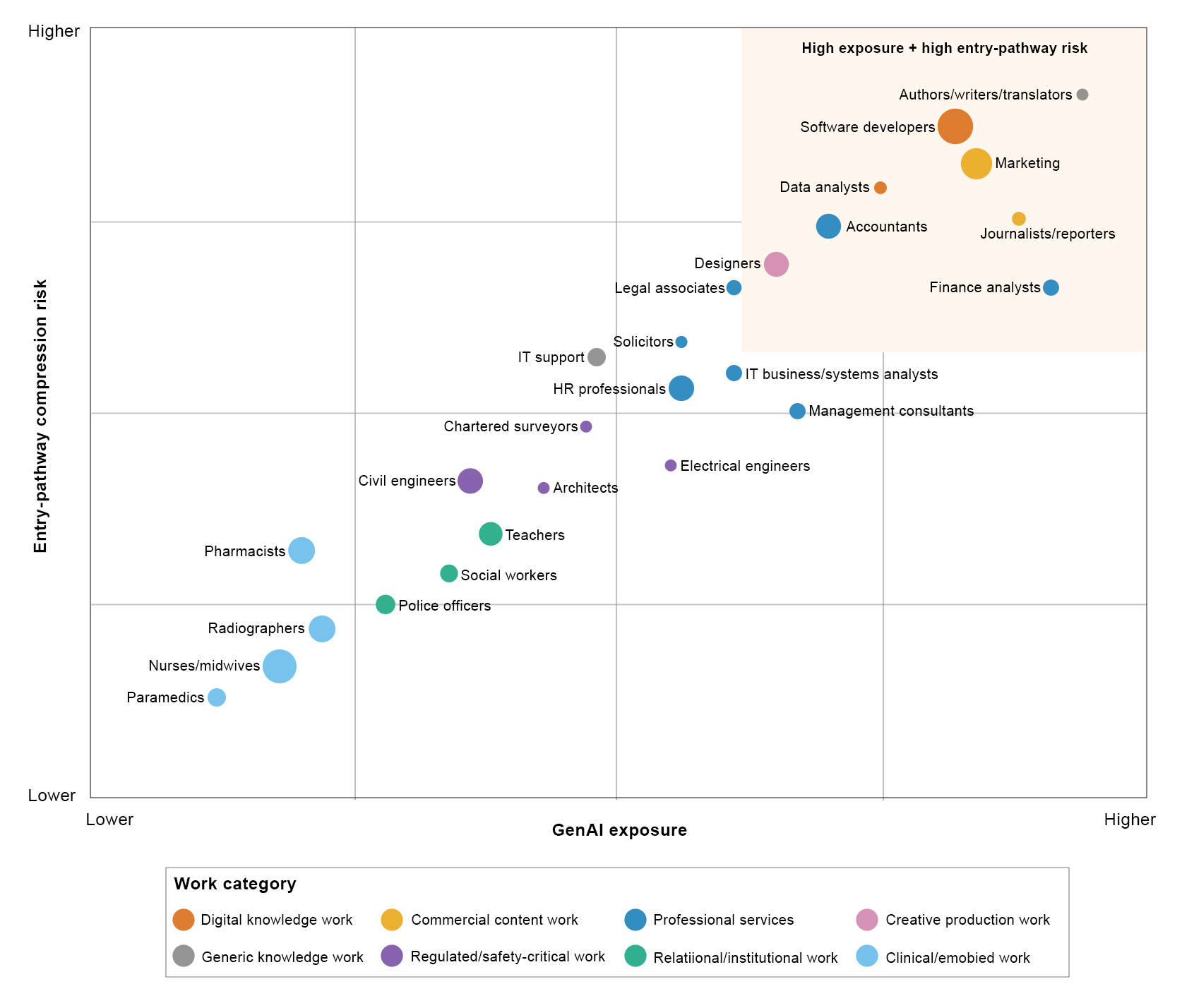
The chart plots selected occupations from the data, not every graduate destination. Horizontal placement is based primarily on published GLA/ILO exposure levels, interpreted alongside other evidence where methods diverge. Vertical placement is an interpretive assessment of entry-pathway compression risk. The shaded area is indicative, not a predictive threshold. Bubble size reflects the number of Graduate Outcomes records.
At the exposed and pathway-sensitive end are software, marketing, journalism, writing and translation, finance, accounting, design, data analysis and parts of business services. Here, AI use is concentrated in tasks commonly allocated to graduates and junior staff, creating a credible risk that entry-level work will be compressed or reorganised.
The middle band includes HR, IT support, IT business and systems analysis, management consulting, surveying and some technical engineering roles. These occupations have meaningful exposure, but domain expertise, organisational context, client-facing judgement or site-based work make straightforward substitution less likely.
The lower-exposure end includes teaching, civil engineering, architecture, pharmacy, nursing and midwifery, paramedicine, allied health work, social work and policing. AI may reshape lesson planning, design iteration, clinical documentation and administrative workflows, but the core work remains more strongly anchored in relationships, physical systems, regulation and professional accountability.
Law illustrates why these positions require careful interpretation. Whole-occupation analysis can make legal work appear relatively durable, but task-level evidence points to pressure on the research, drafting and document-review work that has historically given trainees and paralegals their grounding. LLMs do a remarkably good job of this type of work.
A basis for better questions
This is what AI-exposure analysis can add to portfolio review. It should not mechanically trigger course closure, nor can an occupational score replace employer intelligence or academic judgement. However, it can reveal where a course’s labour-market case rests heavily on work that is being reorganised.
That creates a basis for better questions: what work does this course prepare graduates to do; which parts of that work are changing; what remains valuable when AI is widely available; and is there credible evidence for demand at the volumes currently recruited?
The answers will imply different actions. Some courses may need radical redesign around AI-augmented professional judgement, work-integrated learning and stronger employer involvement. Some may need clearer specialisation, smaller recruitment targets or different combinations of technical, relational and domain expertise. Some provision may be better offered through apprenticeships, shorter credentials or employer-led routes. Lower exposure should not guarantee protection, just as higher exposure should not automatically condemn a course.
Universities already hold much of the data needed to begin this work. Detailed Graduate Outcomes records can be mapped to public occupational-exposure frameworks and then tested against vacancy data, employer conversations and professional-body intelligence. The method will need regular updating because both AI capability and workplace adoption are moving quickly. Its value lies in making assumptions about future graduate demand visible and contestable rather than leaving them buried inside historical recruitment forecasts.
At my own university, this is becoming part of an institution-wide change to the curriculum framework. Course teams are being asked to demonstrate how changes in graduate work, AI exposure and the enduring sources of professional value have informed the redesign of their courses. They must show where these considerations are embedded in the curriculum and how assessment has been redesigned so that students develop and demonstrate the capabilities the changing labour market demands.
In a financially fragile sector, portfolio review cannot remain a retrospective performance exercise. AI exposure is not proof that demand will collapse – but it is material evidence about how graduate work may change. Senior leaders should be asking for that evidence now, while universities still have time to reshape their portfolios deliberately rather than waiting for applications and fee income to deliver the answer for them.