

A funny way to work out who gets maintenance grants
Michael Salmon is News Editor at Wonkhe
Tags
Today’s new release from DWP and DfE – Pathways to priority occupations – is an odd thing.
The post-16 education and skills white paper committed the government to establishing (and then to tracking) a metric about participation in priority subject areas related to the industrial strategy. Based on previous Skills England’s analysis, followed by some odd choices within DfE and DWP, we now have a baseline: 616,000 starts on “priority pathways” in 2023–24.
This is a crude aggregate, but inoffensive. Each year the government will be able to see how much progress it’s making – though with no particular target in mind – and make the case internally for further resource and reform to support its goals.
The problem is this table, which is said to show the proportion of starts in priority pathways by provision type in 2023–24:
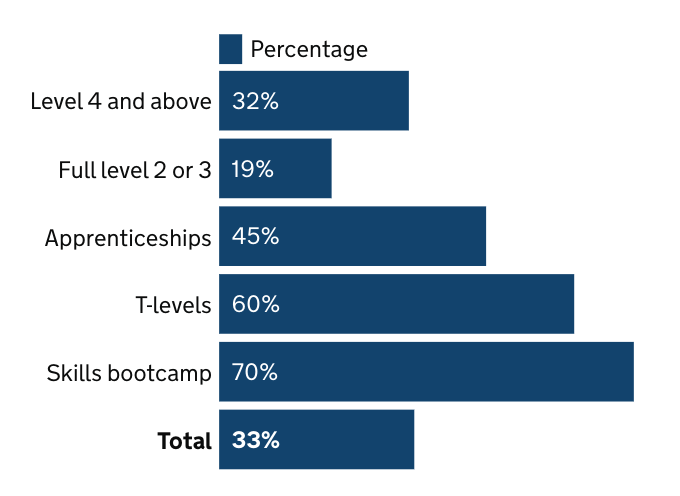
Or more precisely, the problem is the absolutely bananas methodology used to arrive at these oddly specific percentages.
Priority occupations, priority pathways
If you’ve not come across the language of priority subjects/pathways/occupations before, it’s worth looking back at our coverage of the Assessment of priority skills to 2030 report, which explains how these terms have been agreed within government (expanded on in much more detail in this follow-up article).
But in a nutshell: for the industrial strategy priority sectors (the IS-8), plus health and social care and construction, a list has been drawn up of what the “priority occupations” are for industries in these areas – essentially those where it has been determined (opaquely) that there will be growing demand, and need, in the coming years.
In the Assessment of priority skills report, Skills England sketched out how different higher education subjects are contributing to these occupational pipelines, in a way that was very broad-brush – again, I’d point you back to our previous coverage for more detail here.
What’s been done in today’s report is in part an update of this work, based on more recent data, leading to the blunt appraisal that the following are the “priority HE subjects”:
| HE subject (CAH2) | Percentage of recent leavers in priority occupations (%) |
|---|---|
| Medicine and Dentistry | 96 |
| Nursing and Midwifery | 95 |
| Pharmacology, Toxicology and Pharmacy | 80 |
| Architecture, Building and Planning | 78 |
| Computing | 76 |
| Allied Health | 74 |
| Engineering | 74 |
| Medical Sciences | 72 |
| Physics and Astronomy | 72 |
| Economics | 68 |
| Chemistry | 65 |
| Mathematical Sciences | 60 |
Other subjects further down the list are therefore not “priority HE subjects”. This list isn’t shared, but in the previous version we saw that subjects including business, health and social care, languages, and biosciences were all pretty close behind in percentage terms. But the cut-off for being classed as a priority subject has been drawn at 60 per cent (with the result that “around a third of HE provision is designated a priority subject, which allows for meaningful prioritisation of those subjects”).
There are many oddities in how this has been pulled together. But it has the appearance, at least, of a logical sequence of decisions with roots in the industrial strategy. Let’s see how it plays out in other areas of the skills system.
For FE at levels 4 and 5, the government simply matches further education subject areas to the higher education subject list. That’s a little strange, but let’s see where this goes.
For FE at levels 2 and 3, we go back to the calculation of a percentage of recent learners in priority occupations. But this time the cut-off is 40 per cent, with no reason given. And building and construction (38 per cent of recent learners go into a priority occupation – so almost two-thirds do not) is included, because there is “strong policy alignment”.
For apprenticeships, it gets stranger. Rather than looking at learner destinations, someone has simply been through the associated occupational maps to decide which apprenticeships are linked to priority occupations. It doesn’t matter what the actual outcomes are – the only thing that counts is how the qualification is designed. This is where the figure that 45 per cent of apprenticeship starts are in priority pathways comes from.
For T levels, it’s the same. But there is a different qualification mix, so this time 60 per cent of T level starts are said to be in priority pathways (remember, only 32 per cent of HE provision is determined to be). Does it matter where these students are ending up? Nope – but it does make T levels look good.
And then for skills bootcamps (70 per cent of starts in priority pathways), DWP and DfE have made a “qualitative assessment”, and just gone ahead and chosen the priority sectors.
This all serves to privilege those qualifications that the government “owns” (that is, the ones it has linked to occupational standards). Apprenticeships and T levels are essentially magic, in that anyone on the right pathway is assumed to be heading for employment in one of the priority occupations.
This all matters
If the outcome of this set of deeply arbitrary choices was simply that there was a table saying that only 32 per cent of higher education degree provision was in a priority pathway for the industrial strategy – compared to 45 per cent of apprenticeships, and 70 per cent of skills bootcamps – then there would be no particular harm done, other than to the sector’s pride.
It would be a further entry into what I’ve previously called the performance of linking education and skills with the industrial strategy – one that ignores some pretty important questions, not least the places involved, the specific institutions in question, and the actual subjects being studied (beyond the topline subject area).
But as we’ve flagged before, this work is not just a desk exercise. According to this morning’s written ministerial statement, the publication will “support students to make informed choices about their courses” (the statement adds in passing that the government is also “exploring how AI can further strengthen the information available”). It seems unlikely that many prospective students will care that much about aggregate percentages and abstract concepts such as priority occupations.
But according to the overnight press release from DfE, there’s more at stake:
This measure provides a crucial first step in helping us identify which subjects will be eligible as part of our new targeted maintenance grant offer. It will be used alongside other data and stakeholder feedback to best assess how to target this funding for students in academic year 2028 to 2029.
While some leeway is left for later refinement, this suggests that maintenance grants are on the cards for (at least a portion of) the list of HE subject areas above, and not elsewhere. It is also very possible that a similar list will inform how the government shakes up the Strategic Priorities Grant and its associated high-cost subject funding.
This would seem a very simplistic way of working out how high-cost subject funding should flow, given the expenses involved in delivering teaching in many areas which don’t happen to fit the industrial strategy playbook. It’s quite the contrast with, for example, the Future Framework exercise taking place in Scotland, which is explicitly attempting to better understand the actual costs of delivery.
The government wants to make choices about what subjects to prioritise – but wouldn’t it be better just to go ahead and make them, rather than dressing them up in a pseudo-data-driven process? Being more intentional about “priority subjects” would mean there could also be a read-across to what is actually happening in institutions, what capacity the HE system needs, and what’s at risk as cold spots proliferate and expensive programmes are whittled down or closed up.
It’s also worth thinking about how durable this approach will really be, given the imminent change of Labour party leadership. A system which blindly tots up historic graduate employment outcomes while ignoring the question of where in the country graduates study and where they go on to work doesn’t feel very in keeping a more devolved and place-conscious tertiary system.
Note: A previous version of this article suggested that the Pathways to priority occupations report was a Skills England-led publication – in fact, it is a joint DWP/DfE policy paper. We’re happy to make that clear.