


There’s a story about some polling we did back in 2019 that Jim tends to tell a lot.
We’d just put out some survey numbers that looked at the link between loneliness, student activities and mental well-being.
At the time, Wonkhe’s advisory group included the late (and very much great) Clare Callender. And during a brief presentation of the findings, Clare declared that the findings were all a bit “traditional student”.
Her argument was that commuters and mature students weren’t like the students Jim had in his head. They already had friends.
It was true that when Jim was doing his MSc in voluntary sector management at the weekend every month, the attraction of City SU’s Freshers Fair was limited.
But whether he labelled them as “friends” or not, he definitely did need to know some of the other people on his course. For a whole range of obvious reasons.
Since then – and we’re not claiming we started it – there’s very much been a belonging boom in HE policy debates.
But like lots of agendas in HE, it often feels like it’s become both too complicated (mitigating against taking action) and too simple (generating actions that don’t make a difference).
Mack’s doomscrolling again
Anyway, back in November, Mack wrote a piece on here about student loneliness.
He’d noticed the TikToks, the Reddit threads, the students posting “day 2 at uni no friends” into the void, the avoidance loops, and the narrow window for friendship formation that closes by November and doesn’t reopen.
His conclusion was that universities had built systems that produced loneliness at scale and then acted surprised by the results.
Some people probably thought it was a bit anecdotal. Well.
Last week we published a mini report for SUs called Friends have benefits, which analyses over seven waves of data from more than 18,000 students across 178 UK institutions.
The main finding is that friends matter – not in a hand-wavy pastoral sense, but in a specific, structural, academically consequential sense that we think the sector may have missed.
The headline is wrong
Our headline proxy belonging question is the one that used to feature in the National Student Survey. Across nine waves and 178 institutions, “I feel part of a community of students and staff” returns 79 per cent positive.
That 79 per cent figure stands in for at least three different things, and the populations hidden underneath it are not marginal cases. More than four in ten students who say they belong also report feeling lonely weekly or more – their life satisfaction runs at 5.68 against 7.39 for students with both belonging and low loneliness, and their anxiety sits at 5.86 against a sample average of 5.01.
They rate the institutional offer essentially identically to students who are actually fine. The difference doesn’t show up in what they say about belonging. It shows up in the wellbeing data underneath.
That masking effect matters even more when you look at what belonging actually predicts. Across the dataset, the belonging question turns out to be one of the strongest organising variables in the whole survey. How students answer it doesn’t just track their social experience. It tracks their satisfaction with teaching, assessment, feedback, resources, voice, and services – across almost every dimension we measured.
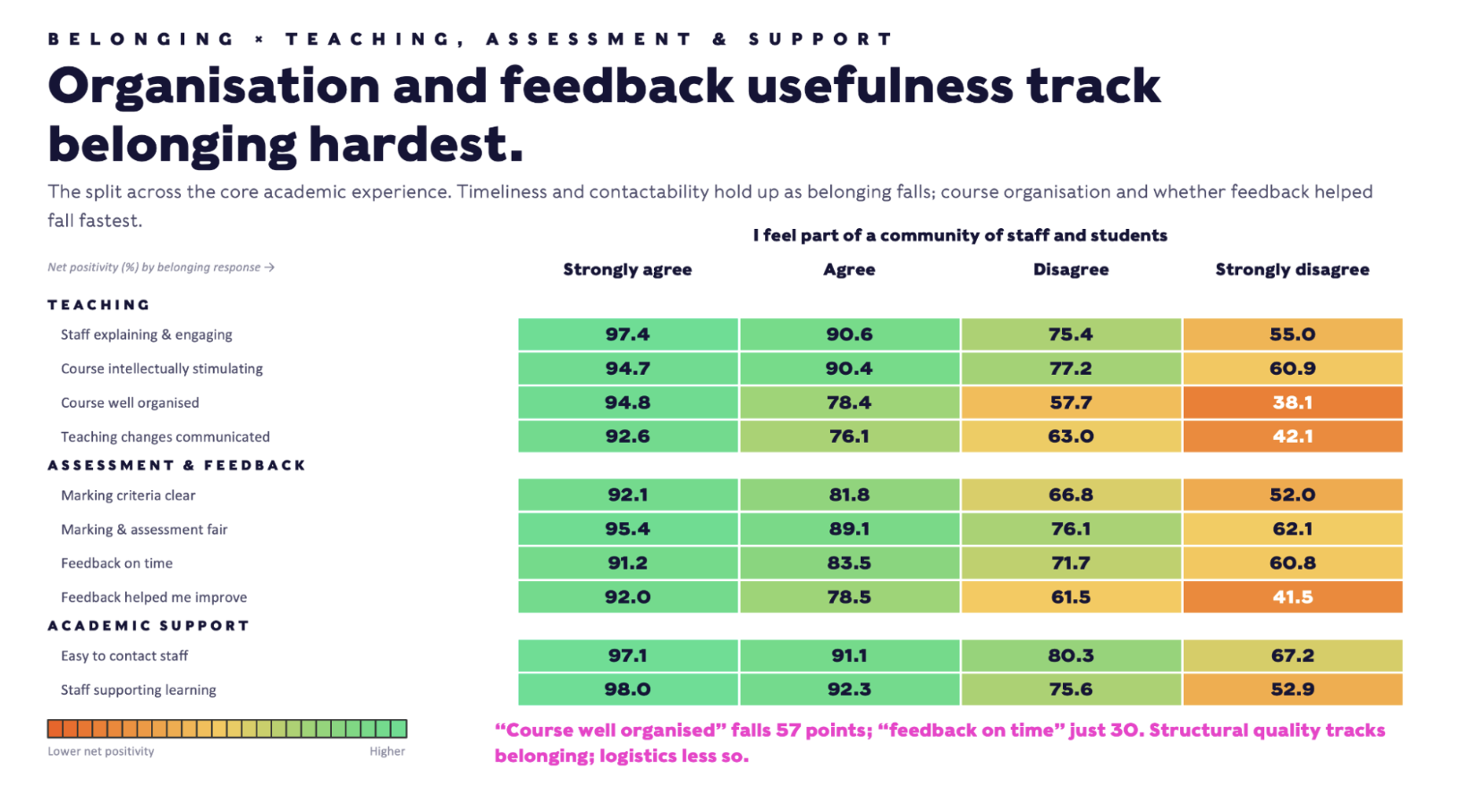
Some things hold up as belonging falls. Library resources drop just 23 percentage points from strongly agree to strongly disagree. IT provision, subject-specific resources, even staff contactability – these are facilities-type measures, and facilities are relatively belonging-insensitive. Students who don’t belong still broadly have access to the library.
But structural quality collapses. Course organisation falls 57 points. Whether feedback helped improvement falls 51 points. “Feedback acted on” falls 61 points – from 87.6 per cent among students who strongly agree they belong, to 26.6 per cent among those who strongly disagree. Opinions valued by staff fall 53 points. SU representation of academic interests falls 48 points.
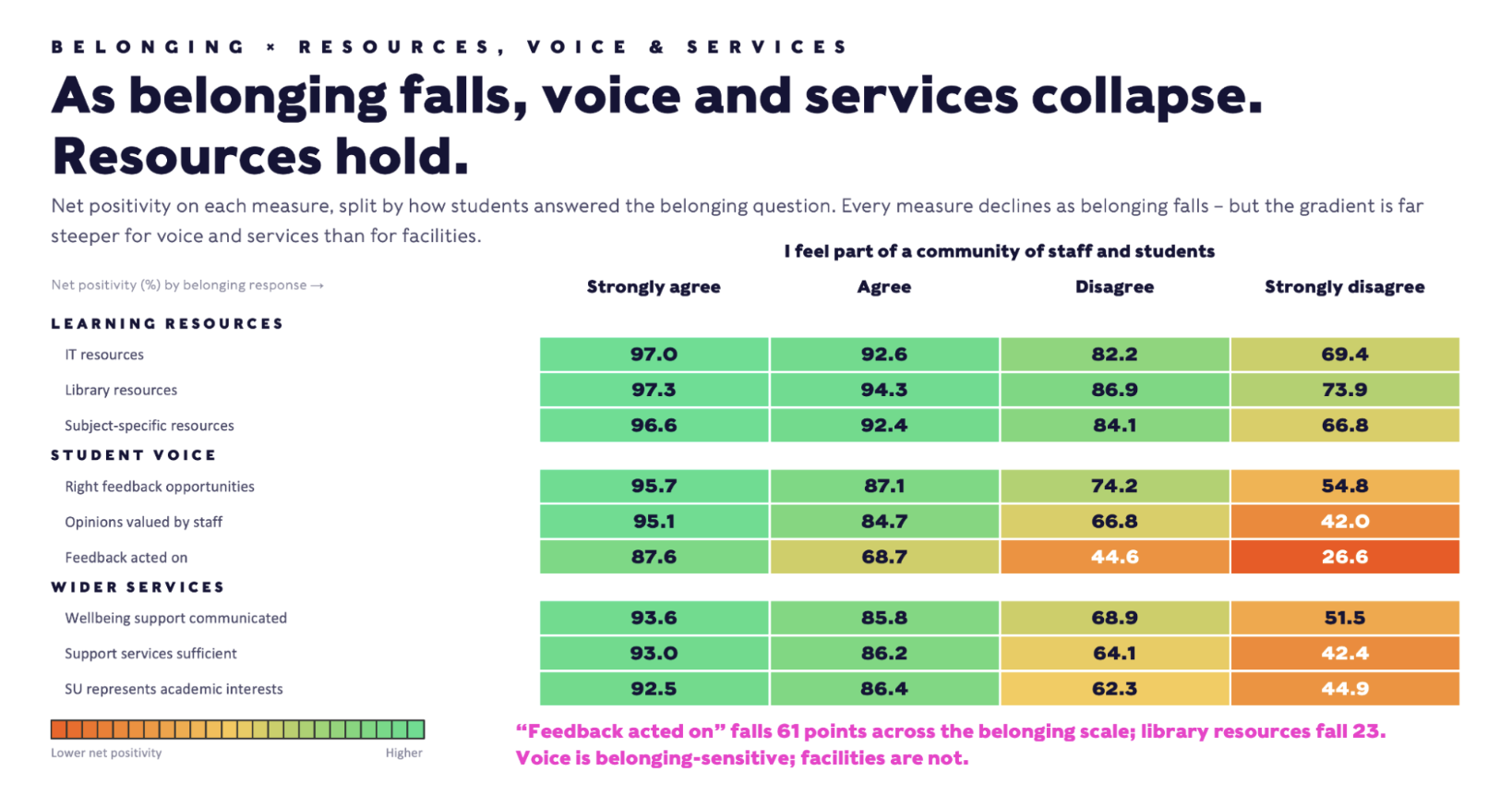
These aren’t marginal differences. They mean that students who don’t belong are, in effect, experiencing a fundamentally different institution – not because the institution has changed, but because connection is the mechanism through which most of what a university offers actually reaches a student. Voice infrastructure, feedback loops, academic support – all of it is doing work, but almost exclusively for the students who already feel part of things.
There’s a strand of belonging commentary (the simplification tendency) that argues the sector needs to simplify its measurement and just ask students if they feel like they belong – get a clear number, improve on it and job done. The problem is that more than four in ten students who say they belong are living proof that the number can be positive and still be concealing a genuine crisis of connection. Simple measurement, if it’s the wrong measurement, is the enemy of action, not the enabler of it.
Not a conceptual problem
There’s a parallel strand of commentary (the look how clever academics are tendency) arguing almost the opposite – that belonging is too contested a concept to do useful work, that we need to replace it with “mattering,” that whose definition of belonging are we prioritising anyway, that the term risks assuming assimilation, that what students really need is to feel valued through a relational co-creation process underpinned by meaningfulness, safety and availability.
The problem with this approach isn’t that it’s wrong about everything. It’s right that different students experience belonging differently, right that the institutional definition can diverge from what students actually mean, right that commuter students and mature students and PGR students aren’t naturally served by the same model as a first-year living in halls. Those concerns are real.
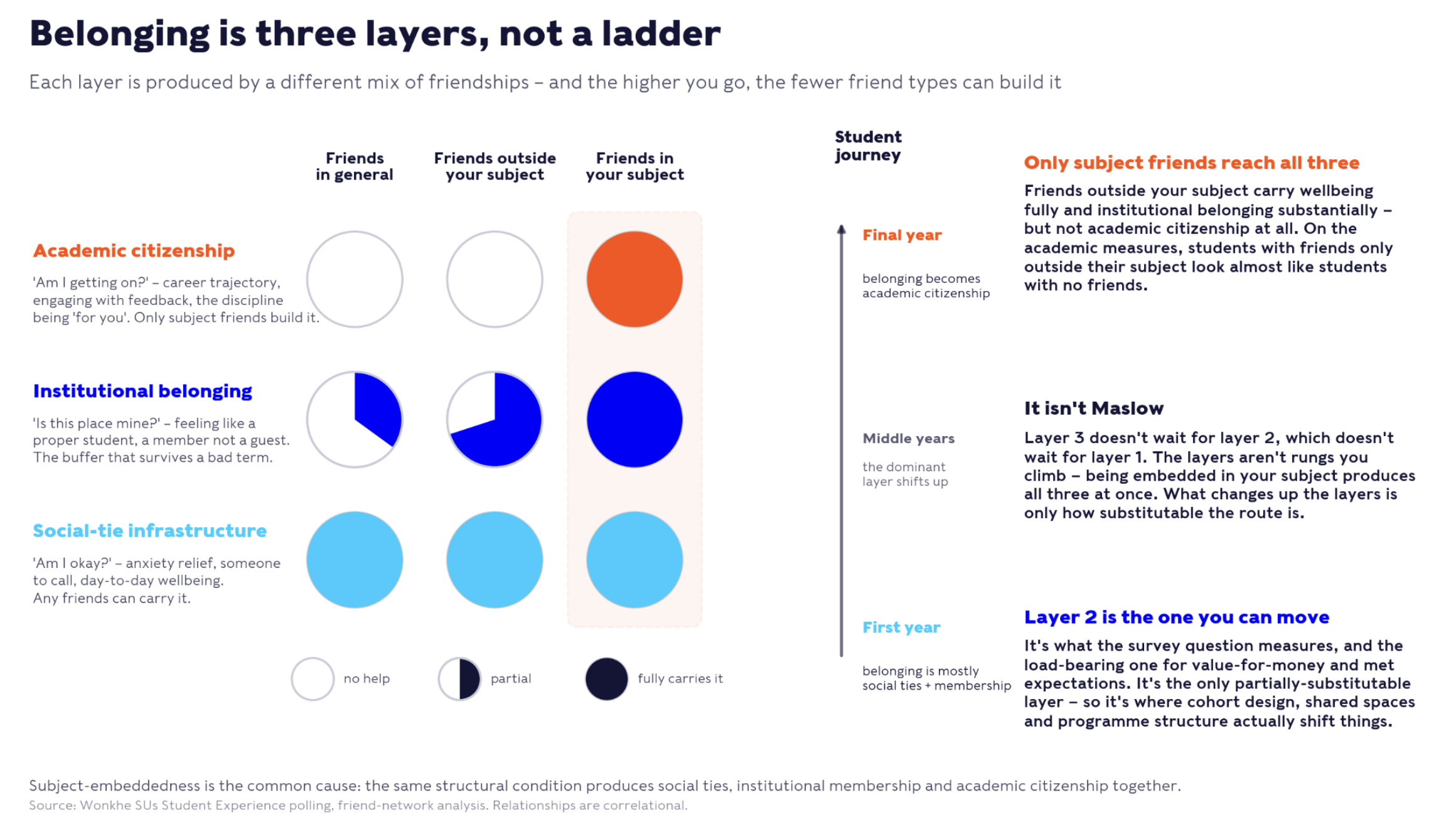
But the data don’t support the conclusion that belonging is too slippery to measure or act on. What they show is that belonging is actually three fairly specific things – close friendships, a felt sense of place at the institution, and academic citizenship – and that these come about through different mechanisms and are carried by different kinds of friend.
That’s less conceptual ambiguity, more useful structural information. Renaming the problem “mattering” and calling for more co-creation and more listening doesn’t tell you what to build. Our report does.
What Mack got right
The avoidance loop Mack described – student has no friends, can’t go to the event alone, doesn’t go, therefore doesn’t meet anyone, therefore still has no friends – is confirmed directly.
Students who get a high-quality institutional offer but still don’t belong are systematically more anxious than students for whom both are working, across every predictor we tested. Mean anxiety on a 0-10 scale runs 4.96 in the high-staff-support, high-belonging group, and 5.62 in the high-staff-support, low-belonging group. The pattern repeats for voice, for SU activities satisfaction, for freedom of expression. In every case, the evidence is consistent with anxiety blocking the bridge between a working offer and the student who can’t reach it – though the cross-sectional data can’t confirm the causal direction. More opportunity at the front door does nothing to close that gap.
Mack’s argument that universities should be building universal peer mentoring – not the scattered, targeted-at-international-students version, but the European model where every new student is allocated to a small group with a trained mentor before they arrive – is also confirmed. Named-buddy schemes, seeded groups, social mentoring that networks students before they have to walk into something alone – these are what the free text asks for, repeatedly. They tackle anxiety rather than just opportunity. Events and initiatives that don’t deal with anxiety will only reach the students who would have turned up anyway.
What the data add, which the TikToks couldn’t, is that not all friendship does the same thing. It’s the finding that should change how the sector thinks about belonging strategy, and it’s the one most likely to get missed.
When we split students into four groups – both subject and off-course friends, subject friends only, off-course friends only, and no friends at all – the measures behave very differently across them.
(This bit of the analysis draws on two survey waves; the percentage differences are directional rather than precise. The survey asked about “course” friends, but the mechanism – shared academic space and activity over time – operates equally at subject or discipline level, which in UK institutions with many closely related degree titles is often the more meaningful unit.)
The largest single step on almost every measure is from having no friends to having any friends at all. But beyond that, the two single-friend groups are not interchangeable, and subject friends consistently do more of the academic-side work.
On career confidence, students with both types of friend score 7.42. Subject friends only: 7.39. Off-course friends only: 6.64. No friends: 6.57. Freedom of expression in academic settings runs at 90.6 per cent for both subject-friend groups, 84.2 per cent for off-course only, and 74.4 per cent for students with no friends at all.
These are the things only subject friends can deliver. Academic citizenship – being on a trajectory, feeling like a participant in academic life rather than a customer of it – doesn’t come from the flatmate you met in Freshers’ Week, or the society, or the faith group, or the sports team, or the WhatsApp group for your accommodation block. It comes from having people who are doing similar academic things as you, in the same seminar rooms, over time.
This matters because 29 per cent of the friend-network sample have only off-course friends – and they’re over-represented among disabled, mature and commuting students. Those students look fine on the belonging headline. Their career confidence says otherwise.
What works?
The conventional belonging strategy – more societies, more events, more pastoral wrap-around, more activities – builds close friends and a sense of place. It won’t move academic citizenship for the off-course-only population.
Conversely, the conventional academic-experience strategy – better teaching, better feedback, more contact time – will build academic citizenship for students already embedded in the cohort. It won’t reach the students whose lack of any peer connection has already pushed them out of the academic environment – the ones spending the day in the dark in bed, as one of Mack’s students described.
The data suggest that more contact with staff helps, but back here in the real world, that’s an argument to deployed in an attempt to protect funding from cuts and to protect the SSR rather than a real strategy. And anyway, the pattern suggests that subject friends appear to enable students to access staff support – not the other way around.
The interventions that do both are subject-level structural design that lets subject friendships and staff relationships co-emerge. In the UK, where a single department often runs several closely related degree titles, the relevant unit is the subject or discipline rather than the individual course – study groups (that don’t have to be run by academic staff) that cut across those titles, departmental social infrastructure, and shared physical space are the levers. And alongside that, SU-owned off-course infrastructure – societies, identity groups, accommodation networks – that carry the close-friendship and institutional-membership layers for students whose programme doesn’t deliver a tight cohort. The students who do well on every measure get both. The students who do worst get neither.
As for the students the belonging headline reads as a success but the wellbeing data reads as a problem – the more than four in ten who say they belong and are frequently lonely – they’re over-represented by under-25s, first years, LGBTQ+ students, and students in Design, Creative and Performing Arts. Their free text reads almost identically to students who are thriving. The difference, when you look for it, is the absence of close ties. A belonging score wouldn’t see them, but a friend-network measure would. The report calls for that to become standard.
One more thing worth noting – “feedback acted on” satisfaction falls 61 points across the belonging scale, from 87.6 per cent among students who strongly agree they belong to 26.6 per cent among those who strongly disagree. Library resources fall 23pp. Voice is belonging-sensitive – facilities aren’t.
Which means that all the investment in student voice infrastructure – the reps, the surveys, the “you said, we did” communications – is doing something important, but it’s doing it for the students who already feel part of things. The ones who don’t belong aren’t rating it, because they’re not experiencing it as reaching them.
Friends, it turns out, have benefits that differ by where you find them. And regardless of whether the student is a 30 year old commuter or a 19 year old in halls, friends in the subject really help. Universities and SUs collaborating to deliver the scaffolding and infrastructure that cause and sustain those friendships are the ones that are doing the right thing in the years ahead.
Friends have benefits report, and slide deck.