


Drawing inferences from raw OIA receipts is a dangerous game.
More complaints into England and Wales’ adjudicator could mean more provider failure, and they could also mean better signposting and easier access to the Scheme.
They might mean students who are more confident than they used to be about their rights, or just more students.
More international students could mean a cohort under more visa-and-fee pressure than ever – higher stakes when things go wrong, more debt or family money on the line, and fewer realistic alternatives if their provider lets them down.
The fact that 42 per cent of complainants now disclose a disability could mean a sector still structurally unable to accommodate them, or Disabled Students’ Allowance (DSA) delays compounding into disputes that internal services are themselves cutting back to handle, or just a growing willingness to disclose.
A rise in service issue complaints can mean financial pressure finally biting through into module cancellations, staffing thinness, withdrawn options, and broken commitments – or it might mean students are just getting better at recognising what they were promised.
It could be all of these things at once, in different proportions, in different parts of the sector, in different parts of the caseload.
The headline numbers are nonetheless striking. In 2025, the Office of the Independent Adjudicator (OIA) received a record 4,234 complaints – up 17 per cent on 2024 and the first time receipts have crossed 4,000.
October alone saw 516 complaints, the busiest single month in the OIA’s history. The OIA also resolved 3,950 cases, with 90 per cent closed within six months and the average case handling time down to 81 days.
But it’s the long view that’s the most striking.
In 2008, the OIA received 900 complaints against an England and Wales enrolment denominator of 2,117,535 – a rate of 42.5 complaints per 100,000 students. The 4,234 complaints in 2025 translate to roughly 165.8 per 100,000.
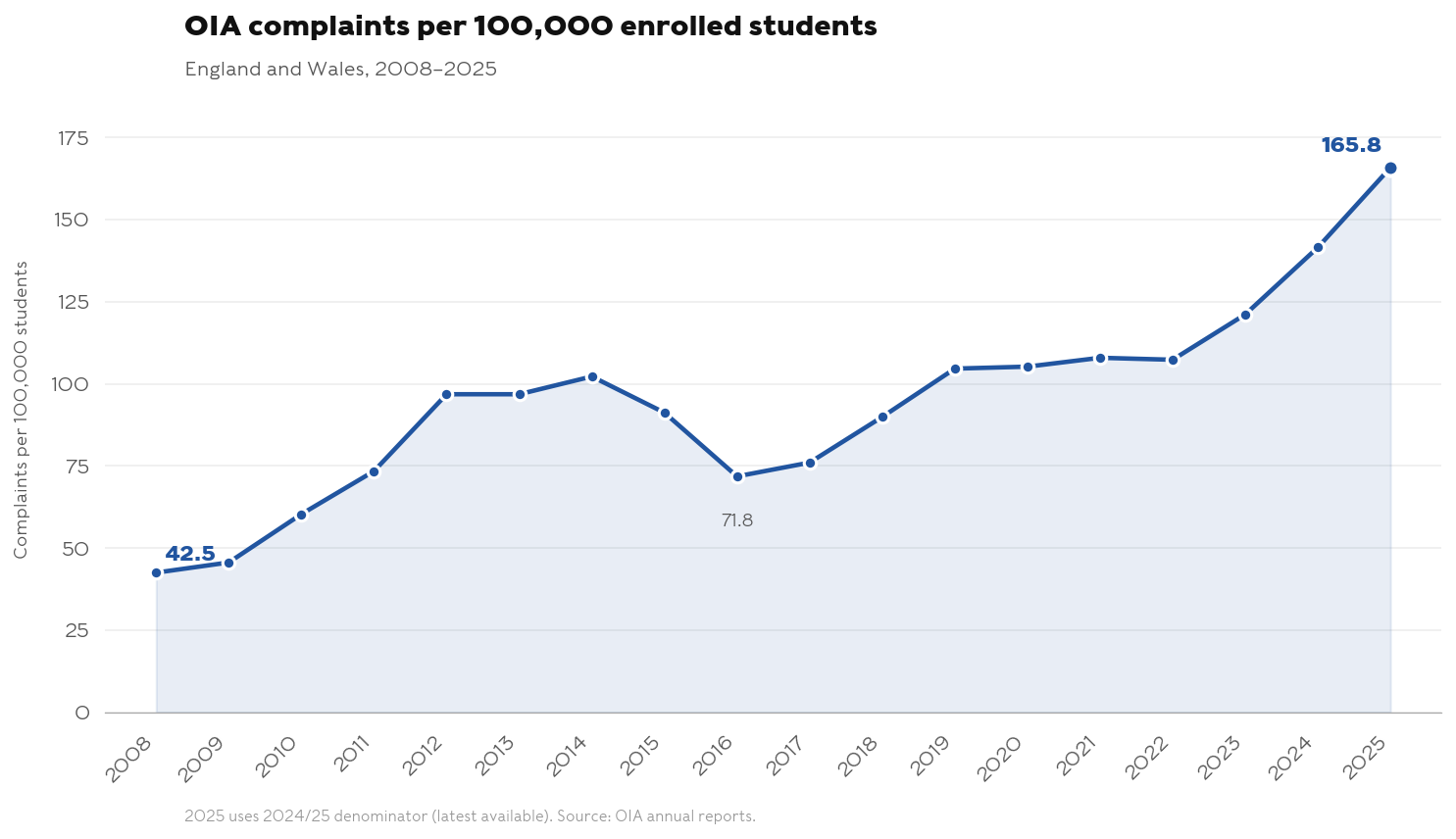
So the rate has roughly quadrupled since 2008. That isn’t enrolment growth, and it isn’t just signposting. The rate per student of complaints reaching the external scheme has climbed steadily and structurally for a decade and a half.
The Office for Students (OfS) used to say complaints to the OIA were a “lead indicator”. If they are, the lights are flashing. OIA chair Sim Scavazza’s foreword says the annual report makes a “compelling case” for why the OIA’s work is more important than ever.
It does – but not quite in the way the foreword intends.
Will they never learn
Academic appeals remain the largest category of stuff the OIA sees, at 42 per cent of receipts. In more than two-thirds, the student raised a personal circumstance they say affected their performance.
The system is meant to be more inclusive by design, but when students get a bad mark and only then put the circumstances forward, providers point them to the rules.
The OIA observes that students often experience these decisions as “lacking compassion”. Six years on from when this first hit the casework as a top theme, providers are still puzzling over why students don’t engage at the right time.
Some 42 per cent of complainants now disclose a disability. The numbers within the numbers are fascinating – 65 per cent of fitness to practise complaints reviewed came from disabled students, and where reasonable adjustments were raised complaints were “almost three times as likely to be upheld or settled overall,” with delays featuring in around a third of those cases.
The DSA safety net is fraying, the gap is being passed to providers who are themselves cutting back, and the gap from there is being passed to disabled students, who are then complaining.
Service issues rose from 30 to 33 per cent of complaints closed. The OIA is cautious about attribution, but adds a line worth reading carefully:
…we do not expect students themselves to identify the reasons causing any failure to deliver a service as promised.
A student complaining about a cancelled module doesn’t write “this was caused by the financial crisis at my provider” in their complaint form. They write that their module got cancelled. If they complain at all.
And the share of complaints closed as not eligible rose from 16 to 20 per cent – 70 per cent brought too early, mostly by students who had begun internal procedures and felt they had waited too long for a decision.
There’s a couple of things the report doesn’t say. First, the relationship between the regulator and the ombud has not produced what it was supposed to.
OfS frames OIA case data as a lead indicator and has talked about consumer protection, contracts, and student information for years. Progress has been haplessly glacial.
The other issue is that the OIA’s own theory of change is creaking. In a year where one provider racks up 58 non-compliances and another goes into liquidation owing students £6,000-plus refunds each, and where compliance with student-centred recommendations is slipping, the iron-fist-in-velvet-glove approach is fraying.
The OIA can ask, recommend, signpost, train, visit, and publish. It cannot order, fine, register, deregister, or require an OfS condition. And shame doesn’t really seem to be more important than implementing cuts anyway these days. The risk balances are all out, and the learning isn’t happening.
The complaints confidence problem
In November, Public First’s research on student consumer rights confidence reported that just 8 per cent of students had heard of the Office of the Independent Adjudicator. Half couldn’t describe their rights as students, and the biggest barrier to complaining wasn’t process complexity – it was futility.
Some 36 per cent of students cited doubt that complaining would make a difference as the main reason they wouldn’t bother. A further 26 per cent had no faith anything would change. A quarter feared consequences for grades or staff relationships. Most students who did raise concerns went informal rather than formal, by a ratio of more than two to one.
Among those who used formal procedures, only just over half felt the institution had handled it satisfactorily. The other half presumably went away less likely to escalate, and less likely to tell anyone else to bother.
Then in January, Savanta polling for OfS reported that 83 per cent of students saw a gap between the experience they believed had been promised and the reality.
A quarter were considering dropping out, 36 per cent transferring, 24 per cent deferring – the kind of decisions that, taken individually, look like personal preference but in aggregate look like a slow consumer revolt. International postgraduates were the most likely to notice cost-cutting and the most concerned about course closure. More than half of students didn’t know their provider’s student protection plan existed.
Both reports speak directly to what the OIA’s annual report describes as its mission – sharing learning from individual complaints to drive systemic improvement. In another world, or at least in another jurisdiction, both should have produced a substantive OIA response. Neither has – no commentary, no good practice update, no thematic case summary, no engagement with the gap between the students who reach the OIA and the 92 per cent who don’t know it exists, or the 83 per cent who say they were promised something they didn’t get.
The OfS-OIA collaboration agreement requires annual meetings on these issues. As Ossian Elkington has noted on the site, there’s no auditable record those meetings are happening.
The international PGT problem is particularly acute. A one-year taught masters student typically has to exhaust internal procedures, then go to the OIA – a process that, even with the OIA’s faster handling times, routinely outlasts the course itself.
Add the not-eligible-because-too-early problem – 70 per cent of newly ineligible cases caused by providers not finishing internal procedures fast enough – and you have a structural mismatch between the cohort growing fastest, the cohort under most acute pressure, and the cohort the OIA’s existing escalation model is least able to serve.
The conclusion is hard to escape – OfS and OIA don’t look like they have a shared plan. There isn’t a visible joint diagnostic, joint priority list, or joint sense of which problems sit where. Which leaves the rest of us drawing inferences from receipts, polling snapshots, and casework notes that don’t talk to each other – the hedge-betting I opened with.
This is not an argument for collapsing the OIA into OfS, or for taking redress further away from local context. It’s an argument for shifting the independent adjudication function nearer and faster, so the OIA can do what its mission claims – detailed national learning synthesis, sectoral pattern recognition, and actual scrutiny of the quality of complaints handling inside providers, not just adjudication of the cases that reach the external scheme.
The problems are piling up. OfS now maps B-condition failures onto a “reasonable care and skill” frame mirroring section 49 of the Consumer Rights Act, and pulls apprentices, employer-sponsored students, and third-party ancillary services into scope.
But then it falls over on independence – C6’s “independent advice” on complaints means independent of the complaint, not the provider, with other university staff qualifying. The Financial Conduct Authority requires firms to signpost the Financial Ombudsman Service. OfS requires providers to signpost themselves.
Providers will soon, too, have a legal Duty of Candour, and under an amended Higher Education (Freedom of Speech) Act 2023 the OIA is now where student free speech complaints go too.
The OIA’s existing model wasn’t built to carry all of this. It is built around individual student complaints after exhaustion of internal procedures, with a narrow remedial toolkit.
Adding to that load, on top of a doubling complaint rate, C6 expectations, and further education (FE) expansion in Wales is asking one body to be five things at once.
What works elsewhere
I’ve written about Beata Kowalska, Jagiellonian University’s first Advocate for Academic Rights and Values, before.
The role is held by an academic teacher employed for at least ten years, holding no managerial post, nominated jointly by the senate, university employees, the undergraduate and doctoral SUs, and the trade unions. In year one her office handled 236 cases.
Her intervention in the Grzyb/Figiel case – a free speech row tangled with a transphobia accusation, a student social media post praising Stalin’s methods, and disciplinary proceedings – is a textbook example of how a respected local independent voice can douse the flames of a campus row that would, in the UK, have produced a multi-year regulatory mess and a Wonkhe long-read every six months.
Polish Law 2.0 enabled this through Section V of an optional model charter for universities. The VU Amsterdam model is similar but pointedly student-focused – independent, neutral, confidential, with most matters resolved at advice and mediation stage before they harden into formal complaints. We’ve seen similar in Spain, Norway, Denmark, and so on.
The OIA is itself a member of the European Network of Ombuds in Higher Education. It knows what these models do.
In England, we might point to universities’ annual student complaints reports as evidence that internal governance can do this work without statutory reform. The University of Manchester’s report is one of the better ones – public, detailed, numerate, with attention to learning.
Yet it lacks the engine that makes these other models actually produce learning and change. The Dutch ombudsperson works upstream – mediating disputes before they harden into formal complaints, holding standing consultations with management, the Teaching Coordinator and Examination Boards on emerging patterns, and reporting trends directly to the Executive Board. Most issues resolve before they ever become formal cases.
The function isn’t to record what went wrong. It’s to interrupt it before it does, and to make sure the institution sees the pattern early enough to act on it. Domestic reports, by contrast, tend to be careful retrospectives on what a system caught downstream of escalation. Documentation isn’t intervention.
It isn’t good enough
Of all the bodies in this picture, the OIA is at least the one that has actually faced its own delivery challenge head-on. But it isn’t good enough.
It isn’t good enough because the OIA is now closing 90 per cent of cases inside six months while the volume of cases that fail eligibility because providers haven’t responded fast enough has risen. The ombud has got faster while the internal systems it depends on have got slower.
It isn’t good enough because two pieces of OfS-commissioned research published during 2025 told us students hadn’t heard of the OIA, 83 per cent saw a gap between promise and delivery, and the largest single barrier to complaining was that students didn’t believe it would make a difference – and the OIA, the body whose theory of change rests on individual complaints driving systemic learning, hasn’t substantively responded to either.
It isn’t good enough because OfS’ headline answer – C6 on treating students fairly – delivers no structural independence, no defined role for the only bodies on campus whose job is to be on the student’s side, and assumes a bunch of documents on a webpage will just cause fairness forever.
And every individual case in the Annual Report, however well-handled, is by definition a case where things went wrong on campus and the campus didn’t put it right. The OIA’s record-breaking output in 2025 isn’t a celebration. It is a measurement of how much avoidable harm reached the only national body capable of intervening externally.
Time for campus ombuds
This isn’t hard. Every higher education provider in England and Wales should be required, in statute, to provide access to an independent campus ombuds for academic rights and values.
The position should command confidence – nominated by the senate or governing body, the SU, the trade unions, and the wider academic community.
It should be structurally independent of line management, free to students and staff, with a remit covering student complaints, contested procedural fairness in academic appeals, harassment and sexual misconduct casework, free speech and academic freedom disputes, and reasonable adjustment failures.
It should produce a public annual report. And it should be networked nationally by the OIA, which, freed from the bulk of first-instance casework, could finally do what its mission statement claims it does – detailed national learning synthesis, sectoral pattern recognition, and actual scrutiny of the quality of complaints handling inside providers. Small and specialist providers would cluster regionally.
The external scheme of last resort doesn’t disappear. It becomes the part of the OIA’s work that isn’t currently happening.
Fifteen years ago, the OIA’s “Pathway 3” consultation, which proposed pilots of the above sort, rested on rising complaint volumes, internal complaints vastly outnumbering OIA receipts, dissatisfaction with delay and fairness, and the need for early independent intervention.
Today the proportional receipt rate is roughly twice the Pathway 3 level, and the cases reaching the ombud are taking longer to get there because internal systems are taking longer to finish. The Pathway 3 conditions have intensified. Add in the C6 independence gap and the new free speech load, and the case has structurally compounded.
As I say, drawing inferences from raw OIA receipts is a dangerous game. But we shouldn’t have to. An ombuds for every provider is the answer because student fair treatment needs to be near enough and fast enough to be visible – not inferred from a report on the cases that made it to Reading, or hedge-bet between twenty plausible readings of patchy data.
The OIA’s existing model is under more pressure than at any point in its history, and the case it tested in 2011 has only got stronger. The sector saw it off then – there’s no good reason to see it off again.








p.40 – “When an offer of settlement has been made during our process but is not accepted by the student, we take this into account when we review the complaint. In 2025, around 30% of settlements which were not successful (because the provider had made an offer during our process which the student did not wish to accept) resulted in Not Justified (Reasonable Offer Made) decisions.” Couldn’t this be seen as putting pressure on students to accept a settlement or risk the complaint being rejected – surely the focus should be on the matter of the complaint, not whether the student chose not to accept an offer of settlement?