In September 2019, just as the sector was celebrating the return of post-study work visas, the then Education Secretary Gavin Williamson wrote to the Office for Students with a specific set of instructions about the management of the coming expansion.
To avoid "resting on our laurels" he asked that OfS ensured international students would receive "the employability skills they need", and be "supported into employment, whether in their home country or the UK".
He also wanted OfS to publish "transparent data on the outcomes achieved by international students", and for that data to "inform the approach the OfS takes to setting and monitoring compliance with its quality requirements."
Within two years the sector would embark on the largest expansion of non-EU postgraduate taught recruitment in its history. The sector hit recruitment targets very early. Employability ambitions? Not so much.
What the data shows
HESA Graduate Outcomes asks graduates to reflect on their activity roughly fifteen months after completing their studies. Three questions ask whether they are utilising what they learnt, whether their current activity fits with their future plans, and whether it is meaningful or makes a difference.
"Active dissatisfaction" – the proportion who strongly disagree or disagree – is a decent signal of genuine unhappiness rather than mere ambivalence.
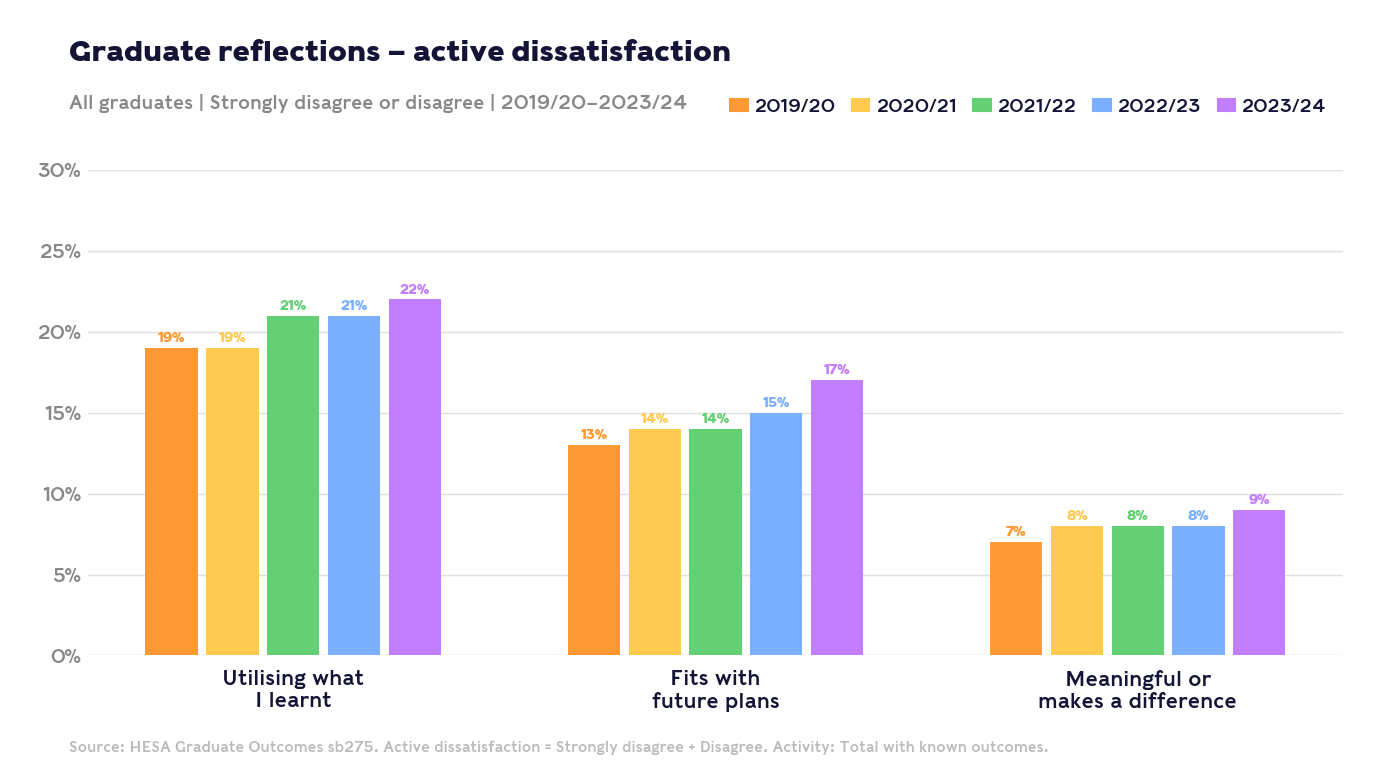
For all graduates, the picture is one of gentle and sustained drift upward – active dissatisfaction on "utilising what I learnt" has risen from 19 per cent in 2019/20 to 22 per cent in 2023/24. It's not alarming in isolation, but a consistent direction of travel.
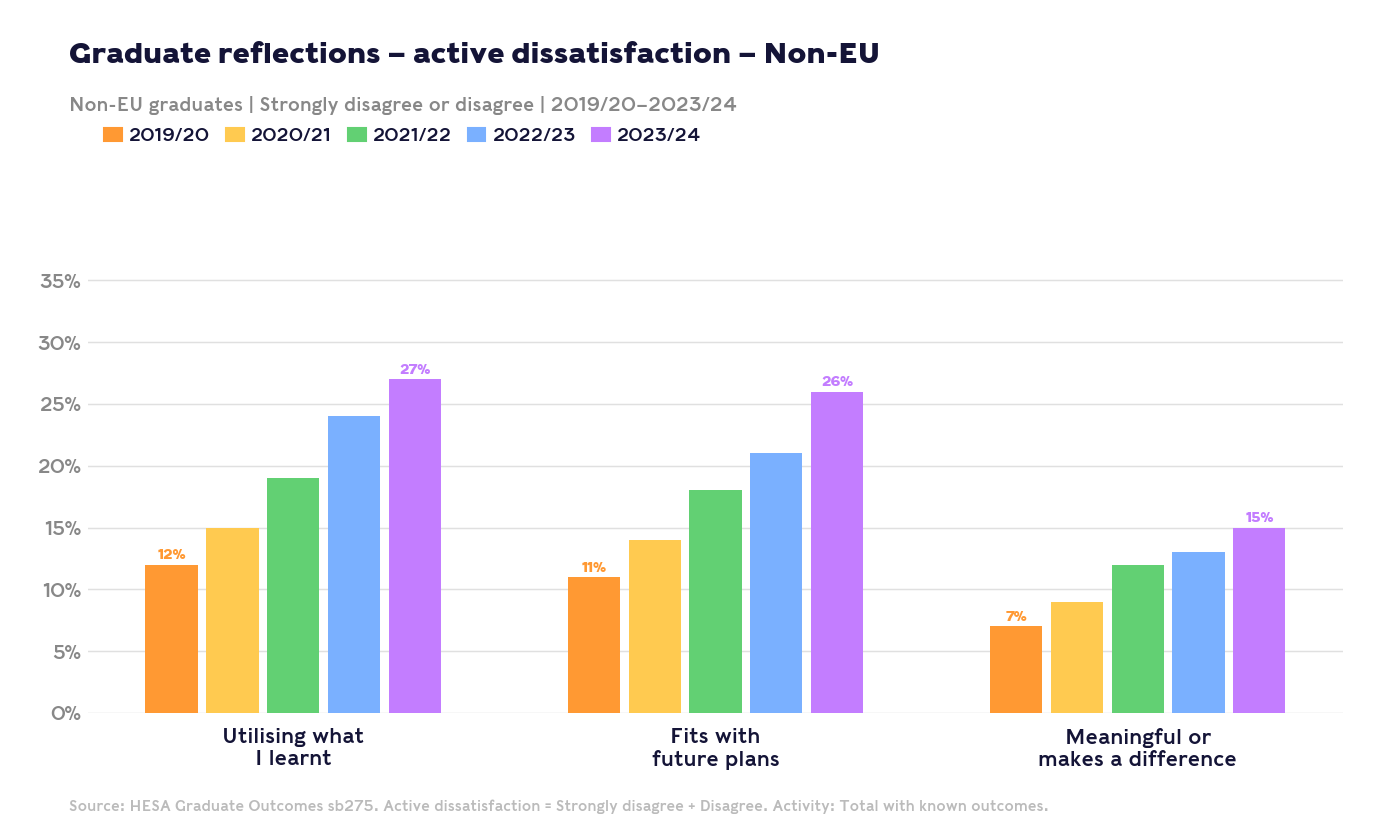
For non-EU graduates, the picture is substantially worse. Active dissatisfaction on "utilising what I learnt" has more than doubled – from 12 per cent to 27 per cent – over the same five-year period. "Fits with future plans" has moved from 11 per cent to 26 per cent. Where above we saw drift, here we see a trend with momentum.
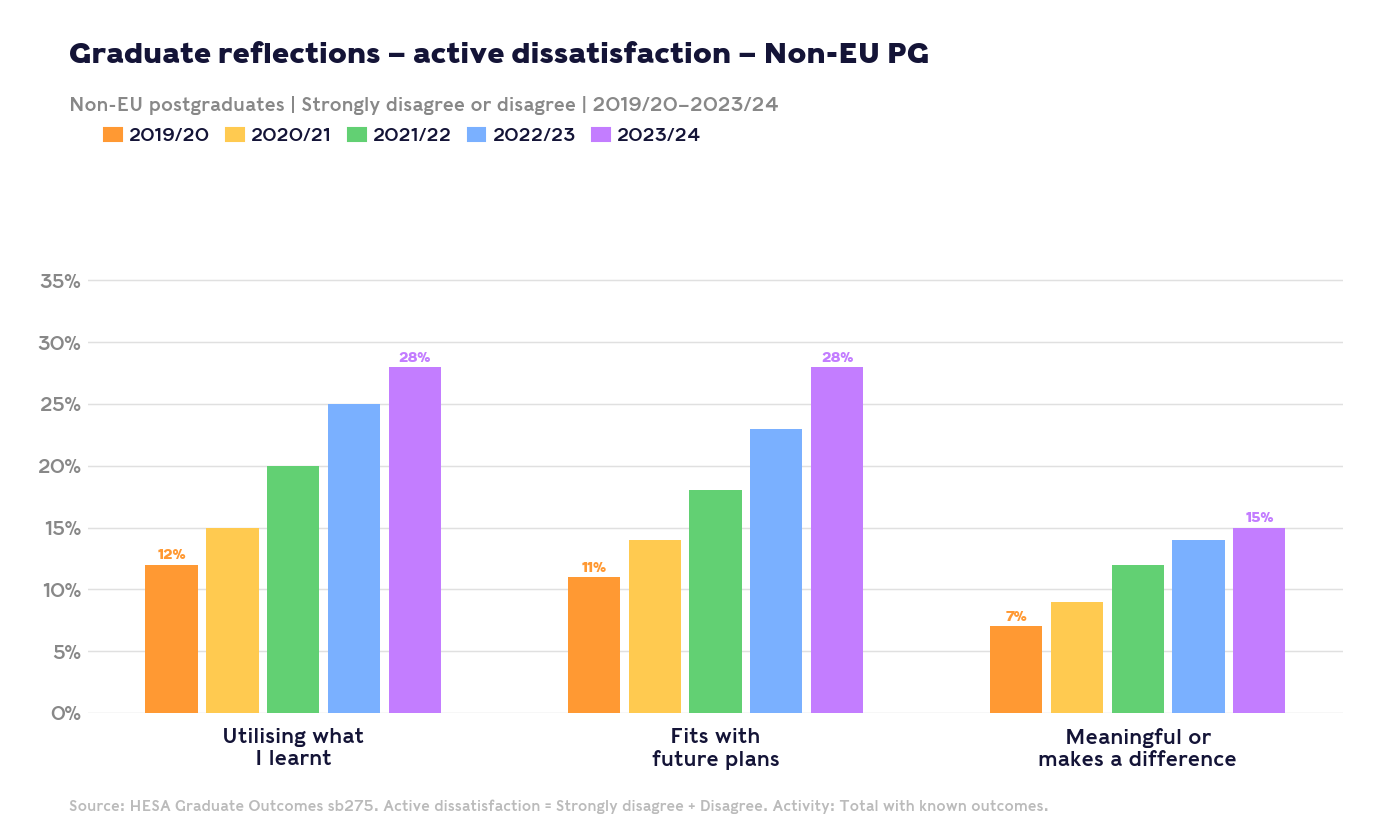
If we narrow down further for non-EU postgraduates specifically, the trajectory is steeper still. By 2023/24, 28 per cent of non-EU postgraduates actively disagreed that their current activity was utilising what they had learnt, and 28 per cent disagreed that it fit with their future plans – a figure that has more than doubled since 2019/20.
These two lines have converged at the top of the chart in a way that is significant – when "I'm not using my skills" and "this isn't what I came here for" produce the same level of active dissatisfaction, we are looking at something systemic rather than incidental.
Caveat time. The GO survey's overall response rate sits at around 35 per cent, and it is not certain that non-respondents have similar outcomes to those who do respond. The aggregate figures should be read as indicative rather than definitive. That said, the direction of travel is consistent across five consecutive years and across all three reflection questions – which makes it implausible that response rate changes alone account for the trend.
Provider-level data from the same survey tells a similar story. Among non-UK full-time postgraduate graduates – a reasonable proxy for postgraduate taught, given that 97 per cent of non-UK postgraduates study full-time – unemployment rates vary enormously.
De Montfort and Coventry report over 22 per cent unemployment among this cohort; the University of East London reports over 20 per cent, Hertfordshire, Bedfordshire and Birmingham City are in the high teens. At Oxford and Imperial the equivalent figure is under six per cent. Crucially, the providers with the worst outcomes are also those with the lowest GO survey response rates – the already-alarming unemployment figures may well be underestimates.
Strategic inaction
In January the government published a new International Education Strategy – the first since 2019. The strategy commits to recruiting "high quality international higher education students" and achieving "world-class outcomes". It talks of "well-managed and responsible recruitment" and "a quality student experience". It retains the graduate route and signals support for employer engagement.
It contains no reference to Graduate Outcomes data, sets no threshold for graduate employment rates, and proposes no regulatory consequence for providers where international graduate unemployment is running at one in five.
Nor does it mention that active dissatisfaction among non-EU postgraduates has more than doubled in five years. OfS – the body Williamson specifically asked to use outcome data for compliance purposes – has not done so.
The strategy's delivery mechanism is the Education Sector Action Group (ESAG), whose inaugural meeting took place in April 2026. Sector action plans are due within 100 days – late July. Students ought to expect that action plan to identify the issue and… take action.
What's going wrong
The warnings have been consistent. A 2020 piece on Wonkhe argued that the UK couldn't rely on the graduate route to fix an underlying careers support failure, and a 2022 piece called for employability support to be mapped to the full international student journey rather than bolted on at the end.
UUKi, AGCAS and UKCISA jointly published a report in 2020 finding that 44 per cent of careers services offered no support specific to international students at all, and only 28 per cent felt they were meeting the demand they were seeing.
Several interlocking factors appear to be driving the deterioration. The first is structural – the UK's one-year postgraduate taught model was designed as a premium product (faster and nominally cheaper than competitors) but it compresses the time available for exactly the activities that produce good employment outcomes.
Work experience, employer networking, cultural navigation, and building UK labour market knowledge cannot realistically happen alongside a full-time intensive Masters. A 2025 systematic review by Wang and colleagues in the British Journal of Guidance and Counselling confirmed that the UK's fast-track model structurally constrains employment opportunities, with courses often focused on academic content and offering limited practical or placement elements.
The HEPI/Kaplan research found that 42 per cent of international postgraduate taught students gained no work experience during their studies – and the course duration was the primary reason cited.
The second is employer unfamiliarity. The graduate route has been available since July 2021 and allows international graduates to work without employer sponsorship for two years. A 2023 HEPI survey found only three per cent of employers had knowingly used it, and more than a quarter weren't familiar with it at all.
The burden of explanation falls on the graduate in the job interview – an APPG inquiry into the graduate visa described this as unsustainable. Where employers default to "we don't sponsor" even when sponsorship is not required, the graduate route is a right on paper that doesn't function in practice.
The third factor is who the expansion recruited. The sector's rapid growth in non-EU PGT numbers between 2020/21 and 2022/23 was not uniform. It was concentrated at post-92 providers, and it drew disproportionately from Nigeria, Bangladesh, and Pakistan – cohorts that were typically more financially stretched, more reliant on agents who oversold graduate labour market prospects, and more dependent on their UK qualification for an actual economic return. International students still choose the UK – but for how much longer?
The one-year model was not designed for a student who needs to work during term to cover living costs and is depending on their Masters to change their economic trajectory. When that mismatch is replicated at scale, the GO data is what you get.
What needs to change
The diagnosis points pretty clearly to what needs to happen, even if the political will is not yet there. Williamson's 2019 ask – that outcome data should inform regulatory compliance – has not been acted on in seven years. OfS has never used international graduate employment data as a quality threshold. That needs to change, and the ESAG action plan is a near-term test of whether it will.
Provider-level transparency is the minimum. If a provider is reporting 20 per cent unemployment among its non-UK postgraduate cohort alongside a six per cent survey response rate, both figures should be in the public domain in a form that prospective students and their agents can access easily. At present, the GO data exists but is not surfaced in any of the guidance or comparison tools that international applicants actually use.
Embedded employability – not optional workshops or a single immigration webinar, but credit-bearing work-integrated learning built into the curriculum – is the structural fix that the evidence points to. The HEPI/Kaplan finding that 75 per cent of international students who had employability embedded in their course were satisfied versus 43 per cent of those who did not is one of the cleaner findings in this literature. For one-year programmes in particular, the only time students have for this is the time the course itself allocates.
Employer education is necessary but currently absent at scale. Fewer than one in ten careers services undertakes any initiative to help employers recruit international students, according to the UUKi/AGCAS/UKCISA review – despite two-thirds perceiving that employers treat international students differently. Institutions cannot simultaneously recruit aggressively on the promise of UK employment and then leave graduates to navigate employer ignorance alone.
And the underlying question – about whether the one-year model, at the volume and price point it has been sold to the cohort that bought it, was ever going to produce good outcomes – needs to be asked directly. It's not so much that the product changed, and nor did the marketing, which sold outcomes vibes on a smaller and different cohort's data. The Graduate Outcomes data is now the bill.