Wonk Corner|8/12/25 · 10:00
Study a Bachelors DEGREE without paying a single penny? You’re on
On Instagram, prospective students are told that they can:
Jim Dickinson
Jim is an Associate Editor (SUs) at Wonkhe
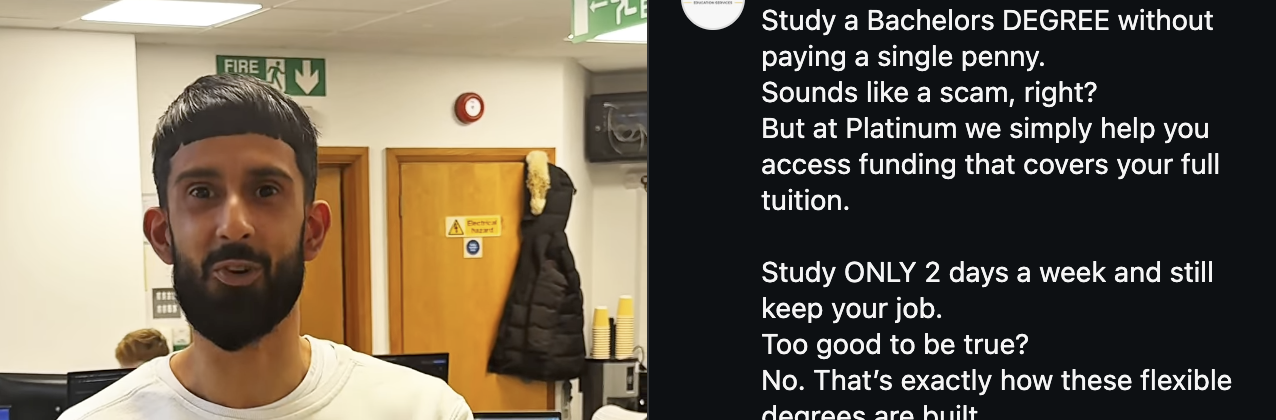
Study a Bachelors DEGREE without paying a single penny.
It goes on to ask:
Sounds like a scam, right?
Apparently, at that agency they simply “help you access funding that covers your full tuition”.
That’s a loan to me and you. The good news?
Study ONLY 2 days a week and still keep your job.
That’ll be a statement that describes the required attendance pattern, and obscures the independent study required.
Too good to be true?
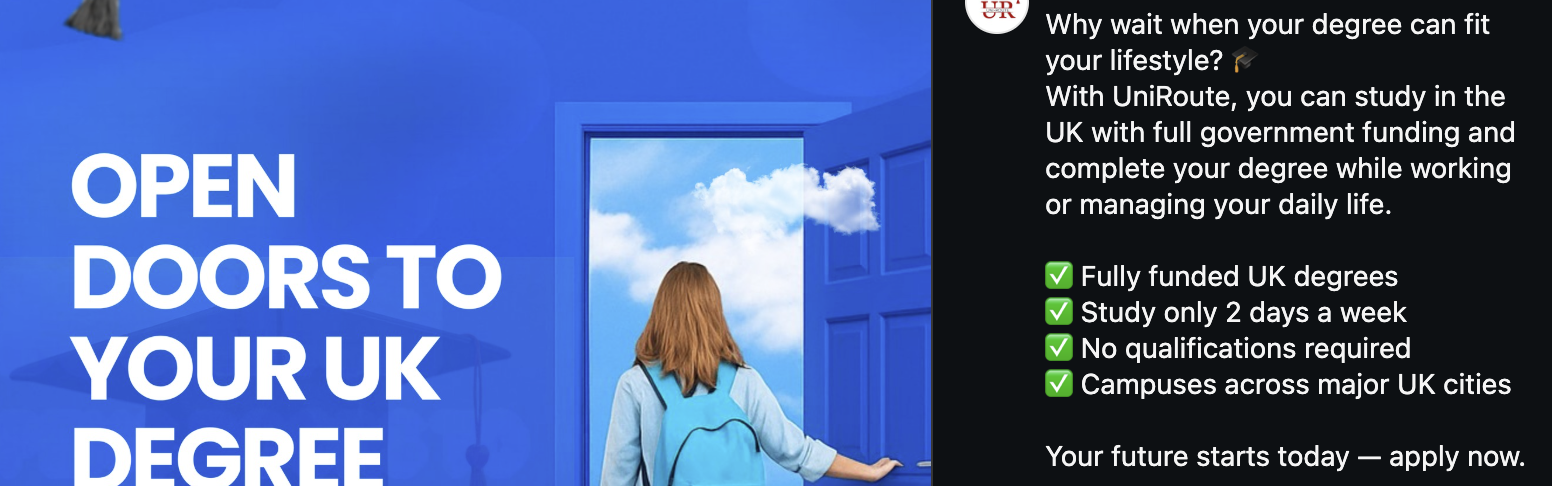
Another ad says that you can study in the UK with “full government funding” and complete your degree while “working or managing your daily life”.
Fully funded UK degrees…
…appears again to mean those that attract a tuition fee loan.
Another one has the following headline:
Want To Study In The UK With ZERO Tuition Fee?
Readers are then told that it’s possible to “get admitted to a Top UK University” and earn a globally recognised degree “without paying tuition fees”.

Eligibility – which again suggests we’re looking at student loan system – is for “British Citizens”, “EU Settled/Pre-settled”, “ILR Holders” and “Refugees”.
Apply Today & Get A £100 Gift Voucher After Registration!

There are variations.
Imagine unlocking UK education and someone hands you up to £25,000 a year to make it possible.
That’s another one describing the loan system.
Sounds unreal? That’s exactly what students experience – real support that opens real doors.
Again, the details point at the SLC:
Apply for Childcare Grant, NHS Grant or PLA.
There are – literally – hundreds of these ads on TikTok and Instagram.
If these outfits are operating as domestic agents for a university that is a UUK Fair Admissions Code signatory, then the material could be a problem on multiple fronts.
Plenty of them describe standard tuition loans and grants as if they were free money, which seems to conflict with the code’s requirement that marketing and third-party information is complete and accurate on costs and terms.
Claims on time commitment may misrepresent the real study commitment, gift vouchers “after registration” seem to brush up against the prohibition on incentives that place undue pressure on decision-making, and generic “Top UK University” / “study in the UK” language could obscure who the provider is and how any franchise arrangement works.
The code also says providers must only use domestic agents for targeted WP outreach or specialist courses, and must take responsibility for the quality of information those agents provide – these examples look like mass-market domestic recruitment using highly questionable messaging.
If OfS Condition C5 (or a version of it) was in force for the universities being recruited to, the material could trip multiple wires. C5 covers “any arrangements the provider has made or plans to make to attract individuals to study”, including advertising and marketing, and applies to higher education delivered “by, or on behalf of, a provider” – so anything an agent is pumping out on a university’s behalf is squarely “information about the provider”.
The prohibited behaviours list then bans describing a service as “gratis”, “free”, “without charge” or similar where there are costs that have not been explained – explicitly including “the repayment of student loans at a later date” – which is exactly what “without paying a single penny”, “ZERO Tuition Fee” and “fully funded UK degrees” seem to be doing if the debt and repayment obligations are never mentioned.
It also prohibits displaying information “likely to have the effect of misleading” someone into believing something inaccurate about the provider, which the “two days a week” and “up to £25,000 a year” lines may do by presenting legal entitlements to loans and standard independent study patterns as if they are special features unlocked by the agent.
On top of that, offering a £100 voucher “after registration” but not clearly spelling out the conditions engages the clause on prizes and promotional benefits, and C5’s separate detriment limb would let OfS say that this pattern of marketing creates a likelihood of financial detriment to students who are induced into long-term loan commitments on the basis of “free” messaging.
So if C5 applied, a university allowing domestic agents to advertise in this way would seem to be at serious risk of being found not to be treating students fairly.
The Digital Markets, Competition and Consumers Act (DMCC Act) does apply now. DMCC Section 226 bans false or misleading information and deceptive overall presentation, and the CMA’s new unfair commercial practices guidance explicitly picks up long-standing rules against describing something as “free” or “without charge” where the consumer faces unavoidable costs – including later loan repayments – so lines like “Study a Bachelors DEGREE without paying a single penny”, “ZERO Tuition Fee” and “fully funded UK degrees” that actually mean “you’ll be taking out a tuition fee loan and maybe maintenance support” feel like a breach.
Those ads would also seem to be “invitations to purchase”, so section 227 and the CMA’s price transparency guidance require the total cost and nature of payment to be made clear up front – not rebranded vaguely as “funding” or “up to £25,000 a year” with no mention of long-term debt, interest, or what costs are and are not covered.
The regime now makes omissions of material information in an invitation to purchase automatically unfair, and extends “transactional decision” to any decision about whether, how or on what terms to enter into or retain a service contract – the decisions these ads seem to be trying to influence.
Add in section 227’s requirement to identify commercial intent and the new focus on concealed incentivised content and vulnerability – if these accounts present as neutral “study advice” while in reality being paid domestic agents pushing particular providers, and they’re targeting financially stretched or first-in-family applicants with “too good to be true” messaging and £100 vouchers contingent on registration, you potentially have both undisclosed commercial motive and practices likely to exploit situationally vulnerable consumers.
The CMA guidance is crystal clear that liability attaches not just to what the university itself says but to agents and intermediaries acting “on behalf of” the trader – so a provider can’t hide behind “it was the agent’s copy”, and weak oversight of this kind of domestic agent marketing is very likely to fail the tightened professional diligence test under section 229.
It really isn’t hard to spend 10 minutes on Instagram to spot this stuff. I suspect universities might shy away from mystery shopping their own agents because once they uncover mis-selling, they’re obliged to fix it – so “better not to know” feels like the path of least resistance.
But that is exactly what DMCC is designed to stop – the legal test is no longer whether a provider can claim ignorance, but whether it has acted with the skill, care and honesty a reasonable trader would.
If agents are out on TikTok promising “zero tuition fee” and “£25k a year” as if it’s free money, then not running basic checks starts to look like a breach of professional diligence, especially when the students being targeted are young, first in family and financially precarious – the very situationally vulnerable consumers the Act picks out for extra protection.
Mystery shopping is now the obvious control, and choosing not to look moves from being a convenient organisational shrug to a compliance risk in its own right.
Alternatively, there’s Secretary of State Bridget Phillipson’s announcement of her (seemingly doomed) intervention into Oxford Business College back in March, when her actions were to include:
… putting an end to the abuse of the system by agents recruiting students based in this country: this government believes they should have no part to play in our system whatsoever.
If the assumption inside Sanctuary Buildings was that UUK’s Fair Admissions Code and OfS’ Treating Students Fairly would fix things, then DfE very obviously needs to think again.