Their central campaign is a demand that the government release the full, unredacted Longitudinal Education Outcomes (LEO) dataset – records that link individual graduates’ educational histories to their subsequent earnings.
LFG argues this data exists, that the government uses it internally, and that its “suppression” prevents students from making informed decisions about university.
My colleague David Kernohan has already pointed out that course-level LEO data is publicly available – on Discover Uni, which shows graduate earnings at 15 months, three years, and five years for individual courses at individual providers.
It’s also available through the Department for Education’s (DfE) own published LEO releases, which break down earnings by provider and subject area and are available in machine-readable format.
Nevertheless, instead of downloading the datasets, LFG have made a little game.
The Graduate Journey is a browser-based interactive that takes a named player from A-levels through university and into the graduate job market. Every stage ends badly, and the game ends with a petition asking players to demand the release of the LEO records.
For lols, I’ve reverse-engineered the game’s source code – every piece of text, every statistic, every branching outcome, and every mechanical device has been extracted from the underlying HTML and JavaScript.
The mechanics
The game is built as a linear sequence of screens with occasional branching. The player enters their name at the start, which is inserted into every subsequent screen to create a sense of personal address.
There’s no saving, no scoring, and naturally for a piece of propaganda, no way to win – every path leads to one of two bad endings.
Two persistent devices run underneath every screen from the moment the player enrols. The debt ticker counts upward in real time, calibrated to reach £53,000 – the approximate tuition debt for a three-year English degree – over the course of the game, with 3.2 per cent annual interest compressing three years of study into the playtime. It never stops, never goes down, and no ending places it in any context.
The English student loan system’s income-contingent repayment structure makes the figure largely notional for many graduates – functioning more like a graduate tax than a conventional loan, and the total may never be fully repaid. The game shows a number ticking toward £65,000 without any of this. That’s a choice, not an oversight.
An optimism bar starts at 100 per cent and decreases at every decision point, reaching 31 per cent at best. It has no mechanical effect – it doesn’t change which options are available or what happens. It exists as a visual metaphor.

Funnels and locked doors
The player is told their teachers, school, and the government are all encouraging them to go to university. There is exactly one option:
Continue to University – The Government has promised a £100,000 ‘graduate bonus’ over a lifetime!!
The double exclamation mark signals sarcasm. No vocational pathway, no apprenticeship, no gap year is offered. By offering no alternative, the game replicates the funnel it claims to criticise.
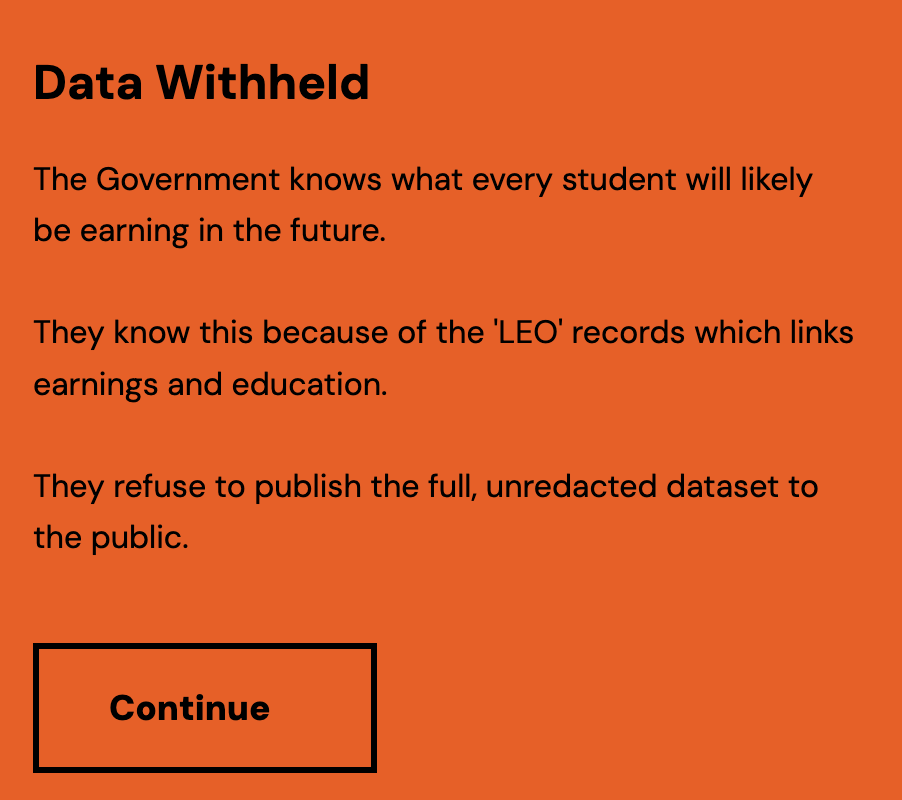
The player is offered one option – research their course by looking at records linking it to future earnings. Clicking it triggers a popup asserting that the government “refuses to publish the full, unredacted dataset to the public.” The only remaining option becomes:
Wing it, University is good!
It’s the game’s central political claim, and it’s false. As DK has demonstrated, course-level LEO data is publicly available on Discover Uni and through DfE’s own published releases. The popup states suppression as fact, forecloses any nuance, and then forces the player to proceed on the basis that they’re flying blind – when the tools to inform their decision are freely available.
University – no good options
The university section is engineered so that every choice either leads to the same outcome or makes things marginally worse. The essay step illustrates it – use AI and a study from the University of Reading is cited to imply honest students are universally penalised; work hard and your AI-using classmate got a better grade anyway.
Both reduce optimism by 8 per cent regardless. The only step where one option genuinely beats the other is the group project – doing it yourself produces a first, while your AI-generating classmates drag you to a 2:2 – though both still cost you optimism points.

The lectures step is representative of the section’s general method. The button text frames attendance as joyless duty – “You spend more than £10,000 a year. You might as well go” – and the lecture itself involves a tutor reading directly from slides for two hours.
Staying home and reading the slides yourself is presented as equally valid. The value-for-money question has genuine force, but the game takes the worst-case experience and presents it as universal.

Graduation and the job market
Both paths from graduation – taking a Master’s or going straight into employment – lead to the same screen. A statistic from the Institute of Student Employers is cited: 1.2 million people applied for just 17,000 graduate roles in 2024. The figure is real, but “graduate roles” in the ISE report refers specifically to structured graduate schemes at large employers – a subset of the overall graduate labour market. LFG present it as if it describes every graduate’s options.
The interview section does capture something real. Eight-round processes and AI-mediated interviews are genuine features of large graduate recruitment. The rejection reason – the HR representative didn’t like the colour of your tie at the eighth round – is deliberately arbitrary, but it gestures at something true – that after an extensive process, rejection can feel entirely capricious and almost never comes with useful feedback.
At the end, moving to the Netherlands produces:
They lied to you. They know the impact of each university and each degree, but they are covering it up.
Choosing Universal Credit produces:
The system failed you, it lied to you. It is not your fault.
The second formulation inoculates the player against any impulse to question whether the game’s account is accurate. Having built a false picture of suppressed data and a universally broken labour market, the game now frames scepticism as victim-blaming. It’s a tidy piece of closure.
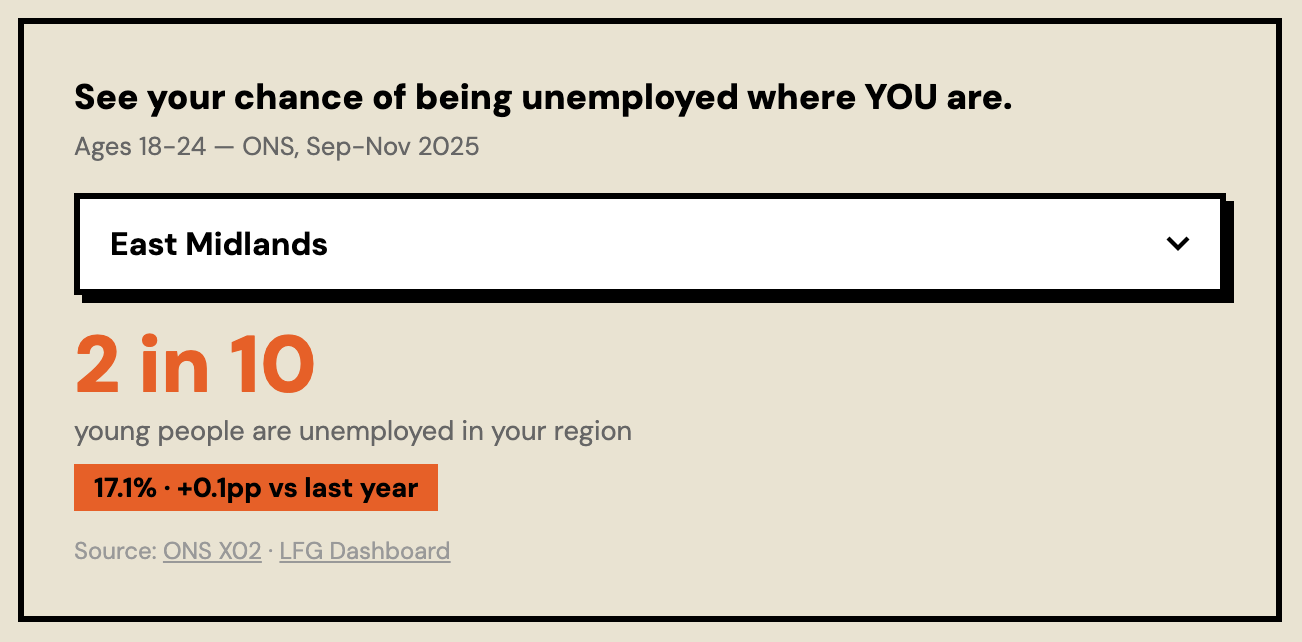
Both endings display a live widget drawing on ONS figures showing youth unemployment for 18–24 year olds by English region. The figures cover all 18–24 year olds, not graduates. Graduate unemployment rates are substantially lower. LFG are using youth unemployment data to make a claim about graduate unemployment, and hoping the player doesn’t notice the difference.
Nasty stuff
The Graduate Journey isn’t a game. It’s a petition funnel with a user interface bolted on. Every mechanical choice is engineered to produce a specific emotional state in a named, personalised player and deposit them in front of a signup form before they’ve had a moment to think critically.
The personalisation is particularly cynical – inserting the player’s own name into every screen of disappointment and rejection is designed to make a structural argument feel like a personal wound. It’s manipulative in a precise and deliberate way, and it’s aimed at young people who are, by definition, at their most anxious and uncertain about their futures.
What makes it worse is that the game does exactly what it accuses others of. Its central charge against the government is withholding information that would help students make better decisions. Yet the game itself withholds – deliberately – every piece of information that would complicate its case, then leaves its own players in the dark about everything that would lead them to a different conclusion.
The game also treats higher education purely as a labour market investment and judges it solely on earnings outcomes. There’s no acknowledgement that education might develop critical thinking, broaden horizons, build networks, or have value that doesn’t show up in LEO data at all – and naturally it doesn’t consider that any problems in the graduate labour market might reflect problems in the wider economy.
There are, to be fair, grains of truth scattered through the game that point toward things worth reforming. The graduate job market is fiercely competitive and the application process at large employers is frequently dehumanising. AI is creating real problems for assessment integrity that universities have been slow to address. The income-contingent loan system, whatever its merits, is poorly understood by most of the people who enter it.
These are real issues, and the pressure to surface better information and accelerate reform in how universities handle AI, how employers run recruitment, and how the government communicates about outcomes is legitimate and overdue. The results of this exercise can’t come fast enough.
But step back and this is good old-fashioned “too many people at uni” ladder-pulling written in JavaScript – only it’s designed to exploit an already anxious generation into joining its cause. Nasty stuff.