This article is more than 4 years old
Wonk Corner|13/06/22 · 14:20
IFS on adult education
However could adult skills provision have sunk to such a low ebb, and will planned changes do much to address it?
David Kernohan
David Kernohan is Deputy Editor of Wonkhe
The government are currently full speed ahead on improving lifelong learning, with spending on adult learning, work based learning, and apprenticeships set to rise to £4bn in 2024-25 - that's just £1.5bn less than it was in 2009-10.
The graph currently doing the rounds on twitter is from a new Institute for Fiscal Studies (IFS) report on adult learning, and it is fair to say that it adds some much needed context to talk of a "skills revolution".
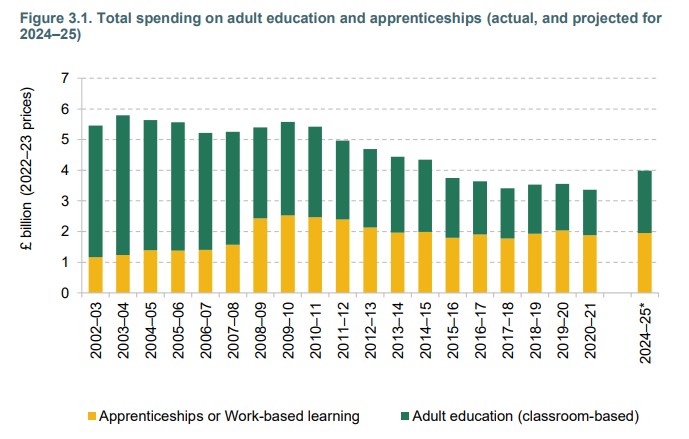
The bulk of the planned increase, according to IFS calculations, is to classroom-based level 2 and level 3 qualifications. The small increase in apprenticeships funding is actually now a real-terms cut given the high prevailing rate of inflation.
What about L4 and above?
With graphs like the above, it is perhaps not surprising that the post-compulsory level findings haven't got as much press. The report notes that the combination of FE/skills and HE funding into a single, more flexible, regime (the Lifelong Loan Entitlement or LLE) will correct the current anomaly where higher education learners can generally claim full fee loans plus maintenance loans, whereas others may have to pay fees from their own pocket and very rarely have access to (provider based) maintenance support.
Pending the release of the response to the consultation held earlier this year, we don't know precisely which courses in FE (beyond the new higher technical qualifications) will be eligible for LLE funds, or how things like long (4 years plus) undergraduate programmes or integrated additional components (foundation years, masters, PGCEs) will be supported in higher education.
IFS notes that this actually makes lifelong learning harder for a lot of very common use cases. Imagine you take a year's worth of FE-based employment focused courses in engineering, get a job, and then decide you want to take a full-four year degree to qualify as a chartered engineer. At the moment this is fairly straightforward and common - post-LLE you wouldn't get funding for a four year course if you'd already used a year's worth of entitlement. The implication would be some kind of credit transfer/recognition of prior learning would happen - but for a regulated profession this is far from straightforward.
The long and the short of it
The IFS is known for its superb use of understatement in policy critiques:
Nevertheless, a lot is still unclear about how the system will operate. On the policy side, we still do not know how Lifetime Learning Accounts will work for those who have already taken up government funding for their post-18 study, or what – if anything – will happen to account balances when maximum tuition fees change. More importantly, it is very hard to predict how many providers will be willing to offer these modules, and to what extent they will in fact be transferable between institutions
All of these are very complex technical questions - you could add ELQs in there too -and will lead to a very complex technical consultation (that I am very much looking forward to). Without the answers to these and related questions much of what is currently understood about the LLE is moot, and ministers may well be advise to ease up on announcing revolutions before matters are a little more settled.
IFS also notes that longer completion times (people picking up a module here and there rather than over a set number of years full time) is very likely to lead to lower overall lifetime earnings - on average - from those who take up funding. This would, of course drive up the RAB rate, increasing the cost to the Exchequer and thus making more restrictive reforms likely later on.