Does the government think that building new universities in higher education cold spots would help its levelling up agenda? Some ministers do, some don’t. Would it give a political return on investment in time for the next general election? Definitely not. Would expanding higher education in one way, while cutting it in another and talking mostly about vocational education and skills create an even more incoherent education agenda? Yes, yes it would. Is the government about to announce a government-led University Challenge style call for higher education providers to expand geographically? No, it’s not.
And yet, it’s not a completely dormant idea. And for good reason.
One of the big themes of this week’s Conservative Party Conference was levelling up, and fringe after fringe was aimed at fleshing out the idea sector by sector, industry by industry as each tried to answer the question “How can [insert sector here] contribute to the levelling up agenda?” Michael Gove’s job now is to stitch this all together into a white paper and get enough done that it helps his party win the next general election.
At one such event on Monday, he was asked by the enterprising journalist and governor of the University of Manchester Michael Crick whether one way to do proper levelling up for the long term would be building more universities in places like Doncaster and Barrow, to which Gove replied: “I agree”. Now, this is far from a major commitment or announcement, but with a government bending over backwards in other departments to talk up vocational routes as an alternative to higher education, and with HE likely to face cuts this autumn, it should give the sector some small cheer.
And he’s not alone in his party in agreeing – last week’s HEPI pamphlet by David Willetts called for higher education to expand in places that needed higher education the most.
And former Gove adviser Sam Freedman made the case this week bluntly but effectively:
Manchester has a prestigious university and Oldham doesn’t. Next. https://t.co/dBp0cyWwJE
— Sam Freedman (@Samfr) October 5, 2021
Though from a different end of the political spectrum, the think tank British Future recently published an interesting report aimed at tackling the national conversation about immigration. It proposes sites for a new generation of higher education institutions and even gives a practical formula for determining the right places to do it:
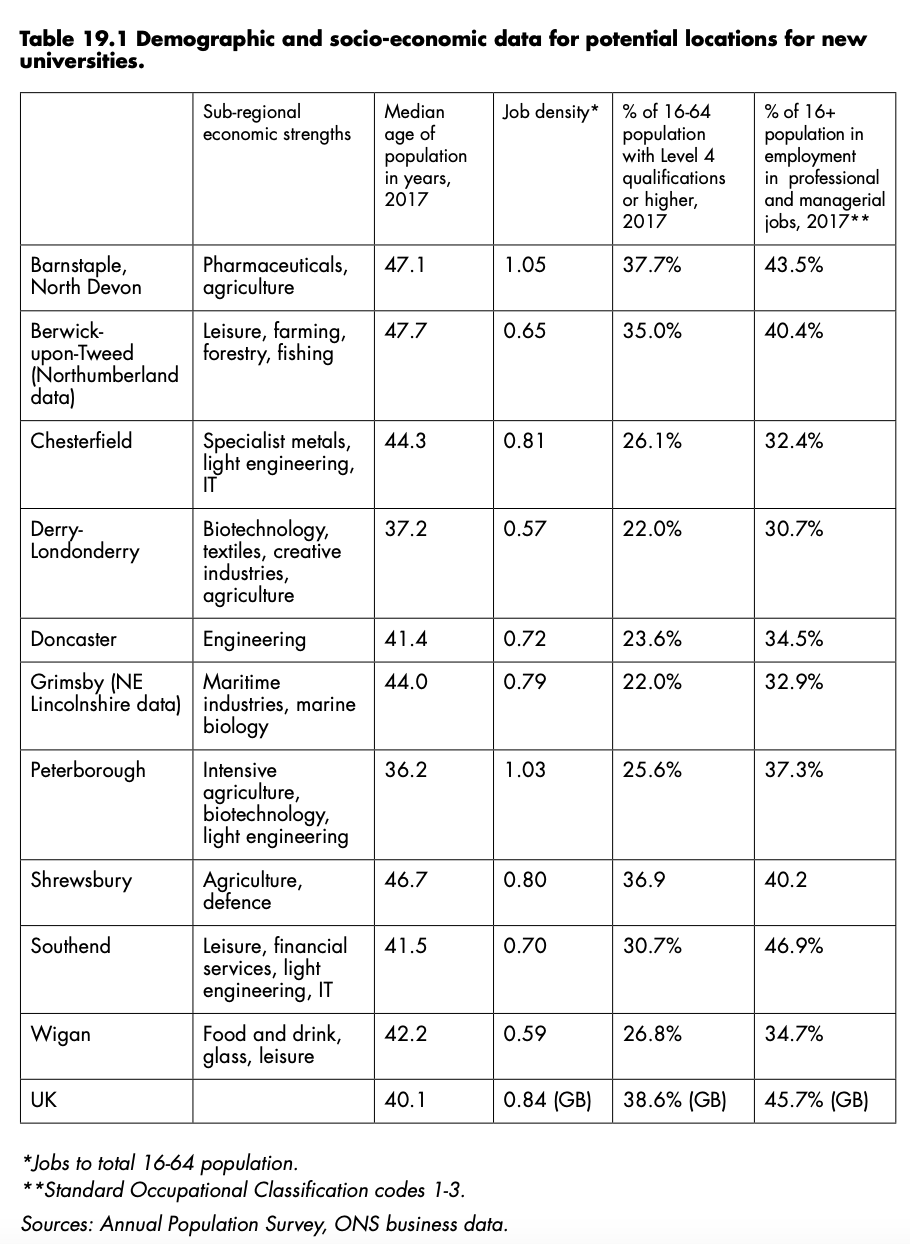
You may notice that many of these areas include seats the Conservatives only recently won need to hold on to at the next election – not to mention the one after that and the one after that. There’s no doubt it would be a long-term commitment, not something that would be visible to people in their communities by 2023 or 2024. Michael Gove is tasked with winning the next election, but is he already also thinking about the next three?
Rachel Wolf from Public First was all over Manchester this week talking about making levelling up a reality, and re-emphasising the point that as an agenda, it will be dead in the water if people can’t see practical improvements to their lives. Public First has done some proper research to back this up too: people don’t care about economic master plans, but they do care about how nice their street looks and whether they can get a GP appointment.
They also don’t think about higher education very much apart from when they want to go, or want to send their children through the system. With the much-discussed demographic bulge heading our way, demand for HE remaining robust, and the likelihood of further caps on student numbers being introduced this year, there is going to be a lot of people over the next three election cycles disappointed to find out that there’s literally no place in higher education for them or their children. And it’s not hard to see how that could start to be a political problem for the government of the day unless they are making noticeable moves in the other direction.
Which brings us back to why building new universities is almost always a good idea. Common sense, even. It also doesn’t have to mean replicating old institutions and their delivery models that work for their own time and place. There’s lots of innovation out there, and if there’s the local will to do something, then local solutions that involve higher education will need to be brokered, likely involving all sorts of partnerships across FE and the education and industrial landscape. And if the government still can’t stomach the language of “building new universities” then that’s fine too – I think they’d find many people happy to use a different form of words if it helped ministers save face while allowing much-needed new provision to bloom.
But although the solutions are bound to be local, and bespoke, a national conversation about expanding higher education is needed if it’s to form any sort of coherent agenda beyond just a pork barrel approach. So let’s start pushing the conversation with the ministers with an eye on a longer-term horizon.
h/t Sunder Katwala for noticing the Michael Gove answer and pointing out the British Future report