What has the pandemic really done for UK postgraduate enrolments?
An uptick in mature postgraduate student numbers is evidence of a desire to learn and new kinds of accessible delivery. Mark Bennett wonders about funding them
This article is more than 4 years old
Comment|

Mark Bennett is VP Research and Insight at Keystone Education Group
It could be like 2008.
If you were working in and around postgraduate education in March 2020, you may well remember hearing (or perhaps even uttering) variations of that phrase
The reasonable assumption was that, by threatening economic disruption, the impact of Covid-19 on higher education would be similar to the last recession the UK experienced, with a sharp rise in the number of people choosing to stay on at university for a master’s, rather than face a challenging graduate recruitment market.
Thanks to last week’s first release of HESA Student data for the 2020-21 academic year, we know that this prediction was broadly true. The number of UK students starting a taught postgraduate course grew by 24 per cent year-on-year. To put that into context, the pandemic appears to have spurred a bigger increase in postgraduate study than the introduction of the master’s degree loan in 2016 (which only led to a 16 per cent rise in UK domiciled postgraduate taught enrolments).
But this isn’t the whole story.
No Zoom in 2008
There’s an obvious – but easily overlooked – difference between 2008 and 2020. Both the recession and the pandemic appear to have more prompted people to study for a master’s, but only the pandemic forced them, at least initially, to do so online.
This is undoubtedly a good thing for 2008. Back then I was a PhD student, working in a kitchen, where I remember a friend showing me BBC breaking news stories on a first-generation iPhone. As impressive as this was, online lectures may have been a step too far (I don’t think there was an app for that yet).
But it may also have been a good thing for 2020 when master’s study didn’t just become a lot more attractive: it also became a lot more accessible.
Returner learners
Here’s what happens if you dig into the HESA data and look at the trend for UK domiciled postgraduate taught enrolments by age:
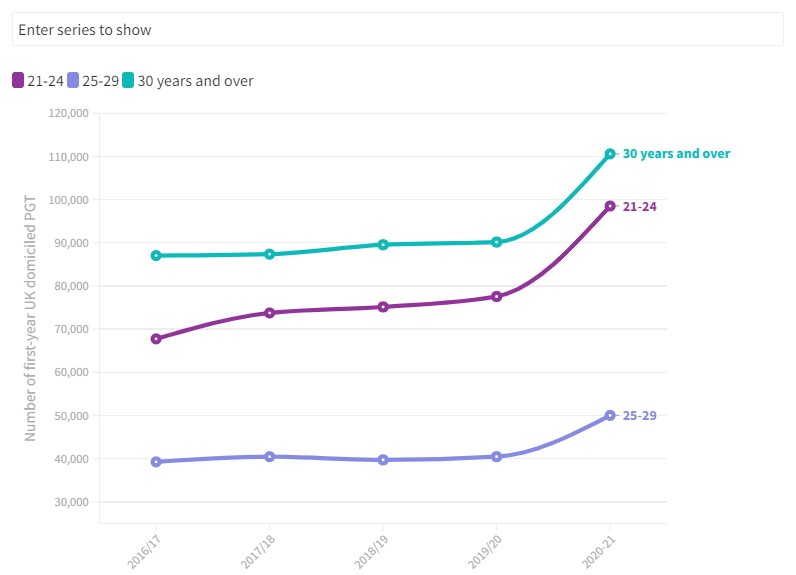
Yes, there’s a sharp rise for all three age bands in 2020-21, with enrolments for 21-24 year olds growing by 27 per cent, 25-29 year olds by 24 per cent and over-30s by 23 per cent (I’ve left out HESA’s 20 and under group as it is – understandably – rather small and I’m not a great one for logarithmic scales).
But take a look at the trends prior to 2020-21.
The 21-24 age group sees a steady rise of 16 per cent from 2016/17 to 2019/20, presumably buoyed by the master’s loan (made available across the UK from 2017/18 onwards). The 25-29 and 30+ age groups are effectively flat, having grown by 3 and 4 per cent, respectively over the previous four years.
What this means is that whilst the size of the 2020-21 increase for 21-24 year olds is more or less unprecedented, the existence of a substantial increase in enrolments for older age groups is even more unprecedented.
The pandemic has apparently done what the master’s loan couldn’t do: it’s attracted more older learners back to master’s-level study.
Opportunities?
There will be many reasons for this shift. So-called ‘mature’ students may have experienced (or anticipated) similar job market disruption to younger graduates. Some may also have been recent graduates themselves (around a fifth of UK undergraduates are over 25). But the ability to study more flexibly must surely be a factor.
Indeed, this is exactly what we’ve seen in our own research with prospective postgraduate students. Our 2021 Future Masters survey found that only 25 per cent of potential UK “returners” (people considering a master’s and not currently at university) were seeking to study on campus, with the remaining 75 per cent almost evenly split between online and blended learning.
This has the potential to be a positive legacy of the disruption Covid-19 has caused for higher education. These audiences are keen to learn online and universities may, in good faith, be able to deploy them and their experiences as exemplars and ambassadors for a level of study that naturally lends itself to flexible retraining and upskilling.
And obstacles
The problem is that, whilst postgraduate study may have become more accessible in one key sense, many of the obstacles that deter older learners are still there.
The most important is funding. The majority of postgraduates over 25 study part-time, a mode for which the UK master’s loan simply cannot scale adequately. The £11,570 available to English-domiciled master’s students in 2021-22 (and paid, pro rata, during a part-time degree) already struggles to keep up with postgraduate fee inflation, with most students having a relatively negligible amount left over for maintenance. Add in a second year (or more) of living costs and it’s unsurprising that the loan did little for part-time master’s enrolments.
A related issue, as Michelle Morgan has observed on Wonkhe, is that, in most cases, the postgraduate loan only covers programmes at full master’s level. Postgraduate certificates and diplomas are left out, despite these being precisely the sort of qualification that might appeal to those seeking shorter and more flexible learning.
Together, these limitations may explain why our Future Masters survey found that only 55 per cent of returning students intend to take up the master’s loan, vs 79 per cent of undergraduate continuers.
Lifelong learning?
The intention to make further study accessible to more people, for longer, is one of the more laudable elements of the government’s higher (and further) education agenda. But, however the lifelong learning entitlement ends up working, it doesn’t yet appear that postgraduate study is factored in. It should be.
For all its disruption, the pandemic underlines the appeal of postgraduate study for older learners looking to reshape their knowledge and, potentially, their careers. The sector should seek to retain them. After all, we all remember what happened to enrolments in the years immediately after 2008-09.
Related articles

Boards can’t predict the future, but they can make sure their institution is ready for it
Debbie McVitty | Comment | 19/10/26

What counts as a graduate outcome when the labour market is changing?
Angel Tan | Comment | 16/10/26

Widening participation isn’t finished while background still predicts destination
Hannah Rolley | Comment | 16/10/26