For these are jolly good Fellows? NTFS and the TEF
The National Teaching Fellowship Scheme has run since the year 2000 – Vivien Rolfe explores how it prefigures and partially explains the results of the TEF
This article is more than 9 years old
Analysis|

Vivien Rolfe is Head of Herbal Research for Pukka Herbs. She writes here in a personal capacity.
Those of us passionate about our learning and teaching practice – probably most academics I’ve ever met – will already be familiar with the idea of ‘teaching excellence’. An initiative to recognise and develop such excellence in individual teaching staff already exists in the form of the Higher Education Academy (HEA) National Teaching Fellowship Scheme (NTFS).
These awards are for individual talent and fellows are required to live up to some glitzy adjectives – to be outstanding, transformative, and to care for learners and the development of their colleagues. Fellowships are often the culmination of many years work and an unswerving dedication to teaching.
The arrival of the TEF has heralded a new way of recognising teaching excellence – institutionally, via the use of output metrics. So it is valid to ask questions about any relationship between NTFs and the TEF.
Is there a relationship? I found that institutions with Gold TEF awards are proportionately more likely to have bumper numbers of NTFs compared to Silver and Bronze. And there is a curious gender difference with proportionally more male NTFs working at Gold award institutions than Silver and Bronze. The majority of institutions with NTFs recorded this within their narratives although around a quarter did not acknowledge the scheme despite having fellows. Several mentioned the transformative work of fellows within their institutions.
Valuing teaching – a history
Higher education teachers have long been recognised as being undervalued, and as having poor promotional structures available. Individuals have been known to flounder in “separate career ‘cul-de-sacs’”. The sector has been slow to change – although the HEA claim the NTF award can be a useful “spring-board” to progress careers.
The National Teaching Fellowship Scheme (NTFS) sprang from a recommendation in chapter 8 of the Dearing Report. Announced in 1999 by HEFCE and the former Institute for Learning and Teaching in HE (ILTHE), the first round of 20 awards was made in 2000. Awards have been made each subsequent year and have taken the total number of National Teacher Fellows (NTFs) to around 750, including the 2016 winners. The fellowships (which are lifetime awards) mostly reward academic staff with teaching responsibilities,though in latter years eligibility has widened to encompass learning support staff in professional services
The first fellows received £50,000 to fund their own projects – the monetary award was later reduced to £10,000 and was £5,000 by 2016. Fellows become members of the Association of NTFs – an active community who promote excellence in learning and teaching through an annual symposium and other events.
The distinction between the NTFS and the parallel UK Professional Standards Framework (UKPSF) often hits murky waters. The UKPSF was introduced by the HEA in 2006 and was based on the ILTHE accreditation schema from 1999, which was in turn based on the principles and values of the Staff and Educational Development Association (SEDA) Teacher Accreditation Scheme formulated back in 1992 – to the extent that SEDA accredited programmes were initially eligible for direct parallel accreditation by the ILTHE.
The UKPSF provides a benchmark for individuals to develop their professional standing in learning and teaching. There are four levels that can be achieved – from Associate Fellow up to Principal Fellow – and as the fellowships require an application fee to make a direct application (although at no direct cost as a part of an accredited provision in universities that subscribe to the HEA), there is no annual quota or financial prize for those receiving awards. The HEA recently announced the award of their 90,000th Fellowship.
NTFS and the TEF: Getting to the data
So – using the Association of National Teaching Fellows ‘Fellows finder’ (which searches the NTF profiles on the HEA website) I searched for fellows in each TEF-eligible institution and collated the names, dates, subject area and recorded job role. This is the most up-to-date publicly available dataset, but it’s still not perfect – I also used the ANTF profiles to weed out those who were recorded as retired, as external consultants, emeritus professors, or did not hold a substantive institutional post.
I linked each individual fellow to their current institution, not where they were working at the time of the original award. Many (but not all) profiles on the ‘fellows finder’ are updated by NTFs themselves, so I assumed that this information is current. Still, I did add details of others through personal knowledge, and from institutional websites. It should be noted that the NTF scheme is not open to applicants in Scotland, so these institutions were removed from the count. The scheme has been running in Wales only since 2011, with England and Northern Ireland included from the outset in 2000.
For the analysis of TEF submissions I merged the narrative submissions into one file, and searched using the keywords “NTF”, “National Teaching Fellows”, “NTFS”, and “National Teaching Fellowship Scheme”.
Awards lead to awards
The numbers of NTFs in TEF Silver and Gold institutions are proportionally higher than those for Bronze; nearly one third of those institutions with a Gold award have 10 or more NTFs. The institutions with the most NTFs are: Gold TEF Award holders: Leeds, Huddersfield and De Montfort, (Leeds being the institution with the singe highest number of NTFs, at 24); Silver Award – Warwick and Oxford Brookes, and Plymouth lead the Bronze Award group with an impressive 15 NTFs.
Overall of the approximate 750 NTFs awarded since 2000, 619 NTFs were identified as being active within TEF-returning institutions eligible to enter the scheme. According to the HEA profiles for each fellow 92 NTFs were in senior management roles (e.g. Directors, Deans, Pro-vice Chancellor or Vice-Chancellor); and a further 527 hold teaching roles covering a range of subject areas, including 70 NTFs from Education departments, and a small number of librarians, educational developers, careers consultants, learning technologists or other learning support and professional service staff.
ALL HEIs (incl APs; Scottish providers removed) TOTAL # Institutions Institutions with NTFs Total No. NTFs Average per institution # Institutions with 10 or more NTFs % of total with 10 or more NTFs
GOLD 45 30 203 7 8 28%
SILVER 66 54 329 6 8 15%
BRONZE 25 19 84 3 1 5%
(*The value of 10 is just taken as an arbitrary cut-off point).
Gender curious
The gender distribution of fellows is curious, with more male NTFs working at institutions with Gold Awards. There is a small difference in the proportion of NTFs in senior management roles across the groups which would partially account for this, but the gender distribution of staff in different institutions and subject areas would be the first place I’d look to make more sense of this very unexpected finding.
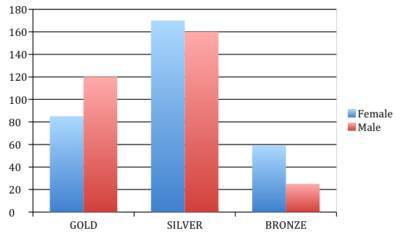
(Y Axis = Number of NTFs; X Axis = Award Group.)
number of NTFs GOLD SILVER BRONZE TOTAL
Female 85 170 59 314
Male 120 160 25 305
Total 205 330 84 619
A culture of teaching excellence?
Of the 103 institutions with at least one NTF, most built this into their narrative – only 25 universities who had NTFs did not write about them. Three universities with no current NTFs mentioned the NTF scheme and discussed the importance of it. A smaller number of institutions mentioned the UKPSF in their documentation than mentioned NTFs.
The important point here for me is that this isn’t just about the numbers, but the contexts and cultures of learning and teaching being recognised. What do the TEF narratives tell us about the value placed on schemes that recognise excellent teachers in universities, and do institutions which have consistently submitted outstanding staff to the scheme ultimately develop cultures that value excellent teaching highly?
Thirty institutions specifically mentioned the numbers of NTFs awarded in their narratives, and five mentioned how NTFs had been promoted or how they were engaged in leading teaching initiatives in their institutions:
Both NTFS winners and applicants receive additional internal recognition and are key champions for strategic teaching initiatives, such as thematic reviews or the development of innovative approaches to teaching practice. (University of Lancaster)
We make active use of the expertise of our NTF community as they initiate and develop institution-wide strategic enhancement projects. (University of Gloucestershire)
Thirteen mentions of the scheme use more emotive language suggesting a sense of pride in their fellows and a recognition that the work of NTFs is transformative:
We are proud of the number of our staff who have been recognised at a national level for excellence in teaching…We believe this puts us amongst the very best performers in the sector. (University of Gloucestershire)
This recognition of individual excellence has served as an important catalyst for dissemination and roll-out of expertise and good practice throughout the University. Significant institutional initiatives have been developed with NTFs as catalysts and institutional leads. (University of Bradford)
A culture of teaching excellence permeates the institution. (University of Plymouth)
Others use the scheme as a springboard for developing their academic staff, and also state the impact that fellow’s work has had nationally and internationally.
Selling points
One third of institutions with Gold Awards have 10 NTFs or more, and a slightly higher than average number of NTFs compared to the Bronze Award group, and this would suggest that having a sizeable NTF community does have a positive impact on the way excellent teaching is fostered and valued. Equally, universities that value the recognition of teaching excellence may be more keen to make the case that their institution is excellent in promoting teaching too. About a quarter of institutions did not mention their NTFs as part of their TEF narrative, but the majority did, with many celebrating these individuals and their creative and innovative contributions to teaching cultures.
With TEF set to reflect subject-level metrics in the future, one might argue that some subjects, particularly Education, will be at an advantage with high numbers of disciplinary NTFs, while other areas will lag behind in building their communities of NTFs (you often see that the appointment of one NTF in a department or area leads to several more in subsequent years as expertise in recognising what is required is developed).
It is also worth noting that a small number of Gold specialist institutions have achieved excellent status notwithstanding having no NTFs, so it would be interesting to find out more about their learning and teaching communities. How is good teaching recognised, and what can we learn from their methods? It is recognised that the University of Plymouth, who are renowned for their pedagogic research and teaching culture, were an outlier in this model. And it should be noted that some of the Welsh universities have achieved impressive numbers of fellows in a short space of time.
But what does the future hold for the NTFS? It is possible that they may offer an enticing selling point – holders as national award-winning teachers – for future TEF submissions.
Related articles

Whose universities are they anyway?
Jim Dickinson | Analysis | 4/09/26
We say we value diverse research, but can we assess it?
Ola Thomson | Analysis | 27/08/26

Accommodation matters, for foundation year students too
Wendy Ashall | Analysis | 26/08/26

Going deeper: Student loans, public expenditure and the devolution funding gap
Jim Dickinson | Analysis | 25/08/26