If the world needs more entrepreneurs, why aren’t more female students choosing that path?
Entrepreneurship education is of increasing importance, yet Aleksandra Bavdaz and Rami Al-Sharif have noticed that gendered expectations in the classroom still shape who sees themselves as a future entrepreneur
Comment|

Aleksandra Bavdaz is an academic in the international business cluster at the Adam Smith Business School, University of Glasgow
Rami Al-Sharif is a Lecturer in Human Resource Management at the Adam Smith Business School
Over the past few years of teaching, we have noticed something interesting in our management classes. Female students tend to work just as hard as their male peers, often producing equally strong – if not stronger – work. Yet when we open up discussions about entrepreneurship and starting new ventures, many of them seem noticeably less confident about their ability to build a business.
That observation led us to ask a simple question: why do so many female students in higher education feel this way? The answer, of course, isn’t straightforward.
For a long time, gendered expectations have shaped how society imagines the roles of women and men. What is striking is how easily these assumptions also find their way into higher education, subtly influencing how students see their ambitions and career possibilities.
The years spent in education are a critical moment for getting this right. For many women, university is where confidence, networks and career identities begin to take shape. If entrepreneurship is still perceived as something that “belongs” more naturally to men, it can quietly shape who sees themselves as capable of starting a business. Perhaps this helps explain why women’s participation in entrepreneurship continues to lag behind – with a recent Scottish report suggesting that only around one in five entrepreneurs is a woman.
This is where educators matter. Universities are not just places where business concepts are taught; they are spaces where students develop their sense of what is possible. If we want to shift the narrative, we need to think more deliberately about how entrepreneurship is taught – through more inclusive curricula, visible role models, and learning environments that encourage female students to see entrepreneurship as a realistic path.
What the students said
To better understand this gap, we asked our female students how they see themselves as future business leaders. Are they motivated to start a business? Do they feel confident in their entrepreneurial skills? And do they actually see entrepreneurship as a realistic career path?
We surveyed 300 management students at the start of six business courses. The results were clear. Across all four entrepreneurship measures we looked at, female students scored lower than their male peers. They were less likely to say they wanted to pursue entrepreneurship after graduating and they reported lower confidence in their ability to develop and evaluate business ideas.
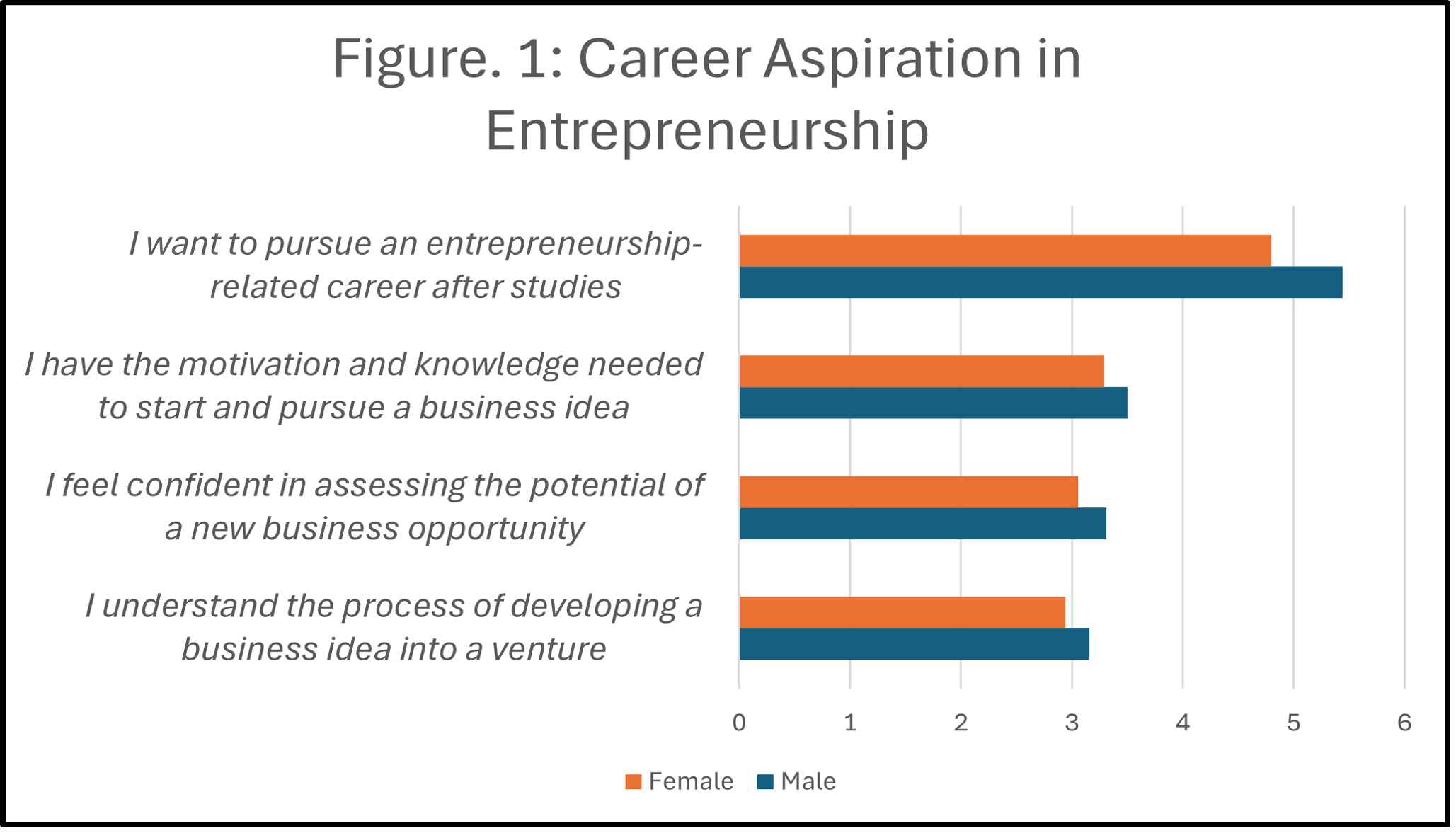
These patterns are tightly linked to the different ways women often socialise and engage with professional environments. Fields like entrepreneurship are still widely perceived as male-dominated, which can shape how comfortable female students feel positioning themselves within them.
Is higher education enabling female entrepreneurs?
This raises an important question: are universities helping students move towards entrepreneurial careers, or unintentionally holding some of them back?
Higher education should be a space where students gain the confidence and skills to pursue entrepreneurship. But for many female students, that door can still feel only partially open.
Evidence from Scotland suggests this is a real concern. A recent Scottish report on women in entrepreneurship found that 73 per cent of female university students felt their education had not adequately prepared them to pursue entrepreneurial careers.
For many women, the issue is not a lack of ability. It is the environment, signals and opportunities they encounter during their studies. When these are missing, entrepreneurship can start to feel like something that simply isn’t meant for them.
What universities can do differently
Entrepreneurship education needs to be more intentional, practical and inclusive. Done well, it can help all students build confidence, curiosity and a sense of belonging in the field.
This starts with curriculum design. If entrepreneurship is treated mainly as an optional or extracurricular subject, many students never encounter it. Entrepreneurial thinking – leadership, innovation and problem-solving – should instead be introduced earlier and embedded across programmes.
Visibility also matters. Seeing diverse entrepreneurial role models helps students view entrepreneurship as a credible and accessible career path. In our teaching, we regularly invite female entrepreneurs to speak about their journeys – including the challenges as well as the successes. Students often say these conversations help them better understand the realities of entrepreneurship and imagine themselves following a similar path.
It is equally important to show that entrepreneurship is not simply about high risk or exceptional confidence. With the right mentoring and support, it becomes something students can explore and develop. We encourage students to engage with university incubators and accelerator programmes where mentoring, industry connections and funding opportunities are available in inclusive ways.
And so, creating spaces where students can test ideas, meet role models and build confidence can make a real difference – particularly for women who may not yet see entrepreneurship as a natural career path.