Higher education postcard: University of Oregon
This week’s card from Hugh Jones’s postbag takes us to the home of the Ducks
This article is more than 2 years old
Comment|
Hugh Jones is a freelance HE consultant. You’ll find a daily #HigherEducationPostcard if you follow him on Bluesky
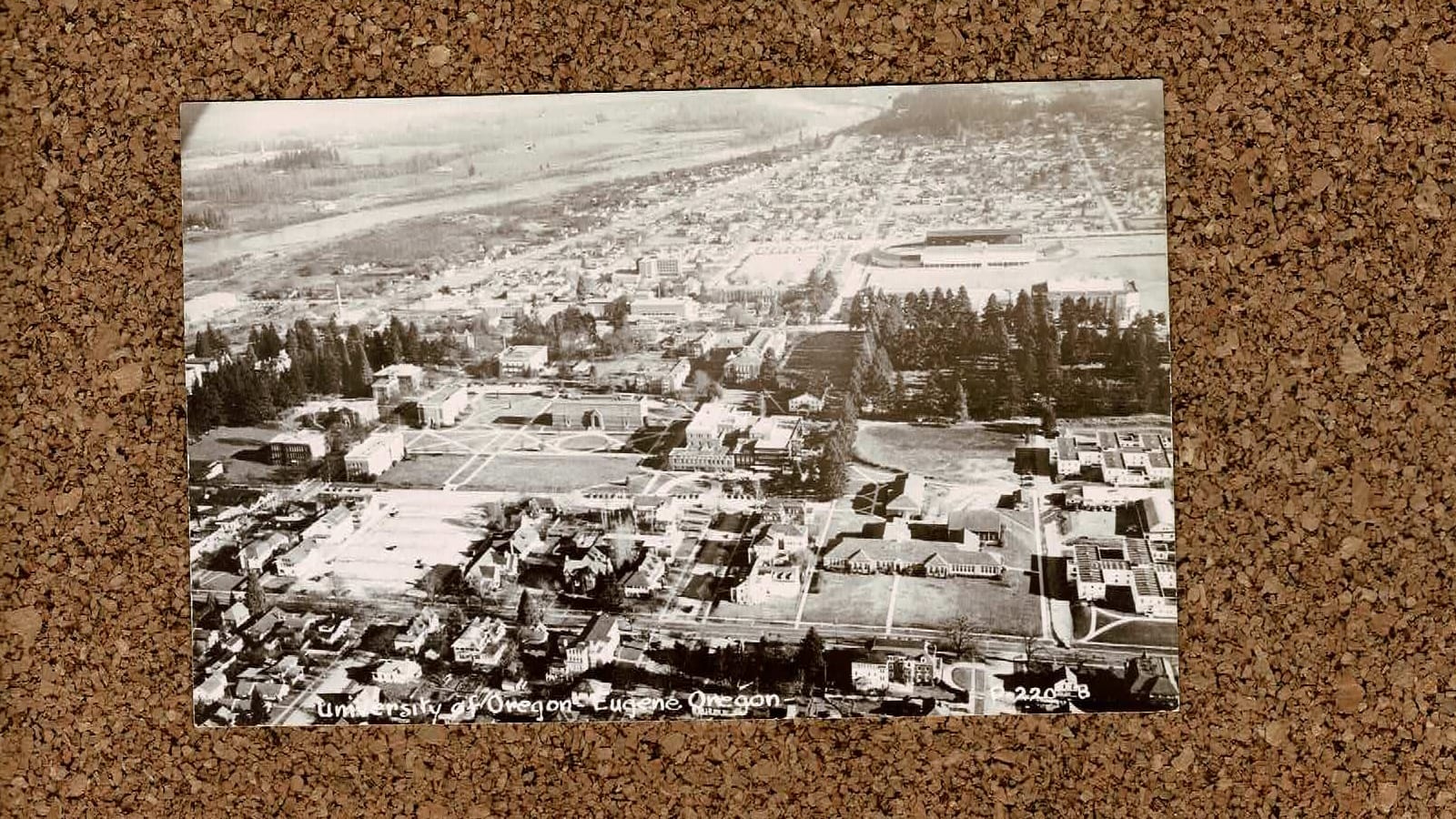
When the state of Oregon was only thirteen years old, in 1872, the state legislature agreed to the foundation of a university.
The citizens of Eugene, Oregon, then just ten years a city, raised $27,500 to support the new institution, which opened its doors in 1876 as Oregon State University. 155 students enrolled, with five faculty to teach them. In 1878 the first five graduates gained their degrees; by then it was simply the University of Oregon.
But the university got off to a tricky start – in 1881 it was almost bankrupt, until railway magnate Henry Villard stepped in with a donation of $7,000.
After this things got better: the university grew tremendously in the first quarter of the twentieth century, with the addition of many subject areas and significant growth in students and staff (there’s a great repository of data here.) But Oregon was also developing as a state, and the college of engineering was transferred to the Oregon State University, which was designated as a land-grant university. (The American university system is very different to that of the UK. A reasonable overview explainer is here; you might also be interested in the Carnegie Classifications.)
The two universities in Oregon – Oregon and Oregon State – were subject to much oversight by the state itself. This took the form of planning to ensure that subjects did not overlap; and also proposals in 1913 and 1932 – both defeated – to merge the two universities.
In 1917 the university moved away from the traditional US semester model of delivery, adopting a three-term model, which is closer to the UK historical approach. This still exists, although is called, confusingly to these British ears, the quarter system. Because there’s three in a whole year, obviously.
The university has continued to grow and expand, and recently has sought to gain greater financial independence from the state, to enable better planning. Governors for both public universities in Oregon are now arms-length from the state, and the university has grown its endowment to $700 million, enabling it to offer more scholarships, and avoid vicissitudes in public funding.
Its sports teams are known as the Ducks, which is one excellent reason to have a soft spot for the university. Its logo was designed by Nike (the company not the Greek god), Nike’s founder being an Oregon alumnus.
It is also – which will be meaningful for maybe a small section of the readers of this blog – the location for National Lampoon’s Animal House, which celebrated frat house culture. If you’ve ever been to, or heard of, a toga party at a university, Animal House is the reason why.
Comments
New comments will come back with sign-in later this year.
Related articles

Students just need to know where they stand on AI
Gracie Otley | Comment | 5/10/26

One year of leading UKRI
Ian Chapman | Comment | 3/10/26

Navigating the storms of student success
Kate Newby | Comment | 2/10/26
Higher education postcard: The Queen’s Tower, Imperial College
Hugh Jones | Comment | 2/10/26

A supplier shouldn’t be able to rewrite who owns students’ essays
Sam Dickinson | Comment | 2/10/26

Emeritus, honorary, and visiting professors are an untapped resource
Roger Watson | Comment | 1/10/26