Austerity, the Spending Review and a crisis in human capital
We thought the last Spending Review in 2010 was bad enough. But this one – covering 2015-16 and then 2016-2018 is beginning to look a whole lot worse. Alongside this is a growing attack on the knowledge economy and the idea of human capital in the media and by policy makers. What might this mean for the future of further and higher education in the UK? Andy Westwood gives his take.
This article is more than 10 years old
Analysis|
Andy Westwood is Vice Dean for Social Responsibility in the Faculty of Humanities and Professor of Government Practice at the University of Manchester
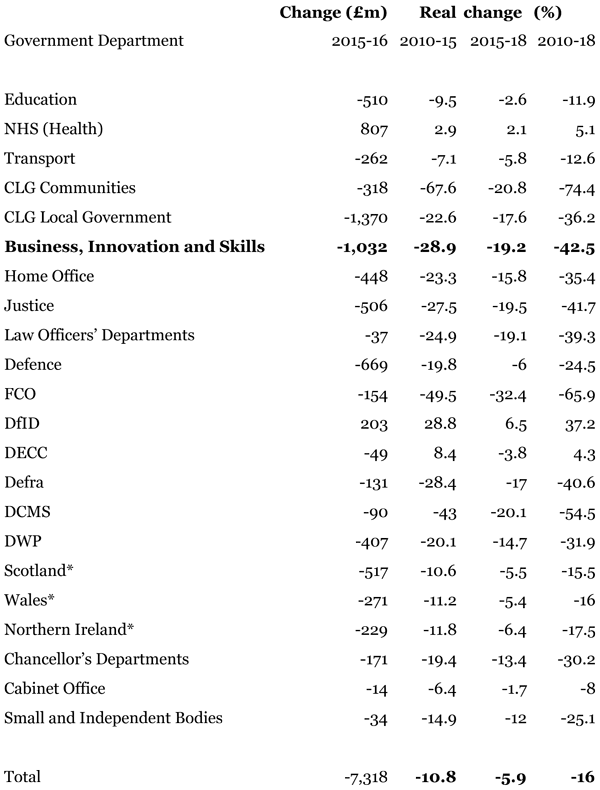
We thought the last Spending Review in 2010 was bad enough. But this one – covering 2015-16 and then 2016-2018 is beginning to look a whole lot worse. Departments across Whitehall are now deep into negotiations with the Treasury. And it’s looked pretty bloody for some time. The Budget confirmed the worst – it showed that it was highly likely that BIS as a non ring-fenced department would be looking at a cut of approximately £1bn (possibly as high as £1.6b) in 2015-16 and more in the years that immediately follow. Science and research may just get a reprieve but that will only magnify the cuts elsewhere in BIS spending.
It already feels like we are fighting a rear-guard action and in HE, the biggest fears look to be for the Widening Participation budget. Alan Langlands warned at the recent HEFCE conference that we need to tell ministers that if they really want social mobility then they will need to pay for it with WP funding. Despite his belligerence it looks a difficult task to persuade a cash strapped Treasury that the extra costs of teaching the disadvantaged can’t be met from within their tuition fees.
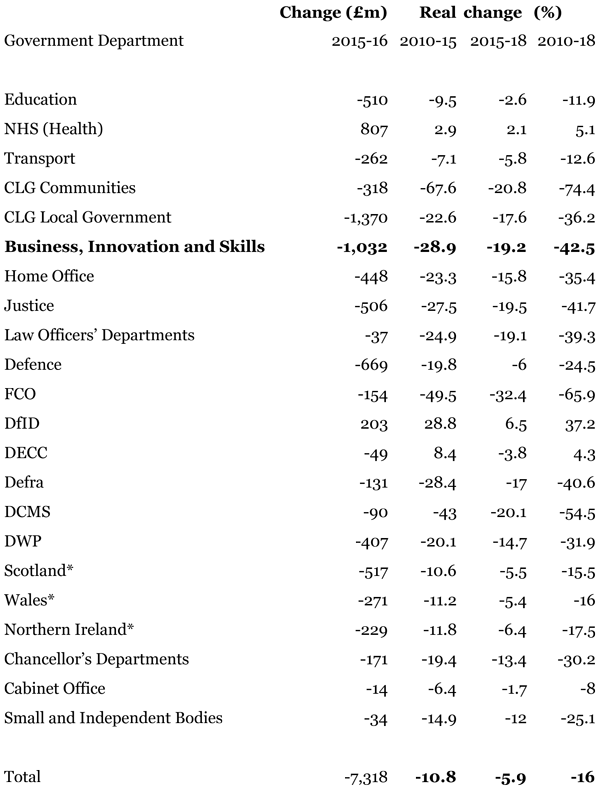
The potential cuts to come are eye watering. As the FT showed in their data above, the total reductions between 2010 and 2018 are staggering. Local Government, Culture, Defence – even Health and Education are going to have to make really tough decisions and looking at each in turn it is also easy to see why they might look at universities and see them ‘awash with cash’…
It gets worse. Cutting WP won’t be enough to save the overall amounts required. Spending on skills and education elsewhere in BIS (and also in DFE where only schools are protected) budgets are being scrutinised. FE will likely take a big hit and given that government has worked out what it can save by shifting teaching grants to loans we can expect a shift of pretty much all level 3 19+ learning to loans managed by the Student Loan Company. If we think adult and part time demand is in crisis now, just wait until these changes start to take effect.
All in all we might describe this as a major human capital crisis – and so much for winning the global race. But perhaps as worrying in the short and longer term is a different aspect of this crisis that is gathering pace amongst academics, media and voters – the belief that investment in human capital, skills, FE and HE may not be worth it after all.
In ‘Does Education Matter?’ (2002), Alison Wolf questioned the assumptions linking human capital to economic growth. More recently Phil Brown, Hugh Lauder and David Ashton – three extremely well respected social scientists from SKOPE – an ESRC centre – published the ‘Global Auction’ questioning the real impact of the knowledge economy and the ‘broken promises of education, jobs and incomes’.
And the media is full of negative headlines too. The Daily Mail and Telegraph fall over themselves to tell stories of graduate unemployment and underemployment and the ‘folly’ of Tony Blair’s 50% target for higher education.
Broadly the argument goes like this… Western Governments’ faith in the coming knowledge economy and in neo-liberal economics – supply side reforms, labour market flexibility, employability all led to the one intervention that didn’t rattle economists or business leaders – investment in skills and human capital. A principle founded in the economics of the Thatcher and Reagan era, but extended significantly in the ideologies and meta narratives of globalisation and technological change under New Labour, Clinton’s Democrats and across the OECD and developing economies throughout the world.
Obviously the crash and subsequent recession has had a major impact on all this and we should be taking an informed longer-term view. It is increasingly accepted that simply focussing on supply side investment in skills and human capital may not be enough – we need ‘demand side’ interventions, smart industrial policy and serious thinking about human capital utilisation – and that goes for universities and colleges as much as for governments. Just chucking ever more human capital and research at a labour market or an economy that isn’t able or doesn’t know how to use it lets us all down. We must not assume that either Government or future applicants are quite as convinced in the knowledge economy and the value of human capital as they might have been in the past.
Yet the data shows that employment rates and earnings over a lifetime – of all people with degrees in the workforce – remains a significantly better option than having lower level or no qualifications. We know that a skilled workforce, especially in key sectors, will drive productivity locally and nationally and that universities and colleges are absolutely fundamental to any plan for short and long term growth. I am still convinced by both the data and the narrative although I can see they are increasingly contested in different quarters. It is no longer simple to assume that these arguments are straightforward or unambiguous.
If we are going to emerge from this current spending round and future spending reviews in the shape we’d all like, then we need to confront both the difficult spending numbers of 2015-16 and also the rather more difficult crisis in human capital that sits uneasily and rather threateningly, alongside it. If policymakers don’t believe in mass human capital anymore then that is a very serious problem for further and higher education in this Spending Review and for the 2015 election manifestos as they begin to emerge.
If voters and the popular media don’t believe it then it is an even more serious problem, because the political cover it brings makes painful cuts that much easier to make. The ring fence is political as much as it is economic and that’s one of the reasons why HE and FE don’t sit within it but schools and hospitals do. Up to now science has at least carried a convincing economic narrative but when politics trumps all and major cuts need to be made, even research cannot be guaranteed to come through intact.
We might have a bigger job on our hands than we thought.
Related articles
Whose universities are they anyway?
Jim Dickinson | Analysis | 4/09/26
We say we value diverse research, but can we assess it?
Ola Thomson | Analysis | 27/08/26

Accommodation matters, for foundation year students too
Wendy Ashall | Analysis | 26/08/26
Going deeper: Student loans, public expenditure and the devolution funding gap
Jim Dickinson | Analysis | 25/08/26