Working towards a sector taxonomy of value
Iain Mansfield offers a personal view of the value for money the sector offers.
This article is more than 8 years old
Comment|

Iain Mansfield is Director of Research and Head of Education and Science at Policy Exchange
Value for money is the watchword in higher education these days. The Office for Students’ first research piece was dedicated to the topic, and it sits front and centre of the post-18 review. But the question must be asked: value for money for whom?
A taxonomy
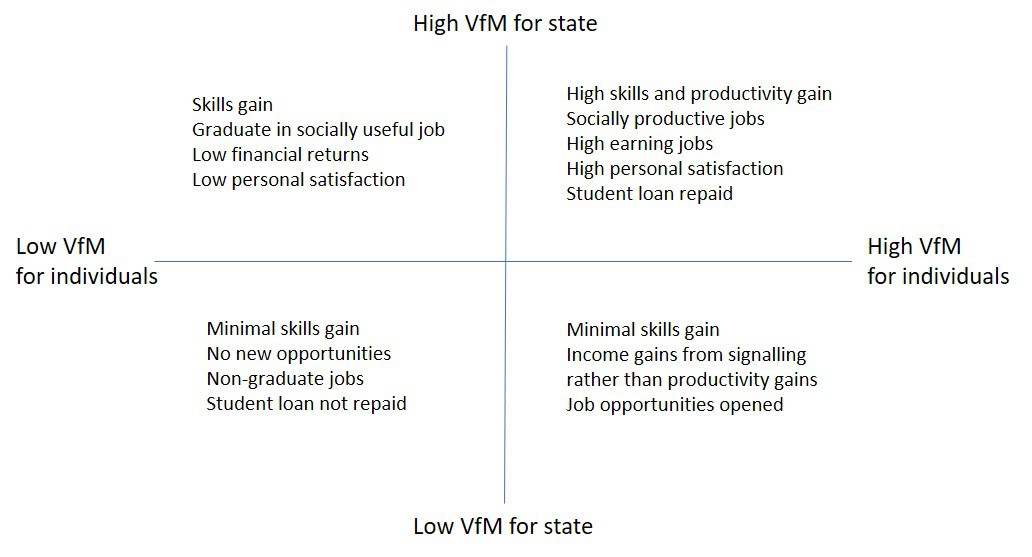
Value for money can be assessed in terms of the benefits to either the state or the individual student. And it can be assessed in comparison to either inputs or outcomes. Considering each in turn:
- The state secures value for money through the increased productivity or skills of those attending higher education. This may be reflected in taxation and student loan repayments from high paying jobs, or from progression to jobs such as nursing that, while not high paying, make an essential contribution to society. The state may potentially benefit from non-employment gains from higher education, such as a reduced likelihood to commit crime, though the extent that such outcomes are causal is debatable.
- A student may secure value for money from increased financial earnings, or from the opening up of career choices that would not otherwise be available to them, such as teaching or becoming a professional musician. They may gain social capital or soft skills, perhaps giving them the confidence to start their own business. An individual, unlike the state, may also consider that value for money is gained from experiential factors, such as the quality of accommodation or recreational facilities.
- Value for money against outputs considers whether the resulting gain exceeds the cost incurred, regardless of the cost of inputs. An extreme case is the Harvard MBA: it almost certainly costs Harvard less than $73,440 to run the course, but given the significant increase in earning potential, many of its graduates may still consider it to have been value for money.
- Value for money against inputs is in some ways a stricter test, considering the extent to which the monetary cost matches the cost of providing the course in question.
A distinctive feature of UK HE has been the essential indifference of students to this latter form of value for money, at least in so far as it impacts their choices. The combination of a free-at-the-point-of-delivery tuition fee system, a loan system in which repayments are based purely on income as opposed to the amount owed by an individual – and the ability of HE to behave as a Veblen good – have combined to create a situation where students will happily pay the maximum fee, leaving it to the government to attempt to bear down on costs.
Figure 1: Possible outcomes associated with differing value for money outcomes
Misalignments
The top-right and bottom-left quadrants are where incentives align. The top-left is of minimal concern: it is rare for a course to generate value for the state without also doing so for the individual. The most challenging area of misalignment involves distinguishing between the two right-hand quadrants, which leads us directly into the knotty problem of productivity gain versus signalling.
An individual will benefit financially if they themselves secure a better job as a result of their education, regardless of whether that job requires a genuine increase of skills or as a result of ‘signalling’, where an employer uses the possession of a degree as a means of selecting an individual. The state only benefits if higher education results in genuine skills gain and therefore an increase in higher productivity jobs.
Spence (1973) established clearly that signalling can lead to gains to individual graduates – and therefore a graduate premium in earnings – even if HE conveys no skills benefit at all, provided that it serves as a marker for some aspect that employers value. In such a circumstance it is entirely rational for an individual to go to university, but no value is generated for the state.
What’s worse is that while attending HE is in the short-term interest of the student, dynamic effects produce a vicious cycle which results in worse value for money for everyone, students included – a situation eloquently explored in Scott Alexander’s allegory, Against Tulip Subsidies. Where signalling predominates, more people acquiring degrees results in increasing pressure to acquire further qualifications such as masters to enhance one’s signalling value. Meanwhile, those without an HE qualification see their opportunities systematically reduced – the range of jobs that one can prosper in without a degree has significantly reduced in recent decades. To quote Alison Wolf, “If everybody spends years re-certificating skills they already have, just to land a job they could already have done, or taking qualifications simply to stay ahead of the next person, then society is wasting a lot of time and money that could be better used elsewhere.”
We are not in this extreme situation. Even the worst course will impart some skills; even the best will involve some signalling. But there are two important takeaways:
- The existence of a graduate premium does not demonstrate productivity gain or value for money for the state.
- One cannot rely on student choice alone to avoid the signalling trap. Rational behaviour by individual students results in negative systemic effects.
Having laid out the theoretical framework where, in today’s HE system, should we be most concerned about value for money?
Poor value for money in teaching
Misaligned incentives, particularly around inputs, can be linked to the “disengagement contract” described by Palfreyman and Tapper and its close cousin, grade inflation, both of which stem from scenarios where a student cares more about the grade awarded than the learning acquired.
In consequence, there are some courses where students receive levels of teaching that do not represent value for money. The HEPI-HEA Student Academic Experience Survey consistently indicates that fewer than 10 hours a week of contact time is correlated with low satisfaction and that a significant minority of students receive such teaching. Such courses are usually, though not always, in the humanities and social sciences. Measures such as the TEF are likely to encourage providers to focus more on providing genuinely high-quality teaching, particularly when extended to subject level.
The growth of signalling
UK productivity growth has completely decoupled from levels of participation in HE; 23% of graduates are in low-skilled, or lower-middle skilled jobs, and employers increasingly use a degree as a sifting mechanism for jobs that previously didn’t require them. Taken together, these points strongly indicate that the government has long since ceased to gain value for money from a further expansion of HE.
This is not to say that value for money could not be achieved by targeted expansion in certain areas, such as high-quality engineering or nursing degrees, or through degree apprenticeships. But the current system of unconstrained, open expansion is unlikely to achieve this.
Failing courses
Courses in the bottom-left quadrant represent value for money for neither the state nor the individual. It is surprising, therefore, that there exist so many providers with outcomes that, in the health or school systems, would lead to them being condemned not just as “improvement needed”, but as failing. Negative graduate premiums projected drop-out rates well above 20% and providers where fewer than half of those enrolling progressing to graduate jobs are alarmingly common – and when one considers individual courses, the statistics are even worse.
This is not a simple case of old vs new, or STEM vs non STEM. Nottingham Trent University, which recently surged to 16th in the Guardian league table on the back of rigorous, high-quality teaching and superb employment outcomes, is simply one of a number of outstanding modern universities. However, the fact that providers taking high proportions of disadvantaged students can achieve such results only emphasises the shortcomings of others in the sector. Earlier this year Amyas Morse, Head of the National Audit office, compared the situation to “mis-selling“, and as the NAO’s report made clear, it is overwhelmingly those from disadvantaged backgrounds who are let down.
The way forward
The creation of OfS and the Post-18 Funding Review offer a tremendous opportunity to drive up value for money, for both students and for the state.
As it registers providers, OfS should take a much more robust approach to determining whether provision genuinely “meets the rigorous national quality requirements”, refusing to tolerate the continued existence of substandard outcomes. The post-18 review, meanwhile, has the opportunity to consider more radical options. Why should government funding be provided for courses where fewer than half of those who begin progress to graduate jobs? It is no kindness to a student to admit them to a course they are unlikely to complete and even less likely to benefit.
More broadly, the funding review has the opportunity to consider value for money across the tertiary sector as a whole. It must weigh up the opportunity cost of a continued expansion of traditional HE against greater investment in high-quality further education, technical courses and apprenticeships.
If we are genuinely to improve value for money and drive up UK productivity we must, in the words of Robert Halfon, Chair of the Education Select Committee:
bring to an end the UK’s obsession with academic degrees and demand a dramatic increase in the delivery of basic skills and technical training by the further education and higher education sectors.