How to improve accountability in your students’ union and make it more democratic
Nick Smith has thoughts on improving student access to structures and systems in students’ unions
This article is more than 4 years old
SU Blogs|

Nick Smith is a consultant specializing in governance
One of the joys of being an uncle is buying your niblings wholly inappropriate Christmas presents just to watch the chaos ensue.
This year we gifted by nephew a miniature drone to terrorise family members over their Brussel sprouts. 10 minutes after unwrapping it ploughed straight into my sister-in-law’s hair.
Without apologising, my nephew turned to my boyfriend and said “really that’s your fault because you bought for me”. The absolute lack of accountability along with his blond tussled hair – one day my nephew could be Prime Minister.
The time is now
It’s a good time to talk about accountability in both the national political sphere but also within our students’ unions. As the cosmic dance of democracy continues and yesterday’s officers leave to be replaced with new representatives (or return to stand on their glorious record) we scrutinise the work of the union and our representatives leading them.
The problem is – do we do this well enough?
Often I’ll do SU democracy reviews and interview students, officers, union and university staff. Almost all of them believe that accountability of elected officers is really important. It adds legitimacy when talking to the Institution, reassurance for officers that they are doing the right thing and also confidence for students that their union is listening to them.
What is fascinating – and a worrying trend – is that despite this need, these structures are often incredibly out of date. They can be based on a model of 100 students in a room carrying out a form of appraisal by mob rule or indignation that their niche topic hasn’t been picked up over that of the other 16,000 people in the union.
While this doesn’t work I have also had unions say to me that they deliberately avoid accountability structure – that it is too hard or, one occasion, “accountability is quite scary for our officers”.
There are three faults here in my view.
Firstly the 1994 Education Act requires SUs to be run democratically. While it then speaks mainly about elections, surely we are able to see that members directing their leaders more than just in their appointment is a good thing.
Not having it is patronising to officers who have the capacity to interact with students (indeed it is their purpose) but also pushes accountability to online bullying, anonymous confession sites and exasperated and ill-informed newspaper articles.
Finally this approach is always doomed to fail. Even with a drone flying around the living room I can’t keep all 12 of my family perfectly happy over Christmas day – there’s no way an officer team can keep a campus full of learners happy over an entire academic year.
Accountability standards
If you are thinking about accountability or wanting to discuss it with your election candidates, let me share my vision of what accountability models should achieve. You will need to place these in your own context of course but I think these principles are useful.
- Clarity on powers We know the President is (and should be) a powerful figure in university meetings. That doesn’t mean that they can achieve a fee rebate for all students or that it is reasonable to “no confidence” them if they can’t. Have a structure that is honest about the limits on power for officers so that students can hold them to account appropriately.
- Clarity on portfolio If you claim that the policy of the union and the manifesto of officers represent their workload then advertise these and create your accountability structure around it. It would be absurd to chastise a staff member in their appraisal for not achieving a target that wasn’t set – don’t allow the same to happen to an officer at council. If you have a manifesto tracker of “Big Union Plan” that is created by the team at the start of the year that can be helpful – but needs nuance as a tool.
- Clarity on capacity Back in the day NUS Conference passed reams of policy that often got ignored. Around 2010 we introduced a system where all of the motions from the previous year were listed in one column and work done against them was written next to it. The most useful points were sometimes when officers were honest and said “I can’t do this – don’t have time or it is not as important”. Pretending officers can do everything is absurd.
- Clarity on political accountability The purpose of accountability structures in councils or general meetings should be focused on whether the representatives and campaigners are representing students or campaigning for them. It’s not the avenue to complain that they arrived at 10.05 when their core hours are 10-4 and definitely not serious allegations of gross misconduct best dealt with under the Code of Conduct.
- Allow student accountability One of the most frustrating sights in union councils is watching a set of officers who have been sat in the same office all day hogging time at council to complain about each other’s behaviour. Give this time to students to hold leaders to account not leaders resolving (or failing to resolve) their differences in an open forum.
- Allow student decision making It seems a real waste if the only times students interact with the policies of the union are when they are set and, maybe, when they are renewed. Policies get deprioritised all the time as new things arise and things change. Officers may well have the power to make these decisions alone but could students also do this? Agree not to work on volunteer accreditation because increased diversity on sports teams is more important right now? Decide to postpone the roll out of healthy food in the café because the new motion on making Halal meat available is more deeply felt? Do your student voice structures say “stop this” or “do this instead” as well as simply “do this too”?
Non-political accountability
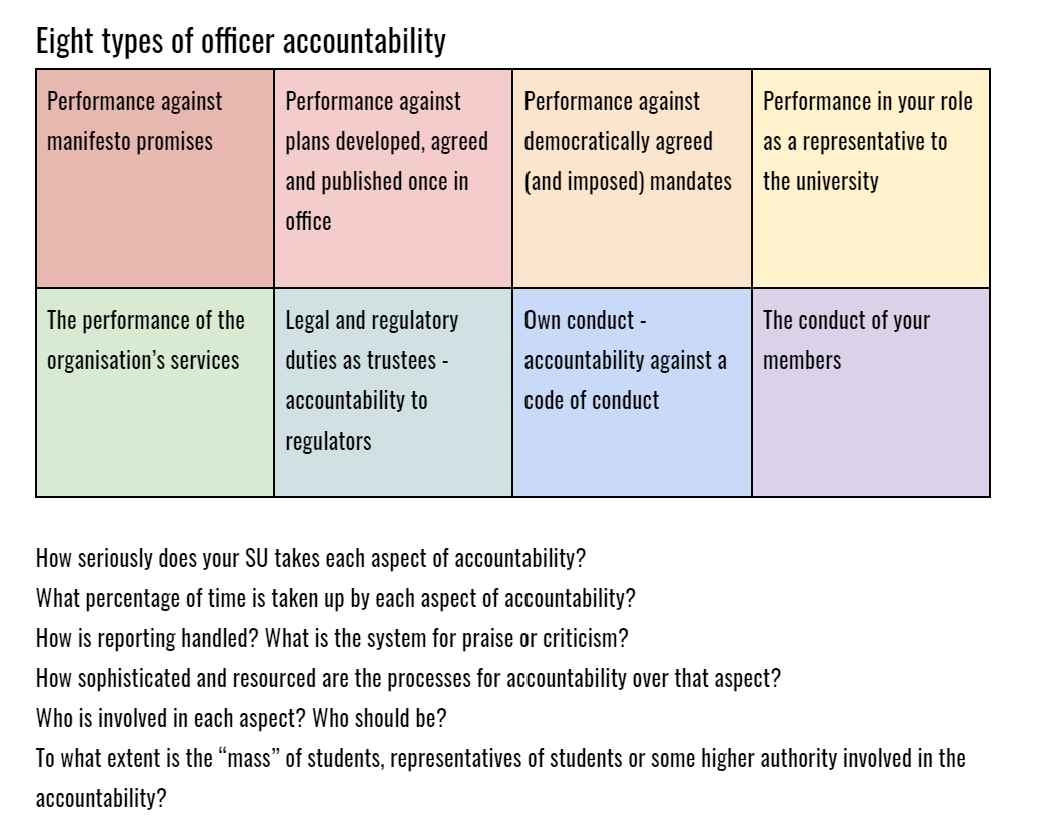
Meaningful political accountability of representation and campaigning is enhanced by not being distracted by other areas of scrutiny. Officers (and others) will also have other times they need direction, whether it be as employees or when there is something serious about behaviour that needs to be addressed. A clear Code of Conduct should have a process which means the case of a student accused of sexual assault isn’t debated at Student Council to the extreme upset of everyone involved. In most SU governing documents the responsibility for the Code of Conduct lies squarely with the Trustee Board, usually with a non-student overseeing this process.
For many, being a sabb is a first job and a shift into the expectations that this brings. When we talk about work behaviours we can too quickly jump to someone who isn’t there in their core hours like I mentioned above. Coaching and support are obvious ways to help people in their new roles and a first port of call. There are however several thousand sabbatical officers across the UK and some of them will need to be called out if they are absent from work without good reason or their behaviours are unsuitable for (any) workplace. Trustee Boards, where issues can be deliberated with student and lay Trustees are surely a better place to look at this in detail then forums of student members.
I said that while undertaking reviews that almost everyone thought accountability was a good thing. I’ll add that often officers about to take up their roles are particularly keen on it. They want to be informed and directed in their work. Famously feedback is the breakfast of champions – when we feedback through political accountability let’s make it a worthwhile meal.
Related articles
Climate, Coffee, Crisis – where do SU’s fit in?
Krzysztof Mikulski | SU Blogs | 14/10/26

Universities can’t keep demanding diagnoses the NHS is slowing down
Sharanya Sivarajah | SU Blogs | 12/10/26

Higher education needs to recognise gambling harm as a student wellbeing issue
Max Gogerty | SU Blogs | 5/10/26
From Oslo to Hamburg – our January 2027 study tour
Jim Dickinson | SU Blogs | 1/10/26
A decade on the bus – some of our fave moments from Wonkhe SUs study tours
Jim Dickinson | SU Blogs | 1/10/26

Students are workers too – and they need to know their rights
Kim Allen | SU Blogs | 30/09/26