

Dundee has required up to £62 million of emergency support to stabilise its finances. Cardiff originally proposed cutting around 400 academic posts. Ulster is consulting on cutting up to 450 jobs.
Wales has launched a review of the future of tertiary education. Northern Ireland’s economy minister has promised one in the run up to the next three-year budget. Scotland has passed a Tertiary Education and Training Act and begun a cross-party review of higher education funding – alongside the bailout funding.
Their students are no better off. Scotland promised its poorest students a living-wage-level income, hit the benchmark for exactly one year, and has frozen the rate £1,378 a year short of its own standard. Wales built its maintenance package on the wage floor and has let it drift £1,709 below it. And Northern Ireland froze support for its poorest students at £6,428 for ten straight years – today’s £10,020 is still the lowest maximum in the UK.
Every one of those reviews will stare hard at fees, grants and institutional efficiency. None of them, on current form, will stare at the biggest number in UK higher education funding – a number that sits in a supplementary table of an Office for National Statistics spreadsheet, and which shows £82.9 billion of student-loan expenditure recorded for England since 2012, against just £6 billion attributed to Scotland, Wales and Northern Ireland combined.
One of us nerds out on these sorts of documents for a living. The other has just been elected to lead Scotland’s students, in a nation whose universities are shedding staff while ministers insist nothing is changeable.
We’ve come to the same conclusion from opposite ends – the crisis in Scotland, Wales and Northern Ireland has a cause that predates any finance director’s spreadsheet, and it’s all about the way the Treasury counts.
Write off the bat
When the UK government lends a student in England £100, it knows the loan carries a cost. Repayments depend on earnings, and after a certain number of years whatever’s left is written off.
On the government’s own forecasts, lending £100 to a full-time undergraduate carried an expected public cost of roughly £29. Think of lending a mate a tenner knowing part of it is effectively a subsidy – an accountant might make you recognise that cost on day one.
For years, the national accounts didn’t make the government do that. Loans counted as assets, the write-off wouldn’t show up for decades, and so England built an entire university funding system – £9,000 fees from 2012, uncapped student numbers from 2015 – on spending that appeared, in the deficit (the overspend number politicians care about), to cost nothing at all.
The Office for Budget Responsibility called it a fiscal illusion. In 2019 the ONS ended the trick – from that point, the portion of each loan treated as a capital transfer has been counted as public spending in the year the loan is issued, and past years were recalculated on the same basis.
That accounting change has a consequence almost nobody has followed through. The subsidy built into student lending is now visible as real, countable public expenditure. And the ONS publishes where it goes.
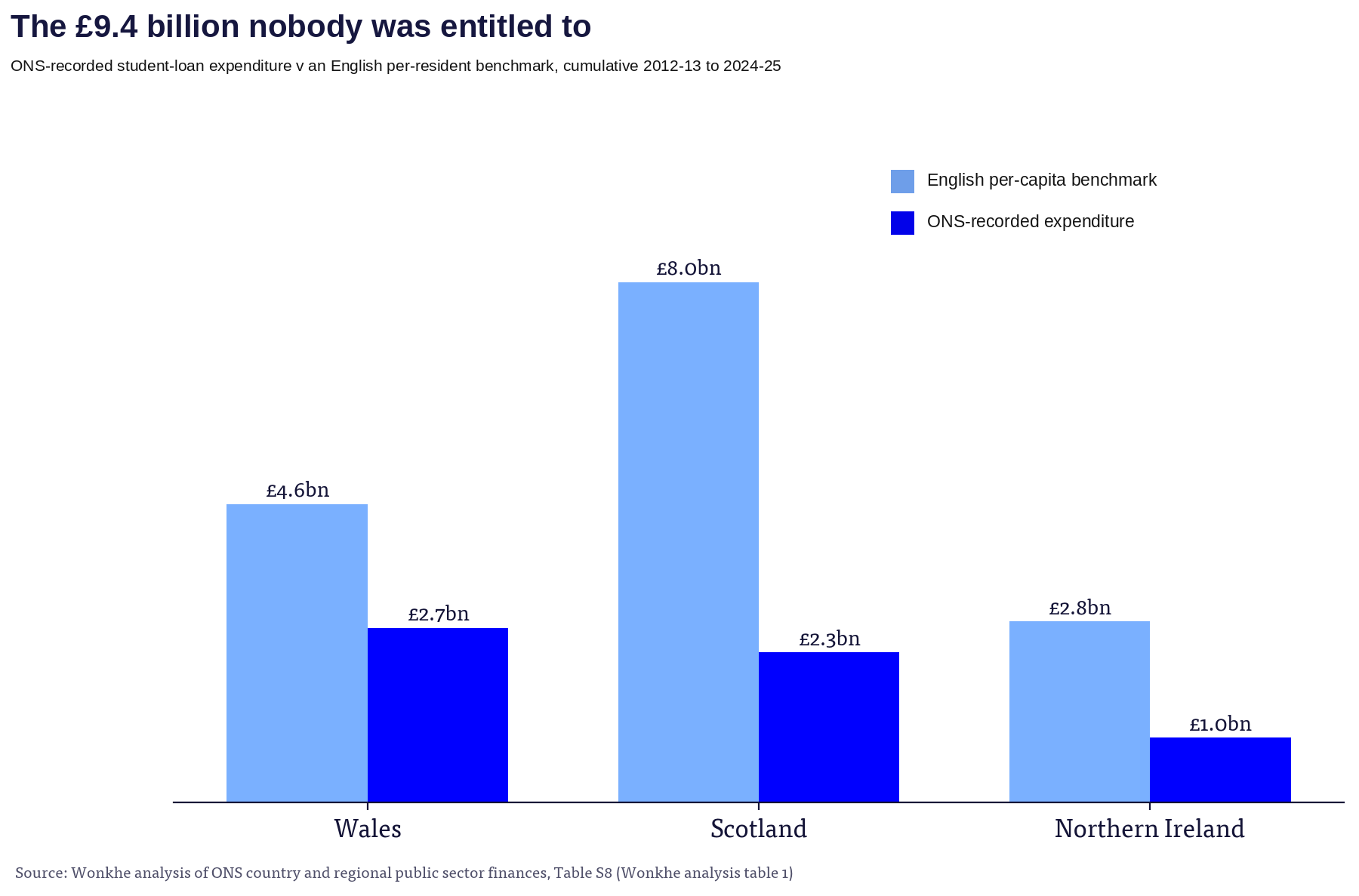
Tucked into Table S8 of the country and regional public sector finances, there’s a line showing how much of this student-loan expenditure is attributed to each UK nation. Since 2012-13, it comes to £82.9 billion for England, £2.7 billion for Wales, £2.3 billion for Scotland and just under £1 billion for Northern Ireland.
Scale England’s spending to the population of the other three nations and you’d expect £15.4 billion. They got £6 billion recorded against them. The difference is £9.4 billion over thirteen years – and £816 million in 2024-25 alone. Per person over the period, the UK government’s counted spending on student loans comes to £1,437 for every resident of England, £857 in Wales, £519 in Northern Ireland and £419 in Scotland.
For health, schools or police, changes in comparable English departmental spending feed through a population-based formula into flexible devolved block grants. England’s student-loan spending doesn’t generate an equivalent population-based pot that Scotland, Wales or Northern Ireland can use another way – and to see why, we need to explain two pieces of machinery.
Filling in the gaps
Devolved government funding runs through two pockets. The first is the block grant – a fixed allowance, adjusted each year by the Barnett formula, which gives each nation a population share of changes in comparable English spending, with everything inside it for the devolved government to spend as it chooses.
The second is called annually managed expenditure, or AME – which works less like an allowance and more like a parent saying “I’ll pay the dentist directly, whatever it costs”. Welfare in Northern Ireland works like that. And student loans work like that.
But the dental plan has a condition, written in a Treasury document called the Statement of Funding Policy – the UK government pays for your student loans only if your scheme offers “broadly similar terms” to England’s. Run something more generous and you pay the excess yourself. Run something cheaper – lower fees, more grants, no fees at all – and you don’t get a freely usable equivalent to spend another way. You’ve simply reduced the amount of loan-related cover your system requires.
Note what this doesn’t mean – devolved governments aren’t barred from enrolling fewer students and spending more on each. Scotland and Northern Ireland already do that. They just get no equivalent flexible Treasury help paying for that choice, because debt-shaped spending taps the loan machinery while everything else comes out of their own budget.
It’s worse than that, because the plan can pay out in a currency you can’t spend. In Northern Ireland, that non-fungibility was especially visible in the ring-fenced subsidy budget used in 2024-25.
Northern Ireland’s cover for 2024-25 was £226.9 million, calculated off England’s costs. Its accounts ultimately recorded a negative outturn of around £40 million, producing a reported variance of around £266 million. That was not £266 million of cash that could buy a single lecture, fund a single maintenance grant, or save a single job at Ulster.
And when Jim tried to establish exactly how the Treasury calculates any of this – the comparisons, the tolerances, the what-if costings – he hit a brick wall.
Freedom from information
England publishes an annual forecast of its lending expected to be written off – for Wales, Scotland and Northern Ireland there’s no equivalent publication at all. Northern Ireland’s figure – 13.8 pence of estimated government cost per pound lent – exists on the public record only because an official said it out loud to a Stormont committee in April 2025.
Wales’s figure – around £367 million forecast for 2025-26 – surfaced only in a ministerial letter to a Senedd committee in March this year. Scotland’s emerged through a freedom of information request. The audited accounts don’t disclose the rates. In Northern Ireland’s case, the auditors have disclaimed the Department for the Economy’s accounts two years running, with problems valuing the student-loan book among the reasons.
So Jim asked HM Treasury directly, under the Freedom of Information Act, for the devolved forecasts and comparability assessments it holds. The response, upheld at internal review in July, confirmed that the material exists – lending and write-off forecasts submitted by all three devolved governments, modelling updates, ministerial submissions, and documents comparing devolved lending to English lending. Every page was withheld, under exemptions for “relations within the UK” and “policy development”. Partial disclosure was refused, and even summaries and tolerance ranges were refused.
Think about what that means in practice – a test that determines hundreds of millions of pounds of funding for each nation, applied annually, by one party to the arrangement, using calculations Treasury won’t publish and the public can’t see.
When a system’s rules are published but its workings are secret, and every one of its incentives happens to point the same way, it stops being reasonable to assume the design is accidental.
Because the incentives do all point the same way. Educate students with less debt and you draw less through the loan machinery. Reduce your write-offs through better outcomes and the saving doesn’t become freely usable money for another purpose. Cap your student numbers – as Scotland and Northern Ireland do, partly because funded places come out of fixed budgets – and, in Northern Ireland at least, the Treasury’s comparison is run on the students you actually have – so fewer borrowers shrinks the amount of loan cover required too.
England, meanwhile, abolished its student number controls as loan financing expanded. Each extra English fee-paying place can draw on demand-led loan finance. Each extra Scottish funded place puts pressure on Holyrood’s fixed budget. That, and not some mystery of management, is why Scotland rations funded places while the state-paid tuition fee for a Scottish student has sat at £1,820 since 2009-10.
A Plan 2 far
How did we get here? In the 2010 Spending Review, England cut its non-research higher education resource budget by £2.9 billion and shifted the system towards £9,000 fees backed by loans. Teaching grant is visible departmental spending, the kind whose changes feed Barnett calculations.
Much of the replacement finance ran through the student-loan and AME channel, which does not generate an equivalent flexible block-grant allocation. England’s support for its universities changed shape, into a form the devolution funding system treated differently.
The full territorial significance was much harder to see at the time. The devolution deal was effectively “we’ll cover the complexity of your loans and you can always make your systems a bit more benign with your own money.”
The structural upshot is that devolved governments have been funding universities out of squeezed general budgets while England’s system increasingly draws on the demand-led loan channel.
One major problem is that the comparator is England’s system, and England keeps changing it. This year the Welsh Government told a Senedd committee that its expected write-off bill for 2025-26 had jumped to around £367 million – driven by a new UK-wide repayments model and by the fact that Wales still runs the loan scheme England abandoned in 2023.
Wales changed nothing. England changed its scheme and its model, the ceiling on Wales’s cover – a fixed share of England’s forecast costs – moved, and the Treasury signalled that £7.7 million now falls on Wales’s own budget, with a warning from Welsh ministers that “even modest further growth in loan outlay or divergence from English repayment policy is likely to prove unsustainable”. Every devolved government now lives with that – their student finance books can blow up mid-year because of decisions taken for England, about England, in Whitehall.
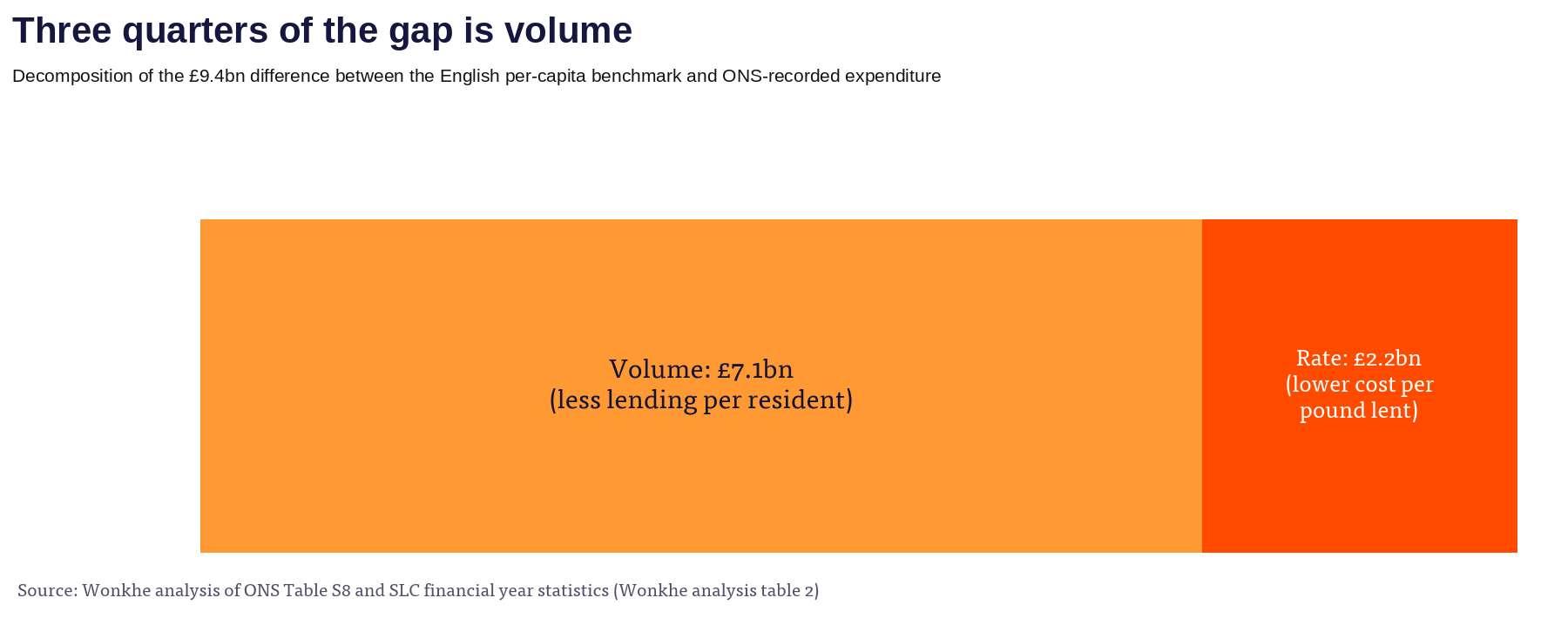
So what actually drives the difference? Two things. Mostly it’s how much gets lent – participation is lower in Wales, funded places are capped in Scotland and Northern Ireland, Scottish students studying at home take no tuition-fee loan, Northern Irish fees are lower, and Wales uses grants for part of maintenance support. The rest is what each pound lent costs – England’s bigger balances and its scheme design mean more expenditure is recorded against every pound lent.
On our sums, the lending shortfall explains about three quarters of the gap and the cost-per-pound difference about a quarter. And remember why places are capped at all – grant-funded students come out of fixed budgets, so the caps are partly the machine’s own work.
HMT would likely say that devolved students borrow less, so of course less is spent on their debt. Two answers. First, we ran the numbers per student, using every enrolled student in each nation rather than every resident, and the gap barely moves – £7.4 billion over the eleven years the data allows.
Second, and more fundamentally – the write-off spending exists to support higher education. Scotland supports its students by not charging fees. Wales supports maintenance through grants. Northern Ireland holds fees below half England’s level. Those choices support the same activity the English write-off supports – but the student-loan machinery gives them no equivalent freely usable fiscal capacity while underwriting English debt in full. A machine that pays out according to the debt a system creates is a machine that rewards debt.
This isn’t some conspiracy. It’s a system assembled from a 1998 budgeting reform, a 2010 funding switch and a 2019 accounting correction, whose territorial distributional consequences have never been subjected to a published review, whose calculations are withheld on request, and whose every incentive rewards the nation that leans most heavily on student debt.
Change for a tenner
What should happen next is simple. Every funding review now underway or promised – the Welsh Government’s five challenges, Caoimhe Archibald’s in Belfast, and Scotland’s review of higher education funding – should put the funding machinery itself in scope, on the record, before it recommends a single fee rise.
The Treasury should publish, annually and for all four nations, the loan outlay, the expected write-off rate and the comparability assessment, exactly as England’s is published now.
And the nations should be offered what Scotland was offered for welfare in 2016 – a negotiated settlement, rising each year in line with English spending, that funds the choice (loans, grants, or free tuition) rather than the debt. The precedent exists, the mechanism exists, and the public accounts show the scale – England’s student-loan expenditure is running at around £130 per resident a year while Dundee rattles the tin.
Think of it in terms of the latest year’s numbers. Had this spending been matched to England’s per-resident rate in 2024-25, Northern Ireland’s government would have had £183 million more fiscal capacity to put behind its universities and students, Wales’s £269 million more, and Scotland’s £364 million more – £816 million between them, in a single year.
That’s equivalent to the scale of Ulster’s proposed reduction of up to 450 roles, Cardiff’s financial hole, and Dundee’s entire rescue nearly six times over – with plenty of money spare to support struggling students – every year, without adding a penny of debt to a single student.
Universities in three nations are on their knees in front of governments that are told, year after year, that there’s no money. Students are told fees must rise – the hobson’s choice of a worsening student experience or ballooning debt.
But the public accounts expose a £9.4 billion gulf between what was recorded for Scotland, Wales and Northern Ireland and what would have been recorded if England’s per-head rate had applied – and it only opens up because the fiscal machinery recognises one kind of student finance so much more generously than the alternatives.
Students have to pay more? No – before plundering the pockets of hungry students or hard-up graduates, the Treasury should stop making fiscal capacity depend on how much student debt a nation is prepared to create.