Wonk Corner|19/04/26 · 15:36
In Wales and Scotland, students were promised a maintenance floor. The promise is broken
On 7 May 2026, voters in Scotland and Wales go to the polls.
Jim is an Associate Editor (SUs) at Wonkhe
Both elections will shape the direction of public services, taxation and the economy for the next parliamentary term. Both are dominated by questions of cost of living.
But on one question that directly affects hundreds of thousands of people – how much cash full-time university students get to live on – the silence is deafening.
As things stand, not a single one of the main parties contesting the Holyrood or Senedd elections have made specific manifesto commitments on the level of student maintenance support.
The SNP has reaffirmed free tuition and pledged cost-of-living increases to the nursing student bursary, but said nothing about the mainstream Student Awards Agency Scotland (SAAS) package for the roughly 130,000 Scottish-domiciled undergraduates who depend on it.
Scottish Labour has committed to maintaining free tuition and protecting university sustainability – again, nothing on maintenance levels. The Scottish Conservatives and Scottish Liberal Democrats have focused on university funding models, college parity and skills.
In Wales, Plaid Cymru has proposed a review of higher education funding but made no concrete pledges on maintenance levels. Welsh Labour’s manifesto is oriented around childcare, the NHS and housing. Reform UK has talked about loan repayment terms. The Welsh Liberal Democrats and Greens have published manifestos without headline maintenance asks.
The contrast with 2021 is sharp. In that election cycle, the SNP pledged to bring total student support up to the equivalent of the living wage within three years. Scottish Labour proposed a Minimum Student Income. The Conservatives, Greens and Liberal Democrats all backed some form of enhanced financial support or benefits protection.
In Wales Welsh Labour, running on continuity, committed to protecting the Diamond Review settlement. Every major party in both nations had something to say about what students should get. Five years later, none of them do.
Not for want of asking
It’s not as though the issue has gone unraised. NUS Scotland’s 2026 manifesto, A fair deal for our future, leads with the cost of living as its first and most prominent chapter. Drawing on the Scottish Government’s own Student finance and wellbeing study 2023–2024, it paints a grim picture – a third of undergraduates skipping meals, 15 per cent of further education (FE) students accessing foodbanks, the average full-time student working at least 19 hours a week.
Its headline ask is unambiguous – increase the standard level of government-funded student financial support in line with the real living wage and raise it regularly with inflation.
NUS Scotland called for the paramedic, nursing and midwifery student bursary to be brought into line with the real living wage after six years without an update, and for regular inflation-linked reviews of the SAAS household income brackets that determine which band of support a student falls into.
Universities were perhaps less helpful. Universities Scotland called for the restoration of a £16 million annual discretionary fund and flagged housing affordability as the biggest single issue facing students – but pointedly deferred the wider maintenance question to the Future framework for sustainable and successful universities, due to report in autumn 2026.
Universities Wales went further in the direction of caution, calling for an independent review of university funding and student support rather than making concrete demands on the level of maintenance.
So SUs have asked for more money, linked to wages and inflation. Universities have asked for reviews and restoration of emergency funds. And the political parties have, so far, offered neither.
The silence carries real consequences, because both Scotland and Wales have, within the last decade, adopted principled, independently reviewed benchmarks for what a full-time student needs to live on – benchmarks tied directly to wage rates. Both nations implemented them – Wales quickly, Scotland slowly. Both have since abandoned them.
The amounts students now receive are falling further behind the benchmarks each year, and the gap is accelerating. A new parliament in either nation that begins without a commitment to a minimum income floor for students will inherit a system that is, by its own governments’ stated standards, failing.
To see how badly, and for whom, it helps to trace what has happened to real families over the past decade.
Six families, four nations, one decade
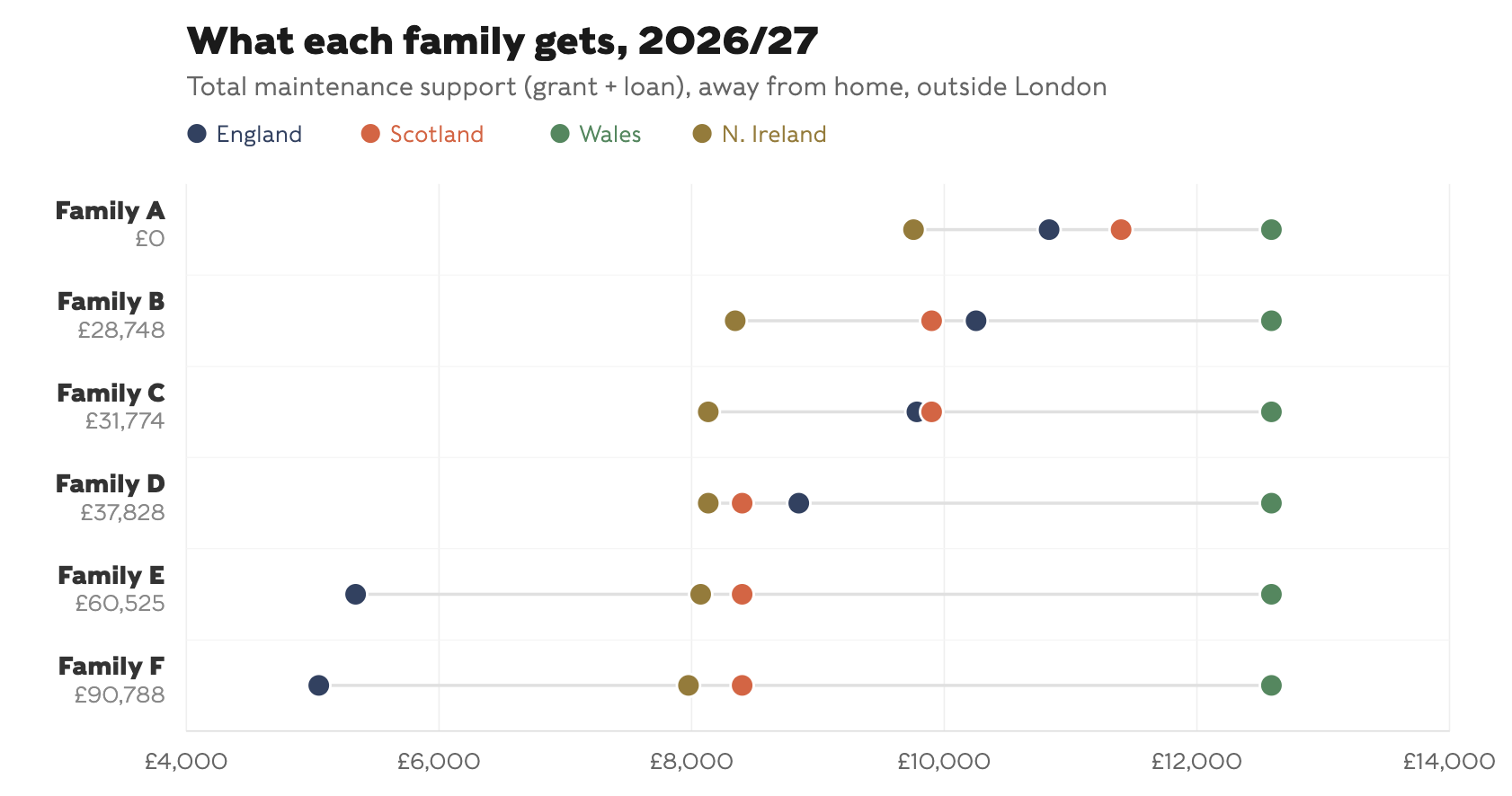
Here I’ve tracked the total maintenance support available to a full-time undergraduate living away from home outside London, at the lowest household income and at five other representative income levels, across all four UK nations from 2016/17 to 2026/27.
The six families are defined by their residual household income in 2016/17, chosen because each sat at or near a significant threshold in at least one national system. Their incomes were then uprated each year using Office for National Statistics (ONS) average weekly earnings growth, so that each family’s income trajectory reflects what would have happened if their wages simply tracked the national average.
- Family A had a household income of £0 in 2016/17. They qualify for the maximum in every nation every year – their story is about the adequacy of the maximum rate itself.
- Family B started on £18,999 – just below the pre-2019 Scottish bursary threshold, and comfortably below England’s £25,000 ceiling. They got the full package everywhere in 2016/17, but by 2026/27 their wages have carried them to £28,748, dragging them above multiple thresholds.
- Family C sat at £20,999 – just above the old Scottish bursary threshold, just below the current one. By 2026/27 their income has reached £31,774.
- Family D started exactly at England’s £25,000 ceiling, qualifying for the maximum English loan – the key fiscal drag family. By 2026/27 their income has reached £37,828, a 51 per cent rise, but the threshold hasn’t moved.
- Family E were already above the threshold in every nation on £40,000 – the squeezed middle. By 2026/27 their income has reached £60,525.
- Family F, on £60,000, were well above all thresholds and get the minimum in most nations. By 2026/27 their income has reached £90,788.
The figures track the maximum total maintenance support – grant plus loan combined – for a full-time undergraduate living away from home outside London. They don’t cover students living at home or in London, where different rates may apply, nor the interaction between student finance and the benefits system – a significant and separate issue.
They don’t cover part-time students, postgraduates, or students on NHS-funded courses, and they don’t address the weighting question – whether the London premium is adequate, or whether the at-home discount is fair.
What they do cover is the core question – for the standard full-time student from the poorest family in the country, how much cash do they actually get, how does that compare with what they used to get, and how does it compare with what the governments’ own reviews said they should get?
Scotland – one year at the benchmark
Scotland’s story begins with the 2017 review, A new social contract for students, which proposed a Minimum Student Income of £8,100. The calculation was grounded in wages – the real living wage (RLW), then £8.45 per hour, multiplied by 25 hours a week over 38 weeks, giving 950 hours. The benchmark was always designed to be delivered through a mix of means-tested bursaries and loans – the headline was a total package floor, not a universal grant.
Even at the outset, the benchmark was a bodge. A standard Scottish full-time year is 120 Scottish Credit and Qualifications Framework (SCQF) credits at 10 notional hours each – 1,200 hours of learning. The review was funding 950 of those hours, and the shortfall of 250 hours – more than 20 per cent of the academic year – was built into the design.
At no point did the review argue that a student could participate fully in 1,200 hours of study while also earning enough to cover the unfunded 250 hours. It just accepted the gap.
Implementation was slow. It took roughly seven years from the review – or three years from the SNP’s 2021 manifesto promise to reach living-wage-equivalent support – before the Scottish Government could claim it had reached the benchmark for the most targeted groups. And it managed it for exactly one year.
In 2024/25, the maximum total of £11,400 briefly matched 950 hours multiplied by £12.00, the RLW rate then in force. By 2026/27, the RLW has moved to £13.45, putting the 950-hour benchmark at £12,778. Scotland’s maximum is still frozen at £11,400 – 89 per cent of its own stated standard. The gap is £1,378 per year and growing.
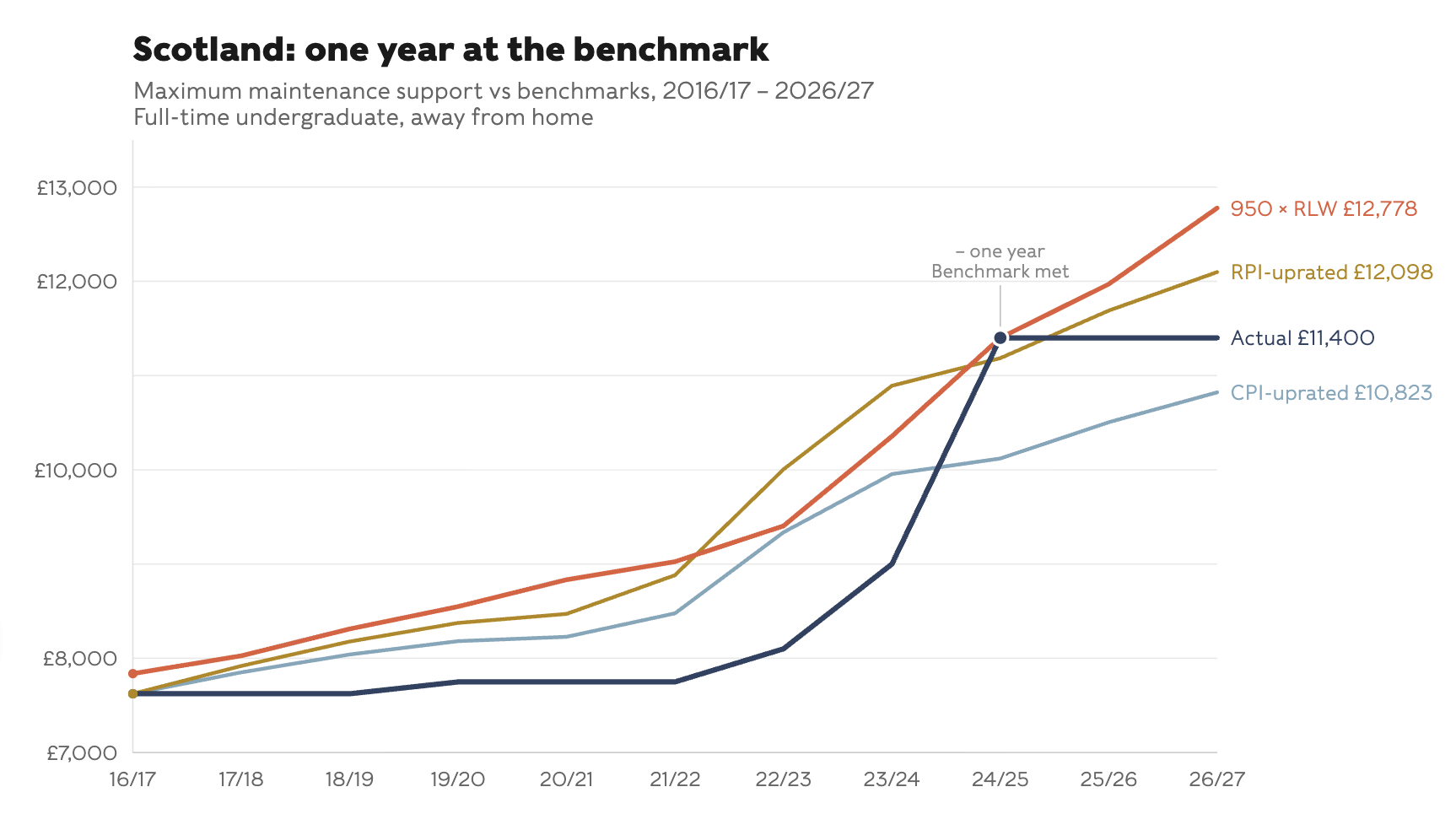
Against broader inflation measures, the picture is less dramatic only because Scotland’s starting point was relatively low and the introduction of the special support loan provided a genuine step-change. The 2026/27 maximum of £11,400 is 5.3 per cent above what the 2016/17 figure would be if simply uprated by the consumer price index (CPI), and 94 per cent of the retail price index (RPI)-uprated equivalent. But that comparison flatters the system – it measures Scotland against its own past, not against the benchmark it chose.
The bursary band system compounds the problem for families above the lowest income. Scotland’s thresholds create sharp cliff edges rather than the gradual taper used in England. Family D – whose wages have risen from £25,000 to £37,828 simply by tracking the national average – has been pushed into the minimum band at £8,400, having lost their entire bursary. They’re no better off in real terms, but the system treats them as though they are.
Family E, on £60,525, also gets £8,400 thanks to the special support loan – which means, paradoxically, that a Scottish student from a household earning over £60,000 gets 57 per cent more maintenance support than an English student from the same household. The Scottish system is more generous than England’s at every income level, but the cliff edges mean that the gap between what the poorest and the middle get is far steeper than in Wales, where the total is flat regardless of income.
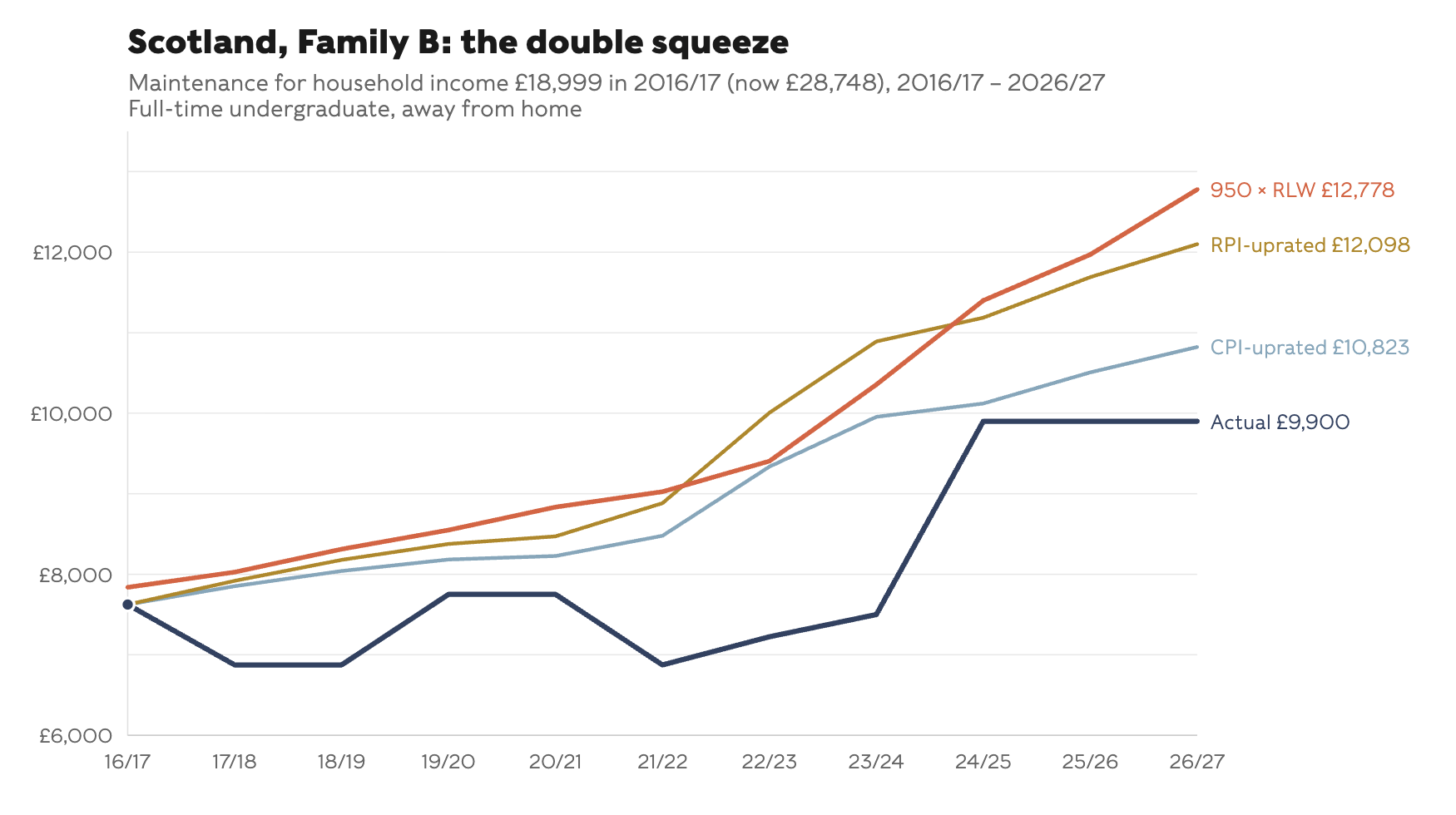
The failure of any major party to commit to a specific maintenance floor in 2026 is, in part, a consequence of the failure to hold the outgoing government to account for the commitment it made in 2021 and then stealthily dropped. The SNP promised living-wage-equivalent support, and delivered it for one year. The rate has been frozen since.
No opposition party or campaign group has made a sustained case that this constitutes a broken promise, and no party has entered the 2026 campaign with an alternative minimum income proposal. The debate has drifted from “how much do students need?” – a question with a quantifiable answer – to “how do we fund universities?”, a question that lets every party avoid specifying a number.
Wales – tracking, then not
Wales’s story is, in many ways, the mirror image of Scotland’s – faster to implement, slower to break, but breaking now in exactly the same way.
The Diamond Review reported in September 2016. The new system came into effect for students starting in 2018/19 – a two-year turnaround that no other UK nation has matched. The review used a benchmark of 37.5 hours a week over 30 weeks – 1,125 hours – pegged to the national living wage (NLW). On the wage rates at the time, that came to about £8,100. The maximum away-from-home package of £9,000 was at or slightly above the benchmark on the NLW rate then in force.
Like Scotland’s benchmark, Diamond’s was hours-faulty from the start. A full-time year in the UK credit framework is 120 credits at roughly 10 hours each – 1,200 hours. Diamond funded 1,125, leaving 75 hours uncovered. That’s a much smaller gap than Scotland’s 250-hour shortfall, and 1,125 hours is a materially better proxy for full-time study than 950 – but it was still less than the whole year, and it was pegged to the NLW, the statutory minimum, rather than the RLW, which reflects what people actually need.
For five years, from 2018/19 to 2023/24, the Welsh maximum tracked the 1,125 × NLW benchmark closely. The Diamond mechanism worked. Then the NLW surged. Between April 2022 and April 2026, the NLW rose from £9.50 to £12.71 – a 34 per cent increase in four years. Welsh maintenance didn’t keep pace.
By 2026/27 the benchmark stands at £14,299. Wales’s maximum is £12,590 – 88 per cent. The gap is £1,709 per year and widening.
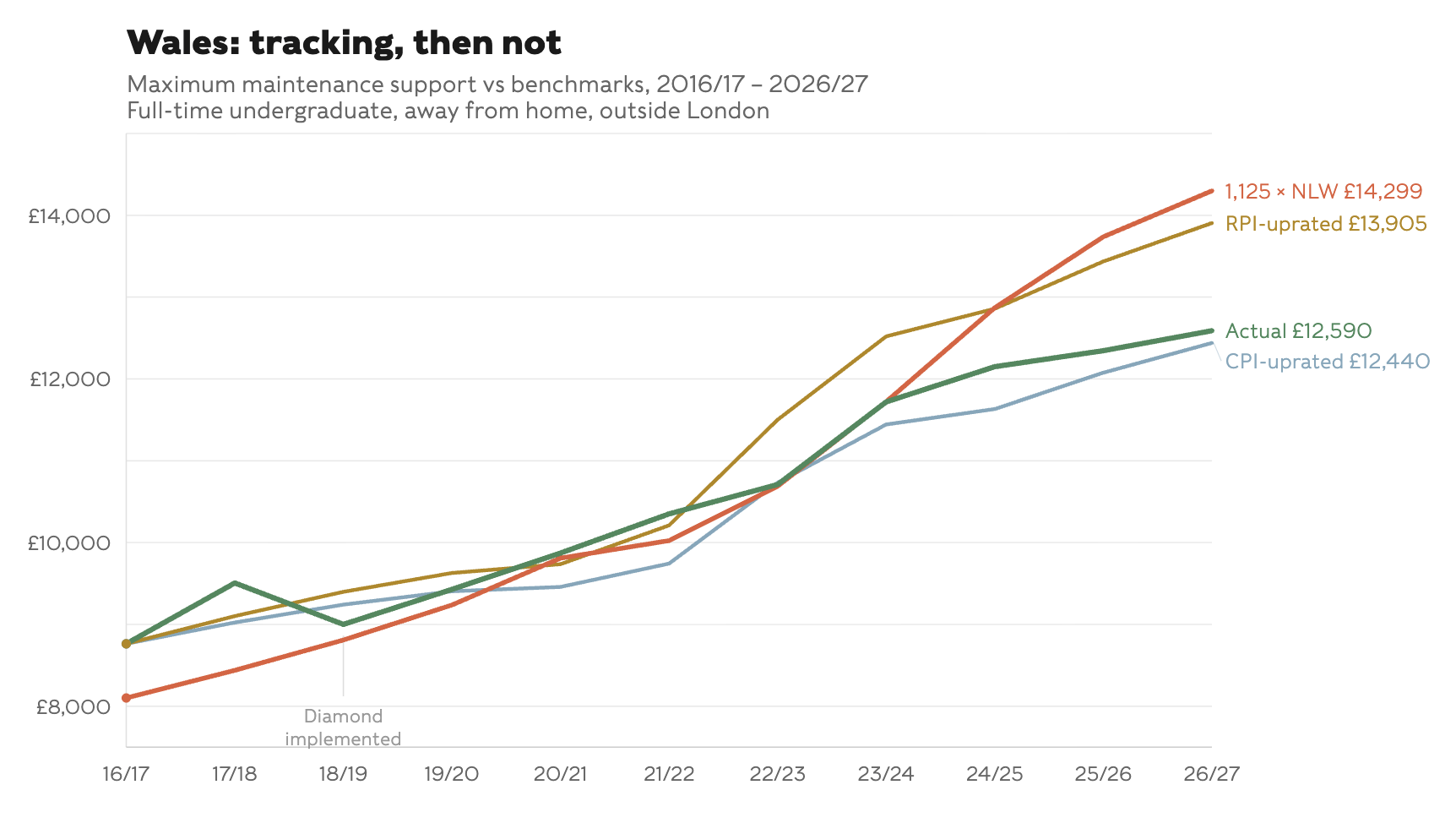
Against CPI, Wales is only 1.2 per cent above its inflation-uprated 2016/17 baseline. Against RPI, it has fallen behind. The mechanism designed to track the wage floor has broken in the same way as England’s RPIX-based uprating, just two years later and from a more generous starting point.
Wales does, however, retain one structural advantage that no other nation offers – the total maintenance package is flat regardless of household income. The grant-loan mix changes – wealthier families get more loan and less grant – but the total doesn’t. There’s no fiscal drag, no cliff edge, no threshold that’s been frozen since 2008.
The consequences for individual families are sharp. Family D – the threshold family, whose wages have carried them from £25,000 to £37,828 – gets £12,590 in Wales and £8,848 in England, a gap of £3,742 produced entirely by structural design. Family E, the squeezed middle on £60,525, gets £12,590 in Wales and £5,340 in England – Wales provides more than double.
And Family F, with a household income now exceeding £90,000, gets £12,590 in Wales and £5,048 in England. A Welsh student from a household earning over £90,000 gets more maintenance support than an English student from a household earning nothing did in most years before 2020.
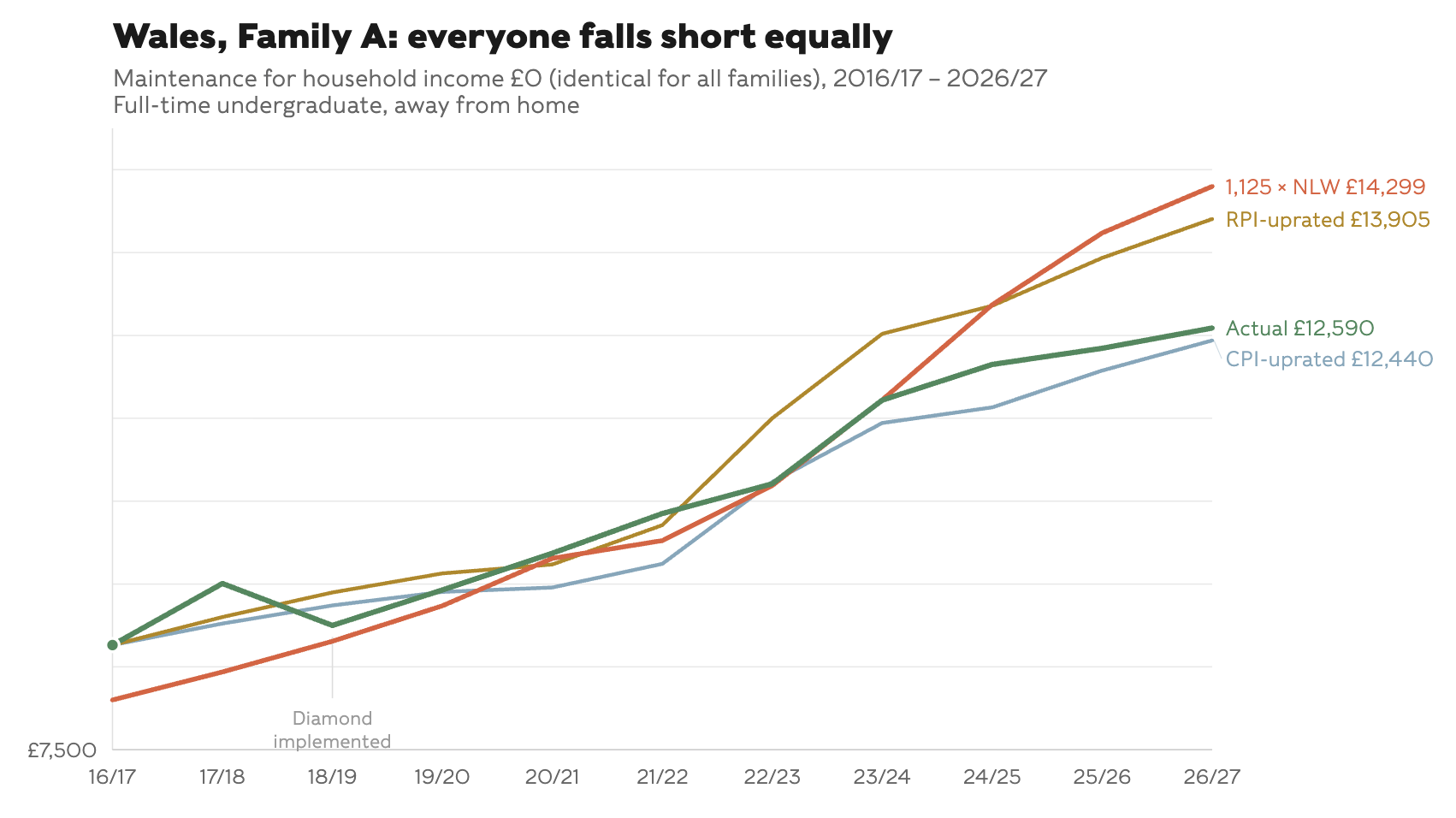
That is perhaps the sharpest illustration of the Diamond principle – and the most politically provocative number in the dataset. The structural choice, made through Diamond, has produced a fundamentally more stable system for students across the income distribution. But it hasn’t protected the headline rate from falling behind the benchmark it was designed to track.
The pattern in Wales is similar to Scotland’s – the current government made a specific manifesto promise to deliver Diamond. But the uprating system that stopped tracking the wage rate it was linked to.
No party in the 2026 campaign has proposed restoring it. Plaid Cymru has called for a review – which may ultimately land on a similar benchmark – but a review isn’t a commitment, and one that reports after the election gives the incoming government years of breathing room before any number is attached to any promise.
As in Scotland, the absence of a minimum income floor in any party’s manifesto means the debate is being conducted in generalities rather than pounds and pence.
Where reviews land
If there is an independent review of student finance in either nation – and Plaid Cymru has proposed one for Wales, while the Scottish Future Framework may touch on it – the evidence from the last decade strongly suggests where it will land.
Three separate reviews in three separate nations, conducted by three separate panels with different terms of reference, have converged on essentially the same answer – student maintenance should be linked to a wage rate multiplied by the hours that full-time study actually requires.
The three reviews disagreed on the wage rate and the hours, but they agreed on the principle – if you want to know what a student needs, work out what full-time study involves and price it at the wage floor.
Whatever a future review does on means testing, on the mix of grant and loan, on the weighting for London or at-home students, a fair bet is that the link to wage rates will be there. The principle isn’t controversial – it has been independently endorsed three times. The problem is that no government has sustained it.
While we’re at it, the English story is the bleakest of the three, and it matters for Scotland and Wales too – because England sets the fiscal and political weather (and loan equivalence envelope) for the devolved nations.
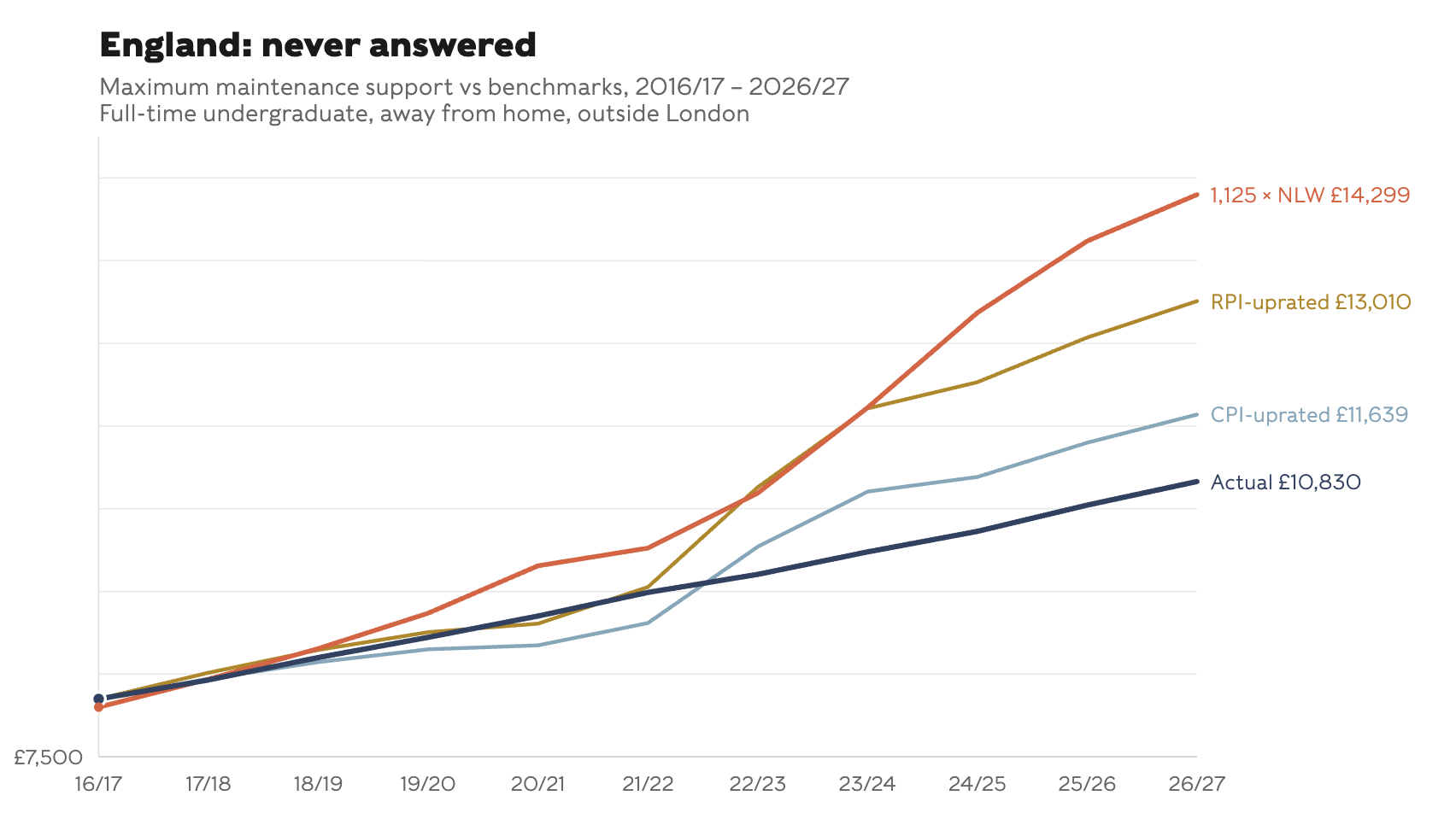
The Augar Review reported in 2019 with a benchmark that matched Diamond’s – 1,125 hours at the NLW. The Conservative government that commissioned it never formally responded, and so no policy change followed.
The incoming Labour government has confirmed that maximum maintenance loans will continue to increase with forecast inflation – the same RPIX-based mechanism that has been in place for years and that the Institute for Fiscal Studies (IFS) has described as not a sensible policy.
Labour has announced small, targeted maintenance grants for low-income students on priority subjects from 2028 – a welcome but modest step that does nothing about the structural erosion of the mainstream loan.
England’s maximum maintenance loan of £10,830 in 2026/27 is £809 short of CPI, £2,180 short of RPI, and a full £3,469 short of the Augar benchmark of £14,299. The explanation lies in how England uprates maintenance – the government uses forecast RPIX from the previous autumn to set rates for the following year. When inflation surged in 2022, the forecasts badly undershot reality. A £1,054 gap between the actual and RPI-uprated figures appeared in a single year, and every subsequent year has compounded on top of that uncorrected base – the error, as the IFS put it, is now effectively baked in.
For families above the lowest income, the damage is compounded by the frozen threshold. The income level above which maintenance starts to taper has been stuck at £25,000 since 2008 – 18 years without adjustment. In 2008, a household earning £25,000 was roughly at the 40th percentile of the income distribution. Average earnings have grown by over 50 per cent since.
Family D – who sat exactly at the threshold in 2016/17, qualifying for the maximum – now earn £37,828 on wages that have simply tracked the national average. They get £8,848, barely more in cash terms than a decade ago, and £5,451 short of the Augar benchmark. Against CPI alone they’re £2,791 short. They’ve been dragged into the taper zone without a single policy decision being taken.
Family E, the squeezed middle on £60,525, gets £5,340 – an actual cash cut in nominal terms from the £6,434 they received in 2016/17, despite a decade of inflation. CPI says their entitlement should now be worth £9,132. They’re £3,792 short.
Inflation bites harder
The immediate economic outlook makes the erosion of student maintenance more dangerous, not less. UK CPI inflation stood at 3.0 per cent in February 2026. The Bank of England has warned it is likely to reach between 3 and 3.5 per cent by the second and third quarters of 2026, driven by energy prices linked to the Middle East conflict. Oxford Economics has suggested inflation could reach 4 per cent in the second half of the year. Core inflation – excluding energy and food – is already at 3.2 per cent, and services inflation at 4.3 per cent.
Student maintenance rates for 2026/27 were set using forecasts from before this latest surge. If inflation overshoots the forecast again – as it did catastrophically in 2022 – the gap between what students receive and what prices demand will widen further.
The RPIX mechanism that sets English rates is structurally incapable of correcting for prior undershoot, with each year compounding on top of an uncorrected base. The devolved nations, which set rates through their own processes, have more flexibility in principle but have shown no greater willingness to use it in practice.
England is relevant to this story for three reasons beyond the fact that it educates the largest number of UK students. The fiscal envelope available to the Scottish and Welsh governments is shaped by English spending decisions. If England doesn’t increase student maintenance spending, there is no consequential to help fund increases in the devolved nations.
England also provides the political comparator. When Scottish or Welsh governments argue that their students get more than English students – which they do – they’re measuring themselves against a system that is, by its own review’s standards, failing. Being better than England has become a low bar. It shouldn’t be the benchmark.
Less well understood is the visa aspect. England’s maximum maintenance rate sets the “maintenance threshold” that UK Visas and Immigration (UKVI) uses across the entire United Kingdom. International students applying for visas must show they can cover their living costs at a level derived from the English rate – regardless of whether they’re studying in Edinburgh, Cardiff or Belfast.
When England’s maintenance ceiling erodes in real terms, it drags down the assumed cost of living for international students everywhere in the UK, creating a framework that is increasingly disconnected from what it actually costs to live and study in any of the four nations.
Northern Ireland – a decade on ice
I know there’s no election on in Northern Ireland, but for completeness, in some respects it is the most cautionary tale of the four.
NI’s total maintenance support for the poorest students was frozen at £6,428 from 2013/14 to 2022/23 – 10 consecutive years at the same cash figure, through a period that included the entire post-2021 inflation surge. By the time the freeze ended, the value of the package had been devastated – CPI alone would have put it at over £8,000.
Emergency uplifts in 2023/24 and 2025/26 brought the figure to £9,757, which is 6.9 per cent above the CPI-uprated 2016/17 baseline – but only because the baseline was so catastrophically low after a decade frozen that even a partial catch-up overshoots the old real value.
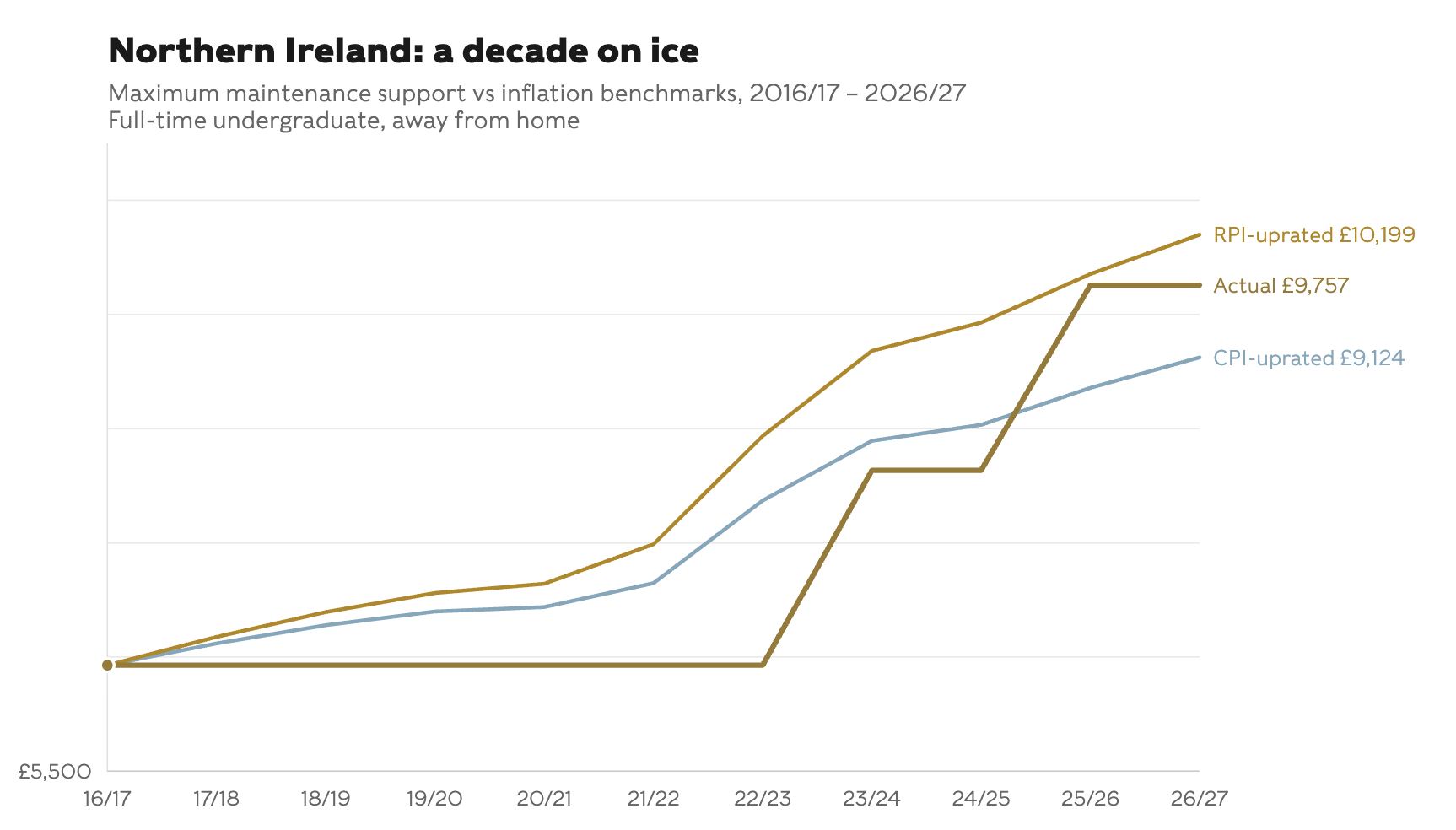
Unlike Scotland, Wales and England, Northern Ireland has never had a modern, wage-linked review of student maintenance. The last substantive review came from the Assembly Committee for Employment and Learning in 2000, in a different era of policy design. It proposed income and repayment thresholds, not study-hours benchmarks. There is no equivalent of “this is how much a full-time student needs, based on what full-time study actually involves.”
The system arrived at its current level by accident rather than design – a decade of neglect followed by emergency correction, with no articulated framework for where it should land or how it should move.
The consequences at either end of the income distribution look like this. Family A, the poorest, gets £9,757 – the lowest maximum of any UK nation, nearly £1,100 less than England and £2,833 less than Wales. At the other end, Family F, on a household income of £90,788, gets just £7,975 – more than England’s £5,048 but far below Wales’s £12,590. NI’s taper at high incomes is less aggressive than England’s, but the absence of any principled benchmark means NI has no vocabulary for arguing that its minimum is too low, or for specifying what it should be instead.
Hours and wages
Set aside, for a moment, all the questions about means testing, about the mix of grant and loan, about the weighting for London or the discount for living at home. There is a prior question that all of those debates depend on – what is the right total amount for a full-time student from the poorest family in the country?
The case for linking that amount to the wage floor, priced at the hours that full-time study requires, isn’t complicated. Full-time study means the student can’t fully participate in the labour market during those hours. If a 120-credit year requires 1,200 notional hours of learning, and the statutory minimum wage is £12.71 per hour, then a student who studies full-time is forgoing at least £15,252 in potential earnings.
The maintenance ceiling – the maximum the government thinks the poorest students need to live on for an entire year – is £10,830 in England, £11,400 in Scotland, £12,590 in Wales, £9,757 in Northern Ireland. In every nation, that ceiling is now substantially below what the same student would earn if they stacked shelves for the same number of hours instead of studying.
A decade ago, England’s maximum was 95 per cent of the NLW equivalent. It is now 71 per cent. The two have been diverging for a decade, and the divergence has accelerated sharply since 2022.
Nobody is arguing students should be paid the minimum wage. The argument is that the minimum wage – the amount Parliament has judged an adult needs to earn per hour – provides the most defensible floor for what a student needs per hour of study. Three independent reviews have reached this conclusion. The logic hasn’t changed – the politics have just found it easier to ignore.
The to-do list
With less than three weeks until polling day, the manifestos are published and the formal policy windows are closing. But the campaign isn’t over, and the first months of a new parliament are when commitments are made or deferred. A few things would make a material difference.
The most urgent step is for both NUS’s to name the number. NUS Scotland has already called for support pegged to the real living wage, and NUS Cymru has called for uprating in line with the cost of living. Both should go further and specify the benchmark in pounds – £12,778 in Scotland (950 × RLW), £14,299 in Wales (1,125 × NLW). Specifying the number forces parties to respond to it. “More support” is easy to nod along with. “£1,378 per year short of the benchmark the last government promised” is harder to ignore.
They should hold the outgoing governments to account for broken promises. In Scotland, the SNP pledged living-wage-equivalent support in 2021 and delivered it for one year. The rate is now frozen £1,378 below the benchmark. That is a broken promise, and it should be described as one – loudly and repeatedly – in every remaining hustings, interview and press release.
Same in Wales, where the Diamond mechanism has drifted 12 per cent below its own benchmark. That is another broken promise, and should be described as one.
Universities might usefully stop deferring to reviews that haven’t yet reported. Universities Scotland has pointed to the Future Framework, due in autumn 2026. Universities Wales has called for an independent review. Both are reasonable long-term positions, but neither helps a student starting in September 2026 who is £1,378 or £1,709 short of the benchmark in the middle of an energy and inflation crisis.
And all four organisations should spell out the hours argument. The case for linking maintenance to wage rates isn’t primarily about generosity – it’s about the structural fact that full-time study displaces full-time work. A student who is studying can’t earn, and the maintenance system exists to bridge that gap. When the bridge falls short, the student either works more hours – undermining the study that the system is supposed to support – or goes without.
Three independent reviews have concluded that the right way to price the bridge is hours of study multiplied by the wage floor. No party has yet explained why that logic no longer applies. All four organisations ought to be asking them to.