

Young people are pessimistic about their future. Should they be?
Jim is an Associate Editor (SUs) at Wonkhe
Tags
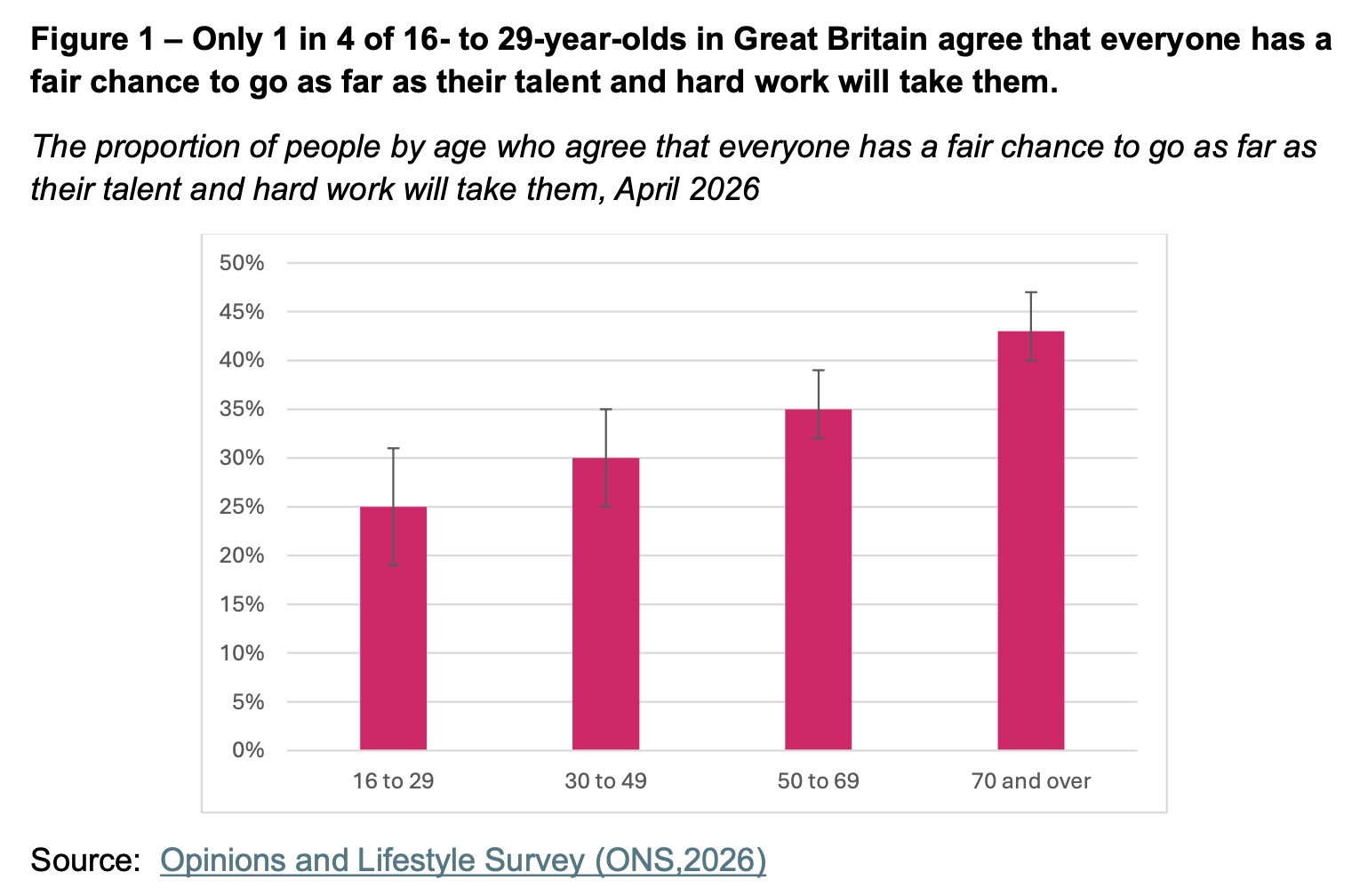
The headline figure comes from the ONS Opinions and Lifestyle Survey. In April 2026, just one in four 16 to 29 year olds agreed that everyone has a fair chance to go as far as their talent and hard work will take them. Every age group is fairly sceptical, but belief declines with each generation – the over 70s are nearly 20 percentage points more likely to agree than the youngest group.
The more interesting material is in IPPR’s analysis of Understanding Society, which has been asking 16 to 21 year olds to rate their own chances of success and of long-term unemployment since 2010.
In 2015-17, fewer than 2 per cent of young people rated their chance of success at 20 per cent or below. By 2023-25 it was around 6 per cent – roughly two students in every classroom. The share rating their chance of long-term unemployment at 80 per cent or above has also roughly tripled, to about one in 14, with young women more worried than young men.
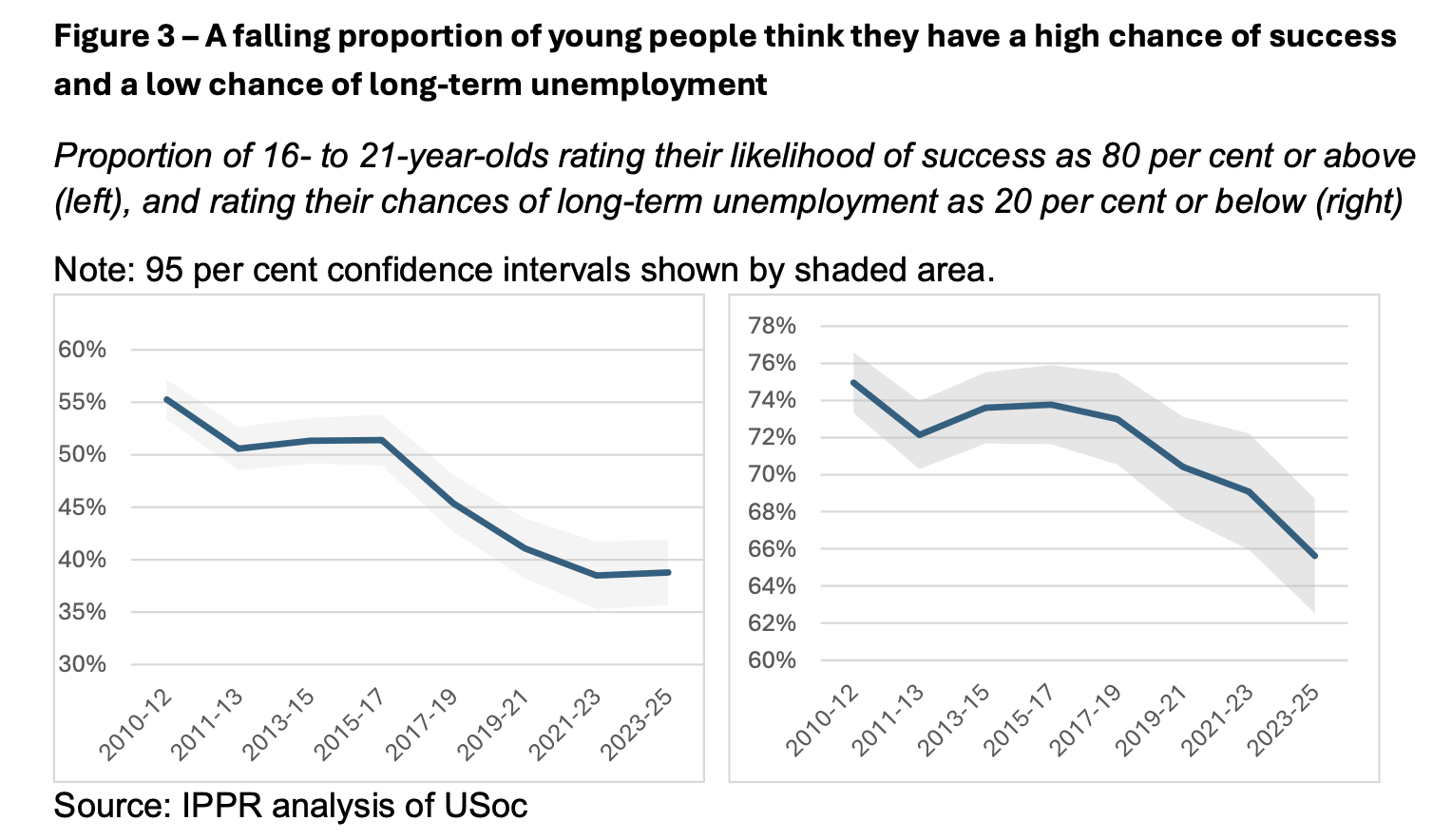
Optimism has fallen at the same time. In 2010-12, 55 per cent of young people put their chance of success at 80 per cent or above. It’s now below 40 per cent. The proportion confident that long-term unemployment is unlikely to happen to them has dropped from 75 per cent to 66 per cent.
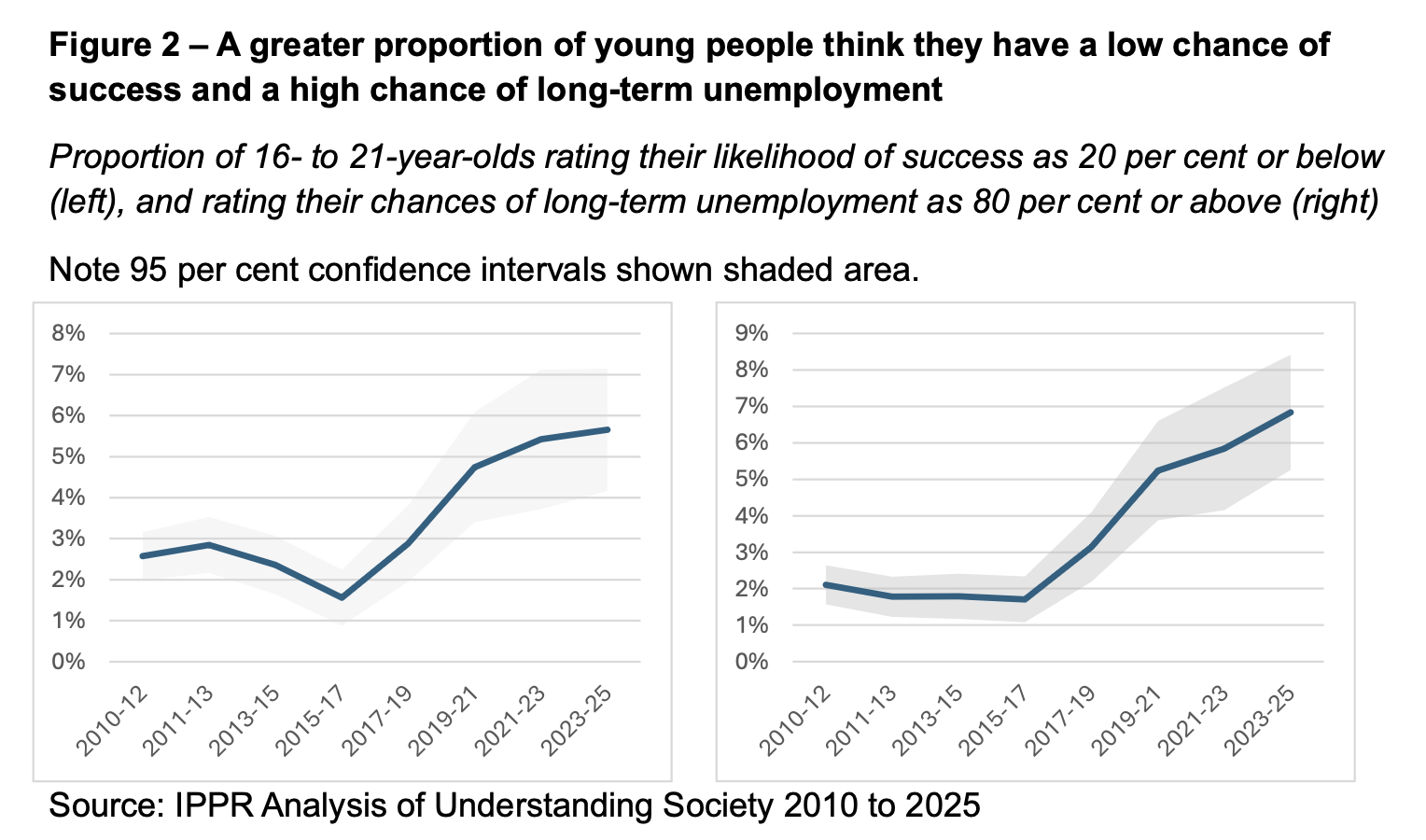
IPPR puts the turning point around 2015-17, and suggests three candidate explanations – austerity becoming more visible, algorithmic personalisation reshaping the information young people consume, and the start of the long deterioration in youth mental health. The fears aren’t obviously irrational either, given over a million 16 to 24 year olds are now outside education, employment and training, and Alan Milburn’s interim review of that problem found challenges across education, health, social security and the labour market rather than any single cause.
The pattern holds across every level of deprivation, though young people in deprived areas remain more worried about unemployment. The biggest gap is by mental health. IPPR estimates that four in ten young women and three in ten young men aged 16 to 24 have poor mental health, and within that group only 24 per cent are confident they’ll be successful, compared with 48 per cent of everyone else. The report is careful to note the causality probably runs in both directions.
The optimism gap
A reasonable objection at this point is that survey respondents are pretty much always gloomy about the state of things. There’s a long literature showing that people are optimistic about their own lives and pessimistic about everything else. Bertelsmann Stiftung’s eupinions research found 58 per cent of EU respondents optimistic about their personal future but only 42 per cent optimistic about their country’s. Ipsos found the same thing across 22 countries – 80 per cent happy with their own lives, 35 per cent satisfied with the direction of their country – and its 2025 Global Trends work still shows the gap. Psychologists call the individual version “optimism bias”.
UK youth polling shows it too. The 2026 UK Youth Poll found 63 per cent of 18 to 29 year olds optimistic about their own future even though only 36 per cent expected to be better off than their parents – a figure that had fallen from 63 per cent in a single year. In the King’s Trust Youth Index, money is the area where young people are least happy, but 70 per cent say they’re determined to achieve their goals.
That’s what makes the Understanding Society findings worth taking seriously. The questions aren’t about the country, the economy or politics – they ask young people about their own chances. Optimism bias should be propping those numbers up, and instead they’ve been falling for a decade. The World Happiness Report has tracked something similar at the wellbeing level – young people globally still report higher life satisfaction than adults, but the advantage is narrowing in western Europe and has reversed in North America, Australia and New Zealand.
The campus version
Higher education’s recruitment pitch is a specific version of the promise IPPR says is breaking down – take on the debt, do the work, and you’ll be better off for it. If fewer young people believe effort leads anywhere, that has implications for participation, but also for what students do once they’ve enrolled.
IPPR describes emerging “financial nihilism” among young people who feel the system no longer rewards effort – spending more relative to their wealth, taking punts on crypto, working less. Anyone who has read student survey data on engagement and assessment recently will recognise the educational equivalent.
The argument that runs through the paper is that this shouldn’t be read as a generation feeling sorry for itself. Young people may be drawing reasonable conclusions from high housing costs, insecure work and strained public services – and when the institutions that shape early adulthood stop delivering, trust in the system erodes with them.
The first full State of a Generation report is due in autumn 2026 – the programme is backed by McDonald’s, Youth Futures Foundation and Big Change.
Young people have good reason to be sceptical. Crudely, the U.K. benefit and tax system currently either pulls up or pushes down the majority of the population to an income level of around £37k per year.